

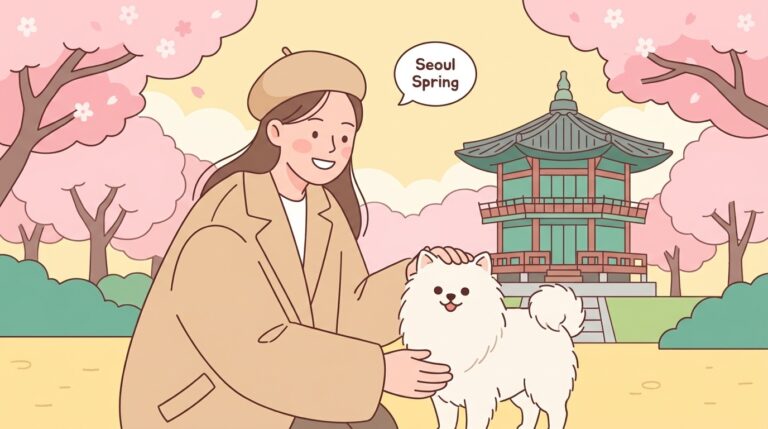
Walkies with Your Pup: Soft and Sweet Korean Phrases for Dog Walking
Phase 1: Empathy (Your Friendly K-Pup Walk Guide)
안녕하세요! (An-nyeong-ha-se-yo!) Hello, my lovely Daily Hangul bestie! It’s your K-culture navigator here.
Picture this: You are walking down a beautiful path in a Seoul park, cherry blossoms or golden autumn leaves gently falling. Suddenly, an adorable, fluffy Maltese or a tiny, stylish Poodle trots toward you wearing a little pastel sweater. Your heart melts. You want to say hi to the pup and talk to the friendly owner, but you freeze. What do I say? How do I ask if the dog is friendly?
Don’t worry! Many of my students who love animals worry about sounding too formal or accidentally being impolite. Today, we are going to learn how to walk a dog or greet someone else’s furry friend in Korean using super easy, beginner-friendly A1-level phrases. By the end of this guide, you will be able to make cute connections with local Korean dog lovers effortlessly!
Phase 2: Key Expressions Deep-Dive
Let’s learn three super-useful, magic expressions you can use immediately in any park in Korea.
1. 만져봐도 돼요? (Man-jyeo-bwa-do dwae-yo?)
- Pronunciation: Mahn-jyeo-bwa-doh dwae-yo? (Sounds like “Mahn-jyo” + “bah” + “doh” + “dweh-yo?”)
- Meaning: Can I pet it / touch it?
- K-Culture Moment: In K-Dramas, when characters meet cute dogs in a neighborhood scene, they always squat down and ask the owner this first before reaching out.
- Editor’s Insight: Korean pet culture is very polite. Even if a puppy runs to you, always ask “만져봐도 돼요?” first. It shows you respect the dog’s space and the owner’s rules!
- Situation Spectrum:
- Casual: 만져봐도 돼? (⚠️ Only with close friends)
- Semi-formal: 만져봐도 돼요? (✅ Perfect for strangers in a park)
- Formal: 만져보아도 괜찮습니까? (🚫 Too stiff, sounds like a textbook!)
- 🤔 Think About It: In your culture, do people ask before petting someone’s dog, or is it common to just wave and touch them? In Korea, asking first is highly appreciated!
2. 귀여워요! (Gwi-yeo-wo-yo!)
- Pronunciation: Gwee-yuh-wo-yo! (Sounds like “Gwee” + “yuh” + “wo” + “yo!”)
- Meaning: It’s cute! / They are cute!
- K-Culture Moment: You hear this in every K-Pop vlog when idols meet animals. It is a universal word of joy!
- Editor’s Insight: Keep your voice high and cheerful. The “yo” at the end makes it polite and warm.
- Situation Spectrum:
- Casual: 귀여워! (⚠️ Only with friends or to the dog directly)
- Semi-formal: 귀여워요! (✅ Best for talking to the owner)
- Formal: 귀엽습니다! (🚫 Sounds like a military report!)
- 🤔 Think About It: Why does saying “cute” instantly break the ice with strangers? Koreans love praising pets, and it opens up warm conversations immediately!
3. 몇 살이에요? (Myeot sal-i-e-yo?)
- Pronunciation: Myut sal-ee-eh-yo? (Sounds like “Mee-uht” + “sahl” + “ee-eh-yo?”)
- Meaning: How old is it?
- K-Culture Moment: Koreans love to establish “age” even for pets! It helps them know if the dog is an energetic puppy or a calm elder.
- Editor’s Insight: “살” (sal) means “years old” and “몇” (myeot) means “how many.” Use this to show genuine interest in the dog.
- Situation Spectrum:
- Casual: 몇 살이야? (⚠️ Too casual for strangers)
- Semi-formal: 몇 살이에요? (✅ Perfect!)
- Formal: 몇 세입니까? (🚫 Sounds like a government document!)
- 🤔 Think About It: Why do you think age is one of the first questions asked in Korean culture, even for dogs? It reflects a social structure that values age and care steps!
Phase 3: Textbook Korean vs. Real Korean
Let’s compare textbook grammar with real, everyday spoken Korean in the dog park!
Situation 1: Expressing that a dog is cute
- 📖 Textbook Korean: 개가 참 귀엽습니다. (Gae-ga cham gwi-yeop-seup-ni-da. – “The dog is very cute.”)
- 🗣️ Real Korean: 우와, 진짜 귀여워요! (U-wa, jin-jja gwi-yeo-wo-yo! – “Wow, so cute!”)
- 💡 Why the difference? Textbook Korean uses the formal “~습니다” which sounds cold and robotic. Real dog owners use “진짜” (really/so) with a friendly “~요” ending to sound sweet and expressive.
Situation 2: Asking if the dog bites
- 📖 Textbook Korean: 이 동물이 뭅니까? (I dong-mul-i mup-ni-ka? – “Does this animal bite?”)
- 🗣️ Real Korean: 얘 물어요? (Yae mul-eo-yo? – “Does this little one bite?”)
- 💡 Why the difference? “동물” (animal) is too scientific. Locals call a nearby dog “얘” (this one/this kid) to show affection. “물어요?” is conversational and natural.
Phase 4: K-Culture Deep-Dive & Non-Verbal Manners
4-1. The Korean “Dog-Walking” Eye Contact & Manners
When you meet a puppy in Korea, do not make direct, intense eye contact with the dog immediately as it can scare them. Instead, look at the owner, smile warmly, and bow your head slightly. This mini-bow (about 15 degrees) shows respect.
4-2. The “Petiquette” (Pet + Etiquette) in South Korea
Korea has a huge pet culture! When walking dogs in Han River Park (한강공원) or local neighborhoods, you will see yellow ribbons on some leashes. This is the “Yellow Dog Project” signaling that the dog needs space (do not touch). Always check the leash before approaching!
Phase 5: Real-Life Roleplay Scenario
Meet Minji, a friendly local walking her adorable white Pomeranian named Bori (meaning “Barley”) at a local park near Hongdae.
🎭 Let’s Practice!
- You: 안녕하세요! (An-nyeong-ha-se-yo!)
🎭 (Smiling warmly, giving a soft nod of the head) - Minji: 안녕하세요! (An-nyeong-ha-se-yo!)
🎭 (Smiles back while holding Bori’s leash) - You: 우와, 강아지 진짜 귀여워요! (U-wa, gang-a-ji jin-jja gwi-yeo-wo-yo!)
🎭 (Gently clasping your hands together, eyes shining) - Minji: 아, 감사합니다! 이름은 보리예요. (A, gam-sa-hap-ni-da! I-reum-eun Bo-ri-yae-yo.)
🎭 (Proudly looking at her pet) - You: 보리요? 이름도 귀여워요. 혹시 만져봐도 돼요? (Bo-ri-yo? I-reum-do gwi-yeo-wo-yo. Hok-si man-jyeo-bwa-do dwae-yo?)
🎭 (Politely pointing to your hand, asking for permission) - Minji: 네, 괜찮아요. 착해요! (Ne, gwaen-chan-a-yo. Chak-hae-yo!)
🎭 (Nodding happily, letting Bori sniff your direction) - You: (Gently petting Bori) 보리야, 안녕? 몇 살이에요? (Bo-ri-ya, an-nyeong? Myeot sal-i-e-yo?)
🎭 (Speaking softly to Bori, then looking up to Minji) - Minji: 두 살이에요. 아직 아기예요. (Du sal-i-e-yo. A-jik a-gi-ye-yo.)
🎭 (Chuckling gently as Bori wags its tail)
🔀 Interactive Choice Point!
How would you reply to Minji’s last comment? Choose your path:
- Choice A: “진짜요? 너무 이뻐요!” (Jin-jja-yo? Neo-mu i-ppeo-yo! – Really? So pretty!)
- Choice B: “개 비싸요?” (Gae bi-ssa-yo? – Is the dog expensive?)
- Choice C: “안녕히 계세요.” (An-nyeong-hi gye-se-yo. – Goodbye.)
💡 Feedback on Your Choice:
- Choice A (Best): Excellent! “너무 이뻐요” (So pretty) is a perfect, warm compliment. Minji will be absolutely thrilled to hear this!
- Choice B (Bad/Risk): Oh no! Asking if a pet is expensive (비싸요) is considered rude and dry in Korea. Avoid talking about money or prices of pets.
- Choice C (Awkward): Too sudden! Saying goodbye right after she told you the age is too abrupt. Take a second to smile before parting ways.
Phase 6: 10-Second Emotional Shadowing Drill
Let’s practice speaking like a real Korean friend. Read these aloud with the emotional cues and pauses (/)!
- [😊 Expressing pure delight]:
우와! / 진짜 / 귀여워요! (U-wa! / jin-jja / gwi-yeo-wo-yo!)
(Wow! / Really / cute!) -
[🥺 Asking politely with puppy eyes]:
혹시… / 만져봐도 / 돼요? (Hok-si… / man-jyeo-bwa-do / dwae-yo?)
(By any chance… / can I touch / it?) -
[💖 Sweet praise to the dog]:
보리야, / 진짜 / 착하다! (Bo-ri-ya, / jin-jja / chak-ha-da!)
(Bori, / you are so / good/gentle!)
Phase 7: K-Culture Mini Dictionary
- 강아지 (Gang-a-ji) | Puppy / Dog
*Even adult dogs are lovingly called “강아지” by their owners, just like how we call dogs “pups” or “babies.” - 댕댕이 (Daeng-daeng-i) | Doggo / Pupper
*A super popular internet slang word! If you look closely at the Korean letters “대” and “댕”, they look visually similar to “개” (dog) and “댕”. It is extremely trendy! - 산책 (San-chaek) | A walk / Stroll
*Used for both humans and dogs. “산책 가자” (Let’s go for a walk) is every Korean dog’s favorite phrase! - 간식 (Gan-sik) | Treats / Snacks
*If you want to make a dog follow you, just whisper “간식?” softly!
Phase 8: Traveler’s Survival Kit
Survival Expressions TOP 3
- 사진 찍어도 돼요? (Sa-jin jjik-eo-do dwae-yo?)
- Meaning: Can I take a picture?
- Pro Tip: Always ask this before filming someone’s pet for Instagram. It is a big privacy respect in Korea!
- 순해요? (Sun-hae-yo?)
- Meaning: Is it gentle/calm?
- Pro Tip: If you are a bit nervous, this is a soft way to ask if the dog is friendly.
- 조심하세요! (Jo-sim-ha-se-yo!)
- Meaning: Please be careful!
- Pro Tip: Use this if you see a cyclist or another fast object approaching a dog owner.
Editor’s Travel Note 🗺️
If you want to experience the peak of Korean dog-walking culture, visit the Han River Park (Yeouido or Banpo) on a weekend afternoon. It’s filled with beautiful dogs! For navigation, do not use Google Maps (it doesn’t work well in Korea). Instead, search for your park using the Naver Map App which is the absolute gold standard for finding walking paths and pet-friendly cafes in Korea.
Phase 9: “One Step Deeper” (Thinking Corner)
In Korea, dogs were traditionally viewed as guard animals in yards. However, today, they are fully considered family members, lovingly referred to as 반려견 (Ban-ryeo-gyeon – companion dogs). This shift is deeply connected to Korea’s growing single-person household culture, where pets provide warm companionship in bustling city lives.
💬 Your Turn: How does dog culture in your home country compare to Korea? Do you have a pet nickname like “댕댕이”? Let me know in the comments below! I love reading your stories.
Phase 10: FAQ & Common Mistakes
Q: Can I call any dog ‘개’ (Gae)?
A: While “개” literally means dog, using it alone to a stranger can sound a bit harsh or clinical. It’s much sweeter and more polite to use “강아지” (gang-a-ji – puppy), even if the dog is huge!
Q: What is the best way to say “Your dog is pretty”?
A: You can say “이뻐요” (i-ppeo-yo) or “예뻐요” (ye-ppeo-yo). Both mean “pretty” and are highly appreciated by dog parents.
Q: Can I feed a stranger’s dog if I have dog treats?
A: Always ask first! You can say “간식 줘도 돼요?” (Gan-sik jwo-do dwae-yo? – Can I give a treat?). Many dogs in Korea have specific diets or allergies.
🚨 Common Mistakes Warning Board
- Mistake 1: Pointing at the dog and saying “이거 뭐야?” (I-geo mwo-ya? – What is this?).
- Why it’s wrong: “이거” is for objects.
- Correct Action: Say “종이 뭐예요?” (Jong-i mwo-yae-yo? – What breed is it?) or “강아지 이름이 뭐예요?” (Gang-a-ji i-reum-i mwo-yae-yo? – What is the puppy’s name?).
- Mistake 2: Using informal talk like “안녕!” to the adult owner.
- Why it’s wrong: It sounds disrespectful to strangers.
- Correct Action: Always use polite style ending with “~요” (e.g., 안녕하세요!).
Phase 11: Action Mission & K-Culture Hunt
To lock this knowledge in your brain, try these missions this week!
- 🥉 Bronze Mission: Say “귀여워요!” out loud 3 times in front of your mirror with a big smile.
- 🥈 Silver Mission: Go to Instagram or TikTok, find a cute Korean dog account (search the hashtag
#댕댕이or#강아지산책), and leave a comment: “너무 귀여워요!” - 🥇 Gold Mission: Next time you see a Korean traveler or expat walking their dog, politely wave and ask: “혹시… 만져봐도 돼요?”
🎮 K-Culture Mission:
Watch an episode of the famous Korean TV show “개는 훌륭하다” (Dogs Are Incredible) or search for it on YouTube. Listen closely to how the trainer, Kang Hyung-wook (often called the Dog President of Korea!), talks to the puppies and their owners!
Phase 12: Interactive Quiz Challenge
Let’s test your puppy skills!
1. Situational Quiz
You see a beautiful Golden Retriever in a Seoul park. You want to ask the owner for permission to pet it. What do you say?
* A) 이거 만져!
* B) 만져봐도 돼요?
* C) 개가 비싸요?
Show Answer & Explanation
Correct Answer: B
“만져봐도 돼요?” is the polite, semi-formal way to ask “Can I touch/pet it?” Option A is too rude/casual, and Option C is inappropriate!
2. Fill in the Blank
Complete this warm praise: “우와, 강아지 진짜 ________!” (Wow, the puppy is really cute!)
* A) 물어요 (mureoyo)
* B) 귀여워요 (gwiyeowoyo)
Show Answer & Explanation
Correct Answer: B
“귀여워요” means “cute,” making the sentence: “우와, 강아지 진짜 귀여워요!” (Wow, the puppy is really cute!). Option A means “bites.”
3. True or False
In Korea, it is okay to touch any dog immediately without asking the owner, because Koreans love friendly gestures.
* True or False?
Show Answer & Explanation
Correct Answer: False
Always ask first! Respecting the dog’s boundary and asking “만져봐도 돼요?” is an essential part of polite Korean pet etiquette.







