

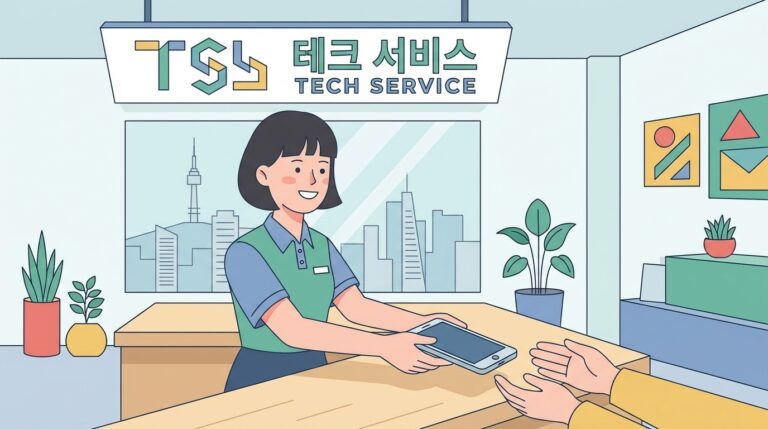
Broken Phone in Seoul? How to Find a Korean ‘AS Center’ Like a Local!
Phase 1: Empathy (Your Korean Tech Savior Guide)
안녕하세요! (Annyeonghaseyo!) I’m your Daily Hangul Chief Editor and your personal culture navigator.
Imagine this: You are walking down the vibrant streets of Hongdae, filming a gorgeous reel of the street buskers. Suddenly—bam! Your phone slips out of your hands and hits the pavement. The screen is shattered, and you have no idea where to go. You search “repair shop” on Google Maps, but nothing useful pops up. You feel lost, disconnected, and stressed in a foreign country.
Don’t worry! In Korea, tech recovery is legendary for its speed and efficiency, but you need to know the right words. We don’t usually search for “repair shops”; we look for an AS 센터 (A-S Senteo), which stands for “After-Sales Service Center.”
This guide is designed for B1 (Intermediate) learners who want to navigate this real-world emergency smoothly. Based on real experiences of foreigners in Seoul, this lesson will turn a stressful moment into a cultural triumph!
Phase 2: Deep-Dive Analysis of 3 Key Phrases
1. 가장 가까운 서비스 센터가 어디에 있어요?
- Pronunciation: Gajang gakkaun seobiseu senteoga eodie isseoyo? (Sounds like: “Gah-jahng gah-kkah-oon seo-bee-seu sen-teo-gah eo-dee-eh eet-seo-yo?” Hint: Pronounce the double “kk” in gakkaun tightly, like the ‘sk’ sound in ‘sky’.)
- Meaning: Where is the nearest service center?
- K-Culture Moment: This is the ultimate survival phrase you’ll hear in K-dramas when a busy office worker’s laptop breaks right before a major presentation.
- Editor’s Insight: Koreans combined the English words “Service” and “Center” into “서비스 센터”. It refers to official brand repair offices (like Samsung or LG) rather than private third-party repair shops.
- Situation Spectrum: Casual (🚫) | Semi-formal (✅) | Formal (✅)
- 🤔 Think About It: Korea has adopted many English loanwords for modern technology. Why do you think “AS” (After-Sales) became more popular than native Korean words like “수리” (repair) in corporate service culture?
2. 핸드폰 액정이 깨졌는데 수리 가능한가요?
- Pronunciation: Haendeupon aekjeongi kkaejeonneunde suri ganeunghangayo? (Sounds like: “Hen-deu-pon ek-jeong-ee kkeh-jeon-neun-deh soo-ree gah-neung-han-gah-yo?”)
- Meaning: My phone screen is broken; is it possible to repair it?
- K-Culture Moment: The classic romance drama trope: the main lead drops their phone in shock, and the camera dramatically zooms in on the cracked screen (액정).
- Editor’s Insight: Ending your statement with ~는데 (neunde) provides gentle background context. It sounds much softer and more polite than directly demanding, “Fix my screen.”
- Situation Spectrum: Casual (⚠️ – only to close friends) | Semi-formal (✅) | Formal (✅)
- 🤔 Think About It: How does the Korean way of softening requests using background-setting grammar (~는데) compare to how you ask for favors in your native language?
3. 오늘 바로 고칠 수 있나요?
- Pronunciation: Oneul baro gochil su innayo? (Sounds like: “Oh-neul bah-roh go-cheel soo een-nah-yo?” Note: “innayo” is pronounced with a nasal ‘n’ sound due to Korean consonant assimilation.)
- Meaning: Can I get it fixed today right away?
- K-Culture Moment: This phrase embodies the core of Korea’s famous 빨리빨리 (Pali-Pali / Fast-Fast) culture.
- Editor’s Insight: 바로 (baro) means “immediately” or “directly.” Asking this shows you are looking for same-day service, which is incredibly common and expected in South Korea.
- Situation Spectrum: Casual (🚫) | Semi-formal (✅) | Formal (✅)
- 🤔 Think About It: In many Western countries, tech repairs take days. In Korea, same-day service is the norm. How does this high-speed service expectation shape daily life in Korea?
Phase 3: Textbook Korean vs. Real Korean
Let’s compare stiff, textbook expressions with what native Koreans actually say in real life.
Scenario 1: Searching for a repair shop
- 📖 Textbook Korean: “수리점을 어디서 찾을 수 있습니까?” (Where can I find a repair shop?)
- 🗣️ Real Korean: “근처에 AS 센터 어디 있어요?” (Where is the AS center nearby?)
- 💡 Why Different? No one says “수리점” (repair shop) or uses the ultra-formal “~습니까” in a casual street conversation. “AS 센터” is the natural, modern term used by everyone.
Scenario 2: Asking about the wait time
- 📖 Textbook Korean: “수리 시간이 얼마나 걸릴 것이라고 예상하십니까?” (How long do you anticipate the repair time will take?)
- 🗣️ Real Korean: “얼마나 걸려요?” (How long does it take?)
- 💡 Why Different? Koreans value speed and efficiency. “얼마나 걸려요?” is highly polite, natural, and gets straight to the point without sounding like a robot.
Phase 4: K-Culture Deep-Dive & Non-Verbal Manners
4-1. 눈치 (Nunchi) & Tech Etiquette
- Grab a Ticket First! When you enter a Korean service center, do not walk straight to the counter. Look for a kiosk near the entrance and print a 대기표 (daegipyo – waiting ticket). Waiting your turn patiently is a key element of Korean public manners.
- The Two-Handed Handover: When you hand your broken phone to the technician, always use both hands. Using one hand can seem dismissive. Receiving your repaired phone back with both hands shows mutual respect.
4-2. The “Pali-Pali” Service Ecosystem
Korean electronics giants like Samsung and LG have built world-class service centers. When you walk in, you will notice clean waiting lounges with free Wi-Fi, phone charging docks, and sometimes even coffee bars. The speed is mind-blowing—a full screen or battery replacement often takes less than 30 minutes. This level of customer service is a point of national pride.
Phase 5: Real-World Roleplay Scenario
Setting: A sleek Samsung Service Center near Gangnam Station.
Characters:
* Min-ji (민지): The friendly and professional customer service agent.
* Alex (알렉스): A foreign student whose phone battery is dying too quickly.
민지: [😊 친절하게 웃으며] 고객님, 어떤 일로 방문하셨나요?
      (Customer, what brings you here today?)

알렉스: [🥺 속상한 표정으로] 핸드폰 배터리가 너무 빨리 달아서 왔어요.
        (My phone battery is draining too fast, so I came here.)

민지: [📋 기기를 조심히 살피며] 아, 그러시군요. 최근에 충전이 잘 안 되거나 뜨거워지진 않았나요?
      (Ah, I see. Has it been hard to charge lately, or has it been getting hot?)

알렉스: [💡 기억난 듯이] 네, 맞아요! 충전할 때 조금 뜨거워져요.
        (Yes, that's right! It gets a bit hot when charging.)

민지: [💻 컴퓨터로 상태를 조회하며] 배터리 수명이 거의 다 된 것 같네요. 교체하셔야 할 것 같습니다.
      (It looks like the battery life is almost over. I think you need to replace it.)

알렉스: [🙏 간절한 목소리로] 오늘 바로 교체할 수 있나요?
        (Can I get it replaced today, right away?)

민지: [⏱️ 대기 화면을 보며] 네, 대기 고객이 적어서 20분 정도면 교체 완료됩니다.
      (Yes, there aren't many waiting customers, so it will be done in about 20 minutes.)

알렉스: [😄 안도하며] 다행이네요! 잘 부탁드립니다.
        (What a relief! Thank you, please do a good job.)
🔀 Interactive Choice Points
How should Alex ask about the cost now?
* A) “수리비는 얼마인가요?” (How much is the repair cost?)
* 🟢 Best: Polite, direct, and uses the correct vocabulary (수리비).
* B) “이거 공짜로 해줘요.” (Do this for free.)
* 🔴 Bad: Highly impolite. Free repairs are only for devices under warranty with manufacturer defects.
* C) “시간 없으니까 빨리해 주세요.” (I don’t have time, so do it quickly.)
* 🟡 Risk: While Koreans love speed, demanding it rudely violates social harmony (인정).
Phase 6: 10-Second Emotion Shadowing Drill
Practice these natural pauses (/) and emotional cues out loud to sound like a local!
- “가장 가까운 / 서비스 센터가 / 어디에 있어요?”
- [🥺 Urgent but polite tone]
- “오늘 / 바로 / 고칠 수 있나요?”
- [🙏 Hopeful and direct tone]
- “핸드폰 액정이 / 깨졌는데 / 수리 가능한가요?”
- [😢 Slightly sad and apologetic tone]
Phase 7: K-Culture Mini-Dictionary
| Word (Korean + Romanization) | Translation | Real-World Usage |
|---|---|---|
| 대기표 (Daegipyo) | Waiting Ticket | The ticket you pull from a touch-screen kiosk when entering banks or AS centers. |
| 액정 (Aekjeong) | Device Screen / LCD | Specifically used for digital screens on phones, tablets, or TVs. |
| 보증 기간 (Bojeung gigan) | Warranty Period | The duration in which you can get free repairs for manufacturer faults. |
| 엔지니어 (Enjineoeo) | Engineer / Technician | The polite term used to refer to the technician fixing your device. |
Phase 8: Survival Kit for Travelers
TOP 3 Emergency Tech Phrases
- “액정 필름 갈아주세요.” (Aekjeong pilleum garajuseyo.)
- Please replace my screen protector. (Great for quick maintenance!)
- “대기표 어디서 뽑아요?” (Daegipyo eodiseo ppobayo?)
- Where do I get a waiting ticket?
- “침수되었어요.” (Chim-su-doe-eot-seo-yo.)
- It got water damaged. (Essential if you drop your phone in the Han River or a bath house!)
🗺️ Editor’s Travel Note
Do not use Google Maps to search for service centers in Korea—it is often outdated. Instead, download the Naver Map App and search for “삼성전자서비스” (Samsung Electronics Service) or “LG전자 서비스센터” (LG Electronics Service Center). It will show you real-time business hours, busy times, and precise walking directions!
Phase 9: “한 발 더 깊이” (Deepening Thought)
Korea’s incredibly efficient after-sales service represents more than just corporate competition. It reflects the deeply embedded social concept of 정 (Jeong – warm emotional attachment and care). Service engineers are trained to treat your problems as their own, offering customized care, polite explanations, and even post-repair follow-up messages. It proves that in Korea, even technology is treated with human warmth.
💬 Your Turn: How does the tech repair process in your home country compare to Korea’s same-day “Pali-Pali” service? Have you ever had a stressful tech emergency while traveling? Share your thoughts in the comments below!
Phase 10: FAQ & Avoiding Misunderstandings
Q: Can I get my foreign-purchased phone repaired at a Korean AS Center?
A: Yes! Major global brands like Samsung and Apple offer repair services in Korea. However, if your specific phone model requires unique parts not used in the Korean market, the repair might take a few days for shipping.
Q: Do I need to make an appointment online before going?
A: While booking online saves time, walk-ins (현장 접수 – hyeonjang jeopsu) are fully accepted. Just arrive early in the morning to beat the lunch-hour rush!
Q: Do service center technicians speak English?
A: Centers located in major international hubs of Seoul (like Gangnam, Hongdae, or Myeongdong) usually have English-friendly kiosks or staff members who speak basic English. Knowing the Korean phrases in this guide, however, will make the process twice as fast!
🚨 Common Mistakes Scoreboard
- ❌ Mistake: Searching for “수리 가게” (repair store) on Korean maps.
- 🟢 Correct Action: Search for “서비스 센터” (Service Center) or “AS 센터”.
- ❌ Mistake: Handing over your phone using only one hand.
- 🟢 Correct Action: Always present your device using both hands to show respect.
- ❌ Mistake: Leaving the center without checking if your data was preserved.
- 🟢 Correct Action: Ask, “데이터 괜찮아요?” (Is my data okay?) before they start the repair.
Phase 11: Action Mission
- 🥉 Bronze Mission: Read the phrase “가장 가까운 서비스 센터가 어디에 있어요?” out loud three times with a confident voice!
- 🥈 Silver Mission: Open Naver Map, type “AS 센터”, and find the closest location near your favorite Seoul district.
- 🥇 Gold Mission: Practice our Phase 5 roleplay script with a friend or record your voice to match Min-ji’s polite tone!
- 🎮 K-Culture Mission: Watch a modern Korean office drama. See if you can spot the characters using the word “액정” (screen) or visiting a sleek corporate service center!
Phase 12: Interactive Quiz Challenge
Test your knowledge before you hit the streets of Seoul!
1. Which term is the most natural to use when searching for a brand repair shop in Korea?
- A) 수리 가게 (Suri gage)
- B) 리페어 샵 (Ripeoeo syap)
- C) 서비스 센터 (Seobiseu senteo)
2. Fill in the blank: “오늘 바로 ______ 수 있나요?” (Can I get it fixed today right away?)
- Hint: It means “to fix/repair”.
3. True or False: You must always make an online reservation to visit a Korean service center.
🔍 Click here to reveal the answers and explanations!
- Answer: C) 서비스 센터 (Seobiseu senteo)
- Explanation: While ‘A’ is technically correct in a dictionary, “서비스 센터” (or AS 센터) is the universal term used by all locals.
- Answer: 고칠 (gochil)
- Explanation: “고칠 수 있나요?” comes from “고치다” (to fix) + “~ㄹ 수 있다” (can do).
- Answer: False
- Explanation: Walk-ins are highly welcomed! Just take a “대기표” (waiting ticket) from the kiosk when you arrive.
- Explanation: Walk-ins are highly welcomed! Just take a “대기표” (waiting ticket) from the kiosk when you arrive.







