

Phase 1: Empathy (스토리 몰입형 오프닝)
안녕하세요! Your favorite Korean culture navigator and Daily Hangul editor is here!
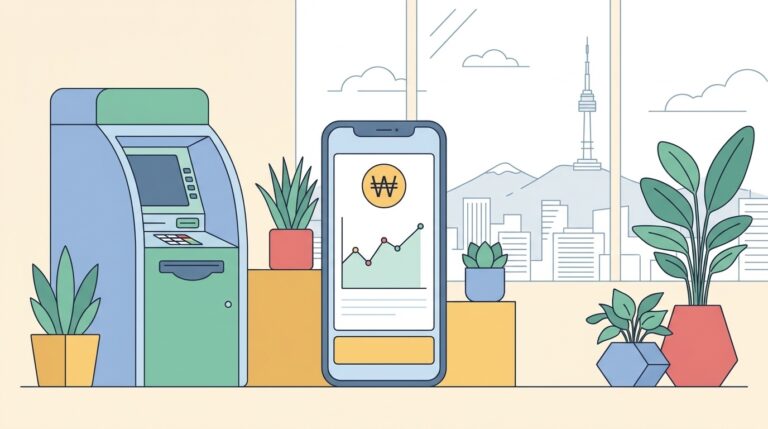
Imagine this: You\’ve just landed at Incheon International Airport. The lights of Seoul are dazzling, and the aroma of freshly fried K-chicken is practically calling your name from the streets of Myeongdong. But as you open your wallet, you realize you only have your home currency cash. You step into a sleek, modern Korean bank. The glass doors slide open, and you are greeted by polite, bowing bank tellers.
Suddenly, your heart beats a little faster. You know the textbook word for exchange, hwan-jeon (환전), but how do you ask for that sweet, money-saving \’preferential exchange rate\’ (우대율)? How do you make sure you aren\’t hit with massive transaction fees (수수료)?
Many of our intermediate learners, like Sarah from Chicago, have told us: \’I could order coffee easily, but entering a Korean bank felt like a boss level in a video game! I ended up just accepting whatever rate they gave me because I was too shy to negotiate or ask questions.\’
Don\’t worry, Sarah, and don\’t worry, reader! Today, we are going to unlock the exact phrases that will make you sound like a savvy local who knows exactly how to navigate the Korean financial system. Knowing these phrases won\’t just save you money for more K-pop albums; it will give you the confidence to walk into any financial institution in Korea with your head held high!
Phase 2: Deep Dive into 3 Core Expressions
Let\’s break down the three most powerful financial phrases you will need at a Korean bank.
1. 환전 우대율이 어떻게 돼요? (환전 우대율이 어떻게 돼요?)
- Pronunciation: hwan-jeon u-dae-ryu-ri eo-tteo-ke dwae-yo? (Sounds like: hwan-jun oo-dae-ryool-ee uh-ttuh-keh dwae-yo?)
- Meaning: What is the currency exchange preference rate?
- K-Culture Moment: You\’ll often see this term in Korean travel variety shows like Youth Over Flowers (꽃보다 청춘) or Traveler (트래블러), where the cast members desperately count their pennies and look for bank coupons to get a better rate.
- Editor\’s Insight: 우대율 (u-dae-ryul) is the magic word here. In Korea, banks offer a \’discount\’ on the exchange spread, often referred to as a \’preferential rate.\’ Asking for this directly shows you understand Korean banking systems!
- Situation Spectrum: Casual ⚠️ | Semi-formal ✅ | Formal ✅
- 🤔 Think About It: In many Western countries, the exchange rate is fixed on the board with little room for inquiry. Why do you think Korean banks have a built-in system of \’preferential treatment\’ (우대) for customers?
2. 수수료는 따로 붙나요? (수수료는 따로 붙나요?)
- Pronunciation: su-su-ryo-neun tta-ro bung-na-yo? (Sounds like: soo-soo-ryoh-neun ttha-ro boong-na-yo?)
- Meaning: Are there separate transaction fees?
- K-Culture Moment: This comes up in K-dramas centered around start-up life or business, like Start-Up or Itaewon Class, when characters calculate transaction costs for their business accounts.
- Editor\’s Insight: Koreans use the verb 붙다 (but-da), which means \’to stick\’ or \’to attach,\’ when talking about fees, taxes, or interest being added to a bill.
- Situation Spectrum: Casual ✅ | Semi-formal ✅ | Formal ✅
- 🤔 Think About It: How does the concept of \’hidden fees\’ compare in your home country versus Korea\’s straightforward fee inquiries?
3. 모바일 앱으로 환전하면 더 저렴한가요? (모바일 앱으로 환전하면 더 저렴한가요?)
- Pronunciation: mo-ba-il aep-eu-ro hwan-jeon-ha-myeon deo jeo-ryeom-han-ga-yo? (Sounds like: moh-bah-il ep-eu-ro hwan-juhn-ha-myuhn duh juh-ryum-han-gah-yo?)
- Meaning: Is it cheaper if I exchange currency through the mobile app?
- K-Culture Moment: This reflects Korea\’s ultra-digitalized, high-speed lifestyle (Bballi-Bballi culture). From KakaoBank to Toss, digital financial transactions dominate modern Korea.
- Editor\’s Insight: Physical bank branches often have lower preference rates than their mobile app counterparts. If you ask this, the teller might guide you to download their app, saving you up to 90% on exchange fees!
- Situation Spectrum: Casual ⚠️ | Semi-formal ✅ | Formal ✅
- 🤔 Think About It: Korea is rapidly becoming a cashless society. How does the reliance on mobile banking in Korea compare to your experience at home?
Phase 3: Textbook Korean vs. Real-Life Korean
Let\’s compare the overly formal, stiff textbook phrases with what native Koreans actually say at the counter.
Situation 1: Asking for a better rate
- 📖 Textbook: 환전 수수료를 할인해 주십시오. (hwan-jeon su-su-ryo-reul hal-in-hae ju-sip-si-o.) – Please discount the exchange fee.
- 🗣️ Real Korean: 혹시 우대율 적용 가능한가요? (hok-si u-dae-ryul jeok-yong gan-eung-han-ga-yo?) – By any chance, is the preferential rate applicable?
- 💡 Why the difference? The textbook sentence sounds like you are haggling at a traditional market. The real Korean phrase is professional, polite, and uses standard banking vocabulary (적용 – application).
Situation 2: Asking about transaction fees
- 📖 Textbook: 제가 수수료를 지불해야 합니까? (je-ga su-su-ryo-reul ji-bul-hae-ya hap-ni-ka?) – Do I have to pay a fee?
- 🗣️ Real Korean: 수수료 얼마나 들어요? (su-su-ryo eol-ma-na deul-eo-yo?) – How much does the fee cost?
- 💡 Why the difference? 지불하다 (to pay) is highly formal and rarely used in daily conversation. Native speakers prefer the natural verb 들다 (to cost/take) when asking about fees.
Phase 4: K-Culture Deep Dive & Non-Verbal Etiquette
4-1. Nunchi (눈치) & Bowing Gestures
When interacting with a bank teller in Korea, non-verbal politeness is key.
1. The Two-Handed Hand-off: When handing over your passport, cash, or credit card, always use both hands. Using one hand can be perceived as careless or slightly rude.
2. The Polite Nod: As the teller explains the rates, keep soft eye contact and nod gently (끄덕끄덕). It shows you are listening attentively.
4-2. The “우대” (Preference) Culture
In Korea, “우대” (u-dae) refers to special, preferential treatment. Whether it is a credit card benefit, a bank exchange rate, or amusement park entry for tourists, Koreans love seeking out 우대 benefits. Before going to a bank, search online for \’환전 우대쿠폰\’ (currency exchange discount coupons) offered by major Korean banks like Hana, KB, or Shinhan!
Phase 5: Practical Roleplay Scenario
Setting: A bustling branch of Hana Bank in downtown Seoul. You are sitting at the counter, facing Min-su (민수), a friendly and efficient bank teller.
- 민수: 안녕하세요! 고객님, 오늘 어떤 업무 도와드릴까요?
(an-nyeong-ha-se-yo! go-gaek-nim, o-neul eo-tteon eop-mu do-wa-deu-ril-ka-yo?)
🎭 [Greeting you with a polite smile and a slight bow]
“Hello, valued customer! How can I help you today?” -
You: 저, 달러를 원화로 환전하고 싶은데요.
(jeo, dal-leo-reul won-hwa-ro hwan-jeon-ha-go sip-eun-de-yo.)
🎭 [Handing over your passport and US dollar bills with both hands]
“Uh, I\’d like to exchange US dollars into Korean Won.” -
민수: 아, 네! 여권이랑 현금 확인하겠습니다. 잠시만 기다려 주세요.
(a, ne! yeo-gwon-i-rang hyeon-geum hwag-in-ha-ges-seum-ni-da. jam-si-man gi-da-ryeo ju-se-yo.)
🎭 [Taking the items politely with both hands and typing on the keyboard]
“Ah, yes! I will verify your passport and cash. Please wait a moment.” -
You: 혹시 환전 우대율은 어떻게 되나요?
(hok-si hwan-jeon u-dae-ryu-rin eo-tteon-ge doe-na-yo?)
🎭 [Leaning in slightly with an inquisitive, polite expression]
“By any chance, what is the preferential exchange rate?” -
민수: 기본 우대율은 오십 퍼센트 적용되는데요, 저희 은행 앱을 사용하시면 구십 퍼센트까지 가능해요.
(gi-bon u-dae-ryu-reun o-sip peo-sen-teu jeok-yong-doe-neun-de-yo, jeo-hui eun-haeng aep-eul sa-yong-ha-si-myeon gu-sip peo-sen-teu-kka-ji gan-eung-hae-yo.)
🎭 [Pointing toward the QR code printed on the desk banner]
“The basic preference rate is 50%, but if you use our bank app, you can get up to 90%.” -
You: 아, 그래요? 그럼 수수료는 따로 안 붙나요?
(a, geu-rae-yo? geu-reom su-su-ryo-neun tta-ro an bung-na-yo?)
🎭 [Nodding and looking closely at the QR code]
“Oh, really? Then are there no separate transaction fees added?” -
민수: 네, 앱으로 하시면 수수료가 거의 안 들어요. 여기서 바로 가입 도와드릴까요?
(ne, aep-eu-ro ha-si-myeon su-su-ryo-ga geo-ui an deul-eo-yo. yeo-gi-seo ba-ro ga-ip do-wa-deu-ril-ka-yo?)
🎭 [Offering a tablet pen to guide you through the digital process]
“Yes, if you use the app, there are almost no fees. Shall I help you sign up right here?” -
You: 네, 그렇게 해 주세요. 감사합니다!
(ne, geu-reo-ke hae ju-se-yo. gam-sa-hap-ni-da!)
🎭 [Smiling warmly and nodding in appreciation]
“Yes, please do it that way. Thank you!”
🔀 Interactive Choice Points
Now, how would you respond if Min-su asked if you want your exchanged money in large bills or small bills?
* Choice A: “가장 큰 돈으로 다 주세요!” (Give me all of it in the biggest bills!)
👉 Feedback (Risk): While grammatically correct, it sounds slightly demanding. It\’s better to ask for a mix of bills.
* Choice B: “오만 원짜리랑 만 원짜리 섞어서 주세요.” (Please mix 50,000 won bills and 10,000 won bills.)
👉 Feedback (Best!): Perfect! This is practical and natural. Having some 10,000 won bills is great for street markets and public transport cards.
* Choice C: “돈은 아무렇게나 주세요.” (Just give me the money anyway.)
👉 Feedback (Bad): This sounds a bit dismissive and uncaring in Korean. Avoid using “아무렇게나” with bank staff.
Phase 6: 10-Second Emotion Shadowing Drill
Let\’s practice speaking like a native! Pay attention to the pauses (/) and try to express the exact emotion indicated in the brackets.
우대율을 / 더 받을 수 있는 / 방법이 있을까요?- [🥺 Full of hope and sweet anticipation]
- u-dae-ryu-reul / deo ba-deul su in-neun / bam-beob-i is-seul-ka-yo?
수수료가 / 너무 많이 나와서 / 깜짝 놀랐어요!- [😲 Utterly shocked and wide-eyed]
- su-su-ryo-ga / neo-mu ma-ni na-wa-seo / kkam-jjak nol-ras-seo-yo!
앱으로 하니까 / 정말 간편하네요!- [😊 Extremely satisfied and happy]
- aep-eu-ro ha-ni-ka / jeong-mal gan-pyeon-ha-ne-yo!
Phase 7: K-Culture Mini Dictionary
- 우대율 (U-dae-ryul) | Exchange Preference Rate
- The discount rate applied to the bank\’s currency exchange margin. A 90% preference rate means you only pay 10% of the standard transaction spread.
- 수수료 (Su-su-ryo) | Service/Transaction Fee
- The fee charged for financial processing. Commonly used for banks, ATMs, and real estate agents (복비).
- 모바일 환전 (Mo-ba-il Hwan-jeon) | Mobile Currency Exchange
- The act of exchanging money via a banking app and collecting physical cash at airport lounges or nearby branches.
- 지폐 (Ji-pye) | Paper Currency/Bills
- Physical paper money in Korea, which comes in denominations of 1,000, 5,000, 10,000, and 50,000 Won.
Phase 8: Survival Kit for Travelers
TOP 3 Emergency Phrases
가장 가까운 은행이 어디예요?(Where is the nearest bank?)- ga-jang ga-kka-un eun-haeng-i eo-di-yeo-yo?
- Pro Tip: Perfect when you run out of cash in a traditional market and need an ATM fast.
여권 여기 있습니다.(Here is my passport.)- yeo-gwon yeo-gi is-seum-ni-da.
- Pro Tip: Say this while presenting your passport with both hands.
동전은 안 주셔도 돼요.(You don\’t have to give me coins.)- dong-jeon-eun an ju-syeo-do dwae-yo.
- Pro Tip: Useful if you hate carrying heavy metallic coins while traveling.
📝 Editor\’s Travel Note
Before stepping foot into a physical bank, we highly recommend checking the official Hana Bank Currency Exchange App on your mobile device. Most major Korean banks allow foreigners to lock in prime exchange rates through mobile reservation systems, which you can pick up directly at Incheon Airport!
(Disclaimer: Rate options and operational guidelines are subject to change, so please double-check the bank website before traveling.)
Phase 9: “One Step Deeper” (Reflective Question)
In Korean culture, the word 우대 (U-dae – preferential/respectful treatment) is rooted deeply in the social concept of building relationships. Korean banks aren\’t just cold, robotic transactional spaces; they value customer loyalty and connections (정 – Jeong). When you ask for 우대, you aren\’t just trying to save money; you are participating in a polite social exchange where mutual benefits are shared.
💬 Your Turn: How does your culture handle negotiations or fees at a bank? Do you think the Korean system of “mobile app preference rates” is easier or harder than what you have at home? Let us know in the comments below!
Phase 10: FAQ & Avoiding Mistakes
Q: Can I exchange any foreign currency at any Korean bank?
A: Major currencies like USD, JPY, EUR, and CNY are readily exchangeable at almost all bank branches. However, if you have less common currencies (like Southeast Asian or Scandinavian currencies), it is highly recommended to visit head offices in Seoul or do a mobile reservation first.
Q: What documents do I need for currency exchange at a Korean bank?
A: You must present your physical passport. Digital copies or driver\’s licenses from your home country are not accepted under South Korean financial security laws.
Q: Why is my exchange rate different from the one I saw on Google?
A: Google shows the “mid-market rate,” which does not include the bank\’s service fee. To get as close to the Google rate as possible, ask for the 우대율 (preferential rate) to minimize the bank\’s margin.
🚨 Common Mistakes Board
- Mistake 1: Handing money or passports over with only one hand.
- Correct Action: Always use both hands to demonstrate polite etiquette.
- Mistake 2: Demanding a discount by saying “깎아 주세요” (Cut the price).
- Correct Action: Use the official term: “우대율 적용되나요?” (Is the preferential rate applicable?).
- Mistake 3: Not counting the cash before leaving the counter.
- Correct Action: Always verify the cash in front of the teller. It is perfectly polite to double-check.
Phase 11: Action Mission & Participation
- 🥉 Bronze Level: Speak the core phrase
환전 우대율이 어떻게 돼요?aloud 5 times in front of your mirror today! - 🥈 Silver Level: Screenshot your favorite Korean currency exchange app screen and share it on Instagram tagging #DailyHangul!
- 🥇 Gold Level: Next time you visit Korea, step into a local bank and successfully ask the teller:
수수료는 따로 안 붙나요?like a real local!
🎮 K-Culture Mission: Watch a modern financial K-Drama (such as Midas or Money Game) and listen closely for the words 수수료 (fee) and 환전 (exchange). Write down the context in your notebook!
Phase 12: Interactive Quiz Challenge
Test your knowledge to see if you\’re ready to dominate the Korean banking scene!
1. Which phrase is the most natural way to ask if there are additional fees?
- A) 수수료를 지불합니까?
- B) 수수료는 따로 붙나요?
- C) 돈이 더 많이 나옵니까?
2. Fill in the blank:
환전 _______이 어떻게 돼요? (What is the currency exchange preference rate?)
3. True or False:
In Korea, it is considered completely polite to hand your passport to a bank teller with just your index and middle finger.
Click here to reveal the answers and explanations!
- Answer: B
- Explanation: “수수료는 따로 붙나요?” is the most natural, authentic way to inquire about additional fees in Korean.
- Answer: 우대율 (u-dae-ryul)
- Explanation: 우대율 is the correct term for the preferential exchange rate.
- Answer: False
- Explanation: Handing anything to someone (especially official documents to a professional) with one hand—or worse, a casual grip—is considered impolite. Always use both hands!







