

Mastering the Art of Korean TRPG: Strategy, Roleplay, and High-Level Narrative Negotiation
Phase 1: Empathy (스토리 몰입형 오프닝)
안녕하세요! Your Korean best friend and Daily Hangul senior editor is here!
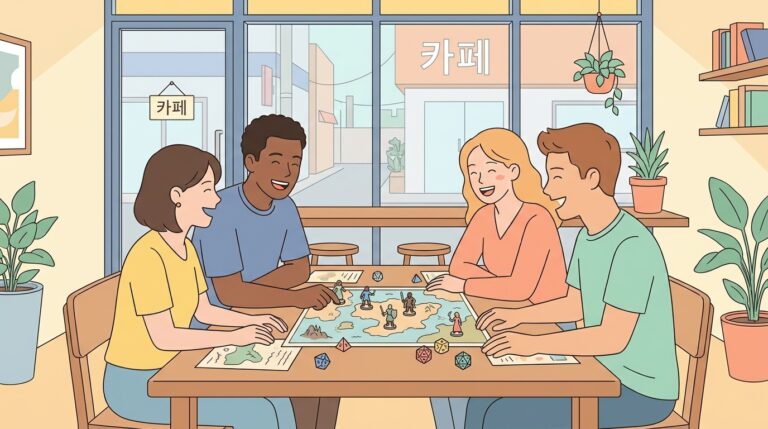
Imagine this: You are sitting in a cozy, dimly lit board game cafe in Sinchon, Seoul. Around the table, your Korean friends are intensely staring at a map, waiting for your character’s next move. The Game Master (GM) looks at you and says, “자, 이제 어떻게 하실 건가요?” (So, what are you going to do now?)
Your heart races. You have a brilliant tactical plan in mind—you want to distract the guard, slip behind the altar, and negotiate a truce. But suddenly, your mind goes blank. How do you articulate complex tactical movements, negotiate narrative outcomes, or express high-stakes risk-taking in Korean without sounding like a dry grammar textbook?
This is the ultimate C1-level hurdle. Tabletop Role-Playing Games (TRPGs) are the absolute pinnacle of linguistic and cultural immersion. They require not just vocabulary, but strategic reasoning, emotional nuance, and ‘Nunchi’ (눈치—reading the room).
Don’t worry! Today, we are going to unlock the exact linguistic tools you need to sound like a seasoned Korean tabletop tactician. Based on years of gaming with both native Koreans and advanced learners, I’ve curated the ultimate guide to mastering Korean TRPG strategy. Let’s dive in!
Phase 2: Key Expressions Deep-Dive (핵심 표현 3선 심층 분석)
To command the table, you need expressions that convey strategic weight. Here are three high-level phrases that will instantly elevate your gaming presence.
1. 판을 짜다 (pan-eul jjada)
- Pronunciation: Pan-eul jjada (Sounds like “pan” as in cooking pan + “eul” + “jja-da” as in salty, but pronounced with a crisp, tensed ‘jj’ sound)
- Meaning: Literally “to weave the board,” meaning to set the stage, lay out a master plan, or orchestrate a situation.
- K-Culture Moment: You hear this constantly in Korean political thrillers or heist movies (like The Thieves or Inside Men), where mastermind characters orchestrate complex schemes.
- Editor’s Insight: In TRPGs, this isn’t just about moving a piece. It refers to setting up a tactical narrative advantage. If you want to coordinate a multi-step ambush with your party, you are “판을 짜는 것” (weaving the board).
- Situation Spectrum: Casual ✅ | Semi-formal ✅ | Formal ⚠️
- 🤔 Think About It: How does the metaphor of “weaving” a board reflect the Korean value of collective creation and interconnected harmony compared to Western military metaphors of “drawing” plans?
2. 밑져야 본전이다 (mit-jyeo-ya bon-jeon-i-da)
- Pronunciation: Mit-jyeo-ya bon-jeon-i-da (Sounds like “meet-jyeo-ya” + “bon-jeon” as in original capital + “ee-da”)
- Meaning: Nothing to lose / Even at worst, you break even.
- K-Culture Moment: Often uttered by protagonists in K-dramas before they take a wild leap of faith or confess their feelings to a long-time friend.
- Editor’s Insight: In gaming, this is your go-to phrase before rolling a high-risk, high-reward D20 (twenty-sided die). It shows your party that while the chances are slim, there is no structural disadvantage to trying.
- Situation Spectrum: Casual ✅ | Semi-formal ✅ | Formal 🚫
- 🤔 Think About It: In Korean culture, saving face is important, yet this phrase embraces the freedom of having “nothing left to lose.” When is it culturally acceptable to take such risks?
3. 어그로를 끌다 (eoguro-reul kkeulda)
- Pronunciation: Eo-gu-ro-reul kkeul-da (Sounds like “uh-goo-roh” + “reul” + “kkeul-da” with a tensed ‘kk’)
- Meaning: To draw aggro / To attract negative attention or provoke a distraction.
- K-Culture Moment: Originally gaming slang from MMORPGs, this has transcended into everyday Korean life. If a celebrity does something controversial to get attention, Koreans say they are “어그로를 끌고 있다.”
- Editor’s Insight: During a TRPG, if your character is a tank or a chaotic rogue, you will use this phrase to tell your party: “I will create a massive distraction while you slip inside.”
- Situation Spectrum: Casual ✅ | Semi-formal ⚠️ | Formal 🚫
- 🤔 Think About It: Why do you think Korean internet and gaming slang like “어그로” integrates so rapidly into standard colloquial speech compared to other languages?
Phase 3: Textbook Korean vs. Real Conversational Korean
Let’s compare the sterile sentences found in standard textbooks with the dynamic, high-context phrasing used by native Korean players.
Scenario 1: Proposing a group strategy
- 📖 Textbook Korean: “우리의 전략을 시작해 봅시다.”
(Uri-ui jeollyag-eul sijag-hae bobsida. / “Let us begin our strategy.”) - 🗣️ 진짜 한국어 (Real Korean): “슬슬 판 한번 짜볼까요?”
(Seulseul pan hanbeon jja-bol-kka-yo? / “Shall we slowly start setting up our play?”) - 💡 Why the difference? The textbook version sounds like a corporate slide presentation. The real Korean version uses “슬슬” (softly/gradually) and “판을 짜다” to sound relaxed, cooperative, and incredibly natural.
Scenario 2: Suggesting a risky roll
- 📖 Textbook Korean: “성공 가능성이 낮지만 시도하겠습니다.”
(Seonggong ganeungseong-i nat-jiman sido-hagesseumnida. / “The probability of success is low, but I will attempt it.”) - 🗣️ 진짜 한국어 (Real Korean): “밑져야 본전인데, 그냥 질러볼까요?”
(Mit-jyeo-ya bon-jeon-inde, geunyang jilleo-bol-kka-yo? / “Nothing to lose anyway, should we just go for it?”) - 💡 Why the difference? “질러보자” (from 지르다 – to blindly execute/commit) perfectly captures the thrill of a wild dice roll, making the gameplay much more exciting and immersive.
Phase 4: K-Culture Deep-Dive & Non-Verbal Manners
4-1. TRPG Nunchi (눈치) & Non-Verbal Cues
When playing TRPGs in Korea, reading the “Nunchi” (social air) of the table is vital.
* The Out-of-Character (OOC) Gesture: To signal that you are speaking as yourself (the player) and not your character, Koreans often hold up two fingers in a ‘V’ shape near their temple, or make a quick framing gesture with their hands. This is called “오프(off) 상태” or “현생(real life) 모드”.
* The Game Master’s Pause: If the GM lowers their voice and slowly taps their pencil, they are signaling that the atmosphere is tense. Jumping in with loud jokes ruins the immersion. Match their volume and tempo to show respect for their narrative craft.
4-2. The Rise of “Gwa-mor-ip” (과몰입) Culture
Korea is currently obsessed with 과몰입 (Gwa-mor-ip—hyper-immersion/over-investment). Whether it’s dating reality shows, MBTI tests, or TRPGs, Koreans love to fully commit to a role. In a TRPG, don’t hold back. Cry when your character’s companion dies, and celebrate wildly when someone rolls a “크리티컬” (Critical Success). Emotional investment is the highest compliment you can pay to your Korean gaming group!
Phase 5: Interactive Roleplay Scenario
Setting: A dark tavern in a fantasy version of historical Seoul (Hanyang). Your party needs to sneak past the guards into the Royal Treasury.
Characters:
* 마스터 (GM): The narrator.
* 민우 (Min-woo): Your party’s elven rogue.
* 지혜 (Ji-hye): Your party’s spellcaster.
* 당신 (You): An advanced warrior/negotiator.
The 8-Turn Script
- 마스터: (낮은 목소리로) 광화문 뒤쪽 창고 앞에 경비병 두 명이 졸고 있습니다. 하지만 작은 소리만 나도 깰 것 같네요.
(In a low voice: Two guards are dozing off in front of the warehouse behind Gwanghwamun. But it seems they might wake up at the slightest noise.) -
민우: (조용히 속삭이며) 이거 정면 돌파는 진짜 무리인데… 지혜야, 주문 남은 거 있어?
(Whispering quietly: Charging straight in is definitely out of the question… Ji-hye, do you have any spells left?) -
지혜: (한숨을 쉬며) 마나가 바닥났어. 아, 아까 보스전에서 다 쓰는 게 아니었는데!
(Sighing: I’m completely out of mana. Ah, I shouldn’t have used it all during the boss fight earlier!) -
당신: (동료들을 바라보며) 걱정 마세요. 밑져야 본전인데, 제가 직접 나서볼게요.
(Looking at companions: Don’t worry. There’s nothing to lose, I’ll step up myself.) -
민우: (깜짝 놀라며) 어? 혼자서 가겠다고? 대체 무슨 판을 짜려는 거야?
(Startled: What? Going alone? What kind of master plan are you trying to weave?) -
당신: (미소를 지으며) 내가 술 취한 행인인 척하면서 저쪽에서 어그로를 끌 테니까, 그사이에 뒤로 넘어가.
(Smiling: I will pretend to be a drunken passerby and draw their aggro over there. In the meantime, slip over the back.) -
지혜: (눈을 빛내며) 대박! 그거 완전 좋은 생각이다. 마스터님, 주사위 난이도(DC) 어떻게 돼요?
(Eyes shining: Awesome! That’s a great idea. Master, what’s the Difficulty Class for the roll?) -
마스터: (미소를 지으며) 좋습니다. 속임수(Deception) 판정입니다. 자, 난이도는 15입니다. 주사위 던지세요!
(Smiling: Great. It’s a Deception check. Now, the DC is 15. Roll the dice!)
🔀 Choose Your Next Action!
A) “제가 동전 한 닢을 던져서 경비병들의 주의를 분산시켜 보겠습니다.”
* Feedback (Risk): Very safe, but a bit plain. The GM might set a high DC because guards are used to random noises. It lacks the “C1 flair” of active strategic play.
B) “밑져야 본전이니까, 저 경비병 바지 뒤에 불을 붙이는 마술을 써볼게요!”
* Feedback (Bad): Too chaotic! This ruins the stealth objective and will immediately alert the entire palace guard. Your party might look at you with severe “눈치” (disapproval).
C) “제가 화려한 말빨로 경비들의 판을 흔들어 놓겠습니다. 협박 판정 갈게요!”
* Feedback (Best!): Perfect! Utilizing advanced slang like “말빨” (gift of gab) and aiming to destabilize the situation (“판을 흔들다”) shows incredible command of both language and tactical initiative.
Phase 6: 10-Second Emotion Shadowing Drill
To sound natural, you must master the cadence of risk and excitement. Try reading these aloud, paying attention to the pauses (/) and the emotional cues!
- “밑져야 / 본전이니까 / 일단 / 주사위 던져볼게요!”
- [🔥 비장하고 당차게 – Bold & Determined]
- “Mit-jyeo-ya / bon-jeon-i-ni-kka / il-dan / ju-sa-wi deon-jyeo-bol-ge-yo!”
- “마스터님, / 진짜 / 이 판을 / 이렇게 짜신다고요? / 너무하십니다!”
- [🥺 억울하고 장난스럽게 – Playfully Indignant]
- “Ma-seu-teo-nim, / jin-jja / i pan-eul / i-reo-ke jja-sin-da-go-yo? / Neo-mu-ha-sim-ni-da!”
Phase 7: K-Culture Mini Dictionary
| Word (한글/Rom) | English Translation | Real-Life / Gaming Context |
|---|---|---|
| 마스터링 (Maseuteoring) | Game Mastering | Facilitating a session. Often used as a verb: “오늘 마스터링 수고하셨어요!” (Thanks for mastering today!) |
| 주사위 신 (Jusawi Sin) | The Dice Gods | The imaginary entities responsible for your rolls. “오늘 주사위 신이 도우셨다!” (The dice gods helped me today!) |
| 과몰입 (Gwa-mor-ip) | Hyper-immersion | Fully getting into character. Essential for premium Korean TRPG tables. |
| 캐해 (Kae-hae) | Character Interpretation | Short for 캐릭터 해석. Understanding a character’s unique psychology and behavior. |
Phase 8: Traveler’s Survival Kit
Top 3 Survival Expressions for Game Day
- “타임이요!” (Time-i-yo!)
- Pro Tip: Use this when you need a brief moment to translate your character’s complicated action sheet or clarify a rule.
- “룰북 좀 봐도 될까요?” (Rul-buk jom bwa-do doel-kka-yo?)
- Pro Tip: Highly polite way to double-check spell parameters without disrupting the flow of the session.
- “제 캐릭터 시트 수정할게요.” (Je kaerikteo siteu sujeong-hal-geyo.)
- Pro Tip: Said after leveling up or taking damage to keep the GM updated.
Editor’s Travel Note 🗺️
If you want to experience authentic local gaming, search for “TRPG 전문 카페” (Specialty TRPG Cafes) in Seoul. The best ones are located around Sinchon and Hongdae. To find them, download the Naver Map App instead of relying on global search engines, which often lack updated listings for niche subculture spots. Note: Operating hours and reservation policies of local cafes are subject to change, so check their social media channels before visiting.
Phase 9: “One Step Deeper” (한 발 더 깊이)
In Western tabletop gaming, the spotlight is often on the individual hero making heroic, solo decisions. However, in Korean gaming spaces, the concept of “우리” (We / Togetherness) reigns supreme.
Even when playing highly individualistic characters, players constantly check in with one another to ensure everyone is having fun and that the narrative flows cohesively. This collaborative mindset is why slang like “판을 짜다” (weaving a collective tapestry) is preferred over direct commands. By learning these phrases, you aren’t just memorizing vocabulary; you are adapting to a collective style of storytelling that values community harmony.
💬 Your Turn!
Have you ever played a tabletop or board game in another language? What is the hardest part about expressing your strategy? Tell us in the comments below!
Phase 10: FAQ & Mistake Prevention
Q: Can I use “어그로를 끌다” in a formal business meeting?
A: Absolutely not! While it is highly understood by anyone under 40, it is considered very casual internet slang. Use “이목을 집중시키다” (to draw public attention) instead.
Q: What is the difference between “판을 짜다” and “계획을 세우다”?
A: “계획을 세우다” simply means to make a plan (neutral). “판을 짜다” implies setting up a complex, multi-layered situation or environment where you manipulate variables for a specific outcome.
Q: How do I address the Game Master?
A: Always address them as “마스터님” (Master-nim). Adding the honorific “-님” shows respect for their preparation and effort.
🚨 Common Mistakes Alert!
- Using too much historical/literary Korean (사극 말투): Even if playing a historical game, don’t speak like a Joseon King unless you are actively roleplaying. Keep player-to-player talk modern.
- Rolling without asking: In Korea, rolling a die before the GM prompts you is considered slightly bad manners. Always ask: “굴려도 될까요?” (May I roll?)
- Ignoring non-verbal cues: If other players are leaning back or quiet, it is a sign to pass the spotlight. Do not dominate the narrative space.
Phase 11: Action Mission & Engagement
- 🥉 Bronze Mission: Write a sentence in the comments below using “밑져야 본전이다” about a goal you want to achieve this week.
- 🥈 Silver Mission: Share this post on social media and tag your favorite gaming group with the hashtag
#DailyHangulTRPG. - 🥇 Gold Mission: Use “어그로를 끌다” or “판을 짜다” during your next casual Korean conversation or online gaming session!
- 🎮 K-Culture Mission: Watch a popular Korean “TRPG 플레이” video on YouTube and try to spot at least two of the terms we learned today!
Phase 12: Interactive Quiz Challenge
Test your strategic Korean skills!
1. What does “판을 짜다” mean in a tactical situation?
- A) To clean the physical game board
- B) To design a beautiful map
- C) To orchestrate a master plan / set the stage
👉 Click to reveal Answer & Explanation
Correct Answer: C
Explanation: “판을 짜다” means to weave or set up a complex tactical layout or situation to gain an advantage.
2. Fill in the blank: “실패해도 손해는 없으니 ___________ 주사위 한번 던져보자!”
- A) 어그로를 끌어서
- B) 밑져야 본전이니까
- C) 판을 짜느라
👉 Click to reveal Answer & Explanation
Correct Answer: B
Explanation: “밑져야 본전이니까” means “since there is nothing to lose anyway,” which perfectly fits the context of taking a risk with zero collateral damage.
3. True or False: “어그로를 끌다” is a perfect phrase to use in formal corporate presentations.
- A) True
- B) False
👉 Click to reveal Answer & Explanation
Correct Answer: B (False)
Explanation: “어그로를 끌다” is highly colloquial gaming/internet slang. In a corporate or formal presentation, use “주목을 받다” (to receive attention) or “관심을 끌다” (to draw interest).







