

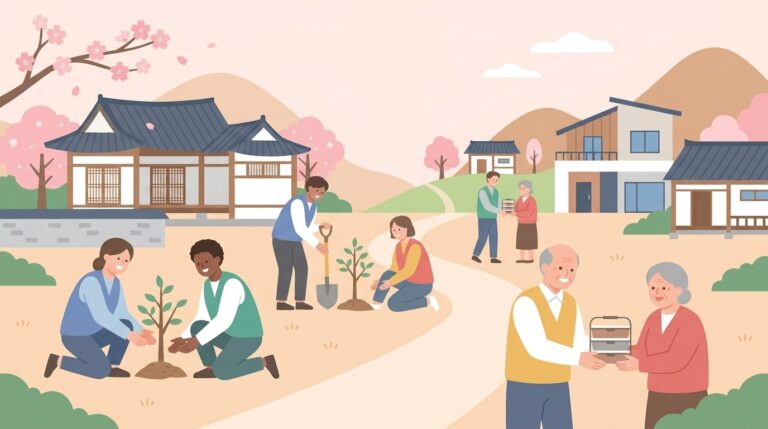
Volunteering & Talent Donation in Korea: Warm Up Hearts with Your Skills!
안녕하세요! Welcome back to another edition of Daily Hangul, your premium cultural navigator. I’m your senior editor, and today we’re diving into a topic that truly highlights the warm, beating heart of Korean society: 자원봉사 (jawon-bongsa – volunteering) and 재능 기부 (jaeneung gibu – talent donation).
Have you ever watched a K-drama where neighbors gather in the freezing winter to carry black coal briquettes (연탄 – yeontan) to elderly residents living alone? Or maybe you’ve seen a celebrity quietly painting colorful murals in an old neighborhood? In Korea, volunteering is not just a resume-builder; it is a manifestation of 정 (jeong – deep affection/bonding) and 품앗이 (pumasi – mutual communal aid).
Many of our intermediate (B2) learners tell us: “I want to help out at a local animal shelter or use my English/coding skills to teach kids in Seoul, but I’m afraid my Korean isn’t natural enough. I don’t want to sound rude or transactional.”
Don’t worry! Today, we’re going to elevate your Korean from textbook-stiff to culturally fluid, so you can offer your helping hands and truly connect with the locals. Let’s get started!
Phase 2: Deep Dive into 3 Core Expressions
1. 재능 기부 (Jaeneung gibu)
- Pronunciation: [Jae-neung Gi-bu] (Think of “Jae” like the first syllable of “gem” with a soft ‘j’, and “gibu” like “give” followed by a short “u”).
- Meaning: Talent Donation (sharing your professional or personal skills for free).
- K-Culture Moment: You’ll often see this term on the news when famous K-pop stars or athletes run free clinics for underprivileged kids, or when local designers design logos for traditional market stalls.
- Editor’s Insight: Unlike regular monetary donation (기부 – gibu), “재능 기부” focuses on sharing a piece of yourself—your skills, knowledge, or artistic talents. It’s highly respected because it requires time and personal effort.
- Situation Spectrum: Casual (✅) / Semi-formal (✅) / Formal (✅)
- 🤔 Think About It: In your home country, is there a distinct word for “talent donation” as separate from general volunteering? How does this distinction shape people’s willingness to help?
2. 봉사 활동에 참여하다 (Bongsa hwal-dong-e cham-yeo-hada)
- Pronunciation: [Bong-sa hwal-dong-e cham-yeoh-hada]
- Meaning: To participate in volunteer activities.
- K-Culture Moment: In high school and university K-dramas, you will often hear characters say they need to complete their “봉사 활동” hours, often leading them to meet their love interest at a library or community center!
- Editor’s Insight: While you can say “봉사 활동을 하다” (to do volunteer work), using the verb “참여하다” (to participate) makes you sound much more proactive, organized, and polite.
- Situation Spectrum: Casual (⚠️ – sounds a bit formal for close friends) / Semi-formal (✅) / Formal (✅)
- 🤔 Think About It: How does participating in collective community work change the way we view our relationship with neighbors?
3. 따뜻한 마음을 나누다 (Tatteut-han ma-eumeul nanuda)
- Pronunciation: [Tah-tteut-han mah-eum-eul nah-nu-dah] (Make sure to double the ‘t’ sound in “Tatteut” for that crisp, tense Korean pronunciation!)
- Meaning: To share a warm heart (figuratively, to share kindness and warmth).
- K-Culture Moment: This is a staple phrase used by MCs during year-end charity broadcasts or on public campaign posters across subway stations in Korea.
- Editor’s Insight: Koreans love the imagery of “warmth” (따뜻함). When you volunteer, you aren’t just providing labor; you are exchanging emotional warmth. It’s a beautiful, poetic way to describe your intentions.
- Situation Spectrum: Casual (✅) / Semi-formal (✅) / Formal (✅)
- 🤔 Think About It: Why is “warmth” such a universal metaphor for kindness, and how does it translate into Korean social actions?
Phase 3: Textbook Korean vs. Real Korean
Let’s look at how to sound like a natural, compassionate local instead of a translating robot.
Scenario 1: Offering general help at a local center
- 📖 Textbook Korean: 저는 자원봉사를 하고 싶습니다.
- Translation: “I want to do volunteer work.”
- Why it’s a bit off: While grammatically correct, it sounds like you are checking a box on a school assignment. It’s very transactional.
- 🗣️ 진짜 (Real) Korean: 혹시 제가 도울 수 있는 일손이 있을까요?
- Translation: “By any chance, is there an extra hand I can lend to help out?”
- 💡 Why it works: 일손 (il-son) literally means “work-hands.” Asking if they need “일손” shows you are ready to roll up your sleeves and do whatever labor is needed, showing deep humility and warmth.
Scenario 2: Proposing a specific talent (e.g., teaching English)
- 📖 Textbook Korean: 저는 영어를 무료로 가르쳐 줄 수 있습니다.
- Translation: “I can teach English for free.”
- Why it’s a bit off: This can accidentally sound a bit boastful or patronizing, as if you are doing them a massive favor.
- 🗣️ 진짜 (Real) Korean: 제 재능을 살려서 영어 교육 봉사를 하고 싶어요.
- Translation: “I would love to do English education volunteering by utilizing my skills.”
- 💡 Why it works: 재능을 살리다 (jaeneungeul sallida) means “to make use of one’s talent.” It frames the offer around your gratitude for having a skill to share, making you sound humble and professional.
Phase 4: K-Culture Deep Dive & Non-verbal Manners
4-1. Nunchi & Physical Manners in Volunteering
When volunteering in Korea, your actions speak much louder than words. Keep these cultural tips in mind:
1. The Two-Handed Hand-off (두 손으로): Whether you are handing out lunch boxes to senior citizens or receiving tools at a construction site, always use both hands. This shows ultimate respect and care.
2. Lower Your Posture: When talking to elderly recipients of volunteer work, bend your knees slightly or squat down so your eyes are at or below their eye level. It shows incredible 눈치 (nunchi – situational awareness) and politeness.
3. Dress Appropriately: Keep clothing modest, comfortable, and simple. Avoid flashy logos or overly revealing clothes, as volunteering environments often value group cohesion and humility over individual style.
4-2. The Spirit of “Jeong” (정) and “Pumasi” (품앗이)
Historically, Korea was an agricultural society where planting and harvesting required the whole village’s effort. This gave birth to 품앗이 (pumasi)—a communal system of exchanging labor. If your neighbor helped you today, you helped them tomorrow. This wasn’t a strict business contract; it was fueled by 정 (jeong), the invisible emotional bond of affection.
When you offer a “재능 기부” in Korea today, locals will view you not just as a passing foreigner, but as a temporary “neighbor” entering this beautiful, ancient circle of mutual support!
Phase 5: Real-world Roleplay Scenario
Let’s practice! You are at a local community welfare center (복지관 – bokjigwan). You meet Min-jun (민준), the enthusiastic and slightly stressed program coordinator.
Character Profile:
- Name: 민준 (Min-jun)
- Role: Welfare Center Coordinator
- Mood: Grateful but busy, trying to organize a weekend children's class.
- 민준: 안녕하세요! 오늘 복지관에 상담 오신다고 해서 기다렸어요. 반갑습니다!
- (Annyeonghaseyo! Oneul bokjigwan-e sangdam osindago haeso gidaryeosseoyo. Bangapseumnida!)
- “Hello! I was waiting for you since I heard you were coming for a consultation today. Nice to meet you!”
- You: 🎭 [😊 Smiling warmly] 안녕하세요, 민준 씨! 저도 오늘 오게 되어 정말 기뻐요.
- (Annyeonghaseyo, Min-jun ssi! Jeodo oneul oge doeyeo jeongmal gippeoyo.)
- “Hello, Min-jun! I’m really happy to be here today, too.”
- 민준: 저희 센터에 외국인 분이 자원봉사 신청을 해주신 건 처음이라서요. 어떤 봉사에 관심이 있으신가요?
- (Jeohui senteo-e oegugin buni jawon-bongsa sincheongeul haejusin geon cheoeum-iraseoyo. Eotteon bongsa-e gwansimi iseusingayo?)
- “It’s actually our first time having a foreign volunteer apply at our center. What kind of volunteer work are you interested in?”
- You: 🎭 [💡 Eager to share] 평소에 아이들을 좋아해서, 제 재능을 살려 영어나 컴퓨터를 가르치는 활동을 하고 싶어요.
- (Pyeongsoe aideureul johahaeseo, je jaeneungeul sallyeo yeongeona kompyuteoreul gareuchineun hwal-dongeul hago sipeoyo.)
- “I usually love kids, so I’d love to use my skills to teach English or computer skills.”
- 민준: 우와, 정말요? 마침 다문화 가정 아이들을 위한 주말 교실 일손이 많이 부족했거든요! 정말 큰 도움이 될 것 같아요.
- (Uwa, jeongmalyo? Machim damunhwa gajeong aideureul wihan jumal gyosil ilsoni mani bujokhaetgeodeunyo! Jeongmal keun doumi doel geot gatat-eoyo.)
- “Wow, really? We actually happen to be very short-handed for our weekend classes for multicultural families! That would be a huge help.”
- You: 🎭 [🥺 Modestly] 에이, 아니에요. 제가 가진 작은 재능으로 따뜻한 마음을 나눌 수 있다면 좋겠습니다.
- (Ei, anieyo. Jega gajin jageun jaeneungeuro tatteut-han ma-eumeul nanul su itdamyeon joketseumnida.)
- “Oh, not at all. I would be happy if I could share a warm heart with the small skills I have.”
- 민준: 말씀도 정말 예쁘게 하시네요. 이번 주 토요일부터 시작해도 괜찮으실까요?
- (Malsseumdo jeongmal yeppeuge hasineyo. Ibeon ju toyoil-buteo sijakhaedo gwaenchaneusingayo?)
- “You speak so beautifully. Would it be alright if we start this Saturday?”
- You: 🎭 [👍 Nodding enthusiastically] 네, 좋습니다! 기쁜 마음으로 가겠습니다. 토요일에 뵐게요!
- (Ne, jokseumnida! Gippeun maeumeuro gageseumnida. Toyoil-e boelgeyo!)
- “Yes, that’s great! I’ll come with a joyful heart. See you on Saturday!”
“`
🔀 Choose Your Path!
What do you say next to Min-jun to seal the deal?
* A. “그럼 돈은 언제 주시나요?” (Then, when do you pay me?)
* B. “제가 토요일에 조금 늦을 수도 있는데, 괜찮죠?” (I might be a bit late on Saturday, but that’s fine, right?)
* C. “혹시 토요일 가기 전에 제가 미리 준비해야 할 자료나 주의사항이 있을까요?” (Is there any material or precautions I should prepare before Saturday?)
💡 Feedback on Your Choice:
- A (Bad): Oops! Volunteering is unpaid. Asking about money breaks the spirit of “봉사” entirely.
- B (Risk): Careful! Korean punctuality is highly valued, especially in volunteering where children or senior citizens are waiting for you. Lateness can harm trust.
- C (Best): Excellent! Proactively asking for prep materials or precautions shows you are incredibly professional, respectful, and serious about your “재능 기부.”
Phase 6: 10-Second Emotional Shadowing Drill
Practice speaking with authentic Korean emotional rhythm! Pause slightly at the / marks.
- [😊 Expressing Humble Intentions]
- 제 / 재능을 살려서 / 도울 수 있는 일이 / 있을까요?
- (Je / jaeneungeul sallyeoseo / doul su inneun iri / isseulkkayo?)
- “Is there any way / I can help / by utilizing my talents?”
- [🥺 Soft & Heartfelt]
- 작은 손길이지만 / 따뜻한 마음을 나누고 싶어서 / 왔습니다.
- (Jageun songirijiman / tatteut-han maeumeul nanugo sipeoseo / watseumnida.)
- “It’s just a small helping hand, / but I came here / because I wanted to share a warm heart.”
Phase 7: K-Culture Mini Dictionary
- 선한 영향력 (Seonhan yeonghyangryeok) | Good Influence / Positive Impact
- Usage: Often used to describe celebrities or everyday citizens whose acts of charity inspire others to do good.
- 일손을 돕다 (Ilsoneul dopda) | To lend a hand / To help with labor
- Usage: Perfect for general labor tasks like rural volunteering (농촌 봉사 활동) or kitchen assistance.
- 복지관 (Bokjigwan) | Community Welfare Center
- Usage: The local government-run hubs where you can find almost all local volunteer programs in Korea.
- 기부금 (Gibugeum) | Monetary Donation
- Usage: Financial charity. Often tax-deductible in Korea at the end of the year.
Phase 8: Traveler’s Survival Kit
Top 3 Survival Phrases
- “처음이라 서툴지만 열심히 하겠습니다!”
- Rom: Cheoeum-ira seotuljiman yeolsimhi hageseumnida!
- Pro Tip: “It’s my first time so I might be clumsy, but I will do my best!” Saying this immediately wins the hearts of Korean coordinators.
- “제가 어떤 일을 먼저 시작하면 될까요?”
- Rom: Jega eotteon ireul meonjeo sijakhamyeon doelkkayo?
- Pro Tip: “What work should I start with first?” Perfect for when you arrive and want to look proactive.
- “수고하셨습니다! 다음에 또 뵐게요.”
- Rom: Sugohasyeotseumnida! Daume tto boelgeyo.
- Pro Tip: “Thank you for your hard work! See you next time.” The standard polite goodbye when finishing a day of volunteering.
📝 Editor’s Travel Note
If you are residing in Korea or visiting long-term and want to volunteer, don’t just search randomly! You can search and sign up directly on the 1365 Volunteer Portal official website or the VMS (Social Welfare Volunteer Information System). These portals are run by the Korean government and welfare associations, and they even issue official volunteer hour certificates (봉사활동 확인서) which are highly recognized in Korea!
(Note: Portal operation details and signup processes may change over time, so please check their official websites for the latest registration guides.)
Phase 9: “한 발 더 깊이” (One Step Deeper)
In western cultures, volunteering is often viewed through the lens of individual civic duty or charity. In Korea, however, it is heavily rooted in the concept of 공동체 의식 (gongdongche uisik – community consciousness). When a disaster strikes in Korea—like a heavy snowfall or a marine oil spill—thousands of citizens voluntarily pack their bags, jump on buses, and head to the site to scoop up oil or shovel snow together. It is an unspoken social pact: “Your pain is my pain, and we heal it together.”
💬 Your Turn: Have you ever volunteered in your own community? How do you think “talent donation” differs from general volunteering in your culture? Leave a comment below, and let’s practice our Korean together!
Phase 10: FAQ & Common Mistakes
Q: Can foreigners volunteer in Korea even if their Korean is only at an intermediate (B2) level?
A: Absolutely! In fact, local community centers love intermediate foreign volunteers because you can act as a cultural bridge. While advanced Korean is needed for complex administrative roles, B2 is more than enough for teaching, social welfare distribution, or artistic talent donations.
Q: What is the difference between 기부 (gibu) and 후원 (huwon)?
A: 기부 usually refers to one-time donations of money or items (e.g., donating clothes). 후원 refers to ongoing, regular sponsorship (e.g., sponsoring a child’s education monthly).
Q: Do I need a specific visa to volunteer in Korea?
A: Pure unpaid volunteering is generally open to everyone, including tourists. However, if the volunteering involves any form of compensation, housing, or stipend, you must check your visa regulations with the Korean Immigration Service to ensure you do not violate labor laws.
🚨 Common Mistakes Warning Board
| Avoid This (Don’t) | Correct Action (Do) | Why? |
|---|---|---|
| Saying “제가 도와줄게요” (I’ll help you) to seniors | Use “제가 도와드리겠습니다” | The verb “주다” must be elevated to “드리다” (honorific) when offering help to elderly recipients. |
| Arriving exactly on time | Arrive 10-15 minutes early | In Korea, arriving “on time” can sometimes be perceived as rushed. Arriving early shows high commitment. |
| Doing tasks without asking first | Always ask “이렇게 하면 될까요?” | Assuming things can lead to mistakes that burden busy coordinators. Always double-check. |
Phase 11: Action Mission & Engagement
Ready to put your knowledge into action? Complete these steps to level up:
- 🥉 Bronze Mission: Write the phrase “따뜻한 마음을 나누고 싶어요” on a sticky note and practice saying it out loud with the shadowing drill rhythm!
- 🥈 Silver Mission: Share this post on your social media and tag @DailyHangul with your favorite Korean volunteering word!
- 🥇 Gold Mission: Look up a local community center (복지관) near your neighborhood in Korea (or online) and draft a short email offering your 재능 기부 using the real-life patterns we learned today!
Phase 12: Interactive Quiz Challenge
Let’s test your knowledge! Click on the toggle boxes below to see if your answers are correct.
1. Situation Quiz
You want to offer to help clean up a local park. Which expression is the most natural?
* A) 제가 공원 청소 자원봉사를 하고 싶습니다.
* B) 공원 청소하는 일손을 돕고 싶어서 왔어요.
Reveal Answer & Explanation
Correct Answer: B
While A is grammatically fine, B utilizes the natural idiom “일손을 돕다”, which sounds much more humble, warm, and native-like!
2. Fill-in-the-Blank Quiz
Complete the sentence using the term for “Talent Donation”:
* “제
___________ (을/를) 살려서 영어를 가르쳐 드리고 싶어요.”
Reveal Answer & Explanation
Correct Answer: 재능 (or 재능 기부)
The phrase “재능을 살려서” (utilizing my talents) is the absolute best way to offer your skills humbly!
3. True or False Culture Quiz
In Korea, it is considered perfectly fine to hand a donation box or item to an elder using only one hand if you are smiling warmly.
* True / False
Reveal Answer & Explanation
Correct Answer: False
No matter how friendly your smile is, using only one hand to hand items to elders or coordinators is considered impolite. Always use 두 손으로 (two hands)!
Keep spreading the warmth, and see you in the next lesson!







