

Overcoming Solitude in Seoul: Your Guide to Korean Single Life and Joining Social Clubs (동호회)
안녕하세요! (Annyeonghaseyo!) It’s your favorite Korean best friend and Daily Hangul Editor. If you are currently living alone in Korea, or planning to, you might have felt that sudden wave of loneliness. In Korea, this lifestyle has birthed a whole new culture. We call single-person households 혼족 (Honjok)—the “single tribe.”
While eating alone (혼밥 – Honbap) or drinking alone (혼술 – Honsul) can be peaceful, humans are social creatures. How do locals in their 20s and 30s overcome this isolation? They join a 동호회 (Donghohoe – hobby club)! Today, we will explore the essential language and cultural nuances you need to break the ice, make real friends, and navigate Korean social circles like an absolute insider.
Phase 2: Three Core Expressions Deep Dive
1. 소모임 (Somoim)
- Pronunciation: so-mo-im (Sounds like “so” in “soft” + “mo” in “more” + “im” in “image”)
- Meaning: Small group / Casual hobby meetup
- K-Culture Moment: In modern K-Dramas, characters often find comfort not in massive corporate clubs, but in small, neighborhood-based hobby meetups they discover via mobile apps.
- Editor’s Insight: Unlike official university clubs, a Somoim is highly casual and flexible. It’s perfect for intermediate learners because the pressure is low, and people are there specifically to share a common interest (like hiking, reading, or board games).
- Situation Spectrum: Casual (✅) / Semi-formal (✅) / Formal (⚠️)
- 🤔 Think About It: Why do you think modern Koreans prefer structured, interest-based “Somoim” over random casual encounters at bars?
2. 뒤풀이 (Dwipuri)
- Pronunciation: dwi-pu-ri (“Dwi” sounds like “we” with a soft ‘d’ in front; “pu-ri” sounds like “puppy” but with an ‘r’ sound instead of ‘pp’)
- Meaning: Afterparty / Post-activity social gathering
- K-Culture Moment: Think of any classic slice-of-life drama where colleagues or club members head straight to a cozy Pocha (street bar) for chicken and beer after a long day.
- Editor’s Insight: The dwipuri is where the actual magic happens. While the main activity is structured, the dwipuri is where people lower their guard, exchange contact info, and form deep bonds. Skipping the dwipuri is often seen as missing the actual event!
- Situation Spectrum: Casual (✅) / Semi-formal (✅) / Formal (🚫)
- 🤔 Think About It: Is there a difference in how “afterparties” are viewed in your country versus Korea’s highly relational social culture?
3. 정모 (Jeongmo)
- Pronunciation: jeong-mo (“Jeong” sounds like “young” with a ‘j’ sound like in “jeans”; “mo” sounds like “more” without the ‘r’)
- Meaning: Regular official meetup (short for 정기 모임 – Jeonggi Moim)
- K-Culture Moment: Online community members finally meeting face-to-face in a rented studio or cafe.
- Editor’s Insight: While a “Bungae” (lightning meetup) is spontaneous, a Jeongmo is scheduled. Showing up to a Jeongmo signals that you are committed to the community.
- Situation Spectrum: Casual (✅) / Semi-formal (✅) / Formal (⚠️)
- 🤔 Think About It: The word “Jeong” (정) represents deep affection and attachment in Korea. How does that cultural value manifest in a “Jeong-mo”?
Phase 3: Textbook Korean vs. Real Korean
Situation 1: Expressing your desire to join a social club
- 📖 Textbook Korean: “동호회에 가입하고 싶습니다.” (Donghohoe-e gaip-hago sipseumnida.) – “I would like to join the club.”
- 🗣️ Real Korean: “저도 같이 끼워주시면 안 돼요?” (Jeodo gati kkiwo-jusimyeon an dwaeyo?) – “Could you let me squeeze/join in too?”
- 💡 Why the difference? The textbook phrase sounds like you are applying for a corporate job. Using the verb “끼다” (to fit in/join) in a polite but playful tone makes you sound incredibly friendly and approachable.
Situation 2: Suggesting an unplanned social gathering
- 📖 Textbook Korean: “오늘 번개 모임을 할까요?” (Oneul beonggae moim-eul halkkayo?) – “Shall we have a lightning meeting today?”
- 🗣️ Real Korean: “오늘 퇴근하고 급벙 고?” (Oneul toegeun-hago geup-beong go?) – “Sudden meetup after work, shall we go?”
- 💡 Why the difference? Intermediate speakers need to know slang! “급벙” (Geup-beong) combines “급” (sudden/urgent) and “번개” (lightning meetup). Adding “고?” (Go?) at the end is the ultimate casual way to rally people.
Phase 4: K-Culture Deep Dive & Non-verbal Manners
4-1. Nunchi (눈치) & Table Manners at a Dwipuri
When you attend a Dwipuri, your 눈치 (Nunchi – situational quick-wittedness) is put to the test. If someone senior or older pours you a drink, always hold your cup with two hands. When drinking, turn your head slightly away as a sign of respect. When clinking glasses, make sure the rim of your glass is slightly lower than theirs. These micro-gestures speak louder than any words!
4-2. The Cultural Rise of “Honjok” (혼족)
K-Dramas like Because This Is My First Life and reality shows like I Live Alone show the reality of Korea’s single-person household boom. Because young Koreans live in small one-room apartments, they crave third spaces. They satisfy their emotional need for community through tightly-knit hobby groups where they can share empathy without the heavy pressure of traditional family obligations.
Phase 5: Real-life Roleplay Scenario
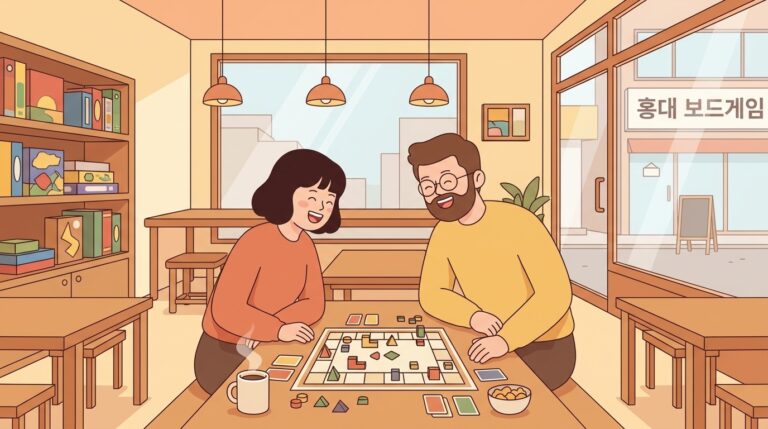
Setting: A warm, brightly-lit board game cafe in Hongdae. You are attending a board game Somoim for the very first time.
NPC Character: Ji-won (지원), the highly energetic and welcoming club organizer.
- Ji-won: “어머, 새로운 멤버 분이시네요! 반갑습니다.” [🎭 Waves enthusiastically with a bright smile]
- Alex: “안녕하세요! 제 이름은 알렉스예요. 오늘 처음이라 조금 떨려요.” [🎭 Smiles shyly and bows slightly]
- Ji-won: “에이, 떨지 마세요! 저희 다 친절해요. 어떤 게임 좋아하세요?” [🎭 Hands you a warm cup of barley tea]
- Alex: “저는 루미큐브 같은 머리 쓰는 게임을 좋아해요. 같이 해요!” [🎭 Points at the game shelf with excitement]
- Ji-won: “오! 마침 저희 오늘 루미큐브 하려고 했어요. 통하셨네요!” [🎭 Claps her hands in delight]
- Alex: “다행이네요. 혹시 게임 끝나고 뒤풀이도 있나요?” [🎭 Tilts head curiously]
- Ji-won: “당연하죠! 오늘 근처 치맥 집 예약해 뒀어요. 같이 가실 거죠?” [🎭 Winks playfully]
- Alex: “당연하죠! 뒤풀이는 빠질 수 없죠.” [🎭 Laughs warmly, feeling relaxed]
🔀 Interactive Choice Points
How do you respond to Ji-won’s invitation to the afterparty?
- A) “저 술 못 마시는데, 그냥 가도 괜찮을까요?” (I can’t drink alcohol, is it okay if I still go?)
- Feedback (BEST): Perfect! Koreans absolutely respect non-drinkers now. Showing your willingness to join for the food and conversation is highly appreciated.
- B) “어… 뒤풀이는 좀 불편해서 게임만 하고 갈게요.” (Uh… afterparties are a bit uncomfortable, so I’ll just leave after the game.)
- Feedback (BAD): While honest, it instantly builds a wall and might make the group feel you aren’t interested in making friends.
- C) “저 완전 술고래니까 다들 오늘 긴장하세요!” (I’m a total heavy drinker, so everyone watch out today!)
- Feedback (RISK): A bit too intense for a first meeting! It might sound boastful or overly aggressive.
Phase 6: 10-Second Shadowing Drill
Let’s practice speaking with the exact emotional intonation of a native speaker. Pay attention to the pauses (/) and emotional cues!
[🥺 Shy but polite]“오늘 / 처음이라 / 조금 떨려요.”- Pronunciation: o-neul / cheo-eum-i-ra / jo-geum tteol-lyeo-yo.
[😊 Bright and enthusiastic]“뒤풀이는 / 빠질 수 없죠!”- Pronunciation: dwi-pu-ri-neun / ppa-jil su eop-jyo!
Phase 7: K-Culture Mini Dictionary
- 혼족 (Honjok): The single-living tribe. Refers to the growing demographic of people who enjoy doing activities solo.
- 급벙 (Geup-beong): Spontaneous, last-minute hangouts scheduled online or through group chats.
- 덕후 (Deokhu): A passionate fan or geek (derived from the Japanese Otaku). E.g., “보드게임 덕후” (board game geek).
- 인싸 (Inssa): Insider. A social butterfly who adapts easily to any social gathering or Somoim.
Phase 8: Survival Kit for Travelers
Top 3 Survival Expressions
- “이 모임 참여해도 돼요?” (I moim cham-yeo-haedo dwaeyo?) – “May I join this group?”
- “혹시 술 안 마셔도 괜찮아요?” (Hoksi sul an masyeodo gwaenchana-yo?) – “Is it okay if I don’t drink alcohol?”
- “다음에 또 만나요!” (Da-eum-e tto manna-yo?) – “See you again next time!”
Editor’s Travel Note
To find authentic local meetups, download the Somoim app on Google Play Store or search for interest-based groups on the Naver Cafe official page. Note: App interfaces and local meetup rules are subject to change over time, so always check the latest community guidelines.
Phase 9: “One Step Deeper” (Cultural Reflection)
In Western cultures, friendship often develops organically through casual run-ins or open house parties. In Korea, however, private spaces are highly guarded, and spontaneous home gatherings are rare. Therefore, Koreans rely heavily on structured frameworks like Donghohoe to create safe, shared environments. This structured socializing helps maintain boundaries while satisfying the deep human need for 정 (Jeong – shared affection).
💬 Your Turn: How do people in your country usually make new friends when living alone? Do you have apps similar to Somoim? Let me know in the comments below!
Phase 10: FAQ & Common Mistakes
Q: Can foreigners easily join local Korean Somoims?
A: Yes, absolutely! Many modern Korean hobby groups are highly enthusiastic about welcoming global friends. As long as you possess intermediate language skills (around B2) and show respect for their group manners, you will be welcomed with open arms.
Q: What should I do if the bill comes at a Dwipuri?
A: In modern Korea, N-빵 (N-ppang – Dutch pay/splitting the bill) is the gold standard. Do not feel pressured to pay for everyone, and do not expect others to pay for you. Simply ask, “보내드릴까요?” (Bonae-deurilkkayo? – “Should I transfer the money to you?”) to the person who paid the total bill.
Q: Is it rude to leave the group early?
A: Not at all, but do not slip away silently (which Koreans call “스텔스 퇴근” or stealth leaving). Simply tell the leader politely, “막차가 끊겨서 먼저 가볼게요!” (Makcha-ga kkeun-gyeoseo meonjeo gabolgeyo! – “The last train is ending, so I must go first!”).
🚨 The “Uh-Oh” Warning Board: Common Mistakes to Avoid
- Mistake 1: Speaking strictly formal literary Korean. It makes you sound cold and distant.
- Correct Action: Soften your ending with friendly conversational patterns like “~고요” or “~네요.”
- Mistake 2: Ignoring the afterparty (뒤풀이).
- Correct Action: Even if you stay for just 30 minutes, showing face at the afterparty builds immensely stronger social credit.
- Mistake 3: Not setting up a mobile banking app beforehand.
- Correct Action: Make sure you have KakaoPay or a local banking app ready for quick transfers during split-bill situations.
Phase 11: Action Mission
- 🥉 Bronze Mission: Practice saying the 10-second shadowing drills out loud in front of a mirror three times.
- 🥈 Silver Mission: Write a comment below introducing your favorite hobby using the sentence: “저는 [Hobby] 덕후예요!” (e.g., “저는 영화 덕후예요!”).
- 🥇 Gold Mission: Install a local meeting app, search for a neighborhood gathering, and send a message to the organizer asking: “안녕하세요! 이번 정모에 참석할 수 있을까요?” (Hello! Could I attend this regular meetup?).
Phase 12: Interactive Quiz Challenge
Test your cultural and linguistic savvy with this quick quiz!
1. Which word refers to the “spontaneous, unplanned lightning meetup”?
- A) 정모 (Jeongmo)
- B) 소모임 (Somoim)
- C) 급벙 (Geup-beong)
🔍 Click to reveal the Answer & Explanation
Correct Answer: C) 급벙 (Geup-beong)
Explanation: “급벙” is the compound of “sudden” (급) and “lightning” (번개). “정모” is a pre-scheduled official meetup, and “소모임” is the general term for a small hobby group.
2. True or False: When pouring a drink for an older member at a Dwipuri, you should hold the bottle/cup with only one hand to show you are relaxed.
🔍 Click to reveal the Answer & Explanation
Correct Answer: False
Explanation: You must always use two hands to show respect when pouring or receiving drinks from someone senior or older in Korea. Keep those hands steady!







