

Phase 1: Empathy (안녕하세요! Welcome to Gangnam!)
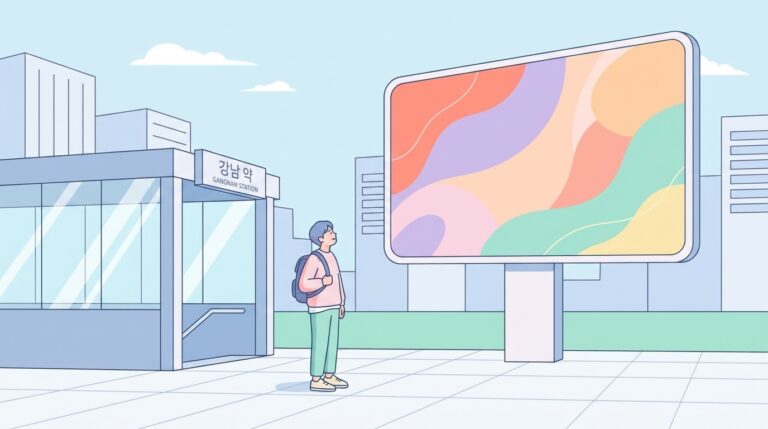
안녕하세요! It’s your Korean bestie and Daily Hangul Editor! 👋 If you’ve ever stepped out of Gangnam Station Exit 10, you’ve probably felt a mix of awe and sensory overload. Towering billboards featuring flawless faces, striking “Before & After” comparisons, and terms like “natural adhesion” or “petit clinics” line the subway walls.
For many language learners, walking through Gangnam can feel like entering a completely different universe with its own unique vocabulary. You might wonder, “Is it okay to talk about plastic surgery openly here?” or “What do these billboard ads actually say?”
Today, we’re going to demystify Korea’s plastic surgery culture (성형 문화). Together, we’ll decode the real-life slang, explore the cultural nuances beyond the stereotypes, and learn B1-level expressions that will make you sound like a local, whether you’re chatting about beauty trends or just navigating Gangnam’s bustling streets!
Phase 2: Core Expressions Deep Dive
1. 자연스럽다 (jayeonseoreopda)
- Pronunciation: jah-yuhn-seu-reop-da (Sounds like “jah-yuhn” + “su-rup-da”)
- Meaning: To be natural / To look natural (subtly enhanced)
- K-Culture Moment: In K-Dramas, characters often discuss subtle enhancements. If a character gets a minor touch-up, her friends might say, “와, 진짜 자연스럽다!” (Wow, it looks so natural!)
- Editor’s Insight: In Western beauty standards, dramatic transformations are often celebrated. However, in Korea, the ultimate compliment for any cosmetic procedure is that it is “자연스럽다.” It means the work is so seamless that people can’t quite tell if you had surgery or were just born with it!
- Situation Spectrum: Casual (자연스러워 ✅) | Semi-formal (자연스러워요 ✅) | Formal (자연스럽습니다 ✅)
- 🤔 Think About It: Why do you think looking “natural” is valued more than looking “dramatically different” in Korean society? How does this compare to beauty trends in your home country?
2. 환골탈태 (hwangol-taltae)
- Pronunciation: hwan-gol-tal-tae (Sounds like “hwan-gohl” + “tahl-tae”)
- Meaning: Rebirth / Complete makeover (Literally: “changing the bones and shedding the skin”)
- K-Culture Moment: You’ll see this four-character idiom (사자성어) used constantly as captions on Korean variety shows like Running Man when a member gets a stunning glow-up or a glamorous styling makeover.
- Editor’s Insight: While it sounds intense, Koreans use this classic idiom in a lighthearted, dramatic way. It refers to a breathtaking before-and-after transformation, whether through surgery, strict dieting, or just a fantastic new haircut.
- Situation Spectrum: Casual (환골탈태했네 ✅) | Semi-formal (환골탈태했네요 ✅) | Formal (환골탈태하였습니다 ⚠️ – a bit too dramatic for business settings)
- 🤔 Think About It: Do you have a similar idiom in your language for when someone changes their appearance completely?
3. 콤플렉스 (komplekseu)
- Pronunciation: kom-plek-seu (Sounds like “complex”)
- Meaning: Insecurity / Physical complex
- K-Culture Moment: In lifestyle vlogs, creators openly say, “제 코가 오랜 콤플렉스였어요” (My nose has been a long-time insecurity of mine) before showing their beauty journey.
- Editor’s Insight: While “complex” in English has broad psychological meanings, in Korea, “콤플렉스” specifically refers to a physical feature that you are self-conscious about. Koreans speak about their komplekseu quite openly with friends, often as a precursor to explaining why they got a minor cosmetic procedure.
- Situation Spectrum: Casual (콤플렉스야 ✅) | Semi-formal (콤플렉스예요 ✅) | Formal (콤플렉스입니다 ✅)
- 🤔 Think About It: Is discussing physical insecurities considered taboo in your culture, or is it talked about openly like in Korea?
Phase 3: Textbook vs. Real Korean
Let’s compare the stiff expressions found in textbooks with the natural phrasing actual Koreans use near the Gangnam beauty clinics!
Situation 1: Desiring a cosmetic change
- 📖 Textbook Korean: “얼굴을 바꾸고 싶어요.” (eolgureul bakkugo sipeoyo) – “I want to change my face.”
- 🗣️ Real Korean: “요즘 외모 고민이 좀 있어요.” (yojeum oemo gomin-i jom isseoyo) – “I have some insecurities/worries about my appearance lately.”
- 💡 Why the difference? Saying “I want to change my face” sounds alarmingly drastic. Locals use “외모 고민” (worries about appearance) to softly express that they are considering a minor touch-up or styling change.
Situation 2: Describing a cosmetic procedure
- 📖 Textbook Korean: “성형수술을 받았어요.” (seonghyeong-susureul badassoyo) – “I received plastic surgery.”
- 🗣️ Real Korean: “눈 집었어요 / 코 세웠어요.” (nun jibeossoyo / ko seowossoyo) – “I got my eyes pinched (double eyelids) / I got my nose raised.”
- 💡 Why the difference? “성형수술” sounds clinical and heavy. Instead, Koreans use vivid colloquial verbs: “집다” (to pinch/clamp) for non-incisional double eyelid surgery, and “세우다” (to raise/erect) for rhinoplasty.
Phase 4: K-Culture Deep Dive & Non-verbal Manners
4-1. Subway Etiquette & The
Frequently Asked Questions (FAQ)
Q: What does "자연스럽다 (jayeonseoreopda)" mean in Korean and how do you pronounce it?
A: In Korean, "자연스럽다 (jayeonseoreopda)" is pronounced [jah-yuhn-seu-reop-da (Sounds like "jah-yuhn" + "su-rup-da"] and means: To be natural / To look natural (subtly enhanced)
Q: What does "환골탈태 (hwangol-taltae)" mean in Korean and how do you pronounce it?
A: In Korean, "환골탈태 (hwangol-taltae)" is pronounced [hwan-gol-tal-tae (Sounds like "hwan-gohl" + "tahl-tae"] and means: Rebirth / Complete makeover (Literally: "changing the bones and shedding the skin")
Q: What does "콤플렉스 (komplekseu)" mean in Korean and how do you pronounce it?
A: In Korean, "콤플렉스 (komplekseu)" is pronounced [kom-plek-seu (Sounds like "complex"] and means: Insecurity / Physical complex







