

Phase 1: 공감 (Empathy)
안녕하세요! (Annyeonghaseyo!) Welcome back to Daily Hangul! It’s your favorite Korean bestie and senior editor here.
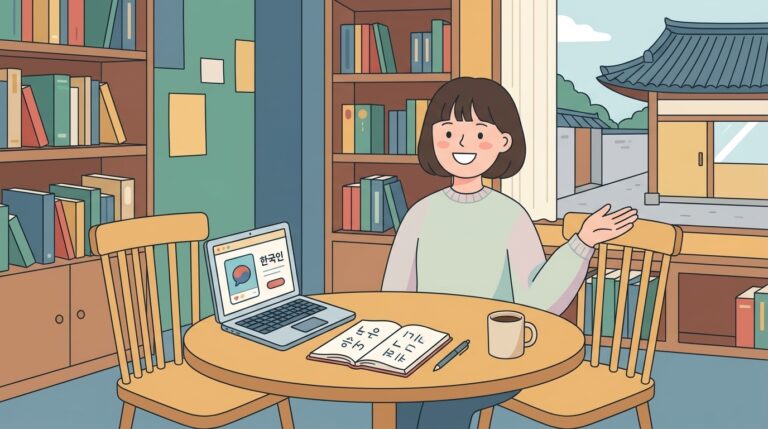
Imagine this: You walk into a cozy, beautiful book cafe in Hongdae or a quiet public library in Seoul. You spot the absolute perfect seat next to the window. The sunlight is warming the wooden table, and it is the ideal place to study. But wait! There is a pencil case on the next table, and you are not sure if the desk is free. Or maybe you need to grab a quick coffee from the vending machine but are terrified someone will take your spot while you are away.
You might feel a wave of anxiety. “What if I accidentally sit in someone’s spot?” or “How do I ask if this seat is taken?” Don’t worry at all! Today, we are going to learn super easy, real-life expressions to help you master 자리 맡기 (ja-ri mat-gi – saving a seat) in Korea like a true local. Our beginner students always tell us that learning these simple phrases made them feel like they truly belonged in Korea’s unique study culture. Let’s dive in!
Phase 2: Core Expressions for Seat Saving
1. 여기 자리 있어요? (Yeo-gi ja-ri isseo-yo?)
- Pronunciation: Yuh-gi jah-ree ee-suh-yo? (Think of “Yo-gee” + “Jah-ree” + “Is soy-o?”)
- Meaning: Literal: “Is there a seat here?” | Natural: “Is this seat taken?” / “Is anyone sitting here?”
- K-Culture Moment: In modern college K-dramas, you often see a student shyly pointing to a chair next to their crush in a crowded campus library and asking this exact question with a beating heart!
- Editor’s Insight: This is your magic golden key. It is extremely polite, simple to say, and perfect for libraries, cafes, and restaurants.
- Situation Spectrum: Casual ✅ | Semi-formal ✅ | Formal ⚠️
- 🤔 Think About It: In English, we ask “Is this seat taken?” (focusing on ownership). Why do you think Koreans ask “Is there a seat here?” (focusing on the existence of the space)?
2. 잠시만 자리 좀 봐주세요. (Jam-si-man ja-ri jom bwa-ju-se-yo.)
- Pronunciation: Chahm-shee-mahn jah-ree johm bwah-joo-seh-yo.
- Meaning: Literal: “Please look at my seat for a short moment.” | Natural: “Could you watch my spot for a second?”
- K-Culture Moment: You are studying alone at a peaceful book cafe. You need to use the restroom, so you turn to your friendly desk neighbor and ask them to keep an eye on your laptop.
- Editor’s Insight: Even though Korea is famous for its high safety levels, asking this is a polite way of building friendly neighborly trust in public spaces.
- Situation Spectrum: Casual ✅ | Semi-formal ✅ | Formal ⚠️
- 🤔 Think About It: How does it feel to trust strangers with your notebook or laptop in a public space? It reflects a wonderful side of Korean community trust!
3. 여기 제 자리에요. (Yeo-gi je ja-ri-e-yo.)
- Pronunciation: Yuh-gi jae jah-ree-eh-yo.
- Meaning: Literal: “Here is my seat.” | Natural: “This is my seat.”
- K-Culture Moment: You reserved a study desk at a library using a digital ticket kiosk, but someone accidentally sat down. You gently show them your ticket and say this expression.
- Editor’s Insight: Make sure to say this with a soft, friendly smile! A polite tone keeps the interaction comfortable and peaceful.
- Situation Spectrum: Casual ✅ | Semi-formal ✅ | Formal ⚠️
- 🤔 Think About It: In your home country, how do you politely tell someone they are in your spot without sounding angry?
Phase 3: Textbook Korean vs. Real Native Korean
Scenario 1: Asking if a seat is empty
- 📖 Textbook Korean: “이 자리가 비어 있습니까?” (I ja-ri-ga bi-eo it-seup-ni-ka? / Is this seat vacant?)
- 🗣️ Real Native Korean: “여기 자리 있어요?” (Yeo-gi ja-ri isseo-yo? / Is this seat taken?)
- 💡 Why the difference? The textbook phrase is grammatically correct but sounds way too robotic and official, like a military interview! Real Koreans prefer soft, conversational question forms.
Scenario 2: Asking someone to guard your spot
- 📖 Textbook Korean: “제 좌석을 보존해 주십시오.” (Je jwa-seok-eul bo-jon-hae ju-sip-si-o. / Please preserve my seat.)
- 🗣️ Real Native Korean: “자리 좀 봐주세요.” (Ja-ri jom bwa-ju-se-yo. / Can you watch my spot?)
- 💡 Why the difference? “보존” (bo-jon) means scientific preservation (like protecting ancient artifacts or national forests!). Saying this at a library will make people laugh. Just ask them to “look” (봐주세요) at your desk.
Phase 4: K-Culture Deep Dive & Non-verbal Manners
4-1. The Korean ‘Nunchi’ & Quiet Space Manners
When you enter a Korean library or study cafe, 눈치 (Nunchi – the art of reading the room) is super important. Before you ask someone if a seat is free, check the table. If there is an open notebook or a pencil case, someone is using that spot, even if they aren’t there!
Friendly Gestures to Use:
* The Gentle Point: When asking “여기 자리 있어요?”, gently gesture toward the empty chair with an open hand instead of pointing aggressively with a single finger.
* The Soft Nod: A small 15-degree nod/bow when you say “감사합니다” (Gam-sa-ham-ni-da) instantly shows that you are a respectful and lovely person.
4-2. The Golden Rule of Laptop Safety
Did you know? Korea has one of the lowest theft rates in the world. It is incredibly common for people to leave expensive laptops, iPads, and wallets on desks while going out for a quick meal. However, you should still mark your territory! Leaving a small notebook, a water bottle, or a jacket lets others know the spot is active and loved.
Phase 5: Real-Life Roleplay Scenario
The Setting: You are at a beautiful, sunny public library near Yonsei University. You find an empty desk, but there is a notebook on the next table, and a friendly-looking student named Minji is sitting nearby. You want to double-check if the seat is free.
- Characters:
- Alex (You): An eager Korean beginner looking for a quiet study spot.
- Minji (NPC): A friendly Korean university student.
- Alex: “저기요… 혹시 여기 자리 있어요?”
(Jeo-gi-yo… hok-si yeo-gi ja-ri isseo-yo? / Excuse me… is this seat taken by any chance?) - Minji: “[😊 미소 지으며] 아, 아니요! 비어 있어요. 앉으세요.”
(Ah, a-ni-yo! Bi-eo isseo-yo. An-jeu-se-yo. / Oh, no! It’s empty. Please sit down.) - Alex: “[🙇♂️ 살짝 머리를 숙이며] 감사합니다! 혹시 공부하러 오셨어요?”
(Gam-sa-ham-ni-da! Hok-si gong-bu-ha-reo o-syeot-seo-yo? / Thank you! Did you come here to study by any chance?) - Minji: “네, 내일 시험이 있어서요. 같이 열심히 해요!”
(Ne, nae-il si-heom-i isseo-seo-yo. Ga-chi yeol-sim-hi hae-yo! / Yes, because I have an exam tomorrow. Let’s study hard together!) - Alex: “우와, 파이팅! … 아, 저기, 혹시 화장실 다녀올 동안…”
(U-wa, pa-i-ting! … Ah, jeo-gi, hok-si hwa-jang-sil da-nyeo-ol dong-an… / Wow, fighting! … Ah, excuse me, while I go to the restroom…) - Minji: “[💡 고개를 끄덕이며] 아! 자리 봐드릴까요?”
(Ah! Ja-ri bwa-deu-ril-ka-yo? / Oh! Shall I watch your seat for you?) - Alex: “네! 잠시만 자리 좀 봐주세요. 감사합니다!”
(Ne! Jam-si-man ja-ri jom bwa-ju-se-yo. Gam-sa-ham-ni-da! / Yes! Please watch my spot for just a second. Thank you!) - Minji: “걱정 말고 다녀오세요. 지켜드릴게요!”
(Geok-jeong mal-go da-nyeo-o-se-yo. Ji-kyeo-deu-ril-ge-yo! / Don’t worry, go ahead. I’ll guard it for you!)
🔀 Choose Your Next Move!
What will you do after returning with a warm canned coffee from the vending machine?
* Choice A (The Polite Angel): Hand her the warm coffee and say: “제 자리 봐주셔서 고마워요. 이거 드세요!” (Je ja-ri bwa-ju-syeo-seo go-ma-wo-yo. I-geo deu-se-yo!)
* 👉 Feedback (Best): 100/100! Sharing a small canned coffee or sweet snack is a very popular and super kind way to show gratitude in Korea. You two might become best study friends!
* Choice B (The Cold Neighbor): Say nothing, sit down, and start typing extremely loudly on your keyboard.
* 👉 Feedback (Bad): Oh no! Giving the silent treatment is a bit cold. Also, typing noisily in quiet zones without a keyboard skin is a major library etiquette mistake in Korea!
* Choice C (The Shy Learner): Avoid eye contact, smile awkwardly, and whisper: “감사합니다.” (Gam-sa-ham-ni-da.)
* 👉 Feedback (Risk): Safe and polite! However, you missed a wonderful golden opportunity to practice your conversational Korean with a sweet native student.
Phase 6: 10-Second Emotion Shadowing Drill
Let’s practice speaking like a real Korean! Pay close attention to the pause slash / marks, and match the feelings in the brackets:
- 여기 / 자리 / 있어요?
[🥺 Shy and hesitant - you don't want to bother them]- Yuh-gi… jah-ree… ee-suh-yo?
- 잠시만 / 자리 좀 / 봐주세요!
[😊 Warm and friendly - with a bright, sweet smile]- Chahm-shee-mahn… jah-ree johm… bwah-joo-seh-yo!
- 정말 / 감사합니다!
[💖 Bright and extremely grateful]- Cheong-mahl… gahm-sah-hahm-nee-dah!
Phase 7: K-Culture Mini Dictionary
- 독서실 (Dok-seo-sil) | Premium Study Room | Quiet, private study booths designed for high concentration during big exams.
- 북카페 (Buk-ka-pe) | Book Cafe | A cozy cafe with high bookshelves where you can drink hot lattes while reading or working.
- 자리 (Ja-ri) | Seat / Spot | A super useful daily word. You will hear this constantly at restaurants, cafes, and subways.
- 노트북 (No-teu-buk) | Laptop | Note: Koreans use this English loanword instead of the word “laptop.”
Phase 8: Traveler’s Survival Kit
Survival Phrases TOP 3
- 콘센트 있어요? (Kon-sen-teu isseo-yo?) | Is there a power outlet?
- Pro Tip: Absolutely essential for keeping your phone and laptop charged!
- 비밀번호가 뭐예요? (Bi-mil-beon-ho-ga mwo-yeo-yo?) | What is the Wi-Fi password?
- Pro Tip: Check the service desk, receipts, or walls for a quick look first!
- 화장실 어디예요? (Hwa-jang-sil eo-di-yeo-yo?) | Where is the restroom?
- Pro Tip: Crucial to know when you plan to stay in a cozy cafe for hours.
Editor’s Travel Note
When searching for beautiful libraries or trendy book cafes in Seoul, don’t use global search engines. For the most accurate directions, reviews, and opening hours, make sure to use the Naver Map App Download before your trip! It is the ultimate survival tool for traveling around Korea.
Phase 9: “한 발 더 깊이” (Going Deeper)
In many busy global cities, leaving your smartphone or laptop unattended on a public table is an invitation for theft. Yet, in Korea, leaving a high-end laptop on a desk while going out for lunch is completely normal. It highlights the wonderful culture of mutual trust and social responsibility in Korean society. However, the real ‘treasure’ is not the laptop—it is the seat! Finding an open spot during university exam weeks is incredibly difficult. So, while your devices are perfectly safe, your cozy spot is highly valued!
💬 Your Turn: Would you feel safe leaving your expensive laptop on a library desk in your home country? Tell us in the comments below!
Phase 10: FAQ & Avoiding Common Mistakes
Q: Can I save a seat for my friend who will arrive in two hours?
A: Generally, saving empty seats for a friend (known as 자리 맡아주기 – ja-ri mat-a-ju-gi) for more than 15 minutes is considered impolite in busy libraries. It is best to let people sit if they are ready to study now!
Q: What should I say if someone accidentally sits in my reserved seat?
A: Simply smile politely and say: “저기요, 여기 제 자리에요.” (Jeo-gi-yo, yeo-gi je ja-ri-e-yo. / Excuse me, this is my seat.) Show them your study ticket or notebook to resolve the confusion gently.
Q: Do I have to pay to enter bookstores in Korea?
A: No! Major bookstores like Kyobo Book Centre have massive public reading tables where you can sit and enjoy books for free. Just keep your voice down!
🚨 Common Mistakes Alert!
- Using “이 자리는 비어 있습니까?”
- The Mistake: Using robotic dictionary expressions.
- Correct Action: Keep it simple and natural: “여기 자리 있어요?” (Yeo-gi ja-ri isseo-yo?)
- Tapping someone forcefully on the shoulder.
- The Mistake: Touching strangers in a quiet study zone can startle them.
- Correct Action: Make gentle eye contact, wave lightly, and say “저기요…” (Jeo-gi-yo / Excuse me).
- Leaving absolutely nothing on the desk during a break.
- The Mistake: Other people will think you went home and clean up the spot.
- Correct Action: Leave a small item like a notebook or a jacket to show the seat is still in use.
Phase 11: Daily Hangul Action Mission!
- 🥉 Bronze Mission (Solo Practice): Stand in front of your mirror and say “여기 자리 있어요?” with a bright, warm smile 5 times!
- 🥈 Silver Mission (Community Share): Take a picture of your current study desk, post it on social media, tag
@DailyHangul, and write “여기 자리 있어요?” in the caption! - 🥇 Gold Mission (Real-Life Challenge): The next time you visit a book cafe or library, politely ask your neighbor: “잠시만 자리 좀 봐주세요” (Jam-si-man ja-ri jom bwa-ju-se-yo).
🎮 K-Culture Mission: Watch a school-themed K-Drama today (like Our Beloved Summer or Cheese in the Trap) and listen closely for library scenes. See if you can spot these phrases!
Phase 12: Interactive Quiz Challenge
Quiz 1: What is the most natural way to ask if a seat is taken in Korean?
- A) 이 자리를 보존하십시오.
- B) 여기 자리 있어요?
- C) 저기요, 앉으세요.
🔍 Check the Answer
Correct Answer: B) 여기 자리 있어요?
Explanation: This is the most natural, friendly way to ask “Is this seat taken?” in Korea. Option A is way too stiff, and Option C means “Excuse me, please sit down.”
Quiz 2: Fill in the blank to say “Please watch my spot for a moment.”
- “잠시만 ____________ 좀 봐주세요.”
🔍 Check the Answer
Correct Answer: 자리 (ja-ri / seat, spot)
Explanation: “자리” means seat or spot. Combined, it translates to “Please watch my spot for a moment.”
Quiz 3: True or False?
In Korean libraries, it is common to leave your phone and laptop on the desk when you go on a short break.
🔍 Check the Answer
Correct Answer: True!
Explanation: Korea is famous for its safety, and leaving electronics on desks during short breaks is highly common. Just leave a small personal item to show the desk is active!
That’s all for today, my friend! You are now fully ready to enjoy cozy Korean libraries and book cafes like a native. Keep practicing, and happy learning! 다음에 또 만나요! (See you next time!)







