

Can I Stay a Little Longer? How to Ask for a Late Checkout in Korean
Phase 1: Empathy (Your Next Morning Rescue Plan)
안녕하세요! Hello there! It’s your Daily Hangul editor, your trusted native friend on this exciting language journey.
Imagine this: You’ve had the absolute best night in Seoul. You walked along the Han River, had a delicious late-night snack of Chimaek (chicken and beer), and talked with friends under the city lights until 2 AM. Now, it’s 9 AM the next morning. Your head is heavy, your bed at the boutique hotel in Myeongdong is incredibly soft, and your checkout is at 11 AM. You desperately need just two more hours of sleep.
How do you ask the front desk for a late checkout without sounding rude or getting lost in translation?
Many intermediate Korean learners know the dictionary terms, but they often end up using phrases that sound too transactional, robotic, or even demanding. Today, based on real feedback from travellers just like you, we’re going to master the art of polite, natural negotiation. By the end of this guide, you’ll be able to ask for that extra sleep with confidence and charm!
Phase 2: Core Expressions (Deep Dive)
Let’s look at the three most natural ways to make this request. These expressions will make hotel staff happy to help you!
1. 혹시 레이트 체크아웃 가능할까요? (Hoksi reiteu chekeu-aut ganeunghalkkayo?)
- Pronunciation: “Hok-shee lay-teu check-oo-ah-oot gah-neung-hal-kka-yo?”
- Meaning: “By any chance, would a late checkout be possible?”
- K-Culture Moment: This is exactly what you would say at a trendy boutique hotel in Hongdae when you want to catch a few more minutes of rest before heading out.
- Editor’s Insight: The magic word here is 혹시 (hoksi), which means “by any chance”. Starting your question with this word instantly softens the tone and shows respect. It signals to the receptionist that you know this is a special request, not a demand.
- Situation Spectrum: Casual ⚠️ / Semi-formal ✅ / Formal ✅
- 🤔 Think About It: In your native language, how do you soften requests? Korean relies heavily on introductory words like “혹시” to create comfortable social distance.
2. 체크아웃 시간을 좀 연장할 수 있을까요? (Chekeu-aut siganeul jom yeonjanghal su isseulkkayo?)
- Pronunciation: “Check-oo-ah-oot shi-gahn-eul jom yeon-jahng-hal soo eess-eul-kka-yo?”
- Meaning: “Could I extend the checkout time a bit?”
- K-Culture Moment: Ideal when staying at an elegant Hanok guesthouse in Gyeongju where you want to enjoy the morning courtyard views a little longer.
- Editor’s Insight: 연장하다 (yeonjanghada) means “to extend”. Adding 좀 (jom), which means “a little/please”, acts as a polite buffer. Without “좀”, the sentence can sound a bit dry and demanding.
- Situation Spectrum: Casual 🚫 / Semi-formal ✅ / Formal ✅
- 🤔 Think About It: Notice how adding “a little” (좀) makes the request sound much more humble in Korean culture.
3. 몇 시까지 레이트 체크아웃이 돼요? (Myeot sikaji reiteu chekeu-auti dwaeyo?)
- Pronunciation: “Myeot shee-kkah-jee lay-teu check-oo-ah-oo-tee dwae-yo?”
- Meaning: “Until what time is late checkout allowed?”
- K-Culture Moment: Perfect when checking out of a luxury hotel in Busan after a late night at the International Film Festival.
- Editor’s Insight: This is a direct but polite question. Use this when you are already sure the hotel offers late checkout (for example, if you have a special membership status) and just need to confirm the exact limit.
- Situation Spectrum: Casual ⚠️ / Semi-formal ✅ / Formal ⚠️
- 🤔 Think About It: Direct questions can sometimes feel sharp in Korean, so keep your voice soft and friendly when using this phrase.
Phase 3: Textbook Korean vs. Real-World Korean
Let’s compare what textbooks teach with what Koreans actually say in real life.
Situation 1: Asking if late checkout is possible
- 📖 Textbook Korean: 늦은 퇴실이 가능합니까? (Neujeun toesiri ganeunghamnikka?)
- 🗣️ Real-World Korean: 혹시 레이트 체크아웃 가능할까요? (Hoksi reiteu chekeu-aut ganeunghalkkayo?)
- 💡 Why the difference? While “늦은 퇴실” is the literal translation of “late checkout”, modern Korean hotels almost exclusively use the English loanword “레이트 체크아웃”. Using the textbook version sounds like a formal military document!
Situation 2: Asking about extra charges
- 📖 Textbook Korean: 추가 요금이 얼마입니까? (Chuga yogeumi eolmaimnikka?)
- 🗣️ Real-World Korean: 혹시 추가 비용이 따로 있나요? (Hoksi chuga biyong-i ttaro innayo?)
- 💡 Why the difference? Asking “How much is it?” immediately can feel a bit blunt. Asking “Are there separate extra costs, by any chance?” is a much gentler way to bring up money.
Phase 4: K-Culture Deep Dive & Non-Verbal Manners
4-1. Nunchi (눈치) & Body Language
When asking for a favor in Korea, your body language speaks louder than your words.
* The Head Tilt & Smile: Tilt your head slightly to the side with a gentle smile. This non-verbal cue signals that you are asking for a favor and are open to their answer.
* Hand Placement: When handing over your room card or ID, use both hands. This is a fundamental sign of respect in Korean etiquette.
4-2. The Rise of “Hocance” (호캉스)
Have you heard of 호캉스 (Hocance)? It is a blend of “Hotel” and “Vacance” (vacation). In Korea, hotels are no longer just places to sleep while travelling. Young Koreans love booking luxury city hotels just to relax, order room service, and enjoy the pool. Because “Hocance” is all about resting, asking for a late checkout has become a very common and highly valued skill!
Phase 5: Real-Life Roleplay
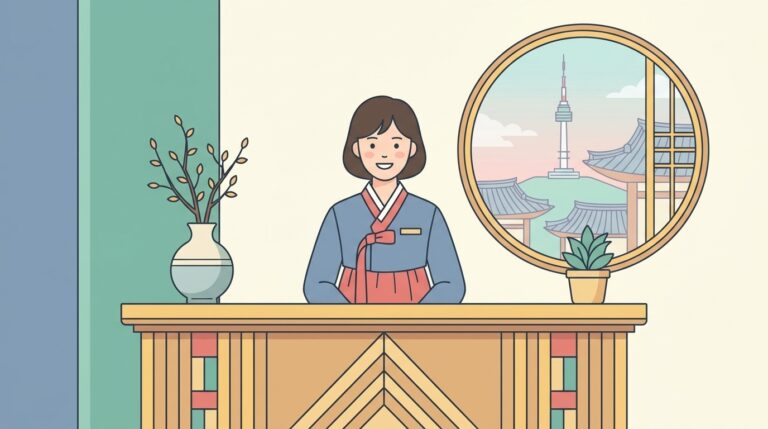
Let’s practice! You are at the front desk of a stylish hotel in Myeongdong. The receptionist, Min-jun, looks friendly.
- Characters:
- You (Guest)
- Min-jun (Hotel Staff)
The Conversation
- You: 안녕하세요! 저… 혹시 레이트 체크아웃 가능할까요?
(Annyeonghaseyo! Jeo… hoksi reiteu chekeu-aut ganeunghalkkayo?)
🎭 (Smiling warmly, holding your room card with both hands)
“Hello! Uh… would a late checkout be possible by any chance?” -
Min-jun: 아, 안녕하세요, 고객님! 원래 체크아웃은 오전 11시인데요, 혹시 몇 시까지 연장을 원하시나요?
(A, annyeonghaseyo, gogaeknim! Wonlae chekeu-aut-eun ojeon yeol-il-si-indeyo, hoksi myeot sikaji yeonjang-eul wonhasinayo?)
“Ah, hello! Standard checkout is at 11 AM. Until what time would you like to extend?” -
You: 혹시 오후 1시까지 가능할까요?
(Hoksi ohu han-sikaji ganeunghalkkayo?)
🎭 (Looking hopeful and polite)
“Would 1 PM be possible by any chance?” -
Min-jun: 확인해 드릴게요. 잠시만요… 네, 가능합니다. 다만 1시까지 연장하시면 추가 비용이 있습니다.
(Haginhae deurilgeyo. Jamsimanyo… Ne, ganeunghamnida. Daman han-sikaji yeonjanghasimeon chuga biyong-i isseumnida.)
“Let me check that for you. One moment… Yes, it is possible. However, there is an extra fee to extend until 1 PM.” -
You: 아, 그래요? 혹시 추가 비용이 얼마인가요?
(A, geuraeyo? Hoksi chuga biyong-i eolmaingayo?)
🎭 (Nodding understandingly)
“Oh, really? How much is the extra fee, by any chance?” -
Min-jun: 시간당 만 원이라서, 총 이만 원입니다.
(Sigandang man woniraseo, chong iman wonimnda.)
“It is 10,000 KRW per hour, so it will be 20,000 KRW in total.” -
You: 아, 네! 괜찮아요. 그렇게 해 주세요.
(A, ne! Gwenchanayo. Geureoke hae juseyo.)
🎭 (Relieved and handing over your credit card with both hands)
“Oh, yes! That’s fine. Please do that for me.” -
Min-jun: 네, 결제 도와드리겠습니다. 편안한 시간 보내세요!
(Ne, gyeolje dowadeurigessnida. Pyeonanhang sigan bonaeseyo!)
“Great, I will process the payment. Have a comfortable stay!”
🔀 Interactive Choice Point
What if Min-jun says: “죄송합니다, 고객님. 오늘 만석이라 레이트 체크아웃은 어렵습니다.” (I’m sorry, guest. We are fully booked today, so late checkout is difficult.)
How do you respond?
* Choice A: “아… 어쩔 수 없네요. 그냥 11시에 나갈게요.” (A… eojjeol su eopneyo. Geunyang yeol-il-sier nagalgeyo.)
* Choice B: “안 돼요? 제가 진짜 피곤해서 그런데 조금만 안 될까요?” (An dwaeyo? Jega jinjja pigonhaeseo geureonde jogumman an doelkkayo?)
* Choice C: “그러면 혹시 체크아웃 하고 짐을 좀 맡길 수 있을까요?” (Geureomyeon hoksi chekeu-aut hago jimeul jom matgil su isseulkkayo?)
Feedback
- Best Choice: C
- Why: This is incredibly smart! If late checkout is impossible, asking to store your luggage (짐을 맡기다) lets you explore the city hands-free until your flight or train. It is polite and highly practical.
- Bad Choice: B
- Why: Pressuring the staff after they explained the hotel is fully booked can make them feel uncomfortable (violating “Nunchi”). It’s best to accept the situation gracefully.
- Risk Choice: A
- Why: Not incorrect, but you miss a great opportunity to ask for luggage storage or alternative solutions!
Phase 6: 10-Second Shadowing Drill
Let’s practice your intonation. Pause briefly at each slash / and match the emotion in the brackets!
- [🥺 Softly and politely]
혹시 / 레이트 체크아웃 / 가능할까요?
(Hoksi / reiteu chekeu-aut / ganeunghalkkayo?) -
[😊 Expressing appreciation]
아, 네! / 그렇게 / 해주세요.
(A, ne! / Geureoke / hae-juseyo.) -
[🙋 Curious and hopeful]
혹시 / 추가 비용이 / 따로 있나요?
(Hoksi / chuga biyong-i / ttaro innayo?)
Phase 7: K-Culture Mini Dictionary
- 호캉스 (Hocance) | Hotel Vacation
- Enjoying a relaxing staycation inside a hotel rather than travelling far.
- 좀 (Jom) | A little / Please
- A magic word used in Korean to make requests sound softer and much more polite.
- 혹시 (Hoksi) | By any chance
- An adverb placed at the beginning of questions to show consideration and politeness.
- 추가 요금 (Chuga Yogeum) | Extra charge
- The fee you pay for extending services like room stays, parking, or amenities.
Phase 8: Travel Survival Kit
Survival Expressions for Hoteliers
- 수건 좀 더 주실 수 있나요? (Su-geon jom deo ju-shil su in-na-yo?)
- “Could I have some more towels, please?”
- 방 카드키를 안에 두고 나왔어요. (Bang ka-deu-ki-reul an-e du-go na-wass-eo-yo.)
- “I left my room card key inside.”
- 와이파이 비밀번호가 어떻게 돼요? (Wa-i-pa-i bi-mil-beon-ho-ga eo-tteog-he dwae-yo?)
- “What is the Wi-Fi password?”
💡 Editor’s Travel Note
When navigating Korea, Google Maps won’t work well because of local security laws. Instead, make sure to download the Naver Map App or KakaoMap for perfect walking and subway directions. Also, keeping a digital copy of your hotel booking on your phone is highly recommended, as some smaller boutique hotels might ask to see it during check-in or when processing special requests!
Phase 9: One Step Deeper (Reflections on Korean Politeness)
Have you noticed how much Korean conversation focuses on the other person’s comfort? Words like 혹시 (by any chance) and 좀 (a little) are not just fillers. They are psychological cushions. In Korean society, making a direct request without these cushions can feel like walking into someone’s house with your shoes on. By using these small words, you show that you respect the other person’s boundaries. It’s a beautiful way of communicating that values harmony above all.
💬 Your Turn: Does your native language have similar “cushion words”? Share them with us in the comments below!
Phase 10: FAQ & Avoiding Common Mistakes
Q: Can I ask for a late checkout at any hotel in Korea?
A: Yes, most modern hotels offer this, but it depends on room availability. At luxury hotels, it might be free for high-tier loyalty members, while boutique hotels usually charge around 10,000 to 20,000 KRW per hour.
Q: Is “레이트 체크아웃” understood by all staff?
A: Absolutely. It is a standard industry term in Korea. Even at small guesthouses, the staff will understand this term perfectly.
Q: What should I do if I need to leave before the front desk opens?
A: Most hotels have an express checkout box at the front desk where you can drop your card key. If you think you’ll need an early departure, it’s best to inform them the night before.
🚨 Common Mistakes Warning Board
- Saying “늦게 나갈게요” (I will leave late) too directly.
- Why it’s bad: It sounds like a statement of intent rather than a polite request.
- Correct Action: Use “혹시 레이트 체크아웃 가능할까요?” instead.
- Forgetting to use “요” (yo) at the end.
- Why it’s bad: Dropping the polite ending makes you sound informal and disrespectful to the staff.
- Correct Action: Always end your sentences with “-요” or “-습니다”.
- Using too much complex textbook grammar.
- Why it’s bad: It can create confusion and make the conversation feel unnatural.
- Correct Action: Keep it simple, natural, and friendly.
Phase 11: Action Mission
- 🥉 Bronze Mission: Read the three core expressions out loud five times in front of a mirror while practicing your gentle head tilt!
- 🥈 Silver Mission: Write down your favorite expression from this lesson in the comments below and tell us when you plan to use it.
- 🥇 Gold Mission: The next time you stay at a hotel in Korea, use these exact phrases at the front desk to secure your extra sleep!
- 🎮 K-Culture Mission: Watch your favorite modern K-drama set in a city. Listen closely during hotel scenes to see if you can hear the characters using “혹시” or “좀” when talking to the staff!
Phase 12: Interactive Quiz Challenge
Test your knowledge before you go!
1. Which word is used to soften a polite request in Korean?
- A) 진짜 (Jinjja)
- B) 혹시 (Hoksi)
- C) 빨리 (Ppalli)
👉 Click here for the Answer & Explanation
- Correct Answer: B
- Explanation: 혹시 (Hoksi) means “by any chance” and is the ultimate cushion word to make your requests sound polite and respectful.
2. Fill in the blank: “체크아웃 시간을 좀 ______할 수 있을까요?” (Could I extend the checkout time a bit?)
- A) 연장 (yeonjang)
- B) 출발 (chulbal)
- C) 준비 (junbi)
👉 Click here for the Answer & Explanation
- Correct Answer: A
- Explanation: 연장하다 (yeonjanghada) means to extend. “출발” means departure and “준비” means preparation.
3. True or False: It is polite to hand over your room key with just one hand in Korea.
- A) True
- B) False
👉 Click here for the Answer & Explanation
- Correct Answer: B (False)
- Explanation: In Korean culture, handing items (especially cards, money, or keys) to someone else should always be done with both hands to show respect.







