

Shopping in Seoul: How to Say “It’s Expensive” and “It’s Cheap” Like a Local
Phase 1: Oh My Eyes! The Sticker Shock in Hongdae
안녕하세요! (An-nyeong-ha-se-yo! Hello!) I’m your Daily Hangul editor, and today we are going on a virtual shopping trip to Seoul!
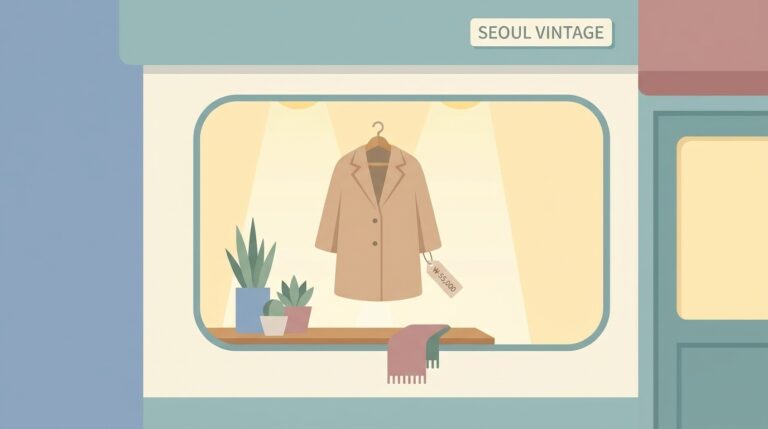
Picture this: You are walking down the vibrant, neon-lit streets of Hongdae. You spot a gorgeous, oversized trench coat in a cozy boutique window. You walk in, feel the premium fabric, and flip the price tag. Your eyes widen. Yikes! It’s way out of your budget.
At the same shop, you find a rack of cute, trendy beanies for just 5,000 KRW (about $4 USD). Score! That is incredibly cheap!
How do you express these exact feelings of surprise, delight, and hesitation in Korean without just staring blankly? Today, we will learn how to describe prices using 비싸요 (It’s expensive) and 싸요 (It’s cheap). Knowing these two words won’t just save your wallet; it will make you sound like a savvy local who knows the value of a good deal! Let’s dive in.
Phase 2: The Core Trio – Essential Price Expressions
Let’s master the three most critical expressions you need when looking at price tags in Korea.
1. 비싸요 (bi-ssa-yo)
- Pronunciation: bee-SAH-yo (Imagine a very busy “bee” saying “sah-yo”).
- Meaning: It is expensive / pricey.
- K-Culture Moment: You will hear this constantly in K-Dramas when a hardworking main character goes luxury shopping with a rich heir and quietly whispers, “이거 너무 비싸요…” (This is too expensive…).
- Editor’s Insight: The root verb is 비싸다 (bi-ssa-da). Adding “요” makes it polite and perfect for speaking to shop owners.
- Situation Spectrum: Casual ✅ | Semi-formal ✅ | Formal ⚠️
- 🤔 Think About It: In your culture, is it considered rude to tell a shopkeeper that an item is expensive? In Korea, saying it with a gentle, slightly apologetic tone is completely normal!
2. 싸요 (ssa-yo)
- Pronunciation: ssah-yo (Make a sharp, strong “S” sound, like the “ss” in “super”).
- Meaning: It is cheap / inexpensive.
- K-Culture Moment: Think of walking through a bustling traditional food market like Gwangjang Market. The vendors will point at delicious spicy rice cakes (tteokbokki) and shout, “싸고 맛있어요!” (It’s cheap and delicious!).
- Editor’s Insight: Be careful with your pronunciation! If you say it with a soft “S” like sa-yo, it actually means “I buy it” (사요). Make that double “SS” strong and crisp!
- Situation Spectrum: Casual ✅ | Semi-formal ✅ | Formal 🚫
- 🤔 Think About It: “Cheap” in English sometimes implies low quality. In Korean, however, “싸요” is purely positive, meaning “great price!”
3. 너무 (neo-mu)
- Pronunciation: neo-moo (Sounds like “no” but with an “eo” sound, followed by “moo”).
- Meaning: Too / Very.
- K-Culture Moment: Used to amplify any emotion. “너무 예뻐요!” (Too pretty!), “너무 비싸요!” (Too expensive!).
- Editor’s Insight: Grammatically, “너무” used to only describe negative things, but modern Koreans use it for absolutely everything positive and negative alike.
- Situation Spectrum: Casual ✅ | Semi-formal ✅ | Formal ⚠️
- 🤔 Think About It: Why do we love emphasizing things? Adding “너무” gives your Korean instant emotional flavor!
Phase 3: Textbook Korean vs. Real-Life Street Korean
Let’s bridge the gap between classroom grammar and real-life shopping talk!
Scenario 1: Expressing that something is expensive
- 📖 Textbook Korean: “가격이 높습니다.” (Ga-gyeog-i nop-seub-ni-da.)
- Translation: “The price is high.”
- 🗣️ Real Street Korean: “진짜 비싸요!” (Jin-jja bi-ssa-yo!)
- Translation: “It’s seriously expensive!”
- 💡 Why the difference? Nobody talks like a legal document while shopping. “진짜” (really/seriously) added to “비싸요” makes you sound natural and expressive.
Scenario 2: Finding an amazing bargain
- 📖 Textbook Korean: “가격이 저렴합니다.” (Ga-gyeog-i jeo-ryeom-ham-ni-da.)
- Translation: “The price is inexpensive.”
- 🗣️ Real Street Korean: “대박 싸요!” (Dae-bak ssah-yo!)
- Translation: “That’s crazily cheap!” or “What a steal!”
- 💡 Why the difference? “대박” (dae-bak) is the ultimate Korean slang for “awesome” or “jackpot.” Combining it with “싸요” shows genuine excitement!
Phase 4: K-Culture Shopping Etiquette & “Nunchi”
4-1. The Art of the “Aegyo Eye-Contact” (Friendly Bargaining)
In traditional markets like Namdaemun, bargaining is an art form. You can’t just demand a lower price. You must use 눈치 (Nunchi – situational wit)!
* The Gesture: Gently tilt your head, clasp your hands together slightly, and offer a soft smile. Avoid pointing aggressively at the item. Instead, hold it with both hands as a sign of respect while saying your phrase.
4-2. The “One-Plus-One” (1+1) Korean Retail Mania
If you step into any Korean convenience store (CU, GS25) or olive young, you will see tags saying 1+1 or 2+1. Koreans call this “원플러스원” (won-peul-leo-seu-won). It is the ultimate local symbol of “싸요”! Finding these deals makes every local feel like they’ve won the day.
Phase 5: Interactive Euljiro Vintage Shop Roleplay
Let’s test your skills! You are in a cool vintage shop in Euljiro. You find a retro leather jacket. The owner is a friendly local “Imo” (Auntie/Shopkeeper).
- Shopkeeper: 어서 오세요! 이 가죽 자켓 진짜 예쁘죠? (Eo-seo o-se-yo! I ga-juk ja-ket jin-jja ye-ppeu-jyo?)
- “Welcome! This leather jacket is really pretty, right?”
- You (🎭 Puzzled but interested): 네, 예뻐요. 이거 얼마예요? (Ne, ye-ppeu-yo. I-geo eol-ma-ye-yo?)
- “Yes, it’s pretty. How much is this?”
- Shopkeeper: 이거 십만 원(100,000 KRW)이에요. 진짜 가죽이에요! (I-geo sip-man-won-i-e-yo. Jin-jja ga-juk-i-e-yo!)
- “This is 100,000 KRW (about $75 USD). It’s real leather!”
- You (🎭 Shocked, checking your small wallet): 아… 십만 원이요? 조금 비싸요… (Ah… sip-man-won-i-yo? Jo-geum bi-ssa-yo…)
- “Ah… 100,000 won? It’s a bit expensive…”
- Shopkeeper (🎭 Smiling warmly): 학생이에요? 그럼 내가 특별히 만 원 할인해 줄게요! (Hak-saeng-i-e-yo? Geu-reom nae-ga teuk-byeol-hi man-won hal-in-hae jul-ge-yo!)
- “Are you a student? Then I’ll specially discount 10,000 won for you!”
- You (🎭 Delighted and bowing slightly): 와, 진짜요? 감사해요! (Wa, jin-jja-yo? Gam-sa-hae-yo!)
- “Wow, really? Thank you!”
- Shopkeeper: 그럼 구만 원에 가져가세요! 진짜 싸게 주는 거야~ (Geu-reom gu-man-won-e ga-jeo-ga-se-yo! Jin-jja ssa-ge ju-neun geo-ya~)
- “Then take it for 90,000 won! I’m giving it to you really cheap~”
- You (🎭 Handing over your card gladly): 네! 정말 감사합니다! (Ne! Jeong-mal gam-sa-hap-ni-da!)
- “Yes! Thank you so much!”
🔀 What would you do next?
If the price was still too high, how would you react? Choose your path:
- A) “너무 비싸요! 안 사요!” (Too expensive! I won’t buy it!)
- 🔴 Feedback (Bad): Oops! This sounds very blunt and rude in Korean. The shopkeeper might feel offended.
- B) “아… 조금 비싸요. 죄송합니다…” (Ah… it’s a bit expensive. I’m sorry…) while slowly backing away.
- 🟡 Feedback (Risk): Polite, but you lose the chance to get a friendly discount! Koreans love a polite negotiator.
- C) “우와, 진짜 예쁜데… 조금만 깎아주시면 안 돼요? 🥺” (Wow, it’s so pretty… could you discount it just a tiny bit?)
- 🟢 Feedback (Best!): Perfect! It compliments the item first, then uses cute persuasion to ask for a friendly deal.
Phase 6: The 10-Second Emotion Shadowing Drill
Let’s practice speaking with local rhythm! Read these out loud, pausing at the slashes / and embodying the emotion in the brackets.
[🥺 Disappointed & Pleading]- “이거… / 너무 / 비싸요…”
- (I-geo… / neo-mu / bi-ssa-yo…)
- “This… is too… expensive…”
[🤩 Super Excited & Amazed]- “대박! / 진짜 / 싸요!”
- (Dae-bak! / jin-jja / ssah-yo!)
- “No way! It’s so cheap!”
Phase 7: K-Culture Mini Dictionary
- 원플러스원 (Won-peul-leo-seu-won) | Buy One Get One Free | Retail strategy found everywhere in Korea.
- 가성비 (Ga-seong-bi) | Value for money / Cost-effective | Short for ‘가격 대비 성능비’. The ultimate compliment for cheap, high-quality food or goods.
- 할인 (Hal-in) | Discount | Keep your eyes peeled for this sign in department stores!
- 얼마예요 (Eol-ma-ye-yo) | How much is it? | The golden key phrase for any traveler in Korea.
Phase 8: The Seoul Traveler’s Survival Kit
Survival Phrases
- 이거 세일 해요? (I-geo se-il hae-yo?) – Is this on sale?
- 카드 돼요? (Ka-deu dwae-yo?) – Do you accept credit cards?
- 영수증 주세요. (Yeong-su-jeung ju-se-yo.) – Please give me a receipt.
🗺️ Editor’s Travel Note
To find local bargain gems, download the Naver Map App and search for “풍물시장” (Flea Market) or “전통시장” (Traditional Market). Tip: Street vendors often prefer cash (현금 – hyeon-geum) or bank transfers, and carrying small cash can sometimes help you negotiate a “싸요” deal!
Phase 9: One Step Deeper – “Jeong” (정) and the Korean Market Soul
In Western supermarkets, prices are rigid. But in a Korean traditional market, prices are fluid, connected by 정 (Jeong)—a deep feeling of warm attachment, affection, and community.
When you tell an elder merchant “비싸요” politely, and they counter with a discount and say “싸게 줄게” (I’ll give it to you cheap), it isn’t just a cold business transaction. It is an exchange of warmth and connection. They are welcoming you to Korea.
💬 Your Turn: Have you ever experienced a shopping moment where you felt a genuine connection with the seller? Let us know in the comments below!
Phase 10: FAQ & Avoiding Common Mistakes
Q: Can I use “싸요” (Ssa-yo) to a strict boss or high-ranking elder?
A: It is better to avoid it. “싸요” is polite enough for shopkeepers, but for formal situations, use the term “저렴합니다” (jeo-ryeom-ham-ni-da) to sound professional and respectful.
Q: What is the difference between “사요” and “싸요”?
A: Pronunciation is key! “사요” (sa-yo with a soft ‘S’) means “I buy.” “싸요” (ssa-yo with a strong, tense ‘SS’) means “It’s cheap.” If you say “이거 사요” it means “I am buying this.” If you say “이거 싸요” it means “This is cheap.”
Q: How do I politely decline if something is too expensive?
A: Simply smile and say, “조금 더 생각해 볼게요. 감사합니다.” (Jo-geum deo saeng-gak-hae bol-ge-yo. Gam-sa-ham-ni-da.) which means, “I will think about it a bit more. Thank you.”
🚨 The “Oops!” Billboard: Common Mistakes to Avoid
- Mistake 1: Saying “이거 비싸다!” directly to a shopkeeper.
- Why: This is casual talk (반말). It sounds like you are complaining rudely to yourself. Always add “요” -> “비싸요.”
- Mistake 2: Confusing “너무” (too) with “많이” (many/a lot).
- Why: Don’t say “많이 비싸요” to mean “too expensive.” Stick to “너무 비싸요.”
Phase 11: Your Daily Hangul Action Missions!
- 🥉 Bronze Mission: Write “너무 비싸요” and “대박 싸요” on a sticky note and place it on your computer screen.
- 🥈 Silver Mission: Go to a Korean online shopping site (like Gmarket or Coupang) and find three items that are “싸요” and three that are “비싸요.”
- 🥇 Gold Mission: Use your phone to record a video saying: “이거 진짜 비싸요!” with your best dramatic K-Drama expression!
- 🎮 K-Culture Mission: Watch a K-Drama scene set in a market or convenience store. Listen closely and spot if they say “비싸요” or mention “원플러스원”!
Phase 12: Interactive Quiz Challenge!
Let’s test your memory!
1. Which word means “It is expensive”?
- A) 싸요 (Ssa-yo)
- B) 비싸요 (Bi-ssa-yo)
- C) 사요 (Sa-yo)
Click for the Answer & Explanation!
Correct Answer: B) 비싸요 (Bi-ssa-yo)
Explanation: ‘비싸요’ means expensive. ‘싸요’ means cheap, and ‘사요’ means buy!
2. How do you say “Too / Very” in Korean?
- A) 진짜 (Jin-jja)
- B) 너무 (Neo-mu)
- C) 대박 (Dae-bak)
Click for the Answer & Explanation!
Correct Answer: B) 너무 (Neo-mu)
Explanation: ‘너무’ is the standard word for ‘too/very’. ‘진짜’ means ‘really’, and ‘대박’ is slang for ‘awesome’.
3. True or False: It is rude to say “싸요” (Ssa-yo) directly to a shopkeeper.
- A) True
- B) False
Click for the Answer & Explanation!
Correct Answer: B) False
Explanation: It is completely fine and polite! Korean shopkeepers love to hear that their goods are ‘싸요’ (cheap/good value).







