

Phase 1: 공감 (Storytelling Opening)
안녕하세요! 매일한글 에디터입니다. Have you ever sat down with Korean friends at a cozy café or watched a gripping Korean political drama like The Whirlwind (돌풍) and felt completely lost when the conversation shifted to governance and elections? Talking about politics is a huge part of Korean intellectual culture, especially among young professionals and students.
Transitioning from basic daily life conversations to discussing 대통령 중심제 (Presidential System) versus 의원 내각제 (Parliamentary System) in Korean can feel like climbing a mountain. But don’t worry! This guide is built from real-world student feedback to help you navigate these complex concepts smoothly and confidently. Mastering these terms will unlock a whole new level of intellectual intimacy with your Korean friends!
Phase 2: 핵심 표현 3선 심층 분석
1. 대통령 중심제 (Dae-tong-ryeong Jung-sim-je)
- Pronunciation: dae-tong-ryeong jung-sim-je (think of “day-tong-ryung” combined with “joong-shim-jeh”)
- Meaning: Presidential System (Direct: “President-centered system”)
- K-Culture Moment: You will hear this constantly on nightly news debates and political talk shows like Ssulzun (썰전) when comparing how power is distributed in democratic nations.
- Editor’s Insight: This isn’t just a political science term; Koreans use it to describe a culture where the “top leader” holds ultimate accountability. It contrasts with systems where power is shared.
- Situation Spectrum: Casual 🚫 | Semi-formal ⚠️ | Formal ✅
- 🤔 Think About It: How does your country’s leadership structure change the way citizens view authority? In Korea, because of the ‘대통령 중심제’, the president is often held directly responsible for almost everything, from national economy to local incidents.
2. 의원 내각제 (Ui-won Nae-gak-je)
- Pronunciation: ui-won nae-gak-je (think of “wee-won” + “neh-gahk-jeh”)
- Meaning: Parliamentary System (Direct: “Member-of-parliament cabinet system”)
- K-Culture Moment: During foreign election coverages (like the UK or Japanese elections), news anchors will explain how “의원 내각제” functions differently from Korea’s system.
- Editor’s Insight: Often shortened simply to “내각제” in casual political conversations.
- Situation Spectrum: Casual 🚫 | Semi-formal ⚠️ | Formal ✅
- 🤔 Think About It: In parliamentary systems, prime ministers can change rapidly. To Koreans accustomed to a fixed 5-year presidential term, this dynamic seems incredibly fast-paced.
3. 견제와 균형 (Gyeon-je-wa Gyun-hyeong)
- Pronunciation: gyeon-je-wa gyun-hyeong (think of “gyun-jeh-wah gyoon-hyung”)
- Meaning: Checks and Balances (Direct: “Check/restraint and balance”)
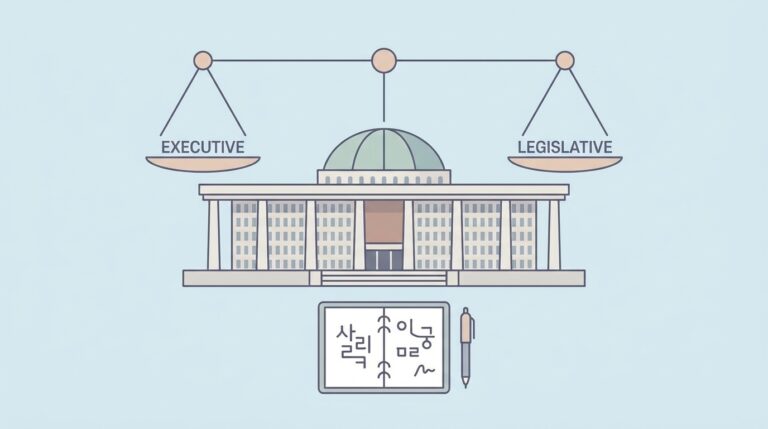
- K-Culture Moment: Used by editorial writers and political commentators when discussing the tension between the executive branch and the legislative branch.
- Editor’s Insight: This phrase represents the healthy democratic ideal. It’s highly respected and using it will make your Korean sound incredibly sophisticated.
- Situation Spectrum: Casual 🚫 | Semi-formal ✅ | Formal ✅
- 🤔 Think About It: Why is “견제와 균형” considered a universal democratic value, and how is it maintained differently under a president versus a prime minister?
Phase 3: 교과서 한국어 vs 진짜 한국어
Situation 1: Describing the concentration of power
- 📖 교과서 한국어: “대통령 중심제는 대통령에게 권한이 집중되는 구조입니다.” (The presidential system is a structure where authority is concentrated in the president.)
- 🗣️ 진짜 한국어: “대통령제는 아무래도 대통령한테 힘이 확실히 실리는 구조예요.” (In a presidential system, the power is definitely more concentrated on the president.)
- 💡 왜 다를까? While “권한이 집중되다” is grammatically correct, native speakers prefer the active and visual expression “힘이 실리다” (power/weight is loaded onto someone) in spoken discussions.
Situation 2: Describing political instability or collapse of government
- 📖 교과서 한국어: “의원 내각제는 의회가 내각을 불신임할 수 있어 정부가 해산될 수 있습니다.” (In a parliamentary system, parliament can pass a vote of no confidence, so the government can be dissolved.)
- 🗣️ 진짜 한국어: “내각제는 국회랑 틀어지면 총리가 바로 날아갈 수도 있어요.” (In a parliamentary system, if they fall out with parliament, the prime minister could get kicked out immediately.)
- 💡 왜 다를까? “틀어지다” (to go wrong/sour) and “날아가다” (to fly away/be dismissed) are highly natural, idiomatic expressions that Koreans use to describe sudden political shifts in conversation.
Phase 4: K-Culture 딥다이브 & 비언어적 매너
4-1. 눈치 (Nunchi) & Non-verbal Etiquette
When discussing political systems in Korea, non-verbal cues are vital to prevent debates from becoming personal arguments:
* Nod and Acknowledge: Even if you disagree with a political point, nod slowly and use soft vocalizations like “그렇군요” (I see) or “아, 그렇게 볼 수도 있겠네요” (Ah, I can see how you’d look at it that way) before presenting your counter-argument.
* Avoid Pointing: Never point your finger at someone during a debate. If you need to refer to your conversational partner, gesture with an open palm facing upward.
4-2. Cultural Code Analysis: The K-Drama Lens
Political dramas like Chief of Staff (보좌관) and Assembly (어셈블리) capture the intense dynamics of the Korean political ecosystem. In Korea, politics is deeply tied to personal relationships, school ties (학연), and regional backgrounds (지연). Understanding this helps you see that political discussions aren’t just about structural theory—they’re about human loyalty and structural tension.
Phase 5: 실전 롤플레이 시나리오
Setting: A quiet cafe near the National Assembly in Yeouido, Seoul.
- 민우: 🎭 (진지한 표정으로 커피를 저으며) 세라 씨, 이번 뉴스 봤어요? 한국 정치 제도에 대해 어떻게 생각해요?
- (Sarah, did you see the news? What do you think about the Korean political system?)
- 세라: 🎭 (생각에 잠기며) 음, 한국은 대통령 중심제라 그런지 대통령의 영향력이 진짜 강해 보여요.
- (Well, since Korea has a presidential system, the president’s influence seems really strong.)
- 민우: 🎭 (고개를 끄덕이며) 맞아요. 그래서 ‘제왕적 대통령제’라는 말도 있죠. 의원 내각제랑 비교하면 장단점이 확실해요.
- (That’s right. That’s why people even use the term ‘imperial presidency’. There are clear pros and cons compared to a parliamentary system.)
- 세라: 🎭 (미소를 지으며) 의원 내각제는 내각과 의회가 긴밀하게 협력해서 신속한 정책 추진이 가능하지 않나요?
- (Doesn’t a parliamentary system allow swift policy implementation because the cabinet and parliament cooperate closely?)
- 민우: 🎭 (손짓을 하며) 그럴 수 있죠. 하지만 정당 간 대립이 심해지면 내각이 쉽게 붕괴해서 불안정할 수도 있어요.
- (That could be true. But if party conflicts worsen, the cabinet can easily collapse, leading to instability.)
- 세라: 🎭 (동조하며) 그렇겠네요. 결국 어떤 제도든 ‘견제와 균형’이 얼마나 잘 작동하는지가 관건이겠어요.
- (I see. In the end, no matter the system, the key is how well ‘checks and balances’ actually work.)
- 민우: 🎭 (감탄하며) 와, 세라 씨 한국어 실력뿐만 아니라 정치 분석력도 대단하시네요!
- (Wow, Sarah, not only is your Korean great, but your political analysis is amazing too!)
- 세라: 🎭 (쑥스러워하며) 에이, 그냥 매일 뉴스 보면서 열심히 공부한 덕분이에요.
- (Oh, it’s just thanks to studying hard while watching the news every day.)
🔀 Interactive Choice Point
How would you reply to Min-woo’s compliment to show your advanced conversational skills?
- Option A: “감사합니다. 앞으로 더 열심히 공부하겠습니다.”
- Option B: “에이, 아직 멀었어요. 한국 정치는 파고들수록 진짜 복잡하더라고요.”
- Option C: “네, 제가 좀 똑똑한 편이라 정치에 관심이 많아요.”
Feedback:
* Option A (Risk): Safe and grammatically correct, but too textbook-like for a C1 speaker. It sounds slightly distant and overly formal.
* Option B (Best): Fantastic! Using “에이, 아직 멀었어요” shows humility (a major Korean cultural value), and “파고들수록” (the deeper you dive/dig) showcases high-level C1 vocabulary.
* Option C (Bad): Too direct and self-assertive. While honest, boasting about your intelligence in Korean culture can come across as arrogant.
Phase 6: 10초 감정 섀도잉 드릴
Let’s practice the natural rhythm and emotional intonation of political debate. Pay attention to the pauses marked by /:
- 🎭 [진지하고 설득력 있게 – Serious and persuasive]
“대통령 중심제는 / 임기가 보장되니까 / 정책을 일관되게 / 밀어붙일 수 있죠.”
(dae-tong-ryeong jung-sim-je-neun / im-gi-ga bo-jang-doe-ni-kka / jeong-chaek-eul il-gwan-doe-ge / mi-reo-bu-chil su it-jyo.)
Translation: Since the presidential system guarantees a set term, policies can be consistently pushed forward. -
🎭 [우려와 비판 섞인 어조로 – With concern and criticism]
“내각제에서는 / 협치가 안 되면 / 내각이 바로 / 해산될 수도 있잖아요.”
(nae-gak-je-e-seo-neun / hyeop-chi-ga an doe-myeon / nae-gak-i ba-ro / hae-san-doel su-do it-ja-na-yo.)
Translation: In a parliamentary system, if compromise isn’t made, the cabinet can be dissolved immediately, you know.
Phase 7: K-Culture 미니 사전
- 여소야대 (Yeo-so-ya-dae) | Divided Government (Small ruling party, large opposition party) | Essential for understanding Korean legislative deadlock.
- 탄핵 (Tan-haek) | Impeachment | A powerful legal process that has shaped modern Korean history and public demonstrations.
- 정권 교체 (Jeong-gwon gyo-che) | Change of government / regime change | The peaceful transfer of executive power between political parties through elections.
- 협치 (Hyeop-chi) | Multi-party governance / compromise | The cooperative political process highly demanded by the public when legislative deadlocks occur.
Phase 8: 여행자를 위한 생존 키트
Top 3 Survival Expressions
- 그건 좀 다른 문제 같아요. (geu-geon jom da-reun mun-je gat-a-yo.) / That seems like a slightly different issue. (Use when you want to gently pivot or redirect the conversation.)
- 제 생각에는요… (je saeng-gak-e-neun-yo…) / In my opinion… (Perfect way to softly introduce your thoughts.)
- 동의하기 어렵네요. (dong-ui-ha-gi eo-ryeop-ne-yo.) / It’s hard for me to agree with that. (A polite but firm way to disagree without being aggressive.)
Editor’s Travel Note
Want to stay updated on real-time political issues in Korea? Download a portal app like the 네이버 뉴스 앱 다운로드 or Daum News. Reading the headlines daily helps you spot trending political vocabulary instantly. Note: Information regarding app store layouts may change over time.
Phase 9: “한 발 더 깊이” (Going One Step Deeper)
Korea’s modern political history is exceptionally dynamic. Within a single generation, Korea transitioned from authoritarian rule to a thriving democracy, heavily influenced by mass citizen participation—such as the historic 1987 June Democratic Struggle and the more recent Candlelight Rallies (촛불집회).
Consequently, Koreans expect highly personal accountability from their presidents. The presidency is viewed not just as an administrative office, but as a moral center. This historical context explains why political debates in Korea are often charged with deep emotional and ethical weight, unlike purely academic debates in other countries.
💬 Your Turn: Does your country place moral expectations on its leaders, or is the relationship purely administrative? Let us know in the comments below!
Phase 10: FAQ & 오해 방지
Q: Does South Korea have a Prime Minister (국무총리) even though it has a presidential system?
A: Yes! Korea uses a hybrid presidential system where the President (대통령) is the head of state and head of government, but a Prime Minister (국무총리) exists to assist the President and supervise the ministries. However, unlike in parliamentary systems, the Prime Minister is appointed by the President (with parliamentary approval) and does not hold supreme executive power.
Q: Why do Koreans get so passionate when discussing election outcomes?
A: Democracy in Korea was hard-won through citizen-led protests rather than passive reform. As a result, there is a strong collective belief that voting is a direct, critical tool for social change.
Q: Is it okay to use slang when talking about politicians or political parties?
A: While Koreans use colorful slang online, it is highly advised to avoid them in face-to-face discussions. Words like ‘개판’ (mess) or derogatory terms for political parties can instantly turn an intellectual chat into an uncomfortable argument. Stick to formal vocabulary.
🚨 Common Mistakes Alert!
- Mistake 1: Using ‘정권’ (regime/administration) and ‘정부’ (government) interchangeably in contexts where institutional stability is key. Use ‘정부’ for the administrative body, and ‘정권’ when discussing a specific political faction’s hold on power.
- Mistake 2: Saying “대통령은 왕이에요” (The president is a king) to describe high authority. This sounds overly childish. Use the term “대통령의 권한이 매우 큽니다” instead.
Phase 11: 액션 미션 & 참여 유도
- Bronze Mission (Self-Practice): Write a 3-sentence comparison of your country’s system versus Korea’s presidential system in the comments below.
- Silver Mission (Social Sharing): Post one political keyword you learned today (like ‘견제와 균형’) on your social media with a short explanation.
- Gold Mission (Real-life Practice): Next time you talk with a Korean friend, ask: “한국은 대통령제와 내각제 중 어떤 제도가 더 어울린다고 생각해요?”
🎮 K-Culture Mission
Watch one episode of the political K-drama The Whirlwind (돌풍) on Netflix and try to spot at least two of the vocabulary words introduced in this guide!
Phase 12: 인터랙티브 퀴즈 챌린지
Test your knowledge of high-level Korean political terms!
- Which of the following refers to a parliamentary system?
- A) 대통령 중심제
- B) 의원 내각제
- C) 여소야대
- True or False: In Korea, the Prime Minister (국무총리) is the head of state.
🔍 Click here to reveal the answers and detailed explanations!
- Question 1 Answer: B) 의원 내각제
- Explanation: ‘의원 내각제’ is the parliamentary system, whereas ‘대통령 중심제’ is the presidential system. ‘여소야대’ means a divided government where the opposition holds the majority in the assembly.
- Question 2 Answer: False
- Explanation: The President (대통령) is the head of state in South Korea. The Prime Minister assists the President but is not the supreme leader.
- Explanation: The President (대통령) is the head of state in South Korea. The Prime Minister assists the President but is not the supreme leader.






