

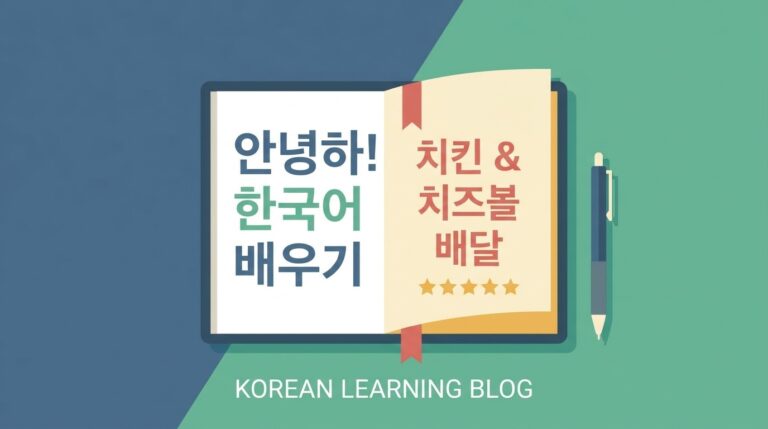
Unlock Free Sides: How to Master Korean Delivery Review Events Like a Local
Phase 1: Empathy (Your Korean Delivery Savior is Here!)
안녕하세요! (An-nyeong-ha-se-yo!) Hello there, fellow food lover! It’s your favorite Korean culture navigator from Daily Hangul.
Picture this: You’re sitting on your cozy sofa in Seoul after a long day of exploring. Your stomach is growling, and you open a Korean delivery app like Baedal Minjok (배달의민족). You find the perfect fried chicken place, but as you scroll, you see something intriguing: “리뷰 이벤트” (Review Event). The restaurant is promising free cheese balls, dumplings, or a colasized upgrade just for promising to write a review!
You desperately want those golden, gooey cheese balls, but your fingers freeze. How do I say ‘I want to participate in the review event’ without sounding like an awkward translator bot? What if I make a mistake and they don’t give me the freebie?
Don’t worry! Today, we are going to master the exact phrases real Koreans use to claim their “서비스” (seobiseu – free extras) politely and naturally. By the end of this guide, you’ll order like a true local and eat like royalty!
Phase 2: The Core Trio – Expressions to Get You Free Food
Let’s break down the three most powerful phrases you can type in the “요청사항” (yocheongsahang – customer request) box.
1. 리뷰 이벤트 참여할게요! (Ri-byu i-ben-teu cham-yeo-hal-ge-yo!)
- Pronunciation Analogy: “Re-view ee-ben-too cham-yuh-hal-ge-yo!” (Make the “r” sound in “리뷰” soft, almost like a light “l”).
- Meaning: I will participate in the review event!
- K-Culture Moment: This is the universal golden ticket. In K-Dramas, you’ll often see characters frantically typing this on their phones while their mouths water.
- Editor’s Insight: The ending “~할게요” (~hal-ge-yo) expresses a friendly, polite promise. It shows the shop owner that you are making a personal commitment.
- Situation Spectrum: Casual ✅ | Semi-formal ✅ | Formal ⚠️
- 🤔 Think About It: Why does Korean delivery culture rely so heavily on trust-based reviews rather than pre-paid promotions? How does this reflect the community-focused nature of Korean society?
2. 리뷰 약속! 서비스 부탁드립니다. (Ri-byu yak-sok! Seo-bi-seu bu-tak-deu-rim-ni-da.)
- Pronunciation Analogy: “Re-view yak-sok! Suh-bee-soo boo-tak-doo-rim-nee-dah.”
- Meaning: Review promise! Please give me the service (freebie).
- K-Culture Moment: This phrase is extremely popular because it uses the word “약속” (promise), which carries a warm, personal weight in Korea.
- Editor’s Insight: “서비스” (seobiseu) in Korea doesn’t mean “customer service” in the Western sense. It specifically refers to free items given as a gesture of goodwill.
- Situation Spectrum: Casual ✅ | Semi-formal ✅ | Formal 🚫
- 🤔 Think About It: In your home country, is there a word like “서비스” that refers to free extras given by businesses?
3. 맛있게 먹고 리뷰 남기겠습니다~ (Ma-sit-ge meok-go ri-byu nam-gi-get-seum-ni-da~)
- Pronunciation Analogy: “Mah-shit-gae muk-go re-view nam-gee-get-soom-nee-dah~”
- Meaning: I will eat deliciously and leave a review~
- K-Culture Moment: The tilde (~) at the end represents a singing, friendly tone. It’s the ultimate polite way to show enthusiasm!
- Editor’s Insight: Using “맛있게 먹고” (eating deliciously) shows respect to the chef/owner, making them much more likely to pack extra portions for you.
- Situation Spectrum: Casual ⚠️ | Semi-formal ✅ | Formal ✅
- 🤔 Think About It: Why do you think expressing appreciation for the food in advance is so important in Korean business interactions?
Phase 3: Textbook Korean vs. Real-Life Korean
Sometimes, textbooks teach you Korean that sounds like a legal contract. Let’s look at the difference:
Situation A: Telling the owner you want the event item
- 📖 Textbook style: “리뷰 작성을 조건으로 증정품을 받고 싶습니다.” (I wish to receive the promotional item on the condition of writing a review.)
- 🗣️ Real-Life style: “리뷰 이벤트 참여할게요! 치즈볼로 부탁드립니다!” (Review event participation! Cheese balls please!)
- 💡 Why the difference? Delivery apps are fast-paced. Real Koreans use brief, enthusiastic phrases with exclamation marks (!) to show high energy and friendliness.
Situation B: Expressing gratitude in the app memo
- 📖 Textbook style: “귀사의 서비스를 제공해 주셔서 깊이 감사드립니다.” (I am deeply grateful for you providing your company’s service.)
- 🗣️ Real-Life style: “서비스 감사히 잘 먹겠습니다!” (I will eat the service items gratefully!)
- 💡 Why the difference? The real-life version uses “잘 먹겠습니다” (I will eat well), which feels warm and relational, fitting the Korean concept of “Jeong” (정 – affection/bonding).
Phase 4: K-Culture Deep-Dive & Non-Verbal Manners
4-1. The Digital Eye Contact: App Request Etiquette
When typing in the delivery request box, punctuation is your body language!
* Use Emojis Wisely: Adding ^^, ㅎㅎ (laughter), or 하트 (hearts ❤️) makes your text look warm.
* Don’t Be Demanding: Writing “리뷰 남길 테니 서비스 주세요” (I will leave a review, so give me a freebie) sounds transactional and slightly rude. Always frame it as a friendly promise.
4-2. The “Jeong” (정) of “Seobiseu” (서비스)
In Western dining, “on the house” items are rare. In Korea, however, “서비스” is a fundamental business strategy rooted in Jeong (정). By offering free food, the owner builds a relationship with you. By writing a glowing 5-star review, you repay that kindness. It’s a beautiful, modern cycle of digital community support!
Phase 5: Real-Life Roleplay Scenario
Imagine you are ordering a late-night feast. You are typing in the “요청사항” (customer request) section of the delivery app.
- Setting: A bustling small-town Fried Chicken shop, run by a friendly owner (사장님 – Sajangnim).
- Goal: You want the free French Fries (감자튀김) offered in the review event.
[The Chat / Memo Dialogue]
- You: 🎭 [Politely typing in the memo box] 사장님, 안녕하세요! 리뷰 이벤트 참여할게요.
(Sajangnim, an-nyeong-ha-se-yo! Ri-byu i-ben-teu cham-yeo-hal-ge-yo.)
“Owner, hello! I’ll participate in the review event.” - Owner: 🎭 [In the app order confirmation message] 네, 고객님! 주문 감사합니다. 리뷰 품목은 어떤 걸로 도와드릴까요?
(Ne, go-gaek-nim! Ju-mun gam-sa-ham-ni-da. Ri-byu pum-mok-eun eo-tteon geol-lo do-wa-deu-ril-kka-yo?)
“Yes, valued customer! Thank you for the order. Which review item can I help you with?” - You: 🎭 [Excitedly replying] 감자튀김으로 부탁드립니다!
(Gam-ja-twi-gim-eu-ro bu-tak-deu-rim-ni-da!)
“French fries, please!” - Owner: 🎭 [Happy with your quick response] 네! 맛있게 준비해서 보내드리겠습니다! 맛있는 리뷰 부탁드려요!
(Ne! Ma-sit-ge jun-bi-hae-seo bo-nae-deu-ri-get-seum-ni-da! Ma-sin-neun ri-byu bu-tak-deu-ryeo-yo!)
“Yes! We will prepare it deliciously and send it over! Please leave a delicious review!” - You: 🎭 [Confirming your promise] 약속할게요! 맛있게 먹고 꼭 별 5개 남기겠습니다~
(Yak-sok-hal-ge-yo! Ma-sit-ge meok-go kkok byeol-da-seot-gae nam-gi-get-seum-ni-da~)
“I promise! I will eat deliciously and definitely leave 5 stars~”
🔀 Your Interactive Turn! Choose Your Response:
What should you do once the food arrives?
* A. Just eat the food and forget to write the review because you are too full.
* B. Take a photo of the food instantly, eat happily, and upload a beautiful 5-star review.
* C. Post a photo but give 1 star because the free fries were slightly cold.
💡 Feedback:
- If you chose A (Bad): Oh no! This is called “먹튀” (meok-twi – eat and run). It hurts local business owners and ruins the trust!
- If you chose B (Best): Perfect! You are a master of Korean “Jeong”. The owner will love you and might even recognize your ID next time for even more freebies!
- If you chose C (Risk): Yikes! Freebies can sometimes get cold during transit. Giving 1 star for a free item is considered very harsh in Korea.
Phase 6: The 10-Second Emotional Shadowing Drill
Let’s practice speaking these naturally. Pay attention to the pauses (/) and the emotion!
- [😊 Bright and excited]
리뷰 이벤트 / 참여할게요! /
(Ri-byu i-ben-teu / cham-yeo-hal-ge-yo!) -
[🥺 Polite and pleading]
서비스로 / 감자튀김 / 부탁드립니다~ /
(Seo-bi-seu-ro / gam-ja-twi-gim / bu-tak-deu-rim-ni-da~) -
[💖 Warm and promising]
맛있게 먹고 / 별 다섯 개 / 꼭 남길게요! /
(Ma-sit-ge meok-go / byeol da-seot gae / kkok nam-gil-ge-yo!)
Phase 7: K-Culture Mini Dictionary
- 서비스 (Seobiseu): Free items or upgrades given by businesses. It has nothing to do with labor/service quality.
- 요청사항 (Yocheongsahang): The “special request” or “delivery note” field in apps where you write notes for the kitchen or the rider.
- 먹튀 (Meok-twi): Slang for “eat and run.” Promising to write a review to get a free item, but deleting the app or ignoring the promise afterward.
- 별점 5점 (Byeol-jeom o-jeom): Five-star rating. This is the lifeblood of small delivery restaurants in Korea.
Phase 8: Traveler’s Survival Kit
Survival Phrases TOP 3
- 문 앞에 두고 벨 눌러주세요. (Mun ap-e du-go bel nul-leo-ju-se-yo.)
- Pro Tip: “Please leave it at the door and ring the bell.” (Perfect for contactless delivery!)
- 젓가락 안 주셔도 돼요. (Jeot-ga-rak an ju-syeo-do dwae-yo.)
- Pro Tip: “You don’t need to give me chopsticks.” (Eco-friendly choice if you are eating at home).
- 조심히 안전하게 와주세요. (Jo-sim-hi an-jeon-ha-ge wa-ju-se-yo.)
- Pro Tip: “Please come safely.” (A sweet message to the delivery rider on rainy/snowy days).
Editor’s Travel Note
To experience this firsthand, download the Baedal Minjok App on Google Play Store or Apple App Store. Note: Most delivery apps in Korea require a domestic phone number for identity verification, so make sure to get a local prepaid SIM card upon arrival! (App interfaces change frequently; verify payment settings beforehand.)
Phase 9: “Going One Step Deeper” (Reflections on Digital Trust)
In many cultures, promotional deals are strictly transactional. However, Korea’s “리뷰 이벤트” functions on a fascinating dynamic of mutual trust. If either side breaks the unspoken contract—if the owner sends bad food, or if the customer does a “먹튀” (eat and run)—the digital ecosystem cracks. It is a modern manifestation of community harmony built entirely on mobile screens.
💬 Your Turn: Have you ever participated in a review event in your country? Do you think this level of mutual trust could work in your hometown? Share your thoughts in the comments below!
Phase 10: FAQ & Avoiding Mistakes
Q: Can I use these phrases when ordering in person at a restaurant?
A: Generally, no. “리뷰 이벤트” is almost exclusively a digital delivery app phenomenon. If you are ordering in person, you can politely ask “서비스 있나요?” (Are there any freebies?) with a smile, but it’s best to let the owner offer first.
Q: What happens if I forget to write the review?
A: While there are no legal penalties, the store records your order history. If you order from them again and they see you skipped a promised review, they might not include the “서비스” next time!
Q: Do I need to write a long paragraph for the review?
A: Not at all! A simple “너무 맛있어요! 서비스 잘 먹었습니다!” (So delicious! I enjoyed the freebie!) with a photo of the food is more than enough to make the owner’s day.
🚨 Common Mistakes Alert!
- Mistake 1: Writing “서비스 꼭 주세요” (Make sure to give me freebies) without mentioning the review event. Why it’s bad: It sounds demanding and lacks politeness.
- Mistake 2: Ordering a review item but not writing your username in the app. Why it’s bad: The owner won’t know you participated!
- Correct Action: Write your app nickname in the request box: “[닉네임] 리뷰 이벤트 참여합니다!”
Phase 11: Action Mission
- Bronze Mission 🥉: Practice pronouncing “리뷰 이벤트 참여할게요!” 3 times in front of the mirror.
- Silver Mission 🥈: Copy and paste the core phrase into your phone’s memo pad so it’s ready for your next trip to Korea.
- Gold Mission 🥇: When you are in Korea, actually place an order, type the phrase, and post your beautiful 5-star review!
- 🎮 K-Culture Mission: Watch a food-centric K-Drama (like Let’s Eat) and count how many times they receive “서비스” (freebies) at a restaurant!
Phase 12: Interactive Quiz Challenge
Try these quick questions to check your delivery mastery!







