

Phase 1: Empathy (Storytelling Opening)
안녕하세요! (An-nyeong-ha-se-yo!) Hello! I am your Daily Hangul editor, your friendly Korean neighborhood guide.
Imagine this: You are sitting in a gorgeous, aesthetic cafe in Seongsu-dong, Seoul. You just ordered a beautiful, overflowing strawberry latte. You take a sip, and drip—a drop of pink cream lands right on your hand. You look around, but there are no napkins on your table! Your heart starts to beat faster. How do you ask the barista for a napkin without sounding awkward or rude?
Don’t worry, my friend. This is a very common scenario that even seasoned travelers face. Today, we are going to learn exactly how to ask for napkins like a local, using simple A1-level Korean that will make any barista smile! Let’s dive in.
Phase 2: Core Expressions
1. 냅킨 좀 주세요 (Naep-kin jom ju-se-yo)
- Pronunciation: Naep-kin (sounds like ‘napkin’) jom (sounds like ‘pome’ but with a ‘j’) ju-se-yo (sounds like ‘ju-say-yo’)
- Meaning: Please give me some napkins.
- K-Culture Moment: In many romantic K-Dramas, when a character accidentally spills coffee on themselves, their partner will quickly run to the counter and say this exact phrase!
- Editor’s Insight: The word 좀 (jom) literally means ‘a little,’ but in Korean requests, it acts as a magic word for ‘please.’ It softens your tone instantly!
- Situation Spectrum: Casual ✅ | Semi-formal ✅ | Formal ✅
- 🤔 Think About It: Why do you think Korean culture values softening requests with words like ‘좀’ (a little bit) even when asking for something free?
2. 냅킨 어디에 있어요? (Naep-kin eo-di-e is-seo-yo?)
- Pronunciation: Naep-kin eo-di-e (sounds like ‘eo-dee-eh’) is-seo-yo (sounds like ‘ees-seo-yo’)
- Meaning: Where are the napkins?
- K-Culture Moment: When exploring large, multi-story Hanok cafes in Bukchon, you might not see the self-service bar. This phrase is your best friend!
- Editor’s Insight: Most modern Korean cafes have a designated corner for napkins, water, and straws. This question helps you find it.
- Situation Spectrum: Casual ✅ | Semi-formal ✅ | Formal ⚠️
- 🤔 Think About It: In your country, do you prefer finding items yourself or asking the staff directly?
3. 휴지 좀 빌릴 수 있을까요? (Hyu-ji jom bil-ril su is-seul-kka-yo?)
- Pronunciation: Hyu-ji (sounds like ‘hue-jee’) jom bil-ril su is-seul-kka-yo
- Meaning: Could I get some tissues/napkins?
- K-Culture Moment: Seen in everyday office K-Dramas, coworkers politely share materials using this high-respect grammar.
- Editor’s Insight: 휴지 (Hyu-ji) means tissue or toilet paper, but Koreans use it interchangeably with napkins in cafes. 빌릴 수 있을까요? literally means ‘Can I borrow?’, which is a very polite and gentle way to ask.
- Situation Spectrum: Casual ✅ | Semi-formal ✅ | Formal ✅
- 🤔 Think About It: How does asking to ‘borrow’ a disposable tissue reflect polite social boundaries in Korea?
Phase 3: Textbook vs. Real Korean
Let’s compare the stiff textbook phrases with what real Koreans actually say!
Situation 1: Asking the barista for napkins
- 📖 Textbook: 냅킨을 제공해 주시겠습니까? (Naep-kin-eul je-gong-hae ju-si-ges-seub-ni-kka? – Would you please provide me with napkins?)
- 🗣️ 진짜 한국어 (Real Korean): 냅킨 좀 주세요~ (Naep-kin jom ju-se-yo~ – Can I get some napkins, please?)
- 💡 Why is it different? The textbook version sounds like a formal business contract! Real Koreans prefer short, warm, and friendly phrases.
Situation 2: Asking where the napkins are located
- 📖 Textbook: 냅킨은 어느 위치에 비치되어 있습니까? (Where is the location where the napkins are placed?)
- 🗣️ 진짜 한국어 (Real Korean): 냅킨 어디 있어요? (Naep-kin eo-di is-seo-yo? – Where are the napkins?)
- 💡 Why is it different? Cafe communication is fast. Shortening ‘어디에’ to ‘어디’ makes you sound natural and fluent without losing politeness.
Phase 4: K-Culture Deep Dive & Non-verbal Manners
4-1. Nunchi & Gestures
When receiving napkins from the barista, always accept them with both hands (or support your right wrist with your left hand). This is a vital sign of respect in Korean culture. Give a light head nod and say “감사합니다” (Gam-sa-ham-ni-da) with a warm smile.
4-2. The ‘Self-Service Bar’ (셀프바) Culture
In Korea, most cafes have a designated wooden table called the 셀프바 (Sel-peu-ba). Here, you will find cold water, paper cups, straws, and plenty of napkins. Before asking the busy barista, look around for this corner! It saves time and shows great cultural ‘Nunchi’ (wits).
Phase 5: Real-world Roleplay Scenario
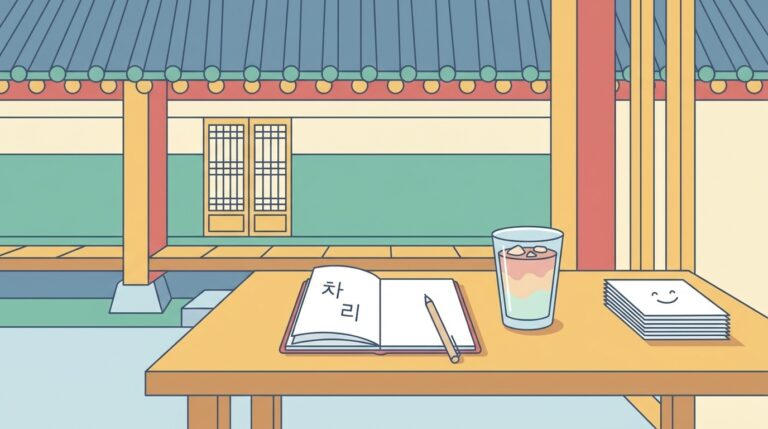
Setting: ‘Cafe Hanok’ in Insadong. You are sitting at a low wooden table, and you accidentally spilled a drop of coffee.
- Barista Minji: 어서 오세요! 주문하신 음료 나왔습니다. (Welcome! Your ordered drinks are ready.)
- You: 아, 감사합니다! (Ah, thank you!)
- You: 🎭 (Pointing gently to your spilled coffee drop) 저기, 죄송한데요… (Excuse me, sorry…)
- Barista Minji: 🎭 (Smiling warmly) 네, 무엇을 도와드릴까요? (Yes, how can I help you?)
- You: 냅킨 좀 주세요. (Naep-kin jom ju-se-yo. / Please give me some napkins.)
- Barista Minji: 아, 네! 여기 있습니다. (Ah, yes! Here they are.)
- You: 🎭 (Receiving the napkins with both hands) 감사합니다! (Gam-sa-ham-ni-da! / Thank you!)
- Barista Minji: 아니에요. 맛있게 드세요! (No problem. Enjoy your drink!)
🔀 Interactive Choice:
What would you say next if you also needed a wet wipe (물티슈)?
* A) 물티슈도 주세요 (Mul-ti-syu-do ju-se-yo) — ‘Give me wet wipes too.’
* B) 물티슈 빌려줘 (Mul-ti-syu bil-ryeo-jwo) — ‘Lend me wet wipes.’
* C) 물티슈는 없나요? (Mul-ti-syu-neun eop-na-yo?) — ‘Do you not have wet wipes?’
Feedback:
- Choice A [Best]: Polite, clear, and perfectly matches the cafe atmosphere!
- Choice B [Bad]: This is casual language (반말) and sounds rude to a barista you don’t know.
- Choice C [Risk]: Grammatically correct, but sounds slightly demanding or negative.
Phase 6: 10-Second Emotion Shadowing Drill
Let’s practice speaking with real emotions! Try reading these aloud:
- [😊 Polite and Warmly]
냅킨 / 좀 / 주세요! (Naep-kin / jom / ju-se-yo!) -
[🥺 Lost and Needing Help]
저기… / 냅킨 / 어디에 / 있어요? (Jeo-gi… / naep-kin / eo-di-e / is-seo-yo?)
Phase 7: K-Culture Mini Dictionary
- 셀프바 (Sel-peu-ba) | Self Bar: The public station in cafes where water, napkins, and straws are kept.
- 물티슈 (Mul-ti-syu) | Wet wipe: Extremely popular in Korea. Baristas usually give these if you order sticky desserts.
- 진동벨 (Jin-dong-bel) | Buzzer/Vibrating bell: The small device cafes give you that buzzes when your order is ready.
- 빨대 (Ppal-dae) | Straw: Usually found at the self bar next to the napkins.
Phase 8: Traveler’s Survival Kit
Survival Phrases TOP 3
- 물티슈 있어요? (Mul-ti-syu is-seo-yo? / Do you have wet wipes?)
- 휴지 어디 있어요? (Hyu-ji eo-di is-seo-yo? / Where is the tissue?)
- 감사합니다 (Gam-sa-ham-ni-da / Thank you)
Editor’s Travel Note
Before exploring Seoul’s amazing cafes, make sure to download the Naver Map App or the KakaoMap App. Google Maps is not very accurate in Korea, but these local apps will guide you directly to the prettiest cafes! Note: Cafe operating hours change often, so check the apps for live updates.
Phase 9: “한 발 더 깊이” (One Step Deeper)
In many Western countries, cafe supplies like napkins and straws are kept behind the counter to prevent waste. However, in Korea, they are almost always placed in an open “self-service bar” for everyone to use freely. This reflects Korea’s high-trust society and the communal culture of sharing. People trust each other to take only what they need, keeping the space clean for the next person.
💬 Your Turn: Is it common to have self-service napkins in your country’s cafes? Share your experience in the comments below!
Phase 10: FAQ & Avoiding Mistakes
Q: Is there a difference between 냅킨 (naep-kin) and 휴지 (hyu-ji)?
A: Yes! 냅킨 refers specifically to paper napkins used at dining tables. 휴지 is a broader term for tissues or toilet paper. However, in a cafe, if you ask for “휴지”, they will easily understand you mean napkins!
Q: Do I have to pay extra for napkins or wet wipes in Korea?
A: No, cafe napkins and wet wipes are always free of charge in South Korea.
Q: What if I spill a large amount of coffee?
A: Don’t try to clean a massive spill with small napkins! Go to the counter and say: “음료를 쏟았어요, 도와주세요” (Eom-ryo-reul ssod-at-seo-yo, do-wa-ju-se-yo – I spilled my drink, please help me).
🚨 Common Mistakes
- Saying ‘Tissue please’ in English: Some baristas might not understand. Use 냅킨 (naep-kin) or 휴지 (hyu-ji).
- Pointing and saying ‘Give me’: Always add 주세요 (ju-se-yo) to stay polite!
- Searching behind the counter yourself: Always check the public self-service bar first before reaching behind the staff area.
Phase 11: Action Mission & Participation
- Bronze Mission: Say “냅킨 좀 주세요” (Naep-kin jom ju-se-yo) aloud 3 times in front of your mirror.
- Silver Mission: Share this post on your social media with your favorite Korean cafe aesthetic!
- Gold Mission: Go to a local Korean bakery or cafe and use this phrase to ask for a napkin!
🎮 K-Culture Mission: Watch any modern K-Drama cafe scene and see if you can spot the ‘셀프바’ (self-service bar) in the background!
Phase 12: Interactive Quiz Challenge
1. Which phrase means ‘Where are the napkins?’
* A) 냅킨 주세요
* B) 냅킨 어디에 있어요?
* C) 물티슈 주세요
🔍 View Answer & Explanation
Correct Answer: B
Explanation: ‘냅킨 어디에 있어요?’ means ‘Where are the napkins?’. A means ‘Please give me napkins’, and C means ‘Please give me wet wipes’.
2. True or False: You should grab napkins from behind the counter yourself without asking.
🔍 View Answer & Explanation
Correct Answer: False
Explanation: You should look for the public ‘셀프바’ (self-service bar) first. If you can’t find it, ask the staff politely using the phrases you learned!







