

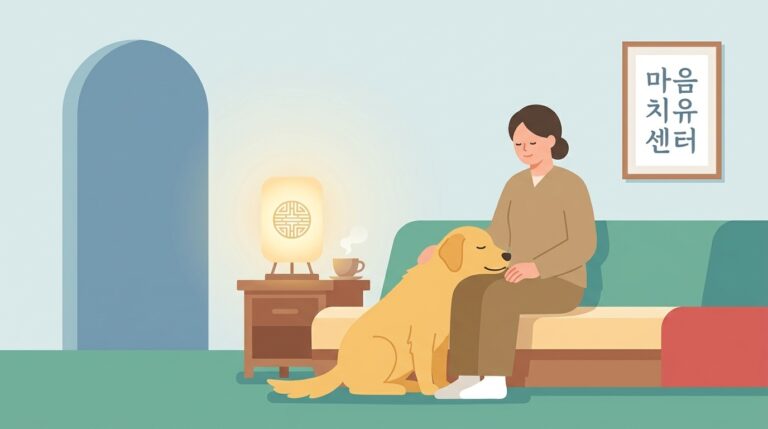
Master C1 Korean: Healing Hearts Through Animal-Assisted Therapy
Phase 1: Empathy (Opening)
안녕하세요! Hello, my dear language companions! It’s your chief editor and local guide from Daily Hangul. Have you ever felt completely drained by the fast-paced modern life, only to find solace in the quiet presence of a pet?
In South Korea, where the societal pace is notoriously fast, a profound cultural shift has occurred. The country is rapidly embracing 동물 매개 치료 (dong-mul mae-gae chi-ryo), or Animal-Assisted Therapy (AAT). From healing programs in community centers to therapeutic dog cafes in Seoul, companion animals are no longer just ‘pets’—they are recognized as emotional lifesavers.
As a C1-level learner, you aren’t just learning how to order pet food anymore. You are entering the realm of deep emotional articulation. Today, we will explore the sophisticated ways Koreans express emotional healing, psychological safety, and the profound connection with animals. If you have ever wanted to discuss therapy, mental wellness, or your own pet’s healing power in high-level Korean, this guide is crafted just for you. Let’s dive deep into the vocabulary of the soul.
Phase 2: Key Expressions Analysis
Let’s analyze three advanced expressions crucial for discussing therapeutic encounters.
1. 마음의 문을 열다 (ma-eum-ui mun-eul yeol-da)
- Pronunciation: mah-eum-ee moon-eul yeol-dah (Sounds like “mah-um-ee” + “moon-ul” + “yuhl-dah”)
- Meaning: To open one’s heart (lit. “to open the door of one’s mind/heart”)
- K-Culture Moment: You’ll often hear this in documentary programs like Dogs Are Incredible (개는 훌륭하다) or healing K-dramas when a deeply traumatized character finally smiles while petting a therapy dog.
- Editor’s Insight: This metaphor goes beyond simply ‘becoming friendly’. It denotes a psychological breakthrough where defensive walls are lowered because of a non-judgmental presence.
- Situation Spectrum: Casual ✅ | Semi-formal ✅ | Formal ✅
- 🤔 Think About It: In English, we “open our hearts.” In Korean, the mind/heart (마음) has a “door” (문). How does this imagery of unlocking a barrier change how you perceive emotional trust?
2. 위안을 얻다 (wi-an-eul eot-da)
- Pronunciation: wee-ahn-eul eut-dah (Sounds like “we-ahn-ul” + “uht-dah”)
- Meaning: To find comfort / to receive consolation
- K-Culture Moment: Used by artists in interviews when discussing how their companion animals help them cope with the pressures of fame.
- Editor’s Insight: While ‘위로 (wi-ro)’ is active comfort given by someone else, ‘위안 (wi-an)’ is an internal state of peace and emotional shelter that you obtain (얻다) from a presence.
- Situation Spectrum: Casual ✅ | Semi-formal ✅ | Formal ✅
- 🤔 Think About It: Why do you think humans often find it easier to ‘obtain comfort’ (위안을 얻다) from animals than from other humans?
3. 반려동물과 교감하다 (ban-ryeo-dong-mul-gwa gyo-gam-ha-da)
- Pronunciation: bahn-ryuh-dong-mool-gwah gyoh-gahm-hah-dah
- Meaning: To commune emotionally with a companion animal
- K-Culture Moment: Frequently used in professional veterinary therapy panels and high-end lifestyle magazines discussing pet wellness.
- Editor’s Insight: ‘교감 (gyo-gam)’ is a beautiful C1 word. It refers to a mutual, unspoken, soulful resonance where two beings share feelings without words.
- Situation Spectrum: Casual ⚠️ | Semi-formal ✅ | Formal ✅
- 🤔 Think About It: How does ‘교감하다’ differ from simply playing (놀다) with an animal?
Phase 3: Textbook Korean vs. Real-Life Korean
| Situation | 📖 Textbook Korean | 🗣️ Real-Life Korean (C1 Natural) | 💡 Why the difference? |
|---|---|---|---|
| Describing the healing effect of a pet | 개가 내 기분을 좋게 만듭니다. (The dog makes me feel good.) |
반려견 덕분에 지친 일상에서 큰 위안을 얻고 있어요. (Thanks to my companion dog, I find great comfort in my exhausted daily life.) |
The textbook version is too robotic and simplistic. Real native conversations at an advanced level utilize passive gratitude (덕분에) and abstract nouns of comfort. |
| Explaining therapeutic bonding | 동물을 만지면 치료가 됩니다. (If you touch animals, it cures you.) |
동물과의 정서적 교감이 심리적 안정감을 가져다주더군요. (I observed that emotional communion with animals brings a sense of psychological stability.) |
High-level speakers use scientific yet warm terminology like ‘정서적 교감’ (emotional communion) and the retrospective observer suffix ‘-더군요’. |
Phase 4: K-Culture Deep-Dive & Non-verbal Manners
4-1. Nunchi & Mindful Approach
When participating in therapy sessions or visiting healing spaces in Korea, your 눈치 (Nunchi – situational awareness) is vital. Culturally, physical boundaries are respected, even with animals.
* The “Nose Touch” Greeting: Do not immediately pet the head. Instead, present the back of your hand gently at their nose level, allowing them to sniff you first. This is known as giving them ‘인사’ (greeting).
* Tone of Voice: Koreans use a high-pitched, soft, nasal tone of endearment, often dropping the ending consonant (e.g., “아이구 예뻐라~” sounds like a-i-gu yeh-puh-rah).
4-2. The “Healing” (힐링) Phenomenon
Korea has institutionalized ‘healing’. Animal-assisted therapy is no longer an alternative medicine; it is being integrated into public fire stations (for PTSD sufferers), schools, and nursing homes. This stems from the Korean social trend of 소확행 (so-hwak-haeng)—small but certain happiness. The presence of an animal offers an uncomplicated sanctuary from competitive societal pressures.
Phase 5: Real-Life Roleplay Scenario
Setting: A serene animal-assisted therapy center (마음 치유 센터) in Seoul.
Characters:
* 지민 (Jimin): Head Therapy Coordinator (Professional, warm, encouraging)
* 민우 (Minwoo): A stressed local graduate student seeking emotional support (Introspective, initially guarded)
Dialogue
- 지민: [smiling warmly] 어서 오세요, 민우 씨. 오늘 저희 치료견 ‘보리’와 처음 만나는 날이네요. 기분이 어떠세요?
(Welcome, Minwoo. Today is your first day meeting our therapy dog, Bori. How are you feeling?) - 민우: [nervously adjusting glasses] 사실… 처음이라 조금 긴장도 되고, 제가 정말 마음의 문을 열 수 있을지 걱정이 돼요.
(To be honest… since it’s my first time, I’m a bit nervous, and I’m worried whether I can truly open my heart.) - 지민: [gently nodding] 당연한 감정이에요. 보리는 사람의 긴장을 정말 잘 알아채거든요. 먼저 편안하게 앉아서 보리의 눈을 맞춰 보세요.
(That’s a completely natural feeling. Bori is really good at sensing tension. First, sit comfortably and try to make eye contact with Bori.) - 민우: [squatting down slowly] 아, 보리가 제 손에 코를 대고 냄새를 맡네요. 촉감이 참 따뜻해요.
(Oh, Bori is putting her nose against my hand and sniffing. Her touch feels really warm.) - 지민: [observing] 맞아요. 이제 천천히 쓰다듬어 보세요. 동물과의 정서적 교감은 이렇게 아주 작은 접촉에서부터 시작된답니다.
(Exactly. Now pet her slowly. Emotional communion with animals starts from very small physical contact like this.) - 민우: [taking a deep breath, expression relaxing] 신기하네요. 보리가 곁에 가만히 앉아 있어 주는 것만으로도 말로 다 할 수 없는 위안을 얻는 느낌이에요.
(It’s amazing. Just having Bori sit quietly by my side makes me feel like I’m obtaining an unspeakable amount of comfort.) - 지민: [beaming] 보리가 민우 씨의 진심을 느낀 거예요. 마음의 상처를 치유하는 데는 거창한 말보다 이런 침묵의 교감이 더 강력할 때가 있죠.
(Bori felt your sincerity. Sometimes, this silent communion is much more powerful than grand words when it comes to healing emotional wounds.) - 민우: [patting Bori gently] 왜 사람들이 동물 매개 치료를 찾는지 이제야 온전히 이해가 가네요. 가슴이 뭉클해요.
(Now I fully understand why people seek animal-assisted therapy. My heart feels deeply moved.)
🔀 Interactive Choice
How should Minwoo respond next to deepen the therapy session?
* Choice A: “근데 보리는 하루에 간식을 몇 번이나 먹나요?” (By the way, how many snacks does Bori eat a day?)
* Choice B: “보리의 심장 박동을 느끼다 보니, 제 머릿속을 가득 채우던 잡념들이 눈 녹듯 사라지는 것 같아요.” (As I feel Bori’s heartbeat, it feels like the distracting thoughts filling my head are melting away.)
* Choice C: “치료가 끝났으니 이제 보리를 분양받아 가도 될까요?” (Since the therapy is over, can I adopt Bori now?)
Feedback
- Best (Choice B): Excellent! This uses poetic, advanced metaphorical language (눈 녹듯 사라지다 – to melt away like snow) to describe cognitive and emotional relief, perfectly matching the C1 tier and therapeutic goal.
- Risk (Choice A): While cute, it shifts the focus too abruptly from deep therapy to trivial maintenance, breaking the healing atmosphere.
- Bad (Choice C): Oh no! Therapy dogs belong to the institution and are highly trained professionals. Asking to adopt them right away violates professional boundaries.
Phase 6: 10-Second Emotional Shadowing Drill
Practice saying this emotionally charged sentence. Pause at the slashes (/) and embody the emotion in brackets.
[😌 Relieved and deeply moved]
“보리가 / 제 곁에 가만히 있어 주는 것만으로도 / 말로 다 할 수 없는 / 큰 위안을 얻고 있어요.”
- Romanization: Bo-ri-ga / je gyeot-e ga-man-hi it-eo ju-neun geot-man-eu-ro-do / mal-ro da hal su eop-neun / keun wi-an-eul eot-go is-eo-yo.
- Speech Guide: Soften your voice on ga-man-hi (quietly), and slightly elongate wi-an (comfort) to emphasize your emotional state.
Phase 7: K-Culture Mini Dictionary
- 반려 (Ban-ryeo): Companion. Historically, dogs were called ‘애완동물’ (pet/toy animal). Today, the term ‘반려동물’ (companion animal) is legally and socially mandated, reflecting their status as family members.
- 정서적 교감 (Jeong-seo-jeok Gyo-gam): Emotional communion. A highly sophisticated term used in psychology and wellness to describe deep, mutual emotional resonance.
- 마음의 병 (Ma-eum-ui Byeong): Sickness of the heart/mind. A common term used to refer to psychological ailments such as depression, anxiety, or burnout.
- 치료견 (Chi-ryo-gyeon): Therapy dog. A certified dog trained specifically to provide comfort and affection in clinical, educational, and emotional settings.
Phase 8: Survival Kit for Travelers
Survival Expressions
- 만져봐도 괜찮을까요? (man-jyeo-bwa-do gwaen-chan-eul-kka-yo?) – May I pet him/her?
- Pro Tip: Always ask this before touching any dog on the streets of Seoul to show high cultural respect.
- 겁이 많은 편인가요? (geop-i man-eun pyeon-in-ga-yo?) – Is he/she easily frightened?
- Pro Tip: Perfect for therapy sessions to understand the animal’s temperament.
- 정말 순하고 영리하네요. (jeong-mal sun-ha-go yeong-ri-ha-ne-yo.) – He/she is so gentle and smart.
Editor’s Travel Note
If you want to experience healing companion spaces in Korea, use Naver Map (do not rely on Google Maps in Korea!) and search for “애견 동반” (Pet-friendly) or “동물 매개 치료” (Animal therapy center). Note that many healing spaces require reservation in advance to keep the environment calm for the animals.
Phase 9: “One Step Deeper” (Inquiry)
In the West, animals are often treated as independent companions. In Korea, the linguistic shift from 애완 (Ah-wan – loving toy) to 반려 (Ban-ryeo – life partner) is deeply tied to the philosophical concept of ‘정’ (Jeong – shared affection and bond). To refer to an animal as ‘반려견’ is to state that your souls are interconnected. It is not just a pet; it is a mirrors of your own inner state.
💬 Your Turn: Do you believe animals have the power to heal human mental illness without words? Leave a comment below sharing your thoughts in Korean!
Phase 10: FAQ & Common Mistakes
Q: Can I use “애완견” instead of “반려견”?
A: While older generations still use “애완견” (pet dog), in modern, educated, and professional healing environments, “반려견” (companion dog) is highly preferred as it shows respect for the animal’s life.
Q: What is the difference between “치료” and “치유”?
A: “치료 (Chi-ryo)” refers to medical or physical treatment/cure. “치유 (Chi-yu)” is spiritual, psychological, and emotional healing. Animal therapy is both, but the emotional result is always “치유.”
Q: How do I express “The dog is healing me” naturally?
A: Instead of translating literally (“개가 나를 치료해요”), say “강아지 덕분에 힐링하고 있어요” (I am healing thanks to the puppy).
🚨 Common Mistakes Alert!
- Mistake: Calling a therapy dog “개” (gae) bluntly in a formal session.
- Correct Action: Use the respectful term “치료견” (chi-ryo-gyeon) or the affectionate “강아지” (gang-a-ji).
- Mistake: Using “위로를 받았어요” when you mean deep existential comfort.
- Correct Action: Use “위안을 얻었어요” to emphasize deep emotional solace.
Phase 11: Action Mission
- Bronze: Translate this sentence into your own journal: “I want to find comfort through animal therapy in Korea.”
- Silver: Go to Instagram or YouTube, find a Korean rescue dog account, and leave a warm comment: “정말 사랑스러워요. 덕분에 힐링하고 갑니다!” (So lovely. Thanks to you, I’ve got healed before leaving!)
- Gold: Write a paragraph in Korean explaining an experience where an animal helped you open your heart (마음의 문을 열다).
Phase 12: Interactive Quiz
Test your knowledge of high-level Korean therapy expressions!
- Which word means “emotional communion” or







