

Master the Art of ‘Naeng-teol’: Portioning Ingredients and Conquering the Korean Fridge-Digging Culture
Phase 1: Empathy (스토리 몰입형 오프닝)
안녕하세요! Your favorite language partner and editor at Daily Hangul is here!
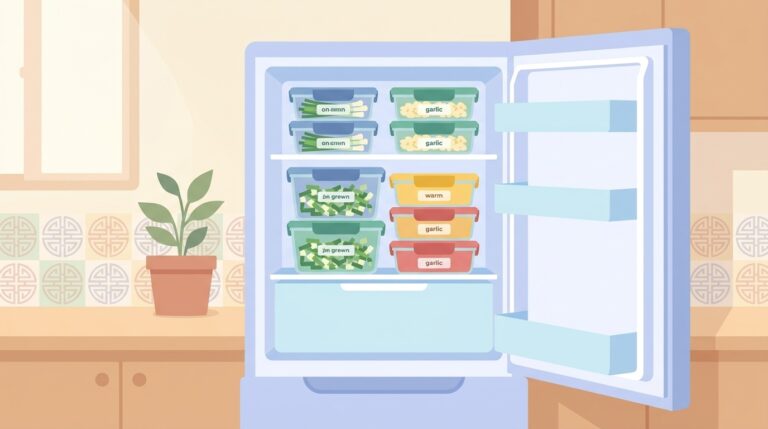
Picture this: You just had an amazing weekend trip to a Korean mart like E-Mart or Costco. Excited to try your hand at cooking Korean food, you bought a massive bundle of green onions (대파), a family-sized pack of pork belly (삼겹살), and a giant tub of minced garlic (다진 마늘). But fast forward three days… you live alone in a cozy one-room (원룸), and you realize there is absolutely no way you can finish all of this before it turns into a science project in your fridge.
In Korea, especially among young professionals and students living alone (자취생), managing groceries is a high-stakes survival game. If you don’t know how to 소분하다 (portion and pack) your food, you’ll end up throwing away more than you eat. This is where the ultimate Korean life hack comes in: 냉장고 파먹기 (literally, “eating/digging through the fridge,” often shortened to 냉털).
Based on feedback from our advanced learners who struggled with food waste and high grocery bills in Seoul, we’ve put together this C2-level masterclass. Today, you won’t just learn sterile textbook phrases; you’ll master the high-level, culturally rich idioms that will make you sound like a seasoned Korean home cook who knows exactly how to stretch a single block of tofu into three different meals!
Phase 2: 핵심 표현 3선 심층 분석 (Deep-Dive Expressions)
1. 소분하다 (소분하다)
- Pronunciation: so-bun-ha-da (Rhymes with “sew-boon-ha-da”)
- Meaning: To portion out ingredients into smaller, single-use containers or bags before storage.
- K-Culture Moment: You’ll see this constantly on Korean lifestyle vlogs (Vlog) on YouTube. Creators buy bulk meat or vegetables, chop them up, and neatly organize them into little containers with aesthetic labels.
- Editor’s Insight: While the dictionary translates this simply as “to subdivide,” in the modern Korean culinary context, it specifically refers to the smart, systematic portioning of raw ingredients to prevent spoilage and ease future cooking. It’s a hallmark of a disciplined, organized adult.
- Situation Spectrum: Casual (✅) / Semi-formal (✅) / Formal (✅)
- 🤔 Think About It: In many Western cultures, buying in bulk and freezing whole packages is common. Why do you think Koreans place such a high emphasis on individually portioning (소분) even tiny ingredients like minced garlic or green onions? (Hint: Think about the typical size of Korean kitchens and the portion sizes of daily banchan).
2. 냉장고 파먹기 / 냉털 (냉장고 파먹기 / 냉털)
- Pronunciation: naeng-jang-go pa-meok-gi / naeng-teol
- Meaning: “Fridge-digging” or “Fridge looting.” Using up every single leftover ingredient in your refrigerator without going grocery shopping.
- K-Culture Moment: In the hit variety show Please Take Care of My Refrigerator (냉장고를 부탁해), chefs would create gourmet meals out of random, half-used ingredients found in celebrities’ messy fridges. This is the epitome of naeng-teol!
- Editor’s Insight: 냉털 is a slang shorthand for 냉장고 털기 (looting the fridge). While 냉장고 파먹기 sounds a bit more domestic and cozy, 냉털 is highly colloquial and popular among younger generations who practice 짠테크 (salty-tech / extreme frugality) to save money.
- Situation Spectrum: Casual (✅) / Semi-formal (⚠️ – acceptable in light business/lifestyle contexts) / Formal (🚫)
- 🤔 Think About It: How does the concept of “fridge-digging” in your home country differ from the Korean naeng-teol, which almost always culminates in making a massive bibimbap, gimchijjigae, or bokkeumbap?
3. 소비기한 (소비기한)
- Pronunciation: so-bi-gi-han (Rhymes with “so-bee-ghee-han”)
- Meaning: Use-by date / Consumption deadline (the actual date until which food is safe to consume, distinct from the sell-by date).
- K-Culture Moment: On January 1, 2023, South Korea officially transitioned from the old 유통기한 (distribution limit/sell-by date) to 소비기한 (consumption limit/use-by date) to curb food waste. You will see this term printed on all modern Korean food packaging.
- Editor’s Insight: C2 speakers must know this distinction. While 유통기한 is still widely used in casual speech out of habit, 소비기한 is the correct, modern regulatory term you should use when discussing food safety or policy.
- Situation Spectrum: Casual (✅) / Semi-formal (✅) / Formal (✅)
- 🤔 Think About It: How has the shifting of terms from “sell-by” to “use-by” affected food waste awareness in your own country?
Phase 3: 교과서 한국어 vs 진짜 한국어 (Textbook vs. Real Korean)
Situation 1: Explaining how you store large portions of meat
- 📖 교과서 한국어: “고기를 작은 크기로 나누어 보관하세요.”
(Divide the meat into small sizes and store it.) - 🗣️ 진짜 한국어: “고기는 사 오자마자 1회분씩 소분해서 냉동하는 게 국룰이에요.”
(It’s the unwritten national rule to portion meat into single servings and freeze it as soon as you buy it.) - 💡 Why the difference? Textbooks teach dry, imperative instructions. Real Koreans use the word 국룰 (guk-rul / national rule/the ultimate life hack) to emphasize that portioning immediately after grocery shopping is an absolute must-do standard practice.
Situation 2: Suggesting making dinner out of whatever is left in the fridge
- 📖 교과서 한국어: “냉장고에 남은 음식을 다 먹읍시다.”
(Let’s eat all the food remaining in the refrigerator.) - 🗣️ 진짜 한국어: “오늘 저녁은 마트 가지 말고 냉털해서 비빔밥이나 해 먹자.”
(Let’s not go to the mart tonight; let’s just do some fridge-looting and whip up some bibimbap.) - 💡 Why the difference? The textbook sentence sounds like a strict campaign slogan. The real-life version uses the trendy slang 냉털 combined with ~이나 해 먹자 (which gently implies “let’s just casually make something with what we have without putting in too much formal effort”).
Phase 4: K-Culture 딥다이브 & 비언어적 매너 (Deep-Dive & Non-Verbal Manners)
4-1. 눈치(Nunchi) & The Art of Food Waste Disposal
In Korea, how you dispose of food waste (음식물 쓰레기) is just as important as how you store it. Getting this wrong is a major source of friction with neighbors and landlords.
* The Animal Test: The ultimate rule of thumb in Korea is: “Can an animal eat this?” If yes, it is food waste. If no (like chicken bones, eggshells, onion skins, or walnut shells), it goes into the general garbage (일반 쓰레기).
* The Non-Verbal Cue of Apology: If you are caught by an elderly neighbor (아파트 경비원 or 빌라 반장) throwing food waste into the wrong bin, do not argue. Bow slightly (about 15 degrees), bring your hands together in front of you, and say, “아, 죄송합니다! 제가 아직 서툴러서요. 다시 할게요.” (Ah, I’m so sorry! I’m still getting used to this. I’ll do it again.) Showing immediate compliance and humility is the ultimate Nunchi move.
4-2. The “자취생” (Solo-Living) Culture Code
Korea has seen a massive surge in single-person households. This has birthed a unique culture of online grocery shopping optimized for small spaces. Apps like Kurly (마켓컬리) and Coupang Rocket Fresh (쿠팡 로켓프레시) specialize in selling ultra-small portions. However, because buying in bulk is still cheaper, online communities are flooded with “honey tips” (꿀팁) on how to freeze raw green onions so they don’t turn mushy, or how to freeze tofu in water-filled containers. Mastering these tips is considered a rite of passage for any foreigner truly integrating into local Korean life.
Phase 5: 실전 롤플레이 시나리오 (Real-Life Roleplay)
Characters:
- 지아 (Ji-a): An experienced Korean friend who takes pride in her zero-waste, high-efficiency kitchen.
- You: An advanced expat who bought too much food at the wholesale market and is currently in a state of panic.
- 지아: 🎭 (냉장고를 열어보며 경악하는 표정으로) 어머! 너 이거 대파 한 단을 그냥 통째로 야채칸에 넣어둔 거야? 이러면 금방 물러서 다 버려야 해!
- You: 🎭 (머리를 긁적이며 난감한 듯이) 아, 진짜요? 어쩐지 저번에 산 대파는 일주일도 안 돼서 썩더라고요. 그냥 봉지째 넣으면 안 되는구나…
- 지아: 🎭 (단호하지만 다정하게 팔을 걷어붙이며) 당연하지! 대파는 깨끗이 씻어서 물기를 바짝 말린 다음에, 국용이랑 볶음용으로 용도에 맞게 썰어서 소분해 놔야 해.
- You: 🎭 (감탄하며 메모장을 켜며) 아, 소분해서 냉동 보관하는 거군요! 역시 자취 만렙 지아 선배님은 다르시네요.
- 지아: 🎭 (으쓱해하며 웃으며) 에이, 자취하다 보면 누구나 이렇게 돼. 그리고 이 삼겹살 남은 건 어떻게 할 거야? 이거 유통기한 오늘까지잖아.
- You: 🎭 (한숨을 쉬며) 휴, 그러게요. 삼겹살은 오늘 다 못 먹을 것 같은데… 그냥 버려야 하나 고민 중이었어요.
- 지아: 🎭 (눈을 동그랗게 뜨며) 버리긴 왜 버려! 오늘 저녁에 당장 냉털 들어가야지! 마침 냉장고에 시들어가는 버섯이랑 먹다 남은 두부도 있네.
- You: 🎭 (눈이 반짝이며) 와, 좋아요! 그럼 남은 삼겹살이랑 냉장고에 있는 짜투리 야채 다 넣고 김치찌개 끓여서 냉장고 파먹기 할까요?
- 지아: 🎭 (엄지를 치켜세우며) 그렇지! 바로 그거야! 오늘 아주 냉장고 구석구석 제대로 한번 털어보자구!
🔀 인터랙티브 분기점 (Interactive Choice)
Ji-a asks you how you want to handle the remaining minced garlic (다진 마늘) that you bought in a giant tub.
- [Option A] “귀찮으니까 그냥 통째로 냉동실에 넣고 쓸 때마다 숟가락으로 파서 쓸게요.”
- [Option B] “얼음 틀(Ice cube tray)에 하나씩 채워 넣어서 얼린 다음에, 한 알씩 꺼내 쓰면 편하겠죠?”
- [Option C] “상온에 두고 그냥 찌개 끓일 때마다 조금씩 덜어 쓸게요. 마늘은 안 상하잖아요!”
💡 Feedback on Your Choice:
- Option A (Risk): Uh-oh! If you freeze a giant block of minced garlic, it becomes as hard as concrete. You will end up bending all your metal spoons trying to chisel out a single teaspoon. Not recommended!
- Option B (Best – ⭐⭐⭐): Perfect! This is the absolute 국룰 of Korean household portioning. Freezing minced garlic in ice cube trays (or flat plastic bags scored into grids with a knife) allows you to pop out exactly one perfect portion whenever you cook. Brilliant!
- Option C (Bad): Danger! Minced garlic turns sour, changes color to a weird greenish-gray, and grows mold very quickly at room temperature. Never keep minced garlic on the counter!
Phase 6: 10초 감정 섀도잉 드릴 (Shadowing Drill)
Read these aloud, paying attention to the emotional markers and intonation breaks (/).
- [🥺 Realizing your mistake / Slightly embarrassed]
“아/ 진짜요? ㅠㅠ / 어쩐지 저번에 산 대파는 / 일주일도 안 돼서 / 다 썩어버리더라고요.”
(Ah, really? No wonder the green onions I bought last time rotted away in less than a week.) -
[🔥 Enthusiastic & Confident / Suggesting a culinary rescue mission]
“오늘 저녁은 / 절대 마트 가지 말고, / 냉장고에 남은 것들로 / 제대로 냉털 한번 하시죠!”
(Let’s absolutely not go to the mart tonight; let’s do a proper fridge-looting with whatever is left!)
Phase 7: K-Culture 미니 사전 (Mini Dictionary)
- 소분용기 (so-bun-yong-gi) | Portioning Containers
- Small, often stackable, airtight containers designed to store single-serving meals or ingredients. Koreans are highly particular about buying matching sets for that satisfying, clean aesthetic.
- 자취템 (ja-chwi-tem) | Solo-Living Essential Items
- A portmanteau of 자취 (living alone) and 아이템 (item). Refers to smart gadgets like mini rice cookers, silicon portioning trays, and bag sealers.
- 음쓰 (eom-sseu) | Food Waste (Slang)
- A highly common, shortened slang for 음식물 쓰레기 (eom-sik-mul sseu-re-gi). You’ll hear this in daily conversations like “오늘 음쓰 당번 너야!” (You’re on food waste duty today!).
- 소비기한 표시제 (so-bi-gi-han pyo-si-je) | Use-by Date Labeling System
- The official regulation system in Korea. Knowing this term shows an advanced understanding of modern Korean consumer affairs.
Phase 8: 여행자를 위한 생존 키트 (Traveler’s Survival Kit)
Survival Expressions
- “이거 음식물 쓰레기에 버려야 해요, 일반 쓰레기에 버려야 해요?”
(Should I throw this into the food waste or the general garbage?)- Pro Tip: When staying in an Airbnb, always ask this to your host on the first day to avoid hefty municipal fines.
- “남은 건 밀폐용기에 넣어서 냉장 보관해 주세요.”
(Please put the leftovers in an airtight container and store them in the fridge.)- Pro Tip: Use this when helping clean up after a housewarming party (집들이) to show your exceptional manners.
- “유통기한은 지났는데 소비기한은 아직 넉넉하네요!”
(The sell-by date has passed, but the use-by date still has plenty of time left!)- Pro Tip: Impress your Korean roommates with this economically savvy remark.
Editor’s Travel Note
Before you start throwing things away in Korea, make sure you download the local district office’s waste guide. You can find precise rules by searching your specific district (e.g., Mapo-gu, Gangnam-gu) on the 서울시 구청 누리집 (Seoul District Office Directory) to check local food waste bag (음식물 쓰레기 봉투) colors and disposal schedules. Remember, each district has different colored bags!
Phase 9: 한 발 더 깊이 (Thinking Deeper)
In Korea, food is rarely just sustenance; it is a medium of 정 (Jeong / warm affection and attachment). When a Korean mother sends her adult child off to live alone in the city, she rarely sends money; instead, she packs dozens of small containers of side dishes (반장), neatly portioned and ready to eat.
Because of this deep cultural value placed on the effort that goes into preparing food, throwing away food is traditionally viewed as a minor sin. This cultural mindset, combined with Korea’s highly advanced waste management system, has made 냉장고 파먹기 (fridge-digging) not just a way to save money, but a respected lifestyle of mindful, ethical living.
💬 Your Turn: How does your culture view leftovers? Do you have an equivalent of “Naeng-teol” in your country, or is throwing away excess food treated more casually? Share your thoughts in the comments below!
Phase 10: FAQ & 오해 방지 (FAQ Schema)
Q: Can I put bone broth or soup leftovers directly into the food waste bag?
A: No! Large amounts of liquid should be drained first. Liquid waste must be poured down the sink (make sure to filter out any solid food particles), and only the solid food residue should go into the food waste bag. Putting too much moisture in the bag makes it leak and smell awful, which is a major etiquette breach.
Q: Is there a difference between ‘유통기한’ and ‘소비기한’? Can I eat food past its ‘유통기한’?
A: Yes, absolutely! 유통기한 (sell-by date) is merely the period the store can legally display and sell the product. 소비기한 (use-by date) is when the food actually starts to go bad. For example, milk can often be safely consumed up to 50 days past its 유통기한 if kept unopened and refrigerated!
Q: What is the most common mistake foreigners make when storing Korean vegetables like green onions (대파)?
A: The biggest mistake is storing them wet. If you wash green onions and store them in a container without drying them completely with a paper towel, they will turn into mush within days. Always dry them completely before portioning (소분).
🚨 흔한 실수 (Common Mistakes) 경고판
- Mistake: Throwing banana peels into the general garbage.
- Correct Action: Banana peels are soft enough for animals to digest, so they must go into the food waste (음쓰).
- Mistake: Throwing eggshells into the food waste.
- Correct Action: Eggshells are hard and contain no nutritional value for animals. They must go into the general waste (일반 쓰레기).
- Mistake: Freezing a whole block of tofu without draining the water.
- Correct Action: Freezing tofu makes it spongy and delicious (excellent for absorbing soup), but you must drain the water and pat it dry before freezing, or you’ll end up with an unmanageable block of ice.
Phase 11: 액션 미션 (Your Action Mission)
- Bronze Medal: Go to your fridge right now, identify one ingredient that is close to its expiration date, and look up a Korean recipe to use it up today.
- Silver Medal: Take a photo of your neatly portioned ingredients (e.g., garlic, onions) in your containers and post it on Instagram tagging
#DailyHangul #소분완료. - Gold Medal: The next time a Korean friend asks you what you are doing for dinner, confidently text them: “오늘 마트 안 가고 냉털해서 대충 때우려고요!” (I’m not going to the mart today; I’m just going to clear out the fridge and make do!)
🎮 K-Culture Mission
Watch a clip of the Korean show Please Take Care of My Refrigerator (냉장고를 부탁해) on YouTube. Write down three random ingredients you saw in the celebrity’s fridge and try to name them in Korean!
Phase 12: 인터랙티브 퀴즈 챌린지 (Interactive Quiz)
Test your mastery of Korean culinary culture and language with this advanced quiz!
1. Situation Quiz
You have some leftover pork belly that expired yesterday but still looks and smells completely fine. Which of the following is the most culturally and linguistically appropriate thing to say to your Korean roommate?
* A) “이 고기 유통기한 지나서 무조건 버려야 해요.”
* B) “유통기한은 지났지만 소비기한은 괜찮을 테니 오늘 바로 냉털해서 먹어치워요!”
* C) “이 고기는 소분해서 상온에 평생 보관합시다.”
2. Fill-in-the-Blank
“식재료를 사 오자마자 한 번 먹을 만큼씩 ___________ (to portion out) 보관하면 요리하기 훨씬 편해요.”
3. True or False
- “Chicken bones and fish bones should be thrown into the food waste (음식물 쓰레기) bag because they are organic matter.”
- (True / False)
🎉 Click here for the Answers & Explanations!
- Correct Answer: B
- Explanation: As a C2 speaker, recognizing that 소비기한 allows for safe consumption after the 유통기한 has passed, and using the natural slang 냉털 shows a flawless grasp of modern Korean life.
- Correct Answer: 소분해서 (sobun-haeseo)
- Explanation: The grammar required is the connective form (~해서) to show the sequence of action: portioning and then storing.
- Correct Answer: False
- Explanation: Animal bones are extremely hard and cannot be processed into animal feed. They must always be disposed of in the general waste (일반 쓰레기) bag.







