

Phase 1: Empathy (스토리 몰입형 오프닝)
안녕하세요! 매일한글 에디터입니다. 😊
Imagine this: You are in your cozy cozy officetel in Seoul, preparing a delicious K-food dinner. You reach for a beautiful glass bowl, but—crash! It slips from your hands and shatters into a million pieces on your kitchen floor.
Your heart races. Not just because of the mess, but because a terrifying question pops into your head: “How on earth do I throw away broken glass in Korea?”
If you’ve lived in Korea for even a week, you know that 분리수거 (bunriseugeo – trash sorting) is taken very seriously here. Throwing broken glass into the wrong bin can lead to heavy fines, or worse, injure the hard-working waste collectors.
Don’t panic! Many of our global learners have shared this exact nightmare with us. Today, we are going to learn how to handle this sticky situation gracefully, safely, and like a true Korean local. By the end of this guide, you will know exactly what to say and what to do!
Phase 2: Key Expressions (핵심 표현 3선 심층 분석)
1. 깨진 유리가 있어요 (kkae-jin yu-ri-ga is-seo-yo)
- Pronunciation: Kkae-jin yu-ri-ga is-seo-yo (Sounds like: “Kae-jean yoo-ree-gah ees-suh-yo”)
- Meaning: “There is broken glass.”
- K-Culture Moment: You might hear this in K-dramas when a character accidentally drops a drink in a cafe, and a staff member rushes over, waving their hands saying, “Oh, wait! Kkaejin yuriga isseoyo!“
- Editor’s Insight: “깨진” comes from “깨지다” (to be broken) and “유리” means glass. It is a straightforward, polite phrase to warn anyone nearby.
- Situation Spectrum: Casual (⚠️ 깨진 유리 있어) | Semi-formal (✅ 깨진 유리가 있어요) | Formal (✅ 깨진 유리가 있습니다)
- 🤔 Think About It: In your home country, do people verbally warn others immediately when glass breaks, or do they quietly clean it up first?
2. 조심하세요 (jo-sim-ha-se-yo)
- Pronunciation: Jo-sim-ha-se-yo (Sounds like: “Joe-seem-hah-seh-yo”)
- Meaning: “Please be careful.”
- K-Culture Moment: This is the ultimate survival word in Korea. Escalator warnings, wet floors, or when a delivery scooter whizzes by—you’ll hear “Josimhaseyo!” everywhere.
- Editor’s Insight: It comes from “조심” (caution/care). Adding “하세요” makes it a polite imperative. It shows immediate warmth and care for the other person’s safety.
- Situation Spectrum: Casual (⚠️ 조심해) | Semi-formal (✅ 조심하세요) | Formal (✅ 조심하십시오)
- 🤔 Think About It: Koreans use “조심하세요” very frequently to show community care. How does this reflect the collective culture of Korea compared to your country?
3. 신문지에 싸서 버려야 해요 (sin-mun-ji-e ssa-seo beo-ryeo-ya hae-yo)
- Pronunciation: Sin-mun-ji-e ssa-seo buh-ryuh-ya hae-yo (Sounds like: “Seen-moon-jee-eh sah-suh buh-ryuh-yah-heh-yo”)
- Meaning: “You have to wrap it in newspaper and throw it away.”
- K-Culture Moment: If you ask a Korean landlord (building manager) how to throw away glass, they will almost always give you this exact golden rule.
- Editor’s Insight: “신문지” is newspaper, “싸다” is to wrap, and “버려야 해요” means “must discard.” This is the safest way to prevent bags from tearing.
- Situation Spectrum: Casual (⚠️ 신문지에 싸서 버려야 돼) | Semi-formal (✅ 신문지에 싸서 버려야 해요) | Formal (✅ 신문지에 싸서 버리셔야 합니다)
- 🤔 Think About It: Why do you think wrapping sharp objects is a basic social rule in Korea? It represents “배려” (baeryeo – consideration for others).
Phase 3: Textbook vs. Real Korean (교과서 한국어 vs 진짜 한국어)
Scenario 1: Warning someone about broken glass
- 📖 Textbook Korean: “유리가 깨졌으니 주의하십시오.” (Yu-ri-ga kkae-jyeot-eu-ni ju-ui-hap-si-o. – “As the glass is broken, please exercise caution.”)
- 🗣️ 진짜 한국어 (Real Korean): “여기 유리 깨졌어요! 조심하세요!” (Yeo-gi yu-ri kkae-jyeot-eo-yo! Jo-sim-ha-se-yo! – “Glass broke here! Be careful!”)
- 💡 Why is it different? Textbook Korean uses overly formal, written-style warnings. In real life, people use active, immediate phrases to prevent accidents.
Scenario 2: Asking where the special non-burnable bag is
- 📖 Textbook Korean: “불연성 쓰레기 봉투는 어디에 위치합니까?” (Bul-yeon-seong sseu-re-gi bong-tu-neun eo-di-e wi-chi-hap-ni-kka? – “Where is the non-combustible garbage bag situated?”)
- 🗣️ 진짜 한국어 (Real Korean): “혹시 안 타는 쓰레기 봉투 어디서 팔아요?” (Hok-si an ta-neun sseu-re-gi bong-tu eo-di-seo pal-a-yo? – “By the way, where do they sell those ‘non-burnable’ trash bags?”)
- 💡 Why is it different? Locals rarely say “불연성” (non-combustible) in daily speech; instead, they call it “안 타는 쓰레기 봉투” (trash bag that doesn’t burn).
Phase 4: K-Culture Deep Dive & Non-verbal Manners (K-컬처 딥다이브)
4-1. 눈치 (Nunchi) & Gestures for Broken Glass
When glass breaks, Koreans show extreme 눈치 (Nunchi – situational quickness/tact).
* The Gesture: Do not try to kick the glass aside with your feet. Instead, use open palms facing down to gesture people away, shaking your head slightly to signal danger.
* Safety Decorum: When placing the wrapped broken glass outside, write “깨진 유리 (Danger: Broken Glass)” clearly on a piece of paper and tape it to the outside of the bag. This prevents the recycling collectors from getting hurt. This small act of kindness is highly respected in Korean neighborhoods.
4-2. The Culture of “안 타는 쓰레기” (Non-burnable waste)
In Korea, waste is strictly divided into burnable (general) and non-burnable. Since glass does not burn, big chunks of broken glass cannot go into the regular pink or yellow general trash bags (종량제 봉투). They must go into a tough, woven sack called 불연성 마대 (non-burnable hemp bag) or PP 마대. Knowing this distinction is the ultimate sign of a culturally well-adjusted resident!
Phase 5: Real-life Roleplay (실전 롤플레이 시나리오)
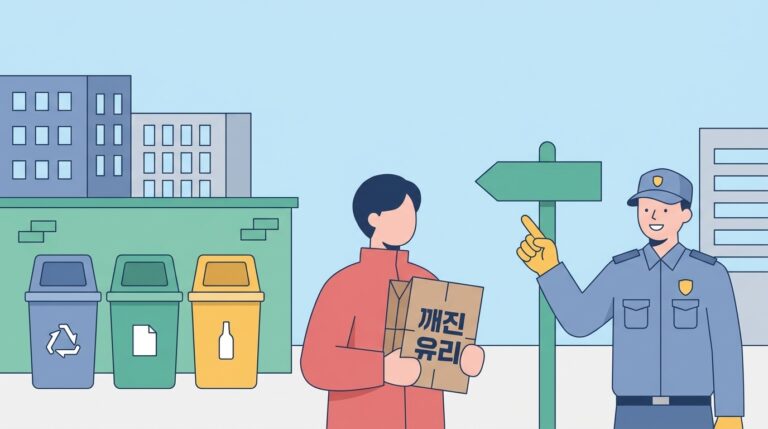
Setting: You are standing near the trash collection zone of your apartment. You are holding a bundle of wrapped broken glass. The building security guard, 경비 아저씨 (Gyeongbi Ajeossi), approaches you with a curious look.
Characters:
* You (A2 Learner): Nervous but polite resident.
* 경비 아저씨 (Security Guard): Friendly but strict guardian of the building’s recycling system.
- 경비 아저씨: 어라, 학생! 손에 들고 있는 거 뭐예요?
(Eora, hak-saeng! Son-e deul-go in-neun geo mwo-yeo-yo?)
(🎭 Curious, pointing gently at your hands)
“Oh, student! What is that you are holding in your hand?” -
You: 아, 아저씨. 이거 깨진 유리가 있어요.
(Ah, a-jeos-si. I-geo kkae-jin yu-ri-ga is-seo-yo.)
(🎭 Bowing slightly, speaking carefully)
“Ah, mister. There is broken glass inside this.” -
경비 아저씨: 아이고, 유리가 깨졌구나. 다치진 않았어요?
(Ai-go, yu-ri-ga kkae-jyeot-gu-na. Da-chi-jin an-at-eo-yo?)
(🎭 Looking concerned)
“Oh dear, the glass broke. You didn’t get hurt, did you?” -
You: 네, 괜찮아요! 신문지에 싸서 안전하게 가져왔어요.
(Ne, gwaen-chan-a-yo! Sin-mun-ji-e ssa-seo an-jeon-ha-ge ga-jyeo-wat-eo-yo.)
(🎭 Smiling reassuringly)
“Yes, I’m okay! I wrapped it in newspaper and brought it safely.” -
경비 아저씨: 잘했네! 근데 그냥 쓰레기봉투에 넣으면 안 돼요. 안 타는 마대 자루 써야 해요.
(Jal-haet-ne! Geun-de geu-nyang sseu-re-gi-bong-tu-e neo-u-myeon an dwae-yo. An ta-neun ma-dae ja-ru sseu-ya hae-yo.)
(🎭 Shaking his head, gesturing toward the general trash bin)
“Good job! But you can’t just put it in the regular trash bag. You must use a non-combustible hemp sack.” -
You: 아… 그렇군요. 혹시 그 마대 자루는 어디서 팔아요?
(Ah… geu-reot-gun-yo. Hok-si geu ma-dae ja-ru-neun eo-di-seo pal-a-yo?)
(🎭 Tilted head, looking curious)
“Ah… I see. By the way, where do they sell those hemp sacks?” -
경비 아저씨: 저기 앞 편의점이나 동네 마트 가면 팔아요. ‘불연성 마대’ 달라고 하세요.
(Jeo-gi ap pyeon-ui-jeom-i-na dong-ne ma-teu ga-myeon pal-a-yo. ‘Bul-yeon-seong ma-dae’ dal-la-go ha-se-yo.)
(🎭 Pointing down the street)
“They sell them at the convenience store across the street or the local mart. Just ask for a ‘Bul-yeon-seong madae’.” -
You: 감사합니다, 아저씨! 지금 바로 갔다 올게요!
(Gam-sa-hap-ni-da, a-jeos-si! Ji-geum ba-ro gat-da ol-ge-yo!)
(🎭 Bowing politely with a bright smile)
“Thank you, mister! I will go and buy it right now!”
🔀 Interactive Choice: What do you do next?
- A) Put it back in your room and ignore it.
- B) Go to the convenience store and ask for “불연성 마대” (Bul-yeon-seong madae).
- C) Throw it in the regular plastic recycling bin when the guard isn’t looking.
Feedback:
- Best Choice (B): Correct! You show cultural respect, stay safe, and practice your new vocabulary!
- Risk Choice (A): Leaving broken glass in your room can cause accidents later. Better solve it today!
- Bad Choice (C): High risk of getting caught on CCTV, receiving a fine of up to 300,000 KRW, and losing the trust of your neighborhood.
Phase 6: 10-Second Emotion Shadowing Drill (10초 감정 섀도잉 드릴)
Practice speaking with real emotional pauses (/ means a brief pause):
[🥺 걱정스럽고 다정하게 - Worried and warm]- 유리 조심하세요! / 다쳐요.
- Yu-ri jo-sim-ha-se-yo! / Da-chyeo-yo.
- “Please be careful of the glass! / You’ll get hurt.”
[❓ 진짜 궁금해하며 - Genuinely curious]- 이거 / 어디에 버려요?
- I-geo / eo-di-e beo-ryeo-yo?
- “This… / where do I throw it away?”
[😊 안도하며 고마운 마음으로 - Relieved and grateful]- 아, / 다행이다! / 정말 감사합니다.
- Ah, / da-haeng-i-da! / Jeong-mal gam-sa-hap-ni-da.
- “Ah, / what a relief! / Thank you so much.”
Phase 7: K-Culture Mini Dictionary (K-컬처 미니 사전)
- 분리수거 (bun-ri-su-geo) | Trash Sorting / Recycling | The systematic separation of waste into plastic, paper, glass, cans, and food. A mandatory daily life skill in Korea.
- 깨진 유리 (kkae-jin yu-ri) | Broken Glass | Glass that is cracked or shattered. Must never be placed in general recycling bins.
- 종량제 봉투 (jong-ryang-je bong-tu) | Government-standard trash bag | Pay-as-you-throw plastic bags issued by specific districts (구). General waste must go here.
- 불연성 마대 (bul-yeon-seong ma-dae) | Non-burnable hemp bag | A heavy-duty bag used for ceramic pots, broken mirrors, or shattered glass.
Phase 8: Survivor’s Kit for Travelers (여행자를 위한 생존 키트)
Survival Phrases TOP 3
- “유리 깨졌어요!” (Yu-ri kkae-jyeot-eo-yo!) – “Glass broke!” (Use when alerting staff at a restaurant or Airbnb.)
- “쓸어 담을 것 좀 있어요?” (Sseul-eo dam-eul geot jom is-seo-yo?) – “Do you have something to sweep this up with?” (To ask for a broom/dustpan.)
- “이거 그냥 버려도 돼요?” (I-geo geun-yang beo-ryeo-do dwae-yo?) – “Can I just throw this away like this?” (To double-check with host or clerk.)
Editor’s Travel Note 🗺️
If you are staying in an Airbnb or temporary rental, finding these bags can be tough. Don’t wander aimlessly! Open the Naver Map App on your phone and search for the nearest 주민센터 (Jumin Center / Community Service Center) or 편의점 (Convenience Store). You can show the clerk this phrase on your screen: “불연성 쓰레기 마대봉투 있어요?” to find the right bag immediately.
Phase 9: “One Step Deeper” Humanities Essay (한 발 더 깊이)
In many Western countries, broken glass is simply wrapped and put into the general waste bin. However, in South Korea, the extreme density of urban areas like Seoul requires a highly cooperative waste disposal system.
Koreans place a massive emphasis on 공동체 의식 (gong-dong-che ui-sik – community consciousness). When a Korean carefully wraps broken glass in newspaper, writes a warning note, and buys a special non-burnable bag, they are not just avoiding a fine. They are actively protecting the safety of the neighborhood sanitation workers (환경미화원 – Hwangyeongmihawon). It is a silent, beautiful conversation of respect and care between neighbors.
💬 Your Turn: How does trash sorting in your country compare to Korea’s meticulous system? Have you ever felt the warmth of Korean ‘Nunchi’ in your neighborhood? Share your stories in the comments below!
Phase 10: FAQ & Misconception Prevention (FAQ & 오해 방지)
Q: Can I put broken beer or soy sauce bottles into the glass recycling bin?
A: No! While unbroken bottles go into glass recycling (and can even get you a tiny deposit refund at supermarkets), broken glass loses its recycling value and poses a safety hazard. It must be treated as non-burnable general waste and disposed of in a special bag.
Q: What happens if I can’t find a “불연성 마대” (non-burnable bag) at my local store?
A: Not all small convenience stores stock them. If your local shop doesn’t have it, head to a larger local supermarket (식자재마트) or visit your neighborhood’s 주민센터 (Community Center). They are guaranteed to sell them there.
Q: Can I use thick cardboard boxes instead of newspaper?
A: Yes! Wrapping the glass in thick cardboard and securing it with tape is an excellent alternative to newspaper. Just make sure no sharp edges poke through.
🚨 Common Mistakes Alert!
| Mistake (실수) | Danger (위험성) | Correct Action (올바른 방법) |
|---|---|---|
| Throwing glass in a regular plastic bag | The bag will rip, spilling trash and glass everywhere. | Wrap in newspaper first, then use a non-burnable bag. |
| Hiding glass under general garbage | Sanitation workers can get seriously cut or injured. | Write “깨진 유리” (Broken Glass) on the outside of the bag. |
| Throwing lightbulbs in glass recycling | Lightbulbs contain hazardous chemicals like mercury. | Take them to designated recycling boxes inside apartment blocks. |
Phase 11: Action Mission & Participation (액션 미션)
Ready to put your knowledge to the test? Complete these three missions!
- 🥉 Bronze Mission: Practice saying “조심하세요!” three times out loud with your best dramatic actor voice!
- 🥈 Silver Mission: Next time you visit a Korean convenience store, try to find where they keep the 종량제 봉투 (government trash bags) and see if they have the heavy-duty 마대자루 (hemp bags).
- 🥇 Gold Mission: Snap a photo of a Korean trash sorting zone or a well-wrapped recycling package, post it on your Instagram, tag @Daily_Hangul, and use the hashtag #DailyHangulRecycling!
Phase 12: Interactive Quiz Challenge (인터랙티브 퀴즈)
Test your survival skills!
Quiz 1: What is the correct way to say “Be careful” in a polite, real-life scenario?
- A) 조심해
- B) 조심하십시오
- C) 조심하세요
Reveal Answer & Explanation
Correct Answer: C
Explanation: While “조심해” (A) is too casual for strangers, and “조심하십시오” (B) is overly formal like a sign board, “조심하세요” (C) is the perfect, friendly, polite phrase for daily situations!
Quiz 2: Fill in the blank:
“유리가 깨졌을 때는 _________에 싸서 안전하게 버려야 해요.”
* Hint: It means “newspaper.”
Reveal Answer & Explanation
Correct Answer: 신문지 (sin-mun-ji)
Explanation: Wrapping the glass in 신문지 (newspaper) prevents it from puncturing the garbage bags!
Quiz 3: True or False?
“You can throw broken glass into the standard plastic general trash bag (종량제 봉투) if it is small.”
Reveal Answer & Explanation
Correct Answer: False!
Explanation: Even small pieces of broken glass can cut through plastic bags easily. They should be wrapped securely and disposed of in non-burnable waste bags (불연성 마대) to prevent accidents.






