

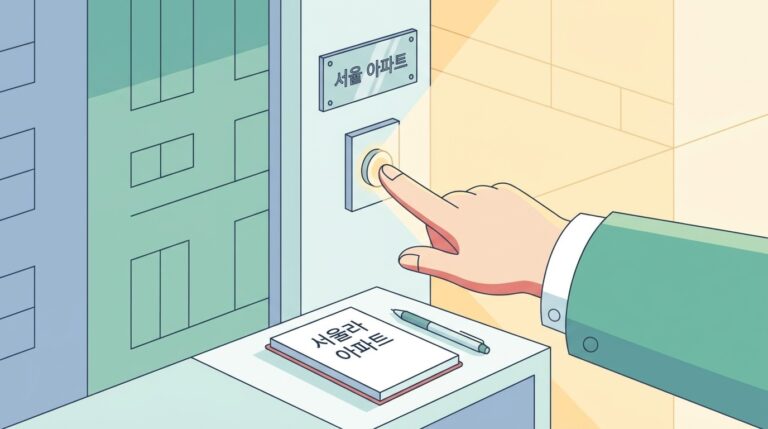
Ringing the Doorbell in Korea: How to Say “It’s Me!” Naturally
Phase 1: Welcome! Let’s Beat the Intercom Anxiety
안녕하세요! (Annyeonghaseyo!) I’m your Daily Hangul senior editor and your trusted K-culture navigator.
Imagine this: You finally travel to Seoul, and your Korean friend, Minji, invites you to her cozy apartment for a delicious home-cooked meal (집밥 – jipbap). You find her apartment building, take the elevator to the 12th floor, and stand right in front of her door. You see the modern intercom screen, take a deep breath, and press the bell.
Suddenly, a voice crackles through the speaker: “누구세요? (Nugu-seyo? / Who is it?)”
Your mind goes blank. Should you say your name? Should you say “It’s me” in formal Korean?
Don’t worry! This is a classic “intercom panic” moment that many of our global learners face. Today, we’ll teach you the exact, natural phrases to use so you sound like a polite, confident local when visiting a friend. Let’s dive in!
Phase 2: Three Core Expressions to Save Your Day
1. 저예요! (Jeo-ye-yo!)
- Pronunciation: [juh-yeh-yo] (Sounds like “juh” as in ‘just’ + “yeh-yo”)
- Meaning: It’s me!
- K-Culture Moment: In K-Dramas, when a character stands outside their crush’s apartment, they press the intercom and softly say, “저예요…” with a hopeful smile.
- Editor’s Insight: “저” (jeo) is the polite way to say “I/me”. Even when visiting a close friend, “저예요” is the perfect, default response because speaking through an intercom can feel a little public. It is polite yet incredibly warm!
- Situation Spectrum: Casual ✅ / Semi-formal ✅ / Formal ⚠️
- 🤔 Think About It: Why do you think Koreans use the polite “저” instead of the casual “나” (na) when speaking into an intercom? It’s a beautiful way of keeping a gentle, respectful boundary while identifying yourself!
2. [Name] 왔어요! ([Name] wass-eo-yo!)
- Pronunciation: [[Name]-i wat-suh-yo] (e.g., “사라 왔어요!” – Sarah wass-eo-yo!)
- Meaning: [Name] is here! / [Name] has arrived!
- K-Culture Moment: You’ll hear this constantly in family dramas when kids return home, or when a best friend pops over with a box of fried chicken.
- Editor’s Insight: If your name ends with a consonant (like Ji-won), add “이” to make it “지원이 왔어요!” (Ji-won-i wass-eo-yo!). If it ends with a vowel (like Sarah), just say “사라 왔어요!”. It sounds bright, energetic, and excited!
- Situation Spectrum: Casual ✅ / Semi-formal ✅ / Formal 🚫
- 🤔 Think About It: In English, saying “Sarah is here!” in the third person can sound a bit childish. But in Korean, stating your name like this sounds friendly and enthusiastic. Isn’t that fascinating?
3. 문 열어 주세요. (Mun yeol-eo ju-se-yo.)
- Pronunciation: [moon yuhl-uh joo-seh-yo] (Sounds like “moon” + “yuhl-uh” + “joo-seh-yo”)
- Meaning: Please open the door.
- K-Culture Moment: Often said by delivery drivers or friends holding heavy bags of groceries who need quick access.
- Editor’s Insight: “문” (mun) means door, and “열어 주세요” (yeol-eo ju-se-yo) means “please open for me.” It’s the standard, polite request format. Use this right after you say who you are!
- Situation Spectrum: Casual ⚠️ / Semi-formal ✅ / Formal ✅
- 🤔 Think About It: The grammatical pattern “~아/어 주세요” is the ultimate key to asking for favors politely in Korea. Keep this in your linguistic pocket!
Phase 3: Textbook Korean vs. Real-Life Korean
Let’s compare what you find in old textbooks with what native speakers actually say on the streets of Seoul.
Situation 1: Telling them who you are
- 📖 Textbook: “저는 마이클입니다.” (Jeon-eun Michael-im-ni-da. / I am Michael.)
- 🗣️ Real Korean: “마이클 왔어요!” (Michael wass-eo-yo! / Michael is here!)
- 💡 Why the difference? The textbook version is grammatically correct but sounds like a robot reporting for a job interview. Real Koreans prefer the cozy, warm vibe of “왔어요” (I’ve arrived/come).
Situation 2: Asking to be let in
- 📖 Textbook: “문을 개방해 주십시오.” (Mun-eul gae-bang-hae ju-sip-si-o. / Please open the gateway.)
- 🗣️ Real Korean: “저 도착했어요! 문 열어 주세요~” (Jeo do-chak-haess-eo-yo! Mun yeol-eo ju-se-yo~ / I’ve arrived! Please open the door~)
- 💡 Why the difference? Nobody talks like a military manual in real life! Adding a sweet “~” at the end of your voice softens your tone instantly.
Phase 4: K-Culture Deep Dive & Non-Verbal Etiquette
4-1. Nunchi & Camera Eye Contact
Most Korean apartments (아파트 – a-pa-teu) use advanced smart home wallpads. When you press the bell, the camera activates.
* The Tip: Stand about one step back so the camera can capture your beautiful face clearly. Look directly at the tiny camera lens and give a sweet wave. If you stand too close, all your friend will see is a giant forehead on their screen!
4-2. The Digital Door Lock Code (비밀번호 – Bimil-beonho)
In K-Dramas, you might see characters walk up to a door and immediately press a passcode to enter without ringing. This is common among family or absolute best friends. However, unless your friend specifically text-messaged you the code, always ring the doorbell first. Respecting privacy is extremely important in Korean culture!
Phase 5: Real-Life Roleplay Scenario
- Background: You are visiting your Korean friend Sujin’s apartment for a cozy movie night. You’ve just stepped out of the elevator on the 10th floor.
- Characters: Sujin (Your Friend) and You (Sarah)
Sujin: (Ding-dong~ Intercom ring) 누구세요? (Nugu-seyo?) [Who is it?]
You: 🎭 Smiling and waving at the camera 저예요, 수진 씨! 사라 왔어요! (Jeo-ye-yo, Sujin-ssi! Sarah wass-eo-yo!) [It’s me, Sujin! Sarah is here!]
Sujin: 아, 사라! 반가워요. 금방 열어 줄게요. 잠시만요! (Ah, Sarah! Ban-ga-wo-yo. Geum-bang yeol-eo jul-ge-yo. Jam-si-man-yo!) [Ah, Sarah! Good to see you. I’ll open it right away. Just a moment!]
You: 🎭 Nodding cheerfully 네, 천천히 하세요! (Ne, cheon-cheon-hi ha-se-yo!) [Sure, take your time!]
Sujin: (The electronic lock clicks open) 어서 와요! (Eoseo wa-yo!) [Come on in!]
🔀 Choose Your Path!
What would you say if Sujin asks “누구세요?” over the speaker?
- Option A: “저기요! 문 열어!” (Jeo-gi-yo! Mun yeol-uh!)
- Feedback: 🚫 Risk! “저기요” is what you yell at waiters, and “문 열어” is very informal ban-mal. Sujin might be shocked by the sudden bossy tone!
- Option B: “저예요, 사라 왔어요! 문 열어 주세요~” (Jeo-ye-yo, Sarah wass-eo-yo! Mun yeol-eo ju-se-yo~)
- Feedback: 🌟 Best! Polite, natural, friendly, and perfectly structured.
- Option C: “저는 외국인 사라입니다. 개방해 주십시오.” (Jeon-eun oegugin Sarah-im-ni-da. Gae-bang-hae ju-sip-si-o.)
- Feedback: ⚠️ Bad. Too formal and mechanical. Sujin might think a robot is trying to hack her home!
Phase 6: 10-Second Emotion Shadowing Drill
Let’s practice the pitch and flow! Use the emotional guide to speak like a native speaker:
[😊 Bright & Excited]저예요! / 사라 왔어요!- [Jeo-ye-yo! / Sarah / wass-eo-yo!]
[🥺 Polite & Friendly]문 / 열어 주세요~- [Mun / yeol-eo / ju-se-yo~]
[👋 Patient & Calm]네, / 천천히 하세요!- [Ne, / cheon-cheon-hi / ha-se-yo!]
(Note: The / marks represent natural pauses where you can take a tiny breath.)
Phase 7: K-Culture Mini Dictionary
- 초인종 (Choinjong) | Doorbell | The physical button located outside a house or apartment unit.
- 월패드 (Wall-pad) | Smart screen | The smart tablet mounted on the living room wall used to view visitors.
- 도어락 (Door-lock) | Digital door lock | Keyless electronic door locks standard in almost all Korean homes.
- 현관 (Hyeon-gwan) | Entryway | The small entrance area where you must take off your shoes before entering a home.
Phase 8: Survival Kit for Travelers
Survivor Phrases TOP 3:
- 몇 호예요? (Myeot ho-ye-yo?) – “Which unit number is it?” (Essential for finding the right door in massive complexes!)
- 배달 왔습니다! (Baedal wass-seub-ni-da!) – “Delivery is here!” (What you will hear if you order late-night Korean fried chicken.)
- 잠시만요! (Jam-si-man-yo!) – “Just a moment!” (Say this if you are inside and someone rings your bell while you are busy.)
📌 Editor’s Travel Note:
To find your friend’s exact apartment block, Google Maps can be unreliable in Korea. Make sure to download the Naver Map App for flawless walking directions inside complex residential zones!
Disclaimer: App features and actual navigation systems may update over time.
Phase 9: Go One Step Deeper
In western cultures, a doorbell is just a bell. But in Korea, modern high-rise apartments have turned the intercom into a vital boundary of security and social manners. Expressing your identity with warmth and politeness before stepping into the “현관” (hyeon-gwan) is a beautiful way of honoring your host’s personal sanctuary.
💬 Your Turn!
Have you ever used an intercom in Korea, or do you have digital door locks in your country? Let us know in the comments below!
Phase 10: FAQ & Avoiding Common Mistakes
Q: Can I just knock on the door instead of pressing the bell?
A: Yes, but modern Korean apartment doors are heavy and soundproofed. A light knock (똑똑 – ddok-ddok) is often hard to hear from the living room. Pressing the bell once is always the best option!
Q: What if my friend doesn’t answer the intercom but I know they are home?
A: Send a quick KakaoTalk message! They might be cooking or drying their hair and couldn’t hear the chime.
Q: Do I really have to take off my shoes?
A: Absolutely! Even if the host says “Oh, you don’t have to!” out of politeness, you must take off your shoes in the entryway (현관) before stepping onto the clean wooden floor.
🚨 Common Mistakes Alert!
- Mistake: Yelling “나야!” (Na-ya! – It’s me!) to an acquaintance.
- Correct Action: Use the polite “저예요!” (Jeo-ye-yo!) instead to sound warm yet respectful.
- Mistake: Pressing the doorbell repeatedly (Ding-dong-ding-dong-ding-dong!).
- Correct Action: Press it once and wait at least 30 seconds. Repeated ringing is considered very rude.
- Mistake: Standing too close to the video camera.
- Correct Action: Step back a little so they can see your friendly face on their wall pad screen.
Phase 11: Action Missions
- Bronze Medal: Look in the mirror and practice saying “저예요!” with your brightest smile 5 times.
- Silver Medal: Take a photo of your front door, post it on social media, and write: “저 왔어요! 문 열어 주세요! 🚪 #DailyHangul”.
- Gold Medal: The next time you practice Korean with a tutor or friend, use the full roleplay sequence from this guide!
🎮 K-Culture Mission:
Watch any slice-of-life K-drama (like Reply 1988 or Hospital Playlist). Listen closely for the sound of the digital door lock opening and try to spot the characters saying “나 왔어!” (I’m home!) or “왔어요!”.
Phase 12: Interactive Quiz Challenge
Quiz 1: What is the most natural way to say “Sarah is here!” through the intercom to a friend?
- A) 저는 사라입니다. (Jeon-eun Sarah-im-ni-da.)
- B) 사라 왔어요! (Sarah wass-eo-yo!)
- C) 사라가 존재합니다. (Sarah-ga jon-jae-ham-ni-da.)
Click here for the Answer & Explanation
Correct Answer: B
“사라 왔어요!” is warm, casual, and perfectly natural.
* Option A is way too formal and stiff.
* Option C translates to “Sarah exists,” which sounds like a sci-fi movie line!
Quiz 2: True or False?
In Korea, it is polite to keep pressing the doorbell continuously if your friend doesn’t answer in 5 seconds.
Click here for the Answer & Explanation
Correct Answer: False
Pressing the bell repeatedly is considered impolite. Always ring once, wait patiently, and send a text message if needed!







