

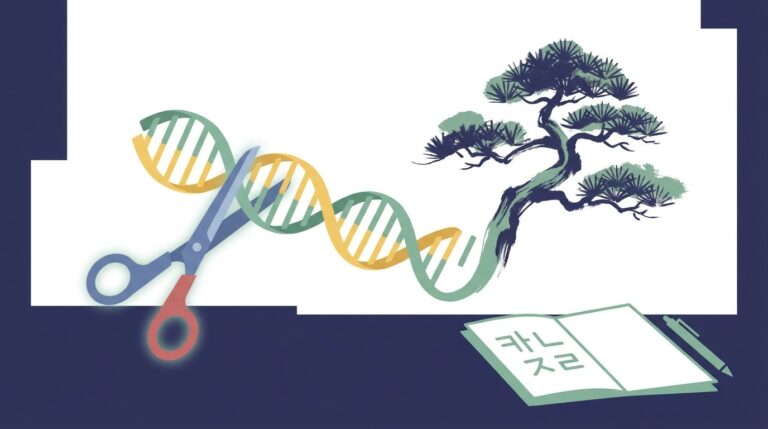
Playing God? How to Debate Gene Editing in Korean Like a Seoul Tech Insider
Phase 1: Empathy (스토리 몰입형 오프닝)
안녕하세요! Your premium Korean culture navigator and editor from 매일한글 (Daily Hangul) is back!
Imagine you are sitting in a sleek café in Pangyo (South Korea’s Silicon Valley), surrounded by brilliant tech minds. The conversation shifts from K-dramas to the mind-bending ethical questions raised by sci-fi series like SF8 or The Silent Sea. Someone brings up CRISPR-Cas9 (유전자 가위) and biotechnology. You want to jump in, but your mind goes blank.
Many of my C1-level students tell me, “I can gossip about daily life, but when the topic shifts to advanced science or bioethics, my Korean vocabulary feels like a toddler’s!”
Today, we are going to fix that. We will bridge the gap between textbook dry terminology and the highly sophisticated, nuanced debate language used by native Koreans. By the end of this guide, you won’t just know the words; you’ll understand the cultural boundaries of discussing high-tech biology in Korea.
Phase 2: Deep Dive into 3 Key Expressions (핵심 표현 3선 심층 분석)
1. 신의 영역에 도전하다 (sin-ui yeong-yeok-e do-jeon-ha-da)
- Pronunciation: Sin-ui yeong-yeok-e do-jeon-ha-da (Sounds like: “Seen-wee young-yuck-eh doh-jun-hah-dah”)
- Meaning: Literally “To challenge the realm of God.” It is used to describe scientific advancements that alter the natural order of life.
- K-Culture Moment: You will hear this phrase in almost every investigative journalism program like SBS 그것이 알고 싶다 (I Want to Know That) or scientific debate panels when discussing cloning or gene editing.
- Editor’s Insight: Even though modern Korea is highly secular and technologically advanced, the phrase “신의 영역” represents the ultimate boundaries of nature that humans should approach with deep reverence.
- Situation Spectrum: Casual (⚠️ – too dramatic for daily chores), Semi-formal (✅), Formal (✅)
- 🤔 Think About It: Does your native culture use “playing God” in the same cautionary way, or does it focus more on human autonomy?
2. 윤리적 문턱을 넘다 (yun-ri-jeok mun-teok-eul neom-da)
- Pronunciation: Yun-ri-jeok mun-teok-eul neom-da (Sounds like: “Yoon-ree-juck moon-tuck-eul num-dah”)
- Meaning: To cross the ethical threshold (or boundary).
- K-Culture Moment: Used by bioethicists on talk shows like Alssinjap (알쓸신잡 – Encyclopedia of Useless Facts) when discussing where scientific research should stop.
- Editor’s Insight: “문턱” means threshold. In Korean culture, crossing a physical or metaphorical threshold carries heavy weight. It signifies entering a territory from which you cannot easily return.
- Situation Spectrum: Casual (🚫), Semi-formal (✅), Formal (✅)
- 🤔 Think About It: What constitutes an “ethical threshold” in your home country when it comes to human DNA modification?
3. 맞춤형 아기 (mat-chum-hyeong a-gi)
- Pronunciation: Mat-chum-hyeong a-gi (Sounds like: “Maht-choom-hyung ah-ghee”)
- Meaning: Designer baby (Literally, “custom-tailored baby”).
- K-Culture Moment: Often discussed in high-society sci-fi dramas where wealthy parents genetically design their offspring to excel in academics and physical traits.
- Editor’s Insight: The word “맞춤형” (customized/tailored) is usually positive in Korea (e.g., customized skincare, tailored suits). However, when paired with “아기” (baby), it instantly triggers a debate on extreme social inequality and genetic determinism.
- Situation Spectrum: Casual (✅), Semi-formal (✅), Formal (✅)
- 🤔 Think About It: In Korea, where academic competition is fierce, why do you think the concept of “맞춤형 아기” causes so much societal anxiety?
Phase 3: Textbook Korean vs. Real Korean (교과서 한국어 vs 진짜 한국어)
Situation 1: Expressing the risks of gene editing
- 📖 Textbook Korean: “유전자 변형은 예상치 못한 부작용을 초래할 수 있습니다.” (Genetic modification can cause unexpected side effects.)
- 🗣️ Real Korean: “유전자 가위는 진짜 양날의 검 같아요. 잘못 쓰면 완전 걷잡을 수 없게 되잖아요.” (Gene editing is really a double-edged sword. If used incorrectly, it will completely spiral out of control.)
- 💡 Why the difference? While the textbook version is grammatically flawless, native speakers use idiomatic expressions like “양날의 검” (double-edged sword) and “걷잡을 수 없다” (unstoppable/out of control) to add emotional weight and natural flow to their arguments.
Situation 2: Expressing skepticism about biotechnology hype
- 📖 Textbook Korean: “생명공학의 상업화에 대해 반대합니다.” (I oppose the commercialization of biotechnology.)
- 🗣️ Real Korean: “아무리 과학이 발달해도 유전자까지 돈으로 사는 건 선 넘은 것 같아요.” (No matter how advanced science gets, buying genes with money feels like crossing the line.)
- 💡 Why the difference? Koreans love the phrase “선 넘다” (crossing the line). It’s a highly versatile, conversational way to describe an ethical, social, or personal boundary breach without sounding overly academic.
Phase 4: K-Culture Deep Dive & Non-Verbal Manners (K-Culture 딥다이브)
4-1. The Art of the “Cautious Nod” and “Tilted Head”
When discussing sensitive scientific topics like gene editing in Korea, non-verbal cues are critical.
* The Cautious Gesture: Do not point fingers or make aggressive chopping motions with your hands. Instead, keep your palms open and slightly face-up when presenting an argument.
* The Head Tilt (고개 갸웃하기): When you disagree with someone’s bioethical stance, do not say “그건 틀렸어요” (That’s wrong). Instead, tilt your head slightly and say “그럴 수도 있겠지만…” (That might be true, but…). This shows intellectual humility, a highly valued trait in Korean debate circles.
4-2. K-Sci-Fi and the Fear of Genetic Divide
In dramas like SF8 (specifically the episode ‘Joan’s Galaxy’), Korea explores a future where society is divided into ‘C’ (clean/genetically edited) and ‘N’ (non-edited). This reflects South Korea’s real-life anxieties regarding the wealth gap and educational competitive pressure (입시 지옥). Genetic engineering is rarely viewed just as a health tool; it is culturally viewed through the lens of social mobility and fairness.
Phase 5: Real-Life Roleplay Scenario (실전 롤플레이)
Setting: A trendy rooftop lounge in Seoul. Jimin (a bioethicist who values natural order) and Minwoo (an enthusiastic biotech startup founder) are having a passionate debate over craft beers.
- 지민: 민우 씨, 유전자 가위 기술이 질병 치료를 넘어 인류를 인위적으로 설계하는 단계까지 가면 어떡해요? 이건 진짜 신의 영역에 도전하는 것 같아요.
(Minwoo, what if CRISPR technology goes beyond treating diseases to the point of artificially designing humans? I really feel like this is challenging the realm of God.) - 민우: 🎭 (맥주 잔을 만지며 열정적으로) 하지만 난치병으로 고통받는 사람들을 그대로 두는 것도 방관 아닌가요? 과학으로 살릴 수 있다면 해야죠!
(Touching his beer glass, passionately: But isn’t it also bystander apathy to leave those suffering from incurable diseases? If we can save them with science, we must!) - 지민: 🎭 (고개를 가볍게 저으며) 치료는 당연히 해야죠. 하지만 부유층만 맞춤형 아기를 가질 수 있게 된다면, 그 사회적 불평등은 어떻게 감당할 건가요? 결국 윤리적 문턱을 넘는 순간 돌아올 수 없어요.
(Shaking her head gently: Treatment, of course, we must do. But if only the wealthy can have designer babies, how will we handle that social inequality? Once we cross the ethical threshold, there’s no turning back.) - 민우: 그 경계를 정하는 게 법과 규제의 역할이죠. 기술 자체를 막을 수는 없어요.
(Setting that boundary is the role of law and regulation. We cannot stop technology itself.)
🔀 Interactive Choice: How do you respond to Minwoo?
- Option A: “기술 발전은 막을 수 없으니, 일단 개발하고 나중에 생각해요.”
- Option B: “민우 씨 말도 일리가 있지만, 생명 윤리는 한 번 무너지면 걷잡을 수 없게 돼요.”
- Option C: “과학자들은 항상 무책임하게 기술만 개발하려고 하는 것 같아요.”
💡 Feedback:
- Best Choice (Option B): Excellent! You acknowledged his point (“일리가 있지만” – has a point) and used the advanced expression “걷잡을 수 없게 돼요” to state your bioethical concern naturally. Highly persuasive and polite.
- Risk Choice (Option A): Too reckless. While grammatically correct, it completely disregards the ethical consensus-driven tone preferred in Korean intellectual debates.
- Bad Choice (Option C): Too aggressive. Using “무책임하게” (irresponsibly) directly attacks Minwoo’s profession, which violates the Korean politeness code of protecting the other person’s * 체면 (face).
Phase 6: 10-Second Shadowing Drill (10초 감정 섀도잉)
Practice the rhythm, pauses (/), and emotional nuance of this high-level phrase. Speak it out loud!
“[🤔 신중하고 진지하게] 아무리 / 과학이 발달해도 / 인간이 / 신의 영역에 / 도전해서는 / 안 된다고 생각해요.”
- Pronunciation Guide: A-mu-ri / gwa-hak-i bal-dal-hae-do / in-gan-i / sin-ui yeong-yeok-e / do-jeon-hae-seo-neun / an doen-da-go saeng-gak-hae-yo.
- English Concept: “No matter how / science advances, / I believe / humans / should not / challenge / the realm of God.”
Phase 7: K-Culture Mini Dictionary (미니 사전)
- 유전자 가위 (yu-jeon-ja ga-wi): CRISPR Gene Editing Technology. (Literally, “gene scissors”).
- 생명 윤리 (saeng-myeong yun-ri): Bioethics. A major keyword in news discussions about clinical trials.
- 난치병 (nan-chi-byeong): Intractable/incurable disease. Used constantly in biotech PR articles.
- 특이점 (teuk-i-jeom): The Singularity. Commonly used by tech-savvy young Koreans to describe a paradigm-shifting moment (e.g., “AI가 이제 특이점을 넘었네요” – AI has now crossed the singularity).
Phase 8: Traveler’s Survival Kit (여행자를 위한 생존 키트)
Are you visiting Korea to attend a tech expo like the Korea Science Festival (대한민국 과학축제) or a medical conference? Here are your survival tools!
Survival Vocab TOP 3
- 등록처가 어디예요? (Deung-rok-cheo-ga eo-di-yeo-yo?) – Where is the registration desk?
- 동시통역기가 필요해요. (Dong-si-tong-yeok-gi-ga pil-yo-hae-yo.) – I need a simultaneous interpretation headset.
- 팜플렛 하나 얻을 수 있을까요? (Pam-pleut ha-na eo-deul su isseu-kka-yo?) – Can I get a pamphlet?
🧭 Editor’s Travel Note:
To navigate massive convention centers like COEX in Seoul or BEXCO in Busan, do not rely on standard international maps. Download the Naver Map App (네이버 지도) to find specific exhibition hall exits, nearby trendy restaurants, and the fastest subway lines. Disclaimer: App interfaces and station configurations are subject to change by local municipal offices.
Phase 9:
Frequently Asked Questions (FAQ)
Q: What does "신의 영역에 도전하다 (sin-ui yeong-yeok-e do-jeon-ha-da)" mean in Korean and how do you pronounce it?
A: In Korean, "신의 영역에 도전하다 (sin-ui yeong-yeok-e do-jeon-ha-da)" is pronounced [Sin-ui yeong-yeok-e do-jeon-ha-da (Sounds like: "Seen-wee young-yuck-eh doh-jun-hah-dah"] and means: Literally "To challenge the realm of God." It is used to describe scientific advancements that alter the natural order of life.
Q: What does "윤리적 문턱을 넘다 (yun-ri-jeok mun-teok-eul neom-da)" mean in Korean and how do you pronounce it?
A: In Korean, "윤리적 문턱을 넘다 (yun-ri-jeok mun-teok-eul neom-da)" is pronounced [Yun-ri-jeok mun-teok-eul neom-da (Sounds like: "Yoon-ree-juck moon-tuck-eul num-dah"] and means: To cross the ethical threshold (or boundary).
Q: What does "맞춤형 아기 (mat-chum-hyeong a-gi)" mean in Korean and how do you pronounce it?
A: In Korean, "맞춤형 아기 (mat-chum-hyeong a-gi)" is pronounced [Mat-chum-hyeong a-gi (Sounds like: "Maht-choom-hyung ah-ghee"] and means: Designer baby (Literally, "custom-tailored baby").







