

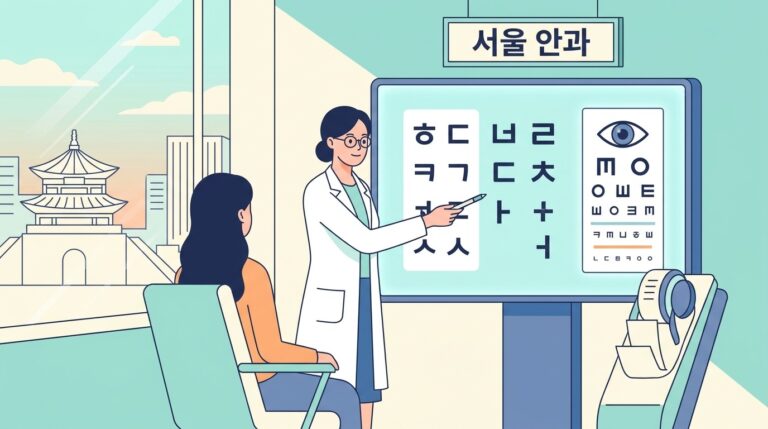
Beyond the Lens: Navigating LASIK, LASEK, and Eye Clinics in Seoul Like a Local
Phase 1: Empathy (An Eye-Opening Confession)
안녕하세요! Welcome back to another masterclass with Daily Hangul. I’m your senior editor and resident cultural navigator.
If you have spent even a week walking around Seoul—or binge-watching high-production K-Dramas like Hospital Playlist—you have likely noticed something striking: almost everyone seems to have flawless, dewy skin, and brilliantly clear eyes. Yet, South Korea also has some of the highest myopia (nearsightedness) rates in the world. How do we reconcile this?
The answer lies in the country’s world-famous medical tourism hub, specifically in the bustling alleys of Gangnam and Apgujeong, where vision correction surgeries—namely LASIK (라식) and LASEK (라섹)—are performed with military efficiency and cutting-edge tech.
Let me share a quick story. Last year, one of our brilliant C2-level students, Julian, an academic from London who speaks fluent Korean, decided it was time to ditch his thick glasses before embarking on a nationwide culinary trail. He walked into a hyper-trendy, multi-story eye clinic in Gangnam, confident in his language skills. Yet, the moment the clinical coordinator (실장님) bombarded him with terms like “glares and starbursts” (빛 번짐), “dry eye syndrome” (안구건조증), and “customized wavefront optimization,” Julian completely froze. He realized that textbook Korean had not prepared him for the hyper-commercialized, fast-paced world of Korean elective surgery.
By mastering the nuanced, high-level vocabulary of ophthalmology and clinical advocacy, you don’t just protect your precious vision—you command respect as an informed, sovereign patient. Let’s make sure you never feel lost in translation when it comes to your health.
Phase 2: Deep Dive into 3 Core Advanced Expressions
1. 부작용을 꼼꼼히 따져봐야 해요 (bu-jak-yong-eul kkom-kkom-hi tta-jyeo-bwa-ya hae-yo)
- Pronunciation: Bu-jak-yong-eul kkom-kkom-hi tta-jyeo-bwa-ya hae-yo / [Sound Analogy: “Boo-jack-yong-ool kkoam-kkoam-hee ttah-jyo-bwah-yah hae-yo”]
- Meaning: You must meticulously weigh and investigate the potential side effects.
- K-Culture Moment: This expression is a staple in medical thrillers where an analytical protagonist refuses to accept a hasty diagnosis, or when a protective Korean mother warns her child before any major cosmetic procedure.
- Editor’s Insight: The adverb 꼼꼼히 (meticulously/scrupulously) combined with 따지다 (to inquire sharply, calculate, or weigh options) shifts the tone from passive listening to active, analytical scrutiny. It shows the clinic that you are not a naive consumer.
- Situation Spectrum:
- Casual (Friends): ✅ (Expressing concern)
- Semi-formal (Clinic staff): ✅
- Formal (Consulting doctor): ✅
- 🤔 Think About It: Why does Korean society emphasize 꼼꼼히 따지다 in medical consumerism? Reflect on how Korea’s rapid transition to private-heavy healthcare has empowered consumers to act more like sharp buyers than passive patients.
2. 과잉 진료 없는 안과를 찾고 있어요 (gwa-ing jin-ryo eop-neun an-gwa-reul chat-go isseo-yo)
- Pronunciation: Gwa-ing jin-ryo eop-neun an-gwa-reul chat-go isseo-yo / [Sound Analogy: “Gwah-ing jeen-ryo up-noon ahn-gwah-reul chat-go eet-suh-yo”]
- Meaning: I am looking for an ophthalmology clinic that does not practice over-treatment (unnecessary medical procedures).
- K-Culture Moment: This phrase is highly valued on Korean community forums like Mom’s Diary or local Naver cafes where residents share “real, honest” medical reviews.
- Editor’s Insight: 과잉 진료 (over-treatment/over-prescribing) is a highly sensitive topic in Korea’s highly competitive medical market. Using this phrase instantly signals that you are savvy, culturally integrated, and aware of commercial medical traps.
- Situation Spectrum:
- Casual (Friends): ✅
- Semi-formal (Reception): ⚠️ (Use cautiously; it signals high skepticism)
- Formal (Doctor): 🚫 (Directly accusing a doctor of 과잉 진료 can harm rapport)
- 🤔 Think About It: How does your home country regulate elective surgeries compared to South Korea’s highly commercialized aesthetic-functional medicine markets?
3. 사후 관리 보장 여부를 확인하세요 (sa-hu gwan-ri bo-jang yeo-bu-reul hwa-gin-ha-se-yo)
- Pronunciation: Sa-hu gwan-ri bo-jang yeo-bu-reul hwa-gin-ha-se-yo / [Sound Analogy: “Sah-hoo gwan-ree bo-jahng yuh-boo-reul hwah-geen-hah-seh-yo”]
- Meaning: Please verify whether post-operative follow-up care is fully guaranteed.
- K-Culture Moment: Often heard in consumer advocacy programs on TV, or seen in the fine print of premium medical contracts in Korea.
- Editor’s Insight: 사후 관리 (post-management/aftercare) is the battleground of Korean customer service. Because Korean clinics operate at lightning speed, ensuring a legally or contractually backed guarantee (보장 여부) is crucial for long-term safety.
- Situation Spectrum:
- Casual (Friends): ✅
- Semi-formal (Clinic coordinator): ✅ (Essential to ask during consultation)
- Formal (Official contract signing): ✅
- 🤔 Think About It: In Korean, 사후 literally means “after-death” but in commercial/medical contexts, it simply means “post-event.” How does this dramatic phrasing highlight the gravity Koreans place on lifetime support?
Phase 3: Textbook Korean vs. Real-World Korean Showcase
When navigating Korean medical spaces, textbook formulations can make you sound overly academic or detached, whereas real-world clinical slang gets you direct, honest answers.
Situation 1: Inquiring about post-op side effects
- 📖 Textbook Korean: 라식 수술을 하면 부작용이 있습니까?
(Ra-sik su-sul-eul ha-myeon bu-jak-yong-i it-seup-ni-ka?)
“Are there side effects if I undergo LASIK?” - 🗣️ Real Korean: 수술 후에 안구건조증이나 빛 번짐이 심할까 봐 걱정돼요.
(Su-sul hu-e an-gu-geon-jo-jeung-i-na bit beon-jim-i sim-hal-kka bwa geok-jeong-dwae-yo.)
“I’m worried that dry eyes or starbursts/glare will be severe after the surgery.” - 💡 Why the difference? The textbook phrase asks a broad, almost rhetorical question. The real-world phrase targets the actual, most common side effects (안구건조증, 빛 번짐), showing you have done your research.
Situation 2: Asking if the surgeon is experienced or if it’s a “factory clinic”
- 📖 Textbook Korean: 의사가 눈 수술 경험이 많습니까?
(Ui-sa-ga nun su-sul gyeong-eom-i man-seup-ni-ka?)
“Does the doctor have a lot of experience in eye surgery?” - 🗣️ Real Korean: 여기 혹시 페이닥터 안 쓰고 원장님이 직접 집도하시나요?
(Yeo-gi hok-si pe-i-dak-teo an sseu-go won-jang-nim-i jik-jeop jip-do-ha-si-na-yo?)
“By any chance, do you use shadow/contract doctors here, or does the chief surgeon personally perform the procedure?” - 💡 Why the difference? 페이닥터 (pay doctor/hired hand) and 집도하다 (to perform surgery as the lead surgeon) are high-level clinical terms. Asking this ensures you avoid “factory-style shadow doctors” who switch places with the famous surgeon once you are anesthetized.
Phase 4: K-Culture Deep Dive & Non-Verbal Manners
4-1. “Nunchi” (눈치) and Body Language in medical settings
When consulting with a highly respected medical chief (원장님) in Korea, your posture should strike a balance between deep respect and firm consumer advocacy.
* The Gentle Tilt: When the doctor explains the corneal scan, slightly lean forward and nod slowly while maintaining soft eye contact. Staring too aggressively can be interpreted as confrontational, while looking away signals a lack of understanding.
* The Medical “Sigh” of Understanding: Emitting a soft, breathy “아… 네…” (Ah… yes…) as they explain complex terms shows that your nunchi is active and you are keeping pace with their explanation.
4-2. The Rise of the “Ophthalmic Factory” (공장형 안과)
In Gangnam, you will find massive clinics occupying entire skyscrapers. They are called 공장형 안과 (factory-style eye clinics).
* The System: You are moved from station to station via automated pagers, tested by ten different technicians, and operated on by a surgeon you might only see for three minutes. It is incredibly cheap and highly efficient, but follow-up care can feel cold and detached.
* The Alternative: 1인 안과 (private boutique clinics run by a single master surgeon) offers premium personal care but at a higher price. Understanding this cultural divide helps you decide whether you want Korean palli-palli (fast-paced) efficiency or slow, detailed safety.
Phase 5: Interactive Roleplay Scenario
The Setting: You are inside a luxurious consult room on the 18th floor of a premier clinic in Gangnam. Soft jazz plays, and a sleek glass table sits between you and Sujin, the sharp, impeccably styled clinical coordinator (실장님).
Cast:
- You: A highly informed C2-level expat seeking the safest surgery.
- Sujin (실장님): Professional, friendly, but highly motivated to sell the premium wavefront package.
Dialogue:
- 실장님: (손님을 보며 미소를 지으며) 환자님, 오늘 정밀 검사 결과는 아주 좋으세요. 각막 두께도 충분하셔서 라식, 라섹 둘 다 가능하십니다.
(Hwan-ja-nim, o-neul jeong-mil geom-sa gyeol-gwa-neul a-ju jo-eu-se-yo. Gak-mak du-kke-do chung-bun-ha-seo-seo ra-sik, ra-sek dul da ga-neung-ha-sim-ni-da.)
“Patient, your detailed scan results are excellent today. Your corneal thickness is sufficient, so both LASIK and LASEK are possible.” -
You: (검사 결과지를 가볍게 가리키며) 다행이네요. 그런데 제가 야간 운전을 많이 해서 빛 번짐 부작용이 제일 걱정돼요.
(Da-haeng-i-ne-yo. Geon-de je-ga ya-gan un-jeon-eul man-i hae-seo bit beon-jim bu-jak-yong-i je-il geok-jeong-dwae-yo.)
“That’s a relief. However, I drive a lot at night, so I am most worried about the side effect of night glares.” -
실장님: (고개를 끄덕이며) 아, 그러시군요. 그렇다면 일반 수술보다는 맞춤형 웨이브프론트 장비가 들어가는 프리미엄 코스를 추천해 드려요.
(Ah, geu-reo-si-gun-yo. Geu-reo-ta-myeon il-ban su-sul-bo-da-neun mat-chum-hyeong we-i-beu-peu-ron-teu jang-bi-ga deul-eo-ga-neun peu-ri-mi-eom ko-seu-reul chu-cheon-hae deu-ryeo-yo.)
“Ah, I see. In that case, instead of the standard surgery, I highly recommend our premium customized wavefront package.” -
You: (눈을 가볍게 찌푸리며) 혹시 그 장비를 쓰면 부작용 발생률이 얼마나 낮아지나요? 통계적인 수치가 있나요?
(Hok-si geu jang-bi-reul sseu-myeon bu-jak-yong bal-saeng-ryul-i eol-ma-na na-ja-ji-na-yo? Tong-gye-jeok-in su-chi-ga in-na-yo?)
“By any chance, how much does that equipment lower the incidence of side effects? Is there a statistical figure?” -
실장님: (약간 당황하며 안경을 고쳐 쓰고) 아… 정확한 수치보다는 임상적으로 환자분들의 야간 시력 대비 만족도가 훨씬 높습니다.
(Ah… jeong-hwak-han su-chi-bo-da-neun im-sang-jeok-eu-ro hwan-ja-bun-deul-ui ya-gan si-ryeok dae-bi man-jok-do-ga hwol-sin nop-seup-ni-da.)
“Ah… rather than an exact number, clinically speaking, patients’ satisfaction with night vision contrast is significantly higher.” -
You: (조심스럽게 질문하며) 알겠습니다. 그리고 수술을 집도해주실 대표 원장님께서 제 사후 관리까지 책임지고 봐주시는 건가요?
(Al-get-seup-ni-da. Geu-ri-go su-sul-eul jip-do-hae-ju-sil dae-pyo won-jang-nim-kkeo-seo je sa-hu gwan-ri-kka-ji chaek-im-ji-go bwa-ju-si-neun geon-ga-yo?)
“Understood. And will the chief surgeon performing the operation personally take responsibility for and manage my post-op aftercare?” -
실장님: (안심시키듯 미소를 지으며) 물론이죠. 저희 병원은 원장님 전담제로 운영되며, 1년간 무상 검진과 케어를 보장해 드려요.
(Mul-ron-i-jyo. Jeo-hui byeong-won-eun won-jang-nim jeon-dam-je-ro un-yeong-dwe-myeo, il-nyeon-gan mu-sang geom-jin-gwa ke-eo-reul bo-jang-hae deu-ryeo-yo.)
“Of course. Our clinic operates on a dedicated head-doctor system, and we guarantee free check-ups and care for one full year.” -
You: (미소를 지으며 확답을 요청하며) 계약서에도 그 내용이 명시되어 있는지 확인하고 싶습니다.
(Gye-yak-seo-e-do geu nae-yong-i myeong-si-dwe-eo in-neun-ji hwa-gin-ha-go sip-seup-ni-da.)
“I would like to verify if that clause is explicitly stated in the consent agreement as well.” -
실장님: (신뢰 가득한 어조로) 네, 서면으로 된 계약서에 서명하실 때 그 조항을 꼼꼼히 짚어 드릴게요. 걱정 마세요.
(Ne, seo-myeon-eu-ro dwen gye-yak-seo-e seo-myeong-ha-sil ttae geu jo-hang-eul kkom-kkom-hi jip-eo deu-ril-ge-yo. Geok-jeong ma-se-yo.)
“Yes, when you sign the written contract, I will carefully point out that specific clause for you. Do not worry.” -
You: (안심하며) 좋습니다. 그럼 검사 세부 데이터 사본을 받아볼 수 있을까요? 다른 곳과 비교해 보고 결정하겠습니다.
(Jo-seup-ni-da. Geu-reom geom-sa se-bu de-i-teo sa-bon-eul bada-bol su isseu-ka-yo? Da-reun got-gwa bi-gyo-hae bo-go gyeol-jeong-ha-get-seup-ni-da.)
“Excellent. Then, may I receive a copy of the detailed test data? I will compare it with other clinics before making my final decision.”
🔀 Decision Point: How do you react to a sudden discount offer?
Sujin suddenly offers a 20% discount if you pay in cash and book the surgery today.
- A. “오늘 당장 예약하면 추가 할인 더 없나요?” (Can I get an even bigger discount if I book today?)
- B. “싸게 해주는 건 좋지만, 제 눈이니까 가격보다 부작용 예방이 먼저예요. 생각할 시간을 주세요.” (Discounts are nice, but since it’s my eyes, preventing side effects comes before price. Please give me time to think.)
- C. “현금영수증 안 끊어주시면 불법 아닌가요?” (Isn’t it illegal if you don’t issue a cash receipt?)
💡 Analysis:
- Best Choice: B. It establishes you as a high-value, self-respecting patient who values safety over cheap promotions. It forces the clinic to treat you with greater clinical care.
- Risk Choice: A. While tempting, chasing cheap deals in Korea’s elective surgery market often channels you into “factory line” surgeries with rushed post-op checks.
- Unnecessary Conflict: C. While legally true, being overly confrontational ruins your clinical relationship. Option B politely declines pressure tactics without creating hostility.
Phase 6: 10-Second Emotional Shadowing Drill
To sound truly fluent, you must master the cadence of clinical negotiation. Practice these sentences with the indicated emotional markers.
- [😤 Firm, protective, and analytical]
“제 눈인데 / 싼 게 비지떡이라고 / 제일 안전한 방식으로 / 하고 싶어요.”
(Je nun-in-de / ssan ge bi-ji-tteok-i-ra-go / je-il an-jeon-han bang-sik-eu-ro / ha-go sip-eo-yo.)
“These are my eyes; as they say, you get what you pay for, so I want to go with the absolute safest method.” -
[😊 Polite but unyielding]
“바쁘신 건 알겠지만 / 원장님 검진 시간을 / 조금만 더 / 늘려주실 수 있을까요?”
(Ba-ppeu-sin geon al-get-ji-man / won-jang-nim geom-jin si-gan-eul / jo-geum-man deo / neul-ryeo-ju-sil su isseu-ka-yo?)
“I know you are busy, but could we extend the chief doctor’s examination time just a little bit?”
Phase 7: K-Culture Mini Dictionary
| Word (Korean) | Romanization | English Translation | Real-World Context & Cultural Nuance |
|---|---|---|---|
| 공장형 안과 | Gong-jang-hyeong an-gwa | Factory-style eye clinic | High-efficiency clinics with low prices, high volume, but sometimes lacking personalized post-op care. |
| 부작용 | Bu-jak-yong | Side effect / Adverse effect | In Korea, this word carries significant weight and is used by patients to demand accountability and quality assurance. |
| 지인 할인 | Ji-in hal-in | Acquaintance discount | A common practice where patients get 10-20% off if referred by someone who previously underwent surgery at the same clinic. |
| 원장님 전담제 | Won-jang-nim jeon-dam-je | Dedicated Chief Doctor system | A premium clinical promise that the head doctor will manage the patient from examination to surgery and follow-up. |
Phase 8: Traveler’s Survival Kit
If you are visiting South Korea and need urgent eye care or wish to consult with an ophthalmologist, keep these 3 emergency phrases handy.
Survival Cards:
- 눈에 통증이 있고 갑자기 앞이 흐려져요.
(Nun-e tong-jeung-i it-go gap-ja-gi ap-i heu-ryeo-jyeo-yo.)
“I have pain in my eye, and my vision has suddenly gone blurry.”- Pro Tip: Use this at any general hospital emergency room (응급실) for immediate triage.
- 라식 수술 후 부작용 검진을 받고 싶습니다.
(Ra-sik su-sul hu bu-jak-yong geom-jin-eul bat-go sip-seup-ni-da.)
“I would like to get an examination for post-LASIK side effects.”- Pro Tip: Ideal when visiting a secondary local clinic to get an objective second opinion.
- 처방전 발급해 주세요.
(Cheo-bang-jeon bal-geup-hae ju-se-yo.)
“Please issue a prescription for me.”- Pro Tip: Essential for getting medical-grade eye drops (인공눈물) which are highly regulated and cheaper with a prescription.
📌 Editor’s Travel Note:
When looking for genuine, un-sponsored clinic reviews, avoid searching blindly on Google or green-portal blogs which are heavily saturated with clinical advertisements. Instead, download the Korean platform Modoodoc (모두닥) or search directly on Naver Maps using the query “안과의원” (Ophthalmology Clinic). Make sure to read the user-verified reviews (영수증 리뷰), which require proof of payment to write.
Phase 9: Depth of Thought — “A Step Closer”
Why does South Korea treat medical procedures, even critical ones like vision correction, with such commercial flair? In many Western societies, medical care is viewed through a lens of necessity and clinical gravity. In Korea, however, medical technology is deeply intertwined with consumer empowerment, efficiency (빨리빨리), and the pursuit of physical perfection.
While this competitive environment has driven medical costs down and technological standards sky-high, it also shifts the burden of safety onto the patient. To survive and thrive in this ecosystem, a patient must not act as a submissive recipient of care, but as an active, critically thinking partner who questions the necessity of every procedure.
💬 Your Turn: How does your home culture view elective or corrective medical surgeries? Is it treated strictly as a serious clinical matter, or is it heavily commercialized like in South Korea? Share your thoughts in the comments below!
Phase 10: FAQ & Avoiding Misunderstandings
Q: Can foreigners easily get LASIK/LASEK in Korea without speaking Korean?
A: Yes, many massive Gangnam clinics have English, Chinese, and Japanese coordinators. However, having a premium command of Korean terms allows you to double-check clinical contracts, ask tough questions about 사후 관리 (aftercare), and ensure you aren’t paying a “foreigner premium.”
Q: Is LASEK safer than LASIK when it comes to long-term side effects?
A: Generally, LASEK preserves more corneal structure, reducing long-term structural risks, but has a longer, more painful recovery. LASIK has rapid recovery but carries a small risk of flap displacement. Always consult a dedicated specialist (원장님) rather than a salesperson.
Q: What should I do if a clinic pressures me into booking on the spot?
A: Politely but firmly demand your test data by saying, “검사 데이터 사본을 이메일로 보내주세요.” (Please email me a copy of my test data). A reputable clinic will never refuse to hand over your medical records.
🚨 Common Mistakes Warning Board:
- Mistake 1: Choosing a clinic solely based on Instagram or TikTok influencers.
- Correct Action: Cross-reference clinics on local medical platforms like Modoodoc to read real receipt-verified reviews.
- Mistake 2: Ignoring the “No Alcohol” rule post-surgery.
- Correct Action: Avoid Chimaek (chicken and beer) or Soju for at least 3 weeks post-op to prevent severe corneal inflammation.
- Mistake 3: Assuming all medical care is covered under national insurance.
- Correct Action: Elective vision correction is categorized as 비급여 (non-reimbursable), meaning you must pay 100% out of pocket.
Phase 11: Action Missions
- 🥉 Bronze (At-Home Challenge): Record yourself saying Phase 6’s Shadowing Drill 1. Pay close attention to the pause markers (
/) to mimic natural Korean pacing. - 🥈 Silver (Network Challenge): Search for the hashtag
#라식후기(LASIK reviews) or#라섹부작용(LASEK side effects) on Instagram or Naver. Find one real post and translate three medical terms used by the user. - 🥇 Gold (Real-World Mission): If you are in Korea, call or walk into an eye clinic and ask: “검사 전에 소프트렌즈는 며칠 동안 빼야 하나요?” (How many days must I keep my soft contact lenses out before the examination?). Spoiler: It’s usually 1 week!
Phase 12: Interactive Quiz Challenge
1. Situational Judgment
You are reviewing your surgery contract and notice it does not specify which doctor will perform the surgery. What should you say?
* A) 대충 해주세요. (Just do it roughly.)
* B) 계약서에 대표 원장님 집도 조항을 명시해 주세요. (Please specify the chief surgeon’s operation clause in the contract.)
* C) 돈 많이 안 낼래요. (I won’t pay a lot of money.)
2. Fill in the Blank
“수술 후에 빛이 번져 보이는 현상을 한국어로 ( )라고 합니다.”
* Hint: Think of “light bleeding.”
3. True or False
Factory-style clinics (공장형 안과) always provide superior and highly personalized follow-up care compared to boutique clinics.
👉 Click here to reveal the answers and explanations!
- Correct Answer: B. Demanding written confirmation of your primary surgeon prevents “ghost surgery” (대리 수술), a critical safety issue.
- Correct Answer: 빛 번짐 (Bit Beon-jim). Literally, “light spreading/bleeding.”
- Correct Answer: False. While highly efficient and affordable, factory clinics are often criticized for their rushed and impersonal post-operative check-ups.






