

The Day Korea Paused: Understanding Suneung and Korean Education Fever
안녕하세요! (An-nyeong-ha-se-yo!) I’m your Chief Editor from Daily Hangul. If you’ve spent any time watching K-dramas or chatting with Korean friends, you’ve probably heard about the legendary intensity of Korea’s academic system. But nothing prepares you for the absolute phenomenon that is Suneung (수능).
Phase 1: The Day a Whole Nation Holds Its Breath
Imagine a chilly Thursday morning in mid-November in Seoul. The streets, usually packed with roaring buses and rushing commuters, are eerily quiet. Suddenly, the silence is broken by the wail of police sirens—not chasing criminals, but escorting stressed high school seniors who are running late for the exam of their lives.
For 35 minutes in the afternoon, the entire country literally stops. Airplanes are grounded, train schedules are adjusted, and military exercises are paused so that the English listening comprehension section of the College Scholastic Ability Test (CSAT)—locally known as Suneung (수능)—isn’t disrupted by background noise.
As a foreigner, this might seem like a scene straight out of a dystopian thriller. But to Koreans, it is an annual reality. In this guide, we will dive deep into the linguistic and cultural nuances of this high-stakes day, giving you the tools to discuss this topic like a true local and support your Korean friends when they need it most.
Phase 2: Three Core Expressions Deep Dive
To talk about Korea’s education fever, you need to master these three foundational terms. Let’s look beyond the dictionary definition.
1. 수능 (Suneung)
- Pronunciation: [su-neung] / Sound-alike: “soo-nung”
- Meaning: The College Scholastic Ability Test (CSAT). It’s a single, eight-hour exam that largely determines a student’s university, career, and sometimes even future relationships.
- K-Culture Moment: In the hit drama Reply 1988, we see the painful but heartwarming reality of the neighborhood kids cramming late into the night, their entire family walking on eggshells as the exam day approaches.
- Editor’s Insight: It is not just an “exam.” It is a national rite of passage. When a Korean tells you, “I’m preparing for Suneung,” they are telling you they have no social life, no sleep, and maximum stress.
- Situation Spectrum:
- Casual (Friends): ✅
- Semi-formal (Coworkers): ✅
- Formal (Bosses/Elders): ✅
- 🤔 Think About It: How does a single exam defining your future compare to the university entrance system in your home country? Is it fairer, or too brutal?
2. 재수하다 (Jaesuhada)
- Pronunciation: [jae-su-ha-da] / Sound-alike: “jay-soo-ha-dah”
- Meaning: To study for a second attempt at the college entrance exam (literally “repeat study”).
- K-Culture Moment: You’ll often see characters in webtoons or dramas living in tiny, windowless rooms called Goshiwon (고시원) solely dedicated to Jaesu to get into the prestigious “SKY” universities (Seoul National, Korea, and Yonsei University).
- Editor’s Insight: Saying someone is a Jaesusaeng (재수생 – a student repeating the exam) carries a mix of sadness and deep respect for their resilience. It’s a highly common path in Korea.
- Situation Spectrum:
- Casual: ✅
- Semi-formal: ✅
- Formal: ⚠️ (Keep it respectful when discussing someone’s academic setbacks)
- 🤔 Think About It: In many Western cultures, a “gap year” is for traveling and finding oneself. Why do you think a Korean gap year is almost exclusively spent back in a study cubicle?
3. 대박 나다 (Daebak nada)
- Pronunciation: [dae-bak na-da] / Sound-alike: “day-bahk nah-dah”
- Meaning: To hit the jackpot / To achieve massive success (in this context, to ace the exam).
- K-Culture Moment: Idols on YouTube upload official “Suneung Cheer Videos” every November, holding placards that read “수능 대박 나세요!” (Ace your Suneung!).
- Editor’s Insight: Daebak is a versatile slang word, but pairing it with nada (to occur/burst out) makes it the ultimate wishing-of-luck phrase. It sounds incredibly supportive and warm.
- Situation Spectrum:
- Casual: ✅
- Semi-formal: ✅
- Formal: ⚠️ (For elders, use standard polite forms like “시험 잘 보세요”)
Phase 3: Textbook Korean vs. Real Korean
When wishing someone luck on an exam, textbooks often teach you phrases that sound robotic. Let’s look at how Koreans actually talk during the Suneung season.
Wishing Someone Luck on the Exam
- 📖 Textbook Korean: 시험을 잘 보기를 바랍니다. (si-heom-eul jal bo-gi-reul ba-rap-ni-da.) – “I hope you take the exam well.”
- 🗣️ Real Korean: 수능 대박 나자! 힘내! (su-neung dae-bak na-ja! him-nae!) – “Let’s absolutely crush the Suneung! Stay strong!”
- 💡 Why is it different?: The textbook version is grammatically perfect but feels distant. Daebak naja injects high energy and shared camaraderie into a stressful situation.
Expressing Extreme Academic Stress
- 📖 Textbook Korean: 공부가 아주 힘듭니다. (gong-bu-ga a-ju him-deup-ni-da.) – “Studying is very difficult.”
- 🗣️ Real Korean: 코피 터지게 공부하고 있어. (ko-pi teo-ji-ge gong-bu-ha-go is-seo.) – “I’m studying so hard my nose is bleeding (literally: to the point of a nosebleed).”
- 💡 Why is it different?: Koreans value extreme effort (Fever). Describing your struggle with physical symptoms like a nosebleed (kopi) emphasizes your relentless dedication, a common badge of honor among students.
Phase 4: K-Culture Deep Dive & Non-Verbal Manners
4-1. The “Sticky” Rule of Suneung Gifting
If you want to support a Korean test-taker, your choice of gift is crucial. Korean folklore dictates that sticky foods help knowledge “stick” to your brain, while slippery foods make it slip away.
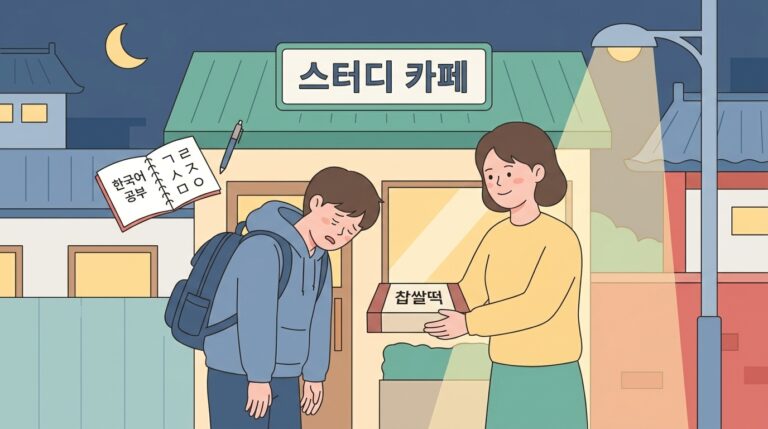
* The Good: Give 엿 (Yeot) (traditional sticky taffy) or 찹쌀떡 (Chapssaltteok) (sticky rice cakes). You are symbolically wishing that they “stick” (which also means “to pass” / 합격하다 in Korean) to their dream university.
* The Bad: Never offer 미역국 (Miyeokguk) (seaweed soup) on or before exam day. Seaweed is incredibly slippery, symbolizing that the student will “slip and fail” the exam.
4-2. The Drama Lens: Sky Castle
If you want to understand the extreme end of Korea’s educational obsession, watch the drama Sky Castle. It depicts elite families hiring “exam coordinators” worth millions of won to secure their children’s admission to medical schools. While dramatized, it reflects the very real anxiety of Korean parents who believe Suneung is the ultimate decider of social class.
Phase 5: Interactive Roleplay Scenario
The Setting: You are at a 24-hour convenience store near a study cafe (독서실) at 11:30 PM, three days before Suneung. You spot your Korean friend, Minji, looking exhausted, buying a highly caffeinated energy drink.
Characters:
* Minji (민지): A high school senior with dark circles under her eyes, clutching her study notebook.
* You: A supportive friend who wants to lift her spirits.
The 10-Turn Dialogue
- Minji: (sighing heavily) 🎭 Sighs while rubbing her temples
“아… 진짜 머리 터질 것 같아.”
(A… jin-jja meo-ri teo-jil geot ga-ta.)
“Ugh… my head is literally about to explode.” -
You: 🎭 Gently patting her shoulder
“민지야, 또 늦게까지 공부하는 거야?”
(Min-ji-ya, tto neut-ge-kka-ji gong-bu-ha-neun geo-ya?)
“Minji, are you studying late again?” -
Minji: 🎭 Points at her energy drink bag
“응, 수능이 사흘밖에 안 남았잖아. 잠을 잘 수가 없어.”
(Eung, su-neung-i sa-heul-ba-kke an na-mat-ja-na. jam-eul jal su-ga eop-seo.)
“Yeah, Suneung is only three days away. I can’t sleep.” -
You: 🎭 Handing her a box of sweet chocolate
“이거 먹고 힘내. 내가 초콜릿 샀어.”
(I-geo meok-go him-nae. nae-ga cho-kol-lit sat-seo.)
“Eat this and gain strength. I bought some chocolates.” -
Minji: 🎭 Smiling faintly with gratitude
“고마워… 진짜 감동이다. 요새 멘탈이 완전 탈탈 털렸거든.”
(Go-ma-wo… jin-jja gam-dong-i-da. yo-sae men-tal-i wan-jeon tal-tal teol-lyeot-geo-deun.)
“Thank you… I’m so touched. My mental state has been completely shattered lately.” -
You: 🎭 Looking directly into her eyes with confidence
“너 그동안 진짜 열심히 했잖아. 스스로를 믿어봐.”
(Neo geu-dong-an jin-jja yeol-shi-mi haet-ja-na. seu-soo-ro-reul mi-deo-bwa.)
“You’ve worked so hard all this time. Believe in yourself.” -
Minji: 🎭 Biting her lip nervously
“잘해야 할 텐데… 실수할까 봐 너무 초조해.”
(Jal-hae-ya hal ten-de… shil-su-hal-kka bwa neo-mu cho-jo-hae.)
“I need to do well… I’m so anxious I might make a mistake.” -
You: 🎭 Making a fist of determination
“실수 안 할 거야! 찍는 것도 다 맞을걸?”
(Shil-su an hal geo-ya! jjik-neun geot-do da ma-zeul-geol?)
“You won’t make mistakes! Even your random guesses will be correct!” -
Minji: 🎭 Laughing out loud for the first time
“하하, 진짜 그랬으면 좋겠다!”
(Ha-ha, jin-jja geu-rae-sseu-myeon jo-ket-da!)
“Haha, I really hope so!” -
You: 🎭 High-fiving her gently
“수능 대박 나자, 민지야! 화이팅!”
(Su-neung dae-bak na-ja, Min-ji-ya! hwa-i-ting!)
“Let’s hit the Suneung jackpot, Minji! Fighting!”
—
🔀 Decision Point: How will you send Minji off?
- A: “시험 잘 안 나오면 재수하면 되지!” (If you don’t get good grades, you can just do Jaesu!)
- B: “수능 대박 나고 맛있는 거 먹으러 가자!” (Ace Suneung and let’s go eat something delicious!)
- C: “공부 덜 해도 대학 갈 수 있어.” (Even if you study less, you can still go to a university.)
💡 Choices Analysis:
- Best Choice: B. It keeps the focus on positive reinforcement and gives her a delicious reward to look forward to immediately after the struggle ends.
- Risky Choice: A. While Jaesu is common, mentioning failure and repeating the exam right before Suneung is highly discouraging and bad luck (un-nunchi!).
- Bad Choice: C. This completely dismisses the immense societal gravity of the Suneung in Korea. It might sound like you don’t take her efforts seriously.
Phase 6: 10-Second Emotion Shadowing Drill
Let’s inject native emotional rhythm into your speaking. Pay attention to the / pause markers!
- Scenario: Encouraging your stressed-out partner or friend.
- Emotion: [😤 Determined and Encouraging]
- Line: “걱정하지 마! / 너는 / 무조건 / 대박 날 거야!”
- Pronunciation: Geok-jeong-ha-ji ma! / neo-neun / mu-jo-geon / dae-bak nal geo-ya!
- Translation: “Don’t worry! / You / absolutely / will hit the jackpot!”
Phase 7: K-Culture Mini Dictionary
| Word (한글/Romanization) | English Meaning | Cultural Context & Usage |
|---|---|---|
| 초조하다 [cho-jo-hada] | To be anxious/restless | Used heavily during exam seasons or waiting for results. It describes that heart-pounding, jittery feeling. |
| 명문대 [myeong-mun-dae] | Prestigious/Elite University | The holy grail of Suneung test-takers. Refers to top tier institutions like SKY, KAIST, etc. |
| 학원 [ha-gwon] | Private Cram School | The epicenter of Korea’s educational fever. Students spend their afternoons here until 10 PM. |
| 엿 [yeot] | Sticky Traditional Taffy | The ultimate good-luck gift. Symbolizes “sticking” to the exam passing list. |
Phase 8: Traveler’s Survival Kit
If you find yourself in Korea during mid-November, here are 3 quick expressions to show solidarity with the locals:
- 수험생 여러분 힘내세요!
- Su-heom-saeng yeo-reo-bun him-nae-se-yo!
- “To all the test-takers, stay strong!” (Great to write on social media or notes).
- 시험 잘 보세요!
- Si-heom jal bo-se-yo!
- “Please do well on your exam!” (Polite, standard wish for acquaintances).
- 끝나고 놀자!
- Kkeut-na-go nol-ja!
- “Let’s play/hang out after it’s over!” (Great for close friends waiting for the exam to end).
📌 Editor’s Travel Note: On Suneung day, public transportation (subway and buses) increases operations between 6:00 AM and 10:00 AM to prevent delays. If you need to navigate around Seoul on this busy morning, rely on the Naver Map App Download Page for real-time traffic alerts rather than standard global maps which do not reflect local emergency schedules.
Phase 9: Deep Inquiry — “한 발 더 깊이” (One Step Deeper)
Why does Korea place such an earth-shattering emphasis on this one single day? Historically, during the Joseon Dynasty, the Gwageo (과거) state examinations were the only way for a family to elevate its social standing. This Confucian meritocracy deeply ingrained the idea that academic success is the ultimate form of filial piety and social honor.
Today, while critics argue that Suneung creates an unhealthy, high-pressure environment, it remains one of the most transparently meritocratic systems in the eyes of many Koreans.
💬 Your Turn: How does your culture view academic success? Is there a single day in your country that carries the same weight as Suneung? Let’s discuss in the comments below!
Phase 10: FAQ & Common Mistakes
Q: Why do police officers transport students on Suneung day?
A: Yes, it’s true! Police motorcycles and patrol cars are officially deployed on Suneung morning. If a student is stuck in traffic or realizes they went to the wrong test site, they can call 112 (the police hotline), and emergency escorts are dispatched immediately to get them to the exam hall on time.
Q: Is it true that temples and churches are packed on this day?
A: Yes. While students are taking the exam, parents flock to churches, temples, and shrines. Many spend the entire 8 hours praying, bowing, and holding up photos of their children. It is a family-wide marathon.
Q: Can I give chocolate or coffee to a test-taker?
A: Absolutely. Modern students love chocolate, energy bars, and caffeinated snacks. Just avoid slippery foods or anything that could upset their stomach!
🚨 Common Mistakes Alert:
- Mistake 1: Wishing a test-taker “푹 쉬세요” (Take a deep rest) the night before. This might sound too relaxed; instead, use “끝까지 힘내세요” (Keep your strength up until the end).
- Mistake 2: Talking about university rankings in front of a stressed student. It adds unnecessary pressure.
- Mistake 3: Calling them during the 8-hour exam window. Their phones must be completely turned off and submitted to supervisors; even a vibrating phone in a bag results in immediate disqualification.
Phase 11: Action Mission
- 🥉 Bronze (At-Home Challenge): Practice saying “수능 대박 나세요!” out loud three times with energetic fist gestures.
- 🥈 Silver (Network Challenge): Share a supportive post or direct message to any Korean acquaintances who have younger siblings taking the exam this year using the hashtag
#수능대박. - 🥇 Gold (Real-world Challenge): Next time you visit a Korean mart or market in autumn, ask the vendor: “수능 선물로 찹쌀떡이 좋을까요?” (Would sticky rice cakes be good as a Suneung gift?).
Phase 12: Interactive Quiz Challenge
Test your knowledge of Suneung culture!
🔍 Q1: Which food is considered BAD luck to eat before Suneung?
Answer: 미역국 (Miyeokguk – Seaweed Soup). Because it is slippery, it symbolizes slipping and failing the exam!
🔍 Q2: Fill in the blank: “너 공부 열심히 했잖아. 이번에 수능 ____ 나자!”
Answer: 대박 (Daebak). The full sentence means: “You studied hard. Let’s hit the Suneung jackpot this time!”
🔍 Q3: True or False: English listening exams temporarily ground all commercial flights in South Korea.
Answer: True! Planes are completely banned from landing or taking off for 35 minutes to ensure absolute silence for the students.







