

Running Late to Your Korean Class? Here is How to Save Face Like a Pro
Phase 1: Empathy (Your Rushed Morning Scene)
Annyeonghaseyo! (안녕하세요!) Welcome back to Daily Hangul, your cozy corner for mastering real-life Korean. I’m your lead editor and tutor, and today we are going to talk about a situation we have all faced: being late.
Picture this: It’s a rainy Tuesday morning in Seoul. You stayed up late watching the final episode of your favorite K-Drama. Your alarm goes off, but you hit snooze. Now, you have exactly 15 minutes to reach your Korean class in Sinchon. You grab your bag, run out of the subway station, and fly up the stairs of the academy. You stand outside the classroom door, completely out of breath.
What do you say when you slide that door open? If you simply say “Sorry” in English, you miss a golden opportunity to show your teacher that you understand Korean manners!
Don’t worry. This guide was created based on the real-world experiences of hundreds of beginner students just like you. Today, you will learn the exact words to apologize gracefully, explain why you are late, and earn major Nunchi (눈치 – situational wit) points from your teacher.
Phase 2: Core 3 Expressions Deep Dive
Here are the top three expressions you need to know when you are running behind.
1. 지각했어요 (jigakhaesseoyo)
- Pronunciation: [jee-gak-haess-eo-yo] / Sounds like ‘gee-gack-hesson-yo’ but smoother!
- Meaning: I am late (specifically for school, class, or a structured event).
- K-Culture Moment: You often hear this in school-themed K-Dramas when a student runs through the school gates just before they close, yelling this to the guard!
- Editor’s Insight: Jigak (지각) specifically means being late for an official schedule like class or work. Do not use this when meeting a friend at a cafe!
- Situation Spectrum:
- Casual (Friends): 🚫
- Semi-formal (Teacher/Classmates): ✅
- Formal (Boss/Elder): ✅
- Think About It: Why does Korean have a specific word for being late to school/work (지각) versus being late for a social appointment (늦다)? It shows how deeply Korean society values structured schedules in institutional settings.
2. 늦어서 죄송합니다 (neujeoseo joesonghamnida)
- Pronunciation: [neu-jeo-seo jweh-song-ham-ni-da] / Focus on the ‘neu’ sound, like the ‘nu’ in ‘neutral’.
- Meaning: I am sorry for being late.
- K-Culture Moment: The classic polite apology used by employees entering a meeting room late in office K-Dramas.
- Editor’s Insight: This is the safest, most respectful phrase. If you only memorize one sentence today, make it this one!
-
Situation Spectrum:
- Casual (Friends): 🚫
- Semi-formal (Teacher): ✅
- Formal (Boss/Elder): ✅
- Think About It: How does your culture apologize for being late? In Korea, saying sorry immediately before explaining the reason is considered much more polite than giving the excuse first.
3. 차가 막혀서 늦었어요 (chaga makhyeoseo neujeosseoyo)
- Pronunciation: [cha-ga mak-hyeo-seo neu-jeoss-eo-yo] / Sounds like ‘cha-ga mock-he-o-seo neu-juss-o-yo’.
- Meaning: The traffic was heavy, so I am late.
- K-Culture Moment: Seoul is famous for traffic jams, especially around Gangnam or Mapo during rush hour. Every commuter knows this pain!
- Editor’s Insight: Use this when you want to gently explain that the circumstances were out of your control, but keep your tone humble.
- Situation Spectrum:
- Casual (Friends): ✅ (change ‘늦었어요’ to ‘늦었어’)
- Semi-formal (Teacher): ✅
- Formal (Boss/Elder): ⚠️ (use ‘늦었습니다’ instead of ‘늦었어요’)
Phase 3: Textbook Korean vs. Real Korean
Let’s look at how textbook sentences differ from what people actually say in real life.
Situation 1: Texting your teacher while on the way
- Textbook Korean: 저는 오늘 수업에 지각할 것입니다. (I will be late for class today.)
- Why it’s unnatural: It sounds like a robotic declaration. It is way too stiff!
- Real Korean: 선생님, 오늘 조금 늦을 것 같아요. (Teacher, I think I will be a little late today.)
- Why it works: Adding ‘것 같아요’ (I think/it seems) softens the sentence, making you sound polite and genuinely sorry.
Situation 2: Arriving and explaining the delay
- Textbook Korean: 지하철이 늦게 도착했습니다. (The subway arrived late.)
- Why it’s unnatural: It sounds like you are reading a transit report to your teacher.
- Real Korean: 지하철을 놓쳤어요. (I missed the subway.)
- Why it works: It’s simple, honest, and natural. Koreans prefer direct personal actions when explaining a minor delay.
Phase 4: K-Culture Deep Dive & Non-verbal Manners
4-1. The Art of the Late Entrance (Nunchi & Bowing)
In Korea, how you physically enter a room when you are late is just as important as what you say.
* Do not: Walk in loudly, pull your chair out with a screech, and start talking to your friend.
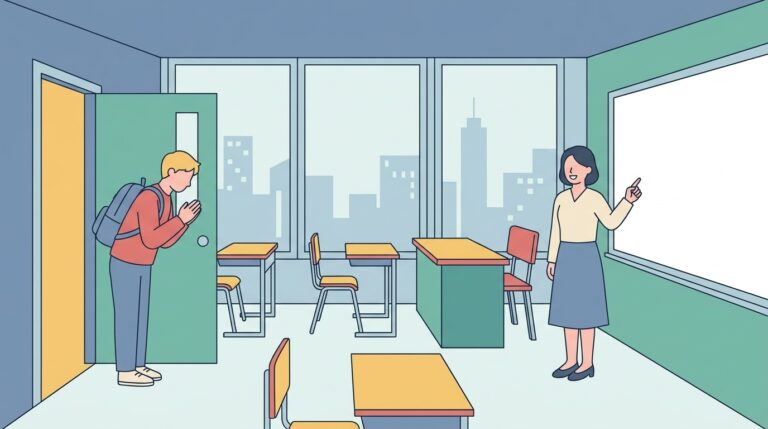
* Do: Quietly slide the door open, make eye contact with the teacher, bow your head at a 15-degree angle (a respectful nod), and whisper: ‘늦어서 죄송합니다’ (neujeoseo joesonghamnida). Then, quietly take your seat.
4-2. The Korean Concept of Time
You might have heard of ‘Korean Time’ (코리안 타임), a term from the past when people were more relaxed about social meetups. Today, however, Korea runs on hyper-punctuality (빨리빨리 – Ppalli-Ppalli culture). Being exactly on time is considered late for business, and arriving 5 to 10 minutes early for class is the golden standard!
Phase 5: Sinchon Classroom Roleplay
Setting: A modern, sunlit Korean classroom in Sinchon. Rain is tapping gently on the window. Teacher Min-ji is writing grammar points on the whiteboard. The clock reads 9:15 AM (class started at 9:00 AM). You quietly slide open the door.
Cast:
* You (A1 level student trying your best)
* Min-ji (Your supportive but structured Korean teacher)
The Dialogue
- You: (🎭 Sliding the door open quietly, bowing your head)
“안녕하세요, 선생님…”
(An-nyeong-ha-se-yo, seon-saeng-nim… / Hello, teacher…) -
Min-ji: (🎭 Putting down her marker, smiling warmly)
“어! 유진 씨, 왔어요?”
(Eo! Eugene-ssi, wass-eo-yo? / Oh! Eugene, you’re here?) -
You: (🎭 Looking apologetic, holding your backpack)
“늦어서 죄송합니다.”
(Neu-jeo-seo joe-song-ham-ni-da. / I am sorry for being late.) -
Min-ji: (🎭 Nodding understandingly)
“괜찮아요. 오늘 비가 많이 와요. 차가 많이 막혔어요?”
(Gwen-chan-a-yo. Oh-neul bi-ga ma-ni wa-yo. Cha-ga ma-ni mak-hyeoss-eo-yo? / It’s okay. It’s raining a lot today. Was traffic heavy?) -
You: (🎭 Nodding quickly in agreement)
“네, 차가 진짜 막혔어요.”
(Ne, cha-ga jin-jja mak-hyeoss-eo-yo. / Yes, traffic was really bad.) -
Min-ji: (🎭 Pointing to an empty seat)
“얼른 앉으세요. 춥죠?”
(Eol-leun an-jeu-se-yo. Chup-jyo? / Hurry and sit down. Cold, right?) -
You: (🎭 Moving to your seat quietly)
“감사합니다, 선생님.”
(Gam-sa-ham-ni-da, seon-saeng-nim. / Thank you, teacher.) -
Min-ji: (🎭 Looking at the textbook page 24)
“책 24페이지를 피세요.”
(Chaek i-sip-sa-pe-i-ji-reul pi-se-yo. / Open your book to page 24.) -
You: (🎭 Quicky opening your book)
“네, 폈습니다!”
(Ne, pyeot-seum-ni-da! / Yes, I opened it!) -
Min-ji: (🎭 Smiling)
“좋아요. 시작해 볼까요?”
(Jo-a-yo. Si-jak-hae bol-kka-yo? / Great. Shall we begin?)
🔀 Decision Point!
Imagine Min-ji asks you: “Why are you late?” (왜 늦었어요?)
Which of the following answers is the best way to respond?
- Option A: “잠을 많이 잤어요.” (Jam-eul ma-ni jass-eo-yo. / I slept a lot.)
- Option B: “늦어서 죄송합니다. 지하철을 놓쳤어요.” (Neu-jeo-seo joe-song-ham-ni-da. Ji-ha-cheol-eul no-chyeoss-eo-yo. / I’m sorry I’m late. I missed the subway.)
- Option C: “아이돌 동영상을 봤어요.” (A-i-dol dong-yeong-sang-eul bwas-seo-yo. / I watched idol videos.)
Solution & Feedback
- Best Choice: Option B! It combines a polite apology with a very understandable, real-world reason (missing the subway).
- Risky Choice: Option A! While honest, telling your teacher you simply overslept makes you look like you don’t value the class.
- Bad Choice: Option C! Unless your teacher is a massive K-Pop fan who loves to gossip about idols, this will definitely get you some funny looks!
Phase 6: 10-Second Emotion Shadowing Drill
Practice speaking like a native! Use the pauses (/) and follow the emotional guides.
- [🥺 Softly & Apologetically]
“늦어서 / 죄송합니다.”
(Neu-jeo-seo / joe-song-ham-ni-da.) -
[🏃 Out of breath & Rushed]
“선생님! / 오늘 조금 / 늦을 것 같아요!”
(Seon-saeng-nim! / oh-neul jo-geum / neu-zeul geot ga-ta-yo!) -
[😊 Relieved & Polite]
“감사합니다 / 선생님.”
(Gam-sa-ham-ni-da / seon-saeng-nim.)
Phase 7: K-Culture Mini Dictionary
| Word | Pronunciation | Meaning & Culture Note |
|---|---|---|
| 지각생 | Jigaksaeng | Latecomer. Often used affectionately in classes or online streams to welcome late viewers. |
| 지옥철 | Jiokcheol | Hell-subway. A combination of ‘Jiok’ (Hell) and ‘Subway’ (Subway). Refers to Seoul subways during peak rush hour. |
| 늦잠 | Neutjam | Oversleeping. Literally ‘late sleep’. You can say ‘늦잠 잤어요’ (I overslept). |
| 눈치 | Nunchi | The art of reading the room. Sensing when to apologize quickly or slip into class without causing a scene. |
Phase 8: Traveler’s Survival Kit
Even if you aren’t in a class, being late happens during travel. Keep these three phrases in your back pocket!
Top 3 Survival Phrases
- 길을 잃었어요 (Gil-eul il-eoss-eo-yo)
- Meaning: I got lost.
- Pro Tip: Perfect when you can’t find your way through the winding alleys of Bukchon Hanok Village.
- 차가 너무 막혀요 (Cha-ga neo-mu mak-hyeo-yo)
- Meaning: The traffic is too crazy.
- Pro Tip: Use this when texting your tour guide or K-beauty salon coordinator.
- 빨리 가주세요 (Ppal-li ga-ju-se-yo)
- Meaning: Please go quickly.
- Pro Tip: Say this politely to your taxi driver if you are rushing to the airport.
📌 Editor’s Travel Note: Google Maps does not work well for walking directions in Korea! To avoid being late, download the Naver Map App Download Page or KakaoMap Official Download before you arrive in Seoul. They provide real-time subway and bus arrivals down to the second!
Phase 9: One Step Deeper — “Think About It”
In Western cultures, apologizing for being late is often accompanied by a detailed, logical explanation immediately. In Korea, however, a sincere, humble apology (죄송합니다) should always come first, followed by a brief, non-defensive explanation only if asked. This reflects the Confucian roots of Korean culture, where taking responsibility and respecting the group’s time is valued over individual explanations.
💬 Your Turn: How does your culture view being late? Is it okay to be 10 minutes late, or is that considered rude? Let us know in the comments below!
Phase 10: FAQ & Mistakes
Q: Can I say “지각했어요” to my friend if I am late for a coffee date?
A: No! ‘지각하다’ is strictly for formal settings like school or work. For friends, say “늦어서 미안해!” (Neu-jeo-seo mi-an-hae! / Sorry I’m late!).
Q: What is the most polite way to text my teacher when I am running late?
A: Use this template: “선생님, 오늘 차가 막혀서 조금 늦을 것 같아요. 죄송합니다.” (Teacher, the traffic is bad today so I think I will be a little late. I am sorry.)
Q: Can I bow my head to classmates too?
A: You can give a small, friendly wave or nod to classmates. Save the polite 15-degree bow for your teacher!
🚨 Common Mistakes Warning Board
- Saying “미안해” (mianhae) to your teacher: This is casual talk (Banmal). Always use “죄송합니다” (joesonghamnida) to teachers and elders!
- Using “지각” for casual meetings: Remember, don’t use ‘지각’ with friends, or you will sound like you think they are your school principal!
- Mumbling your apology: Even if you are embarrassed, speak clearly. Korean teachers value honesty and effort!
Phase 11: Action Missions
- 🥉 Bronze (Mirror Challenge): Stand in front of a mirror, bow slightly, and say “늦어서 죄송합니다” out loud 3 times with a polite facial expression.
- 🥈 Silver (Network Challenge): Write a mock text message to a Korean teacher in the comments below explaining you are late due to traffic.
- 🥇 Gold (Real-Life Challenge): The next time you are even 1 minute late to a Korean language exchange session or class, use “조금 늦을 것 같아요” in your chat room!
- 🎮 K-Culture Mission: Watch your favorite K-Drama today and spot a scene where someone runs into a room late. Write down the body language they used!
Phase 12: Interactive Quiz Challenge
Test your knowledge below!
1. Which expression is best for telling a teacher you are late?
- A) 미안해
- B) 지각했어요
- C) 늦었어
🔍 Click to see the answer!
Correct Answer: B
지각했어요 is the polite, semi-formal way to say you are late for class. A and C are casual speech (Banmal) and should not be used with teachers!
2. Fill in the blank:
“차가 _______ 늦었어요.” (The traffic was heavy, so I am late.)
🔍 Click to see the answer!
Correct Answer: 막혀서 (makhyeoseo)
막혀서 means ‘blocked’ or ‘clogged’, referring to traffic congestion.
3. True or False: It is polite to explain your excuse first before saying sorry in Korea.
🔍 Click to see the answer!
Correct Answer: False!
In Korean culture, always apologize first (죄송합니다), and then explain the reason gently.






