

Beyond the River of Death: How to Discuss the Afterlife and Spirituality in Korean Like a Local
안녕하세요! Welcome back to another deep-dive session with Daily Hangul. I’m your senior editor and resident K-culture navigator. Over my ten years of living in Seoul, wandering through silent Buddhist temples in Odaesan, and debating late-night philosophy over warm cups of ssanghwa-cha (쌍화차 – traditional herbal tea) in Insadong, I’ve realized one thing: Koreans are deeply, albeit sometimes unconsciously, spiritual.
If you have watched K-dramas like Goblin: The Lonely and Great God (쓸쓸하고 찬란하神 – 도깨비) or the blockbuster film Along with the Gods (신과함께), you know that the Korean imagination of what lies beyond is vivid, deeply layered, and surprisingly emotional. Yet, when advanced learners try to engage in these existential discussions with Korean friends, they often find themselves stuck. You either sound like a dry, 15th-century Joseon philosopher or an overly blunt textbook.
Today, we are unlocking the linguistic keys to C1-level conversations on death, rebirth, and spiritual destiny. By the end of this guide, you won’t just know the words—you’ll understand the subtle collective psychology that makes these concepts so uniquely Korean. Let’s cross the river together.
Phase 2: Core Expressions Deep Dive
To navigate these deep waters, you need vocabulary that carries weight, nuance, and cultural history. Here are three crucial expressions used when discussing the transition of the soul.
1. 이번 생은 망했다 (이생망)
- Pronunciation: [I-beon saeng-eun mang-haet-da / “Ee-beon saeng-eun mang-haet-da”]
- Meaning: “This life is ruined” (Often abbreviated as 이생망 – I-saeng-mang).
- K-Culture Moment: This is the ultimate cynical Gen-Z and Millennial humor phrase, frequently spotted in webtoons and slice-of-life dramas like Because This Is My First Life (이번 생은 처음이라).
- Editor’s Insight: On the surface, it sounds incredibly dark and pessimistic. However, it actually relies on the deep-rooted Buddhist concept of reincarnation (환생 – hwansaeng). By jokingly claiming “this life is a wash,” the speaker is subtly comforting themselves with the implicit idea that there is a next life (다음 생) where they can try again. It’s dark humor wrapped in ancient cosmic optimism.
- Situation Spectrum:
- Casual (Friends/Peers): ✅ (Extremely common when failing an exam or missing a train)
- Semi-formal (Coworkers): ⚠️ (Use only if you have a close, casual bond)
- Formal (Bosses/Elders): 🚫 (Can sound unprofessional or overly dramatic)
- 🤔 Think About It: Why do you think Korean society, which is highly competitive, embraced a Buddhist reincarnation joke to cope with daily stress? Does your native language have a humorous way of ‘resigning’ to fate?
2. 다음 생애에는 (다음 생에는)
- Pronunciation: [Da-eum saeng-ae-e-neun / “Da-um saeng-eh-neun”]
- Meaning: “In the next lifetime…” or “In my next life…”
- K-Culture Moment: Often heard in romantic melodrama climaxes, where lovers facing tragedy promise each other: “다음 생에는 꼭 평범하게 만나자” (In our next life, let’s meet under normal circumstances).
- Editor’s Insight: Unlike Western discussions of the afterlife which often focus on Heaven or Hell, Korean spiritual discussions frequently pivot horizontally to the next cycle of earthly existence. When using this expression, you can express deep desires that feel impossible right now—such as “다음 생에는 꼭 고양이로 태어날래” (In my next life, I want to be born as a cat).
- Situation Spectrum:
- Casual: ✅
- Semi-formal: ✅
- Formal: ⚠️ (Keep it poetic, avoid sounding too superstitious in strict business settings)
3. 좋은 곳으로 가셨을 거예요
- Pronunciation: [Jo-eun got-eu-ro ga-shyeot-eul geo-yeo-yo / “Jo-eun got-eu-ro gah-shyeot-eul geo-yeo-yo”]
- Meaning: “They must have gone to a better place.”
- K-Culture Moment: The standard, most comforting thing to say to someone who has lost a loved one, frequently uttered in family dramas and real-life funeral halls (장례식장).
- Editor’s Insight: This phrase is beautifully ecumenical. Because Korea is a pluralistic religious society (with strong Buddhist, Christian, Catholic, and Shamanist communities), “좋은 곳” (a good place) functions as a gentle, non-offensive placeholder for Heaven (천국), Paradise (극락), or peace. It shows extreme empathy without forcing a specific dogma.
- Situation Spectrum:
- Casual: ✅
- Semi-formal: ✅
- Formal: ✅ (Always appropriate for expressing condolences)
Phase 3: Textbook Korean vs. Real-World Korean
When you study from academic texts, you learn rigid structures. But when discussing the metaphysical, Koreans prefer words that evoke soft emotional landscapes.
Scenario 1: Discussing Cosmic Retribution (Karma)
- 📖 Textbook Korean: “그 사람은 인과응보의 법칙에 따라 결국 벌을 받을 것입니다.” (That person will eventually be punished according to the law of cause and effect.)
- 🗣️ Real Korean: “결국 다 뿌린 대로 거두는 법이에요. 자기 업보인 거죠.” (Eventually, you reap what you sow. It’s their own karma.)
- 💡 Why the Difference? The textbook sentence sounds like a law textbook. Real Koreans use the agrarian idiom “뿌린 대로 거두다” (reap what you sow) alongside the Buddhist term “업보” (eopbo – karmic debt) to express cosmic justice naturally.
Scenario 2: Wondering About What Happens After Death
- 📖 Textbook Korean: “인간은 사후세계가 실제로 존재하는지 증명할 수 없습니다.” (Humans cannot prove whether the afterlife actually exists.)
- 🗣️ Real Korean: “죽고 나면 저 세상이 진짜 있을지 가끔 궁금해요.” (I sometimes wonder if ‘that world’ really exists after we die.)
- 💡 Why the Difference? While “사후세계” (sahu-segye) is the technical term for “afterlife,” in spontaneous conversations, Koreans almost always refer to it as “저 세상” (that world) or “저승” (the other side), contrasting it with “이 세상” (this world) or “이승” (this side).
Phase 4: K-Culture Deep Dive & Non-Verbal Manners
4-1. The Body Language of Existential Silence
In Western cultures, deep philosophical debates are often accompanied by intense eye contact, expansive hand gestures, and passionate debate. In Korea, conversations about spirituality and the afterlife require “음미하는 태도” (an appreciative, savoring attitude).
* The Soft Gaze: When discussing deep topics like mortality, do not lock eyes aggressively. Instead, look slightly down at your tea cup or to the side, nodding slowly (끄덕임). This signals that you are deeply pondering their words, rather than preparing a counter-argument.
* Lowering the Pitch: Keep your voice in a lower register. A loud, excited voice when discussing “저승” (the afterlife) can feel disrespectful or trivializing.
4-2. The Syncretic Soul of Korea
To truly understand Korean views on the afterlife, you must understand religious syncretism. Most Koreans do not subscribe to just one spiritual view.
Imagine a typical Korean family: they might go to a Christian church on Sundays, visit a Buddhist temple on New Year’s Day to bow to the spirits, consult a Shamanist fortune-teller (무당) before starting a new business, and perform Confucian ancestral rites (제사) during Chuseok.
This is why in K-dramas, the Grim Reaper (저승사자 – Jeoseung Saja) wears a traditional black Joseon hat (갓) but works in a highly bureaucratic office that resembles a modern Korean civil service building. The spiritual world is viewed as an extension of our social world—complete with paperwork, trials, and administrative processes!
Phase 5: The Interactive Roleplay Scenario
The Setting
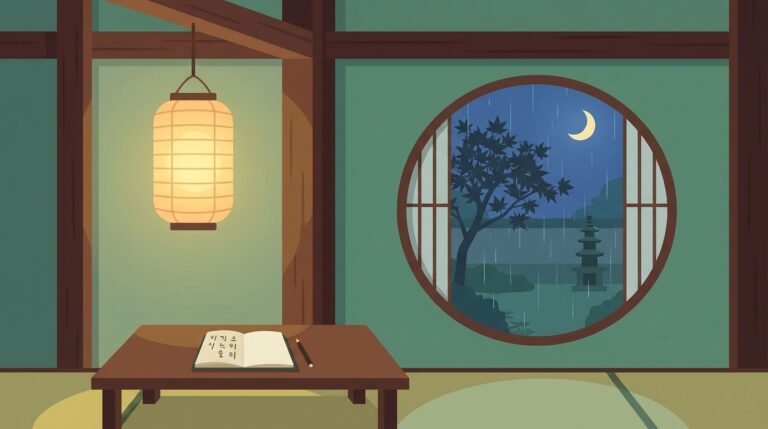
You are sitting in a tucked-away, wooden tea house in Insadong. Outside, a gentle summer rain is drumming on the clay tiles. Inside, the air smells of roasted buckwheat, cinnamon, and aged paper. Your close friend Ji-eun (지은), who recently watched a documentary on near-death experiences, takes a slow sip of her ginger tea and looks out the window.
지은: (찻잔을 만지작거리며) 오늘 비가 오니까 괜히 마음이 차분해지네.
Ji-eun: (Toying with her tea cup) The rain today makes my mind feel strangely calm.

나: 맞아요. 이런 날에는 좀 깊은 생각을 하게 되는 것 같아요.
Me: True. On days like this, I think I end up having deeper thoughts.

지은: (나를 가만히 바라보며) 너는... 사람이 죽으면 어떻게 된다고 믿어? 진짜 저 세상이 있을까?
Ji-eun: (Looking at me quietly) Do you... believe what happens when a person dies? Does "that world" really exist?

나: 와, 진짜 심오한 질문이네요. 사실 가끔 그런 생각 해요.
Me: Wow, that’s a really profound question. Actually, I think about that sometimes too.

지은: 맞아. 나이 들수록 이런 주제가 마냥 멀게만 느껴지지 않더라고.
Ji-eun: Right. As I get older, this kind of topic doesn't feel so far away anymore.

나: 맞아요. 저는 종교는 없지만, 그냥 죽음이 끝은 아닐 것 같다는 느낌이 들어요.
Me: Exactly. I don't have a religion, but I just get the feeling that death might not be the absolute end.

지은: (고개를 끄덕이며) 나도 그래. 불교에서 말하는 환생 같은 게 진짜 있을지도 몰라.
Ji-eun: (Nodding) Me too. Maybe something like the reincarnation they talk about in Buddhism actually exists.

나: 만약 환생한다면, 다음 생에는 어떤 모습으로 태어나고 싶어요?
Me: If you were to reincarnate, what kind of form would you want to be born into in your next life?

지은: (미소를 지으며) 음, 나는 아무 걱정 없는 부잣집 고양이로 태어나고 싶어. 너는?
Ji-eun: (Smiling) Hmm, I want to be born as a rich family's cat with absolutely zero worries. What about you?
🔀 Decision Point: How do you respond to Ji-eun?
- Option A: “저는 다음 생에는 안 태어났으면 좋겠어요. 그냥 이번 생으로 족해요.”
- Option B: “저는 죽은 후에 영원히 천국에서 살고 싶어요. 환생은 안 믿어요.”
- Option C: “저는 다음 생에도 꼭 사람으로 태어나서 지은 씨랑 다시 친구 하고 싶어요.”
💡 Analysis of Your Choices:
- Option A (The Realist/Nihilist Route – Neutral ⚠️): “I wish I wouldn’t be born in the next life. This life is enough.” This leans into Buddhist nirvana concepts (escaping the cycle of suffering) but can sound slightly melancholic over tea. Use only with very close friends who appreciate existential dread!
- Option B (The Dogmatic Route – Risk 🚫): “I want to live in Heaven forever after death. I don’t believe in reincarnation.” While honest, shut-down statements like “I don’t believe in…” can halt the natural, flowing imaginative space of a casual spiritual conversation.
- Option C (The Masterpiece of K-Drama Romance – Best Choice ✅): “In the next life, I definitely want to be born as a human again so I can be friends with you, Ji-eun.” This is pure gold. It uses the concept of 인연 (In-yeon – destiny/karmic connection). In Korean culture, saying you want to meet someone again in the next life is the highest form of platonic or romantic affection.
Phase 6: 10-Second Emotional Shadowing Drill
To sound natural, your rhythm must match your emotion. Practice these sentences with the indicated pacing (/ means a brief pause).
1. [🥺 Softly, with a touch of cosmic comfort]
“좋은 곳으로 / 가셨을 테니까 / 너무 슬퍼하지 마세요.”
Jo-eun got-eu-ro / ga-shyeot-eul te-ni-ka / neo-mu seul-peo-ha-ji ma-se-yo.
“Since they must have gone / to a good place / please do not grieve too deeply.”
2. [😊 Playfully, with lighthearted sighing]
“에휴, / 이번 생은 / 망했으니까 / 다음 생을 노려야겠어요.”
E-hyu, / i-beon saeng-eun / mang-haet-eu-ni-ka / da-eum saeng-eul no-ryeo-ya-get-eo-yo.
“Sigh, / since this life / is ruined / I should aim for the next life instead.”
Phase 7: K-Culture Mini-Dictionary
| Word (한글) | Romanization | English Translation | Cultural Context & Usage |
|---|---|---|---|
| 이승 | I-seung | This World / Living Realm | The physical world of the living. Often contrasted with the spirit realm in folk stories. |
| 저승 | Jeo-seung | The Other World / Underworld | The realm of the dead. Controlled by the Ten Kings of Hell in Buddhist-Shamanist mythology. |
| 인연 | In-yeon | Karmic Connection / Fate | The invisible thread connecting people across lifetimes. If you meet someone often, you have deep in-yeon. |
| 업보 | Eop-bo | Karma / Retribution | The positive or negative cosmic debt accumulated by one’s actions, which dictates reincarnation status. |
Phase 8: Traveler’s Survival Kit
Even if you aren’t debating philosophy daily, if you are visiting Korea, you might run into situations related to spiritual traditions.
Survival Phrases
- 삼가 고인의 명복을 빕니다.
- Sam-ga go-in-ui myeong-bok-eul bim-ni-da.
- Pro Tip: The ultimate formal condolence phrase. Write this on condolence envelopes at funerals. Never say “축하합니다” (congratulations) or use overly bright tones near religious altars.
- 혹시 종교가 어떻게 되세요?
- Hok-shi jong-gyo-ga eo-tteo-ke doe-se-yo?
- Pro Tip: A polite way to ask, “By the way, what is your religion?” in a respectful, non-intrusive manner.
- 공양 올리는 곳이 어디인가요?
- Gong-yang ol-ri-neun got-i eo-di-in-ga-yo?
- Pro Tip: If visiting beautiful mountain temples like Tanyongsa, use this to ask where to place temple offerings.
📌 Editor’s Travel Note
- Navigating Temples: If you plan to experience a Temple Stay (템플스테이) in Korea, which I highly recommend, download the Official Temple Stay Finder to book an authentic English-guided experience.
- Payment & Manners: Traditional temples do not accept card payments for small donations or purchasing wish-tiles (기와 – giwa). Bring physical cash (₩10,000 bills) if you wish to participate in these spiritual rituals.
Phase 9: Deep Thoughts — “한 발 더 깊이” (One Step Deeper)
In many Western cultures, death represents an absolute boundary—a final judgment or a complete cessation of consciousness. In the Korean collective psyche, however, the boundary between I-seung (this world) and Jeo-seung (the other world) is highly porous.
This is why Koreans perform 제사 (Jesa – ancestral rites). The ancestors are not truly gone; they return to eat the essence of the food prepared for them on special holidays. This reflects 정 (Jeong – deep emotional attachment) that refuses to let even death sever a relationship. To a Korean, the afterlife is not just a theological concept; it is an ongoing social contract of love, memory, and cosmic duty.
💬 Your Turn: How does your culture view the connection between the living and the dead? Do you have rituals similar to Jesa? Share your thoughts in the comments below!
Phase 10: FAQ & Common Mistakes
Q: Can I use “죽다” (to die) when talking about someone’s grandmother passing away?
A: Absolutely not. “죽다” is highly colloquial and direct. When referring to humans, especially elders or loved ones, you must use the honorific verb 돌아가시다 (do-ra-ga-shi-da), which beautifully translates to “to return [to where they came from].”
Q: Is it okay to joke about “이생망” (this life is ruined) in a job interview to show humility?
A: No. While it’s a popular internet slang term, using it in professional settings makes you look defeatist and lacking in serious motivation.






