

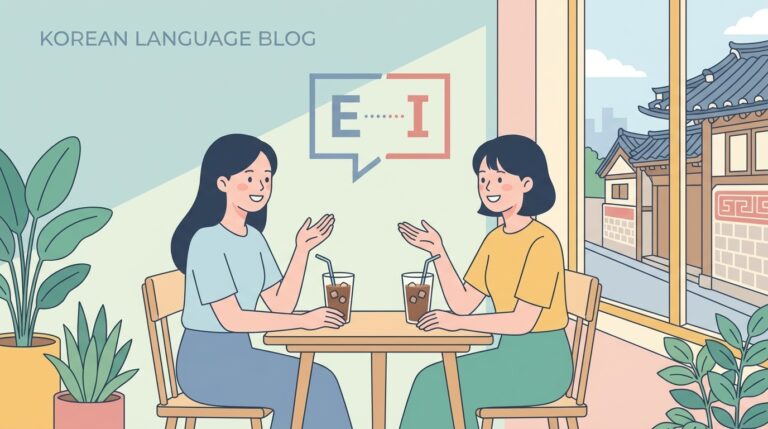
How to Talk About Your Personality Strengths & Weaknesses Like a Local
Phase 1: Embrace the Vibe — Why Talking About Your Personality Matters
안녕하세요! (An-nyeong-ha-se-yo! Hello!) I’m your Senior Editor at Daily Hangul.
Imagine this: You are sitting in a cozy, sunlit cafe in Yeonnam-dong, Seoul. You’ve finally met up with a Korean friend you met online, or maybe you’re doing a language exchange. The conversation is flowing over iced americanos when they suddenly drop the ultimate Korean icebreaker:
“What is your MBTI?” or “What is your personality like?”
You freeze. In English, you might confidently say, “I am very smart, detail-oriented, and extremely outgoing!” But in Korean, translating that directly might make you sound a bit… well, too boastful. On the flip side, trying to explain your flaws might accidentally make you sound overly negative!
This is a classic pain point for A2 learners. In Korea, self-introductions (자기소개 – ja-gi-so-gae) and sharing your strengths and weaknesses (성격의 장단점 – seong-gyeok-ui jang-dan-jeom) are deeply rooted in modesty (겸손 – gyeom-son) and subtlety.
Today, we are going to learn how to describe your true self in a way that sounds incredibly natural, modest, and absolutely charming to Korean ears. By the end of this guide, you won’t just be reciting words; you’ll be connecting on a deeper cultural level. Let’s dive in!
Phase 2: The Core Trio — 3 Essential Expressions to Master
Let’s look at three powerful, versatile phrases that Korean locals use every single day to talk about their personalities.
1. 성격이 밝은 편이에요 (Seong-gyeok-i bal-geun pyeon-i-e-yo)
- Pronunciation: [Seong-gyeok-i bal-geun pyeon-i-e-yo] / Sound-alike: Sung-gyuk-ee bal-geun pyun-ee-yo
- Meaning: “I have a pretty bright/cheerful personality” (Literally: “I am on the bright side when it comes to personality.”)
- K-Culture Moment: This is the ultimate “K-Drama Protagonist” vibe! Think of the cheerful, optimistic leads in dramas like Strong Girl Bong-soon or Welcome to Samdal-ri.
- Editor’s Insight: Notice the magic phrase ~편이에요 (~pyeon-i-e-yo). It means “on the side of.” Instead of saying flatly “I am bright” (which sounds too confident), adding “on the side of” softens the statement, making you sound beautifully modest.
- Situation Spectrum:
- Friends & Casual: ✅ (Perfect)
- Colleagues & Semi-formal: ✅ (Excellent for networking)
- Bosses & Formal: ✅ (Polite and safe)
- 🤔 Think About It: Why do you think Koreans prefer saying “I’m on the bright side” instead of a direct “I am bright”? How does this match your own culture’s style of self-introduction?
2. 꼼꼼하지만 걱정이 좀 많아요 (Kkom-kkom-ha-ji-man geok-jeong-i jom man-a-yo)
- Pronunciation: [Kkom-kkom-ha-ji-man geok-jeong-i jom man-a-yo] / Sound-alike: Kom-kom-ha-jee-man guk-jung-ee jom mahn-ah-yo
- Meaning: “I am detail-oriented, but I worry a bit too much.”
- K-Culture Moment: Perfect for describing the classic K-Pop leader archetype—someone like RM of BTS or Jihyo of Twice—who is incredibly responsible but feels the weight of caring for everyone.
- Editor’s Insight: This is the golden formula for job interviews or meeting new people. You pair a strength (꼼꼼하다 – kkom-kkom-ha-da / to be meticulous) with a harmless, relatable weakness (걱정이 많다 – geok-jeong-i man-ta / to have many worries) connected by ~지만 (~ji-man / but).
-
Situation Spectrum:
- Friends & Casual: ✅ (Shows you are self-aware)
- Colleagues & Semi-formal: ✅ (Highly professional)
- Bosses & Formal: ✅ (Shows maturity)
- 🤔 Think About It: In Korea, worrying too much often implies that you care deeply about doing a good job. Can you see how a weakness can secretly be a strength?
3. 낯을 가리지만 친해지면 말을 많이 해요 (Nat-eul ga-ri-ji-man chin-hae-ji-myeon mal-eul man-i hae-yo)
- Pronunciation: [Nat-eul ga-ri-ji-man chin-hae-ji-myeon mal-eul man-i hae-yo] / Sound-alike: Naht-eul gah-ree-jee-man chin-hae-jee-myun mahl-eul mah-nee hae-yo
- Meaning: “I’m shy around strangers, but once we get close, I talk a lot.”
- K-Culture Moment: This represents almost every lovely introvert in K-Dramas who starts out quiet but becomes the life of the party once they are comfortable with their inner circle.
- Editor’s Insight: 낯을 가리다 (nat-eul ga-ri-da) means “to hide one’s face from strangers” (to be shy). It’s an incredibly warm and cute way to say you’re introverted without sounding cold or anti-social.
-
Situation Spectrum:
- Friends & Casual: ✅ (The ultimate icebreaker phrase)
- Colleagues & Semi-formal: ✅ (Explains your initial quietness)
- Bosses & Formal: ⚠️ (A bit casual; better to use in social contexts)
- 🤔 Think About It: This phrase shows the transition from the “outer self” to the “inner self.” How long does it usually take you to “show your real self” to a new friend?
Phase 3: Textbook Korean vs. Real-World Korean
Sometimes, school books teach us phrases that make us sound like robots from 1995. Let’s see how real Koreans actually talk!
Scenario 1: Describing yourself as shy or quiet
- 📖 Textbook Korean: 저는 내성적입니다. (Jeo-neun nae-seong-jeok-im-ni-da.)
- “I am introverted.” (Sounds like a clinical diagnosis.)
- 🗣️ Real-World Korean: 제가 조금 낯을 가려요. (Je-ga jo-geum nat-eul ga-ryeo-yo.)
- “I’m a little shy around strangers.” (Sounds soft, natural, and relatable.)
- 💡 Why the difference? Real Koreans love using words like 조금 (jo-geum / a little) or 좀 (jom / a bit) to soften their descriptions and sound friendlier.
Scenario 2: Saying you are active and energetic
- 📖 Textbook Korean: 저는 활발한 성격을 가지고 있습니다. (Jeo-neun hwal-bal-han seong-gyeok-eul ga-ji-go is-seum-ni-da.)
- “I possess an active personality.” (Too heavy and overly formal.)
- 🗣️ Real-World Korean: 제가 좀 외향적인 편이에요! (Je-ga jom oe-hyang-jeok-in pyeon-i-e-yo!)
- “I’m on the extroverted side!”
- 💡 Why the difference? Ever since the MBTI boom in Korea, terms like 외향적 (oe-hyang-jeok / extroverted / E) and 내향적 (nae-hyang-jeok / introverted / I) combined with ~편이에요 have become the absolute standard for casual talk.
Phase 4: K-Culture Deep Dive & Non-Verbal Manners
4-1. The Art of Modesty (겸손 – Gyeom-son) & Body Language
When speaking about your personality strengths in Korea, eye contact and hand gestures play a major role:
1. The Gentle Smile: Avoid bragging with a serious face. Smile gently, tilt your head slightly, and look slightly down when talking about your positive traits to show you don’t take your own greatness too seriously!
2. Hand on Chest: When expressing a weakness like “I worry a lot” or “I’m shy,” gently placing one hand over your heart or touching your hair playfully signals to the other person, “I’m warm and approachable, please be gentle with me!”
4-2. K-Culture Trend: The MBTI Obsession
In Korea, your MBTI is almost as important as your name! Asking someone “MBTI가 어떻게 되세요?” (MBTI-ga eo-tteo-ke doe-se-yo? – What is your MBTI?) is the fastest way to make friends. It shows that you understand modern Korean youth culture and instantly opens up topics for laughing about your strengths and weaknesses together.
Phase 5: Live Roleplay — A Night Out in Hongdae
The Setting: You are sitting inside a trendy, neon-lit pocha (Korean pub) in Hongdae. Indie music is playing in the background, and the table is filled with spicy tteokbokki and cool drinks. You are chatting with Min-woo (민우), a friendly local classmate.
- Cast:
- You (The Reader): Ready to show your true, charming self.
- Min-woo (민우): An energetic, curious Korean friend.
1. 민우: (🎭 Leaning forward excitedly) 우와, 우리 이제 진짜 많이 친해졌네요! 그런데 지우 씨는 원래 성격이 어때요?
   Min-woo: (Wow, we've really gotten close now! By the way, Ji-woo, what is your personality like normally?)

2. You: (🎭 Smiling modestly, touching your hair) 음... 저는 성격이 좀 밝은 편이에요.
   You: (Hmm... I have a pretty bright personality.)

3. 민우: (🎭 Nodding vigorously) 맞아요! 항상 잘 웃어서 보기 좋아요. 그럼 MBTI는 뭐예요?
   Min-woo: (That's true! You always smile, so it's great to see. Then, what is your MBTI?)

4. You: (🎭 Laughing softly) 저는 INFP예요! 조금 낯을 가리지만 친해지면 말을 많이 해요.
   You: (I'm an INFP! I'm a bit shy at first, but once we get close, I talk a lot.)

5. 민우: (🎭 Clapping hands in surprise) 진짜요? 전혀 몰랐어요! 장점이 엄청 많아 보여요.
   Min-woo: (Really? I had no idea! You seem to have so many strengths.)

6. You: (🎭 Waving hands playfully) 아니에요~ 꼼꼼하지만 걱정이 좀 많아요.
   You: (No, not at all~ I'm detail-oriented, but I worry a bit too much.)

7. 민우: (🎭 Pouring you some juice) 걱정 많은 건 그만큼 따뜻하고 생각이 깊다는 뜻이에요! 단점이 아니에요.
   Min-woo: (Worrying a lot just means you are warm and thoughtful! It's not a weakness.)

8. You: (🎭 Clinking glasses) 고마워요, 민우 씨! 그렇게 말해줘서 감동이에요.
   You: (Thank you, Min-woo! I'm touched that you said that.)

9. 민우: (🎭 Raising his glass) 아니에요, 진짜로요! 우리 앞으로 더 자주 만나요!
   Min-woo: (No, really! Let's meet up more often from now on!)

10. You: (🎭 Beaming with a bright smile) 네, 좋아요! 건배!
    You: (Yes, great! Cheers!)
🔀 Decision Point: Min-woo asks, “What is your weakness?” How do you reply?
- A) “저는 게으르고 약속에 매일 늦어요.”
- “I am lazy and late to appointments every day.”
- 🚨 Risk Choice: While honest, this might sound too negative and unreliable for a new friendship!
- B) “저는 단점이 아예 없어요.”
- “I don’t have any weaknesses at all.”
- 🚫 Bad Choice: This sounds highly arrogant and breaks the rule of humility in Korean culture.
- C) “제가 조금 덜렁거리지만 항상 노력해요!”
- “I’m a little clumsy/forgetful, but I always try hard!”
- 💖 Best Choice: This is cute, incredibly honest, but shows a positive attitude to overcome the weakness. Koreans will absolutely love this answer!
Phase 6: 10-Second Emotional Shadowing Drill
Let’s practice saying these with the perfect Korean intonation! Raise and lower your voice at the / marks.
- 1. [😊 Cheerful and bright mood]
- “성격이 / 밝은 편이에요!”
- [Seong-gyeok-i / bal-geun / pyeon-i-e-yo!]
- 2. [🥺 Relatable, cute, slightly shy mood]
- “낯을 좀 / 가리지만 / 친해지면 / 말을 많이 해요.”
- [Nat-eul jom / ga-ri-ji-man / chin-hae-ji-myeon / mal-eul man-i hae-yo.]
- 3. [😤 Confident but humble mood]
- “꼼꼼하지만 / 걱정이 / 좀 많아요.”
- [Kkom-kkom-ha-ji-man / geok-jeong-i / jom man-a-yo.]
Phase 7: K-Culture Mini Dictionary
| Word (Korean/Romanization) | Translation | Real-World Cultural Context |
|---|---|---|
| 낯가림 [Nat-ga-rim] | Shyness | Used frequently to describe the warming-up period before showing one’s true warm self to strangers. |
| 인싸 [In-ssa] | Insider / Social Butterfly | Short for “insider.” Refers to people who are extremely outgoing, trendy, and have lots of friends. |
| 아싸 [Ah-ssa] | Outsider / Introvert | Short for “outsider.” Refers to people who love their solo time and feel drained in big crowds. |
| 겸손 [Gyeom-son] | Humility / Modesty | The golden social rule in Korea. Elevating others while keeping oneself grounded in language and action. |
Phase 8: Traveler’s Survival Kit
Even if you’re just traveling, understanding how to express your mood/personality can save your day! Keep these three phrases in your back pocket:
Survival Cards
- 조금 바빠요 (Jo-geum ba-ppa-yo)
- “I’m a little busy.”
- Pro Tip: Perfect when street promoters or salespeople try to approach you in busy tourist areas.
- 조용히 쉬고 싶어요 (Jo-yong-hi swi-go sip-eo-yo)
- “I want to rest quietly.”
- Pro Tip: Tell this to your guesthouse host or taxi driver if you need some quiet downtime.
- 도와주셔서 감사합니다 (Do-wa-ju-syeo-seo gam-sa-ham-ni-da)
- “Thank you for helping me.”
- Pro Tip: Say this to locals who go out of their way to show you directions.
📌 Editor’s Travel Note: To navigate smoothly while traveling, make sure you download the Naver Map App rather than relying on Google Maps, which doesn’t update walking directions perfectly in Korea. For seamless payments, grabbing a Namane Card or T-Money Card at any convenience store is highly recommended!
Phase 9: A Step Deeper — Why Modesty Rules Korean Conversation
In Western cultures, self-introductions often highlight achievements and direct confidence. However, in Korea, the linguistic structure itself is designed to avoid putting yourself “above” others. By using softening grammatical devices like ~편이다 (on the side of) or adding humble adverbs like 조금 (a little), you are showing respect for the listener’s comfort. It is not a sign of weakness; rather, it is an invitation for the other person to fill in the space with kindness.
💬 Your Turn: how do people usually introduce their strengths and weaknesses in your home country? Is it better to be completely direct, or is modesty appreciated? Let us know in the comments below!
Phase 10: FAQ & Common Mistakes
Q: Can I use “성격이 아주 좋습니다” (My personality is very good) to introduce myself?
A: No, try to avoid this. While grammatically correct, saying “My personality is very good” sounds like you are praising yourself way too highly. Instead, say “성격이 둥근 편이에요” (My personality is on the round/easy-going side) or “긍정적인 편이에요” (I’m on the positive side).
Q: What is the difference between “소심하다” and “내성적이다”?
A: They have different nuances. “내성적이다” (nae-seong-jeok-i-da) simply means introverted (focusing energy inward). “소심하다” (so-sim-ha-da) means timid or overly cautious. Be careful not to call yourself “소심하다” too quickly, as it can sound like you lack courage!
Q: How do I reply when a Korean compliments my personality?
A: Always start with “아니에요” (An-i-e-yo / No, not at all) accompanied by a humble wave of your hand. Accepting a compliment immediately with “Yes, I know!” is considered slightly bad manners in traditional Korean etiquette.
🚨 Common Mistakes Alert!
- Saying “저는 완벽해요” (I am perfect): Even as a joke, this can make the atmosphere instantly awkward. Use “꼼꼼한 편이에요” instead.
- Using informal language (Banmal) to older people: Avoid saying “나 성격 좋아” (My personality is good) to older strangers. Always stick to the polite “요” (-yo) ending, like “성격이 좋은 편이에요.”
- Forgetting to smile: Because Korean descriptions of weaknesses can sound quiet, not smiling might make you look genuinely sad or depressed. Keep a light smile!
Phase 11: Action Missions!
Time to put your knowledge into action! Complete these 3 levels of missions:
- 🥉 Bronze (The Mirror Challenge): Stand in front of a mirror, look at yourself, smile gently, and say: “저는 성격이 밝은 편이에요.” out loud 3 times.
- 🥈 Silver (The Social Media Challenge): Write your actual MBTI in Korean on your social media bio or down in our blog comments using the template: “저는 [MBTI]예요! 조금 낯을 가리지만 친해지면 말을 많이 해요!”
- 🥇 Gold (The Real-world Challenge): Next time you talk to a Korean language partner, ask them “MBTI가 어떻게 되세요?” and then share your strengths and weaknesses using ~편이에요.
- 🎮 K-Culture Bonus Mission: Watch an episode of your favorite K-Drama today and count how many times characters use the word “조금” (jo-geum) or “진짜” (jin-jja) when talking about themselves!
Phase 12: Interactive Quiz Challenge
Test your knowledge before you go! Click the toggles below to reveal the answers.
1. Which phrase is the most natural and modest way to say “I am a bright person” in Korean?
A) 저는 아주 밝은 완벽한 사람입니다.
B) 저는 성격이 밝은 편이에요.
C) 저는 활발함을 가지고 있습니다.
👉 Click to see the answer!
Correct Answer: B
Using “~편이에요” (on the side of) is the perfect, polite, and natural way to describe your strengths without sounding boastful!
2. Fill in the blank: “낯을 ________ 친해지면 말을 많이 해요.”
A) 가리지만 (ga-ri-ji-man)
B) 좋아해서 (jo-ah-hae-seo)
C) 없어서 (eop-seo-seo)
👉 Click to see the answer!
Correct Answer: A
“낯을 가리지만…” means “I’m shy around strangers but…” which is the perfect connector for this sentence!
3. True or False: In Korea, when someone compliments you, it is polite to instantly say “Yes, thank you, I agree!”
👉 Click to see the answer!
Correct Answer: False
It is much more polite and culturally natural to start with a gentle “아니에요~” (No, not at all~) before expressing your gratitude!







