

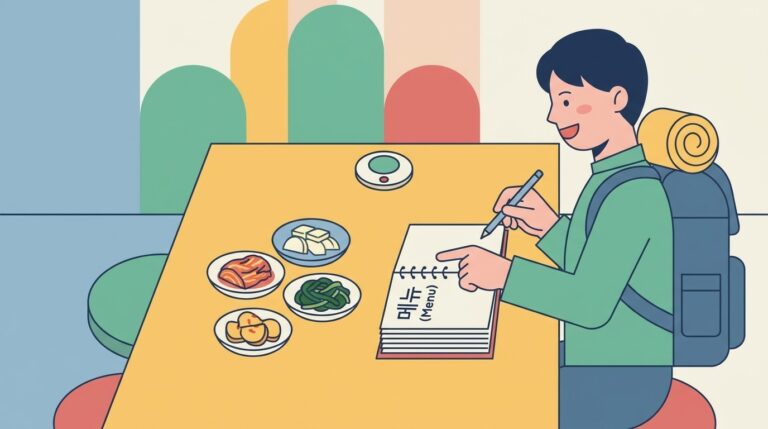
Never Panic at a Korean Restaurant Again: The Ultimate A2 Guide to Ordering Food
Phase 1: Welcome to the Table! (공감)
안녕하세요! (Annyeonghaseyo!) I am your chief editor at Daily Hangul, your trusty Korean friend and guide.
Imagine this: You are walking down a lively street in Hongdae, Seoul. The mouth-watering scent of sizzling pork belly (삼겹살 – samgyeopsal) fills the air. You step inside a cozy restaurant, just like the ones you’ve seen in dramas like Itaewon Class or Weightlifting Fairy Kim Bok-joo. The place is buzzing with energy, laughing friends, and busy servers.
You sit down, your stomach is growling, but suddenly your mind goes blank. How do you grab the server’s attention? Do you wave? Do you whisper? Many of my actual students have shared this exact moment of panic with me.
Don’t worry! Today, we are going to transform you from a hesitant diner into a confident local. By the end of this guide, you will know exactly what to say to get the best food, the quickest service, and maybe even some free side dishes (서비스 – seobiseu) from a delighted owner!
Phase 2: Three Magic Phrases to Rule the Menu (핵심 표현 심층 분석)
Let’s master the three most important phrases you need to order food in Korea.
1. 여기요, 주문할게요! (Yeogiyo, jumunhalgeyo!)
- Pronunciation: Yuh-ghee-yo, joo-moon-hal-gheh-yo! (Sound analogy: Think of saying “Yo-gee-yo, zoo-moon-hal-get-yo” with a soft, polite tone)
- Meaning: Literally, “Here, please! I will order.” -> Real-world Nuance: “Excuse me, we are ready to order!”
- K-Culture Moment: You will see this in almost every K-drama. Hungry characters sit down, and the most confident person in the group raises their hand and calls out this phrase to the busy staff.
- Editor’s Insight: In many Western cultures, shouting across a restaurant is considered impolite. In Korea, it is completely normal and expected! Servers are busy, and shouting “여기요!” (I’m here!) is seen as a helpful, energetic signal that you are ready.
- Situation Spectrum (상황 스펙트럼):
- Casual (Friends): ✅
- Semi-formal (Co-workers): ✅
- Formal (Elderly/Boss): ⚠️ (Use a softer tone, or let the eldest order)
- 🤔 Think About It: Why does Korean culture value this instant, vocal connection between the diner and the server over waiting quietly for eye contact?
2. [Menu Item] 주세요 ([Menu Item] juseyo)
- Pronunciation: [Menu] Joo-seh-yo (Sound analogy: “Ju-say-yo” like the words juice + say + yo)
- Meaning: Literally, “Please give me [Menu Item].”
- K-Culture Moment: Picture a street stall (포장마차 – pojangmacha) under a red tent. You point at the spicy rice cakes and say, “떡볶이 주세요!” (Tteokbokki juseyo!)
- Editor’s Insight: “주세요” is the ultimate magic word in Korean. You can attach it to any noun to request something politely. Want water? “물 주세요” (mul juseyo). Want a menu? “메뉴판 주세요” (menyupan juseyo).
- Situation Spectrum (상황 스펙트럼):
- Casual (Friends): ✅
- Semi-formal (Co-workers): ✅
- Formal (Elderly/Boss): ✅
- 🤔 Think About It: How does adding the polite verb ending “-세요” (seyo) protect you from sounding demanding, even when you are giving a direct command?
3. 이거랑 이거 주세요 (Igeorang igeo juseyo)
- Pronunciation: Ee-gauh-rang ee-guh joo-seh-yo (Sound analogy: “Ee-go-rang ee-go ju-say-yo”)
- Meaning: “Please give me this and this.”
- K-Culture Moment: You are in a traditional market, looking at a menu entirely in Korean characters. Don’t panic! You point at the delicious photos of savory pancakes (전 – jeon) and stew (찌개 – jjigae) while saying this phrase.
- Editor’s Insight: “이랑/랑” (irang/rang) is the casual Korean word for “and” when connecting nouns. If you don’t know the name of a dish, simply point at the menu or a neighboring table and say “이거랑 이거” (this and this).
- Situation Spectrum (상황 스펙트럼):
- Casual (Friends): ✅
- Semi-formal (Co-workers): ✅
- Formal (Elderly/Boss): ✅
- 🤔 Think About It: Does your native language have an easy shortcut like “this and this” that instantly saves you when you don’t know the vocabulary?
Phase 3: Textbook Korean vs. Real Street Korean (교과서 vs. 진짜 한국어)
Let’s look at how textbooks teach ordering versus how real Koreans actually talk in restaurants.
1. Calling the Server
- 📖 Textbook Korean: “저기요, 이리 오십시오.” (Jeogiyo, iri osipsio. – “Excuse me, please come here.”)
- 🗣️ Real Street Korean: “여기요~” (Yeogiyo~ – “Over here!”) or simply pressing the small call button (벨 – bel) on the table.
- 💡 Why the difference? Modern Korean dining values efficiency and comfort. Shouting a long textbook sentence feels too mechanical. “여기요” is warm, fast, and highly effective.
2. Requesting More Side Dishes
- 📖 Textbook Korean: “반찬을 더 많이 원합니다.” (Banchan-eul deo mani wonhamnida. – “I want more side dishes.”)
- 🗣️ Real Street Korean: “이모님, 반찬 좀 더 주세요~” (Imonim, banchan jom deo juseyo~ – “Auntie, some more side dishes please!”)
- 💡 Why the difference? Using the word “좀” (jom – a little) acts as a linguistic cushion. It softens your request so you don’t sound like a boss ordering a servant. Calling a middle-aged female owner “이모님” (imonim – auntie) instantly creates a warm, family-like bond!
Phase 4: K-Culture Deep Dive & Secret Etiquette
4-1. The Magic of “Nunchi” (눈치) and Non-Verbal Manners
To dine like a true Korean, you need 눈치 (Nunchi)—the art of reading the room.
* The Call Button (벨): Look closely at your table. Is there a small plastic button stuck to the side or the middle? That is the “벨” (bel). Instead of waving your hands or shouting, press it! It will make a pleasant “ding-dong” sound, and the server will come running.
* The Table Drawer: Can’t find chopsticks (젓가락 – jeotgarak) or spoons (숟가락 – sutgarak)? Don’t ask the server! Feel under the edge of your table. There is almost always a hidden drawer packed with utensils, napkins, and wet wipes.
4-2. The “Banchan” (반찬) Culture Code
In Korea, side dishes (반찬) are free and unlimited. This reflects Korea’s history of community and sharing food. If you empty a plate of delicious sweet potatoes or kimchi, do not hesitate to ask for more. In some modern places, you might see a sign that says “추가 반찬은 셀프” (Chuga banchan-eun selpeu), which means “Additional side dishes are self-service.” Look around for a salad bar-style station and help yourself!
Phase 5: Live Roleplay – The Bustling Hongdae Diner
Let’s put your skills to the test! You are entering “Mapo Galbi,” a famous Korean BBQ restaurant. Your server, Min-su, is friendly but very busy.
- Setting: A lively restaurant with round metal tables, sizzling pork on grills, and K-Pop music playing in the background.
- Cast: You (Hungry Traveler) & Min-su (Friendly Server)
- Turn 1 (Min-su): (Welcomes you warmly with a bow) 어서 오세요! 몇 분이세요? (Eoseo oseyo! Myeot bun-iseyo?) / “Welcome! How many people?”
- Turn 2 (You): (Holding up two fingers 😊) 두 명이요. (Du myeong-iyo.) / “Two people, please.”
- Turn 3 (Min-su): (Points to a round table near the window) 여기 앉으세요. 메뉴판 여기 있습니다. (Yeogi anjeuseyo. Menyupan yeogi isseumnida.) / “Please sit here. Here is the menu.”
- Turn 4 (You): (Looking at the delicious photos) 감사합니다. (Gamsahamnida.) / “Thank you.”
- Turn 5 (You): (Ready to order, raising your hand 🙋) 여기요, 주문할게요! (Yeogiyo, jumunhalgeyo!) / “Excuse me, we’d like to order!”
- Turn 6 (Min-su): (Walking over with a notepad) 네! 뭐 드릴까요? (Ne! Mwo deurilkkayo?) / “Yes! What can I get you?”
- Turn 7 (You): (Pointing at the menu) 삼겹살 이인분 주세요. (Samgyeopsal i-inbun juseyo.) / “Two portions of pork belly, please.”
- Turn 8 (Min-su): (Nodding and writing it down) 네, 삼겹살 이인분하고 음료수는요? (Ne, samgyeopsal i-inbun-hago eumryosuneun-yo?) / “Okay, two portions of pork belly, and how about drinks?”
- Turn 9 (You): 콜라 하나 주세요. (Kolla hana juseyo.) / “One Cola, please.”
- Turn 10 (Min-su): 네, 감사합니다! 금방 준비해 드릴게요. (Ne, gamsahamnida! Geumbang junbihae deurilgeyo.) / “Yes, thank you! I’ll prepare it for you right away.”
🔀 Decision Point: The Kimchi Dilemma!
Your meat has arrived, but you notice you have no Kimchi left. What do you do?
- Choice A: Shout “김치!” (Kimchi!) loudly across the room.
- Choice B: Press the table button (벨) or call “저기요” softly, then say “김치 좀 더 주세요.” (Kimchi jom deo juseyo.)
- Choice C: Stand up, walk into the kitchen, and grab the kimchi container yourself.
Best Choice: Choice B
Calling “저기요” or pressing the button, followed by “김치 좀 더 주세요,” is the most polite, natural, and respected way to ask for a refill. The word “좀” (jom) shows great Korean manners!
Risk/Bad Choice: Choice A or C
Shouting just “김치!” without “주세요” sounds like a rude command. Walking into the private kitchen (Choice C) is a major safety and etiquette mistake!
Phase 6: 10-Second Emotional Shadowing Drill
Let’s practice speaking with real Korean emotion! Pause at the slashes (/) and match the feeling in the brackets.
- [😊 Energetic & Friendly]
- 여기요! / 주문할게요!
- Yeogiyo! / Jumun-halgeyo!
- [🥺 Soft & Polite – Asking for water]
- 이모님, / 물 좀 / 주세요~
- Imonim, / mul jom / juseyo~
- [😤 Confident & Hungry – Pointing at two things]
- 이거랑 / 이거 / 주세요!
- Igeorang / igeo / juseyo!
Phase 7: K-Culture Mini Dictionary
- 1. 벨 (Bel – Call Button): The magical table-mounted buzzer that brings servers to your table instantly without shouting.
- 2. 반찬 (Banchan – Side Dishes): Free, refillable small plates of food served with your meal, representing Korean generosity.
- 3. 이모님 (Imonim – Lit. Auntie): A friendly, warm title used to address middle-aged female restaurant staff or owners.
- 4. 서비스 (Seobiseu – Service/Freebie): Free food or drinks given by the restaurant as a gesture of kindness to customers.
Phase 8: Traveler’s Survival Kit
Survival Cards: Top 3 Emergency Phrases
| Phrase (Korean) | Romanization | English Translation | Pro Tip |
|---|---|---|---|
| 물 좀 주세요 | Mul jom juseyo | Please give me some water. | In many casual restaurants, water is self-service (물은 셀프). |
| 앞접시 주세요 | Ap-jeopsi juseyo | Please give me a small extra plate. | Great for sharing food and letting hot stews cool down. |
| 계산해 주세요 | Gyesan-hae juseyo | Please check/bill me. | Say this at the counter or to your server when you are ready to pay. |
📌 Editor’s Travel Note
When traveling in South Korea, Google Maps does not always show the best walking directions. To find the absolute best local restaurants, download the Naver Map App Download Page before your trip. Also, for busy trendy restaurants in Seoul, use the Catch Table Reservation App Guide to book your table like a local! Please note: App interfaces may update; check their official sites for the newest versions.
Phase 9: One Step Deeper – The Heart of
Frequently Asked Questions (FAQ)
Q: What does "여기요, 주문할게요! (Yeogiyo, jumunhalgeyo!)" mean in Korean and how do you pronounce it?
A: In Korean, "여기요, 주문할게요! (Yeogiyo, jumunhalgeyo!)" is pronounced [Yuh-ghee-yo, joo-moon-hal-gheh-yo! (Sound analogy: Think of saying "Yo-gee-yo, zoo-moon-hal-get-yo" with a soft, polite tone] and means: Literally, "Here, please! I will order." -> Real-world Nuance: "Excuse me, we are ready to order!"
Q: What does "[Menu Item] 주세요 ([Menu Item] juseyo)" mean in Korean and how do you pronounce it?
A: In Korean, "[Menu Item] 주세요 ([Menu Item] juseyo)" is pronounced [Menu] and means: Literally, "Please give me [Menu Item]."
Q: What does "이거랑 이거 주세요 (Igeorang igeo juseyo)" mean in Korean and how do you pronounce it?
A: In Korean, "이거랑 이거 주세요 (Igeorang igeo juseyo)" is pronounced [Ee-gauh-rang ee-guh joo-seh-yo (Sound analogy: "Ee-go-rang ee-go ju-say-yo"] and means: "Please give me this and this."







