

Navigating Korean Hospitals: How to Inquire About Health Insurance and Medical Bills Like a Local
Phase 1: Empathy (A Warm, Real-World Welcome)
안녕하세요! (An-nyeong-ha-se-yo!) Welcome back to Daily Hangul. I’m your lead editor and friendly neighborhood K-culture guide.
Imagine this: You’re walking through the romantic, neon-lit streets of Hongdae, enjoying some spicy tteokbokki, when suddenly, a sharp toothache strikes. Or maybe you’ve caught a nasty flu while chasing the gorgeous cherry blossoms in Yeouido. Your head is pounding, and you find yourself standing before the sliding glass doors of a local Korean clinic (내과 – nae-gwa).
You’ve watched enough medical K-Dramas like Hospital Playlist to know that Korean doctors are incredibly skilled, but a cold sweat breaks out. How much is this going to cost? Does my insurance cover this? How do I ask for the bill without sounding rude or getting lost in translation?
Many of our intermediate (B2) students tell us that talking about money and insurance in a medical setting is one of the most stressful experiences in Korea. It’s not just about knowing the vocabulary; it’s about knowing the social nuances of Korean healthcare. Mastering these expressions won’t just save your wallet—it will earn you massive respect from clinic staff who are used to flustered tourists. Let’s make sure you never have to pay more than you should, and that you can handle these situations with absolute confidence!
Phase 2: Deep Dive into 3 Core Expressions
Let’s break down the three most vital expressions you need when dealing with medical bills and insurance in Korea.
1. 건강보험 적용 되나요? (Geon-gang-bo-heom jeog-yong doena-yo?)
- Pronunciation Guide: [Geon-gang-bo-heom] [jeog-yong] [doe-na-yo?]
(Sound analogy: “Geon-gang” sounds like “gun-gang” with a soft ‘u’. “Jeog-yong” sounds like “juck-yong”.) - Meaning: “Is this covered by health insurance?” (Literal: “Does health insurance apply?”)
- K-Culture Moment: You’ll hear variations of this in slice-of-life dramas when characters visit a pharmacy or physical therapy clinic after a long day of hard labor.
- Editor’s Insight: In Korea, almost all basic medical treatments are covered under the National Health Insurance Service (NHIS). However, skin clinics (dermatology for cosmetic reasons) or dental scaling might not be. Asking this first shows you understand the system.
Situation Spectrum
- Casual (Friends): 건강보험 적용 돼? (Geon-gang-bo-heom jeog-yong dwae?) — ⚠️ Only use with close friends.
- Semi-formal (Business/Default): 건강보험 적용 되나요? (Geon-gang-bo-heom jeog-yong doena-yo?) — ✅ Perfect for clinic receptionists.
- Formal (Elderly/Highly Polite): 건강보험 적용이 됩니까? (Geon-gang-bo-heom jeog-yong-i doemnikka?) — ✅ Very formal, used in official inquiries.
🤔 Think About It: Notice how the Korean language omits the pronoun “I” or “my” (as in, “my insurance”). Why do you think Korean defaults to collective context over individual ownership in healthcare settings?
2. 진료비가 대략 얼마 정도 나올까요? (Jin-ryo-bi-ga dae-ryak eol-ma jeong-do na-ol-kka-yo?)
- Pronunciation Guide: [Jin-ryo-bi-ga] [dae-ryak] [eol-ma] [jeong-do] [na-ol-kka-yo?]
- Meaning: “Approximately how much will the medical fee be?”
- K-Culture Moment: A classic scene where a struggling main character asks the nurse at the counter about the treatment costs before agreeing to a major procedure.
- Editor’s Insight: Koreans value efficiency, and asking for a ballpark estimate (대략 – dae-ryak) is considered very practical and completely polite, especially if you have to undergo extra tests like X-rays or ultrasounds.
Situation Spectrum
- Casual: 치료비 얼마 나와? (Chi-ryo-bi eol-ma na-wa?) — 🚫 Too blunt for medical staff.
- Semi-formal: 진료비가 대략 얼마 정도 나올까요? (Jin-ryo-bi-ga dae-ryak eol-ma jeong-do na-ol-kka-yo?) — ✅ Highly recommended.
- Formal: 총 진료비가 대략 어떻게 되나요? (Chong jin-ryo-bi-ga dae-ryak eo-tteo-ke doena-yo?) — ✅ Polite and sophisticated.
3. 실비보험 청구 서류 좀 챙겨주세요. (Sil-bi-bo-heom cheong-gu seo-ryu jom chaeng-gyeom-ju-se-yo.)
- Pronunciation Guide: [Sil-bi-bo-heom] [cheong-gu] [seo-ryu] [jom] [chaeng-gyeo-ju-se-yo.]
- Meaning: “Please provide/prepare the documents for private health insurance claim.”
- K-Culture Moment: This is the ultimate “adulting” phrase in Korea. Anyone working in an office in Seoul knows the pain of collecting these papers to get reimbursed.
- Editor’s Insight: 실비보험 (Sil-bi-bo-heom) refers to actual-expense private health insurance, which most long-term expats and Koreans carry. If you have international travel insurance, you’ll need the same documents (itemized receipt: 진료비 상세 내역서).
Situation Spectrum
- Casual: 서류 좀 줘. (Seo-ryu jom jwo.) — 🚫 Extremely rude to clinic staff.
- Semi-formal: 실비 청구 서류 좀 챙겨주세요. (Sil-bi cheong-gu seo-ryu jom chaeng-gyeo-ju-se-yo.) — ✅ Natural and professional.
- Formal: 보험 청구용 서류 발급 부탁드립니다. (Bo-heom cheong-gu-yong seo-ryu bal-geup bu-tak-deu-rim-ni-da.) — ✅ Perfect for large general hospitals.
Phase 3: Textbook Korean vs. Real Korean Showcase
Often, textbooks teach you grammatically perfect but incredibly robotic sentences. Let’s look at what the textbook says versus what is actually spoken in Seoul clinics.
Situation 1: Asking if your treatment is covered
- 📖 Textbook Korean: “국민건강보험의 혜택을 받을 수 있습니까?” (Is it possible to receive the benefits of national health insurance?)
- 🗣️ Real Korean: “이거 보험 적용 돼요?” (Does insurance apply to this?)
- 💡 Why it’s different: Koreans favor speed and economy of words. Stripping down the long official name of the insurance to just “보험” (bo-heom) is natural and immediately understood.
Situation 2: Requesting receipts for insurance claims
- 📖 Textbook Korean: “보험사에 제출할 영수증을 발행해 주십시오.” (Please issue a receipt to submit to the insurance company.)
- 🗣️ Real Korean: “보험 청구하게 영수증(이랑 내역서) 좀 끊어주세요.” (Please print out my receipt [and breakdown] for insurance claim.)
- 💡 Why it’s different: The verb “끊다” (kkeun-ta) literally means “to cut,” but in administrative contexts, it means “to issue/print a slip or ticket.” It sounds incredibly native and savvy.
Phase 4: K-Culture Deep Dive & Non-verbal Manners
4-1. Nunchi (눈치) & Non-verbal Etiquette at the Clinic
When you walk into a Korean clinic, you’ll notice it operates like a well-oiled machine. Speed and quiet courtesy are key.
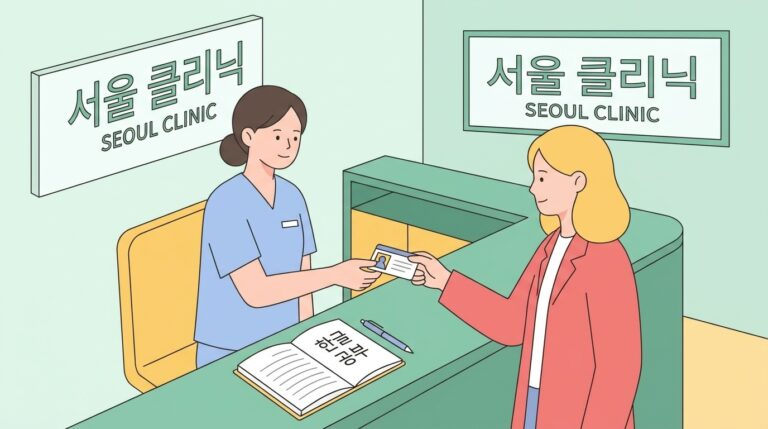
* The Two-Handed Hand-off: When presenting your ARC (Alien Registration Card) or physical ID card, always hand it over with both hands, or with your right hand supported gently at the wrist by your left. This is a subtle sign of deep respect.
* Indoor Voices: Waiting rooms are usually whisper-quiet. Playing videos without headphones or talking loudly on the phone is a major breach of etiquette.
4-2. The “Ppalli-Ppalli” (8282) Culture in Medical Care
Foreigners are often shocked by how fast a Korean medical visit is. You might wait 10 minutes, see the doctor for 2 minutes, get your prescription, pay, and be out the door in under 20 minutes! This is the peak of Korea’s 빨리빨리 (Ppalli-ppalli – fast-paced) culture. Because of this speed, you must have your questions ready. Don’t be afraid to clearly ask, “보험 돼요?” (Is it insured?) before they begin any unexpected, expensive treatments.
Phase 5: Interactive Roleplay Scenario
The Setting: You are at a cozy, modern ENT clinic (이비인후과 – i-bi-in-hu-gwa) in Hongdae. The waiting room has soft jazz playing, and a large monitor shows waiting numbers. You’ve just finished your consultation with the doctor and are at the front desk to pay.
Characters:
* You (A foreigner recovering from a bad cold, holding your ARC)
* Nurse Min-ji (A friendly, efficient clinic receptionist)
Dialogue
- Nurse Min-ji: (Smiling politely) “김지우 님, 수납 도와드리겠습니다. 카드나 신분증 있으신가요?”
(Kim Ji-woo nim, su-nap do-wa-deu-ri-get-seumnida. Ka-deu-na sin-bun-jeung isseu-sin-ga-yo?)
“Ji-woo Kim, I can help you with your payment. Do you have a card or ID?” -
You: 🎭 (Handing over your ARC with both hands) “네, 여기 외국인등록증 있어요.”
(Ne, yeo-gi oe-guk-in-deung-rok-jeung isseo-yo.)
“Yes, here is my Alien Registration Card.” -
Nurse Min-ji: 🎭 (Typing quickly on her keyboard) “네, 건강보험 가입되어 있으시네요. 오늘 진료비는 만 오천 원입니다.”
(Ne, geon-gang-bo-heom ga-ip-deo-eo isseu-si-ne-yo. O-neul jin-ryo-bi-neun man o-cheon won-im-ni-da.)
“Yes, you are registered under national health insurance. Today’s fee is 15,000 KRW.” -
You: 🎭 (Curious and cautious) “혹시 오늘 받은 검사도 건강보험 적용된 건가요?”
(Hok-si o-neul ba-deun geom-sa-do geon-gang-bo-heom jeog-yong-doen geon-ga-yo?)
“By any chance, is the test I received today also covered by health insurance?” -
Nurse Min-ji: “아, 네! 호흡기 치료랑 주사는 다 보험 적용이 되셨어요.”
(A, ne! Ho-heup-gi chi-ryo-rang ju-sa-neun da bo-heom jeog-yong-i doe-syeo-sseo-yo.)
“Ah, yes! The respiratory treatment and injection are all covered under insurance.” -
You: “다행이네요. 혹시 나중에 개인 보험 청구할 수 있나요?”
(Da-haeng-i-ne-yo. Hok-si na-jung-e gae-in bo-heom cheong-gu-hal su in-na-yo?)
“What a relief. Can I claim this on my private insurance later?” -
Nurse Min-ji: “네, 실비 청구 가능하세요. 서류 필요하신가요?”
(Ne, sil-bi cheong-gu ga-neung-ha-se-yo. Seo-ryu pil-yo-ha-sin-ga-yo?)
“Yes, actual-expense claim is possible. Do you need the documents?” -
You: 🎭 (Nodding with a warm smile) “네, 실비보험 청구 서류 좀 같이 챙겨주세요.”
(Ne, sil-bi-bo-heom cheong-gu seo-ryu jom gat-i chaeng-gyeo-ju-se-yo.)
“Yes, please prepare the documents for my private insurance claim as well.” -
Nurse Min-ji: “알겠습니다. 진료비 영수증이랑 세부 내역서 같이 끊어드릴게요. 잠시만 대기해 주세요.”
(Al-get-seumnida. Jin-ryo-bi yeong-su-jeung-i-rang se-bu nae-yeok-seo gat-i kkeun-eo-deu-ril-ge-yo. Jam-si-man dae-gi-hae ju-se-yo.)
“Got it. I will print the medical receipt and detailed breakdown together. Please wait a moment.” -
You: “감사합니다!”
(Gam-sa-ham-ni-da!)
“Thank you!”
🔀 Decision Point: What if she asks if you need a medical certificate (진단서 – jin-dan-seo)?
Nurse Min-ji asks: “혹시 진단서도 필요하세요?” (Do you also need a medical certificate?)
- Option A: “네, 다 주세요!” (Yes, give me everything!)
- Feedback: ⚠️ Risk Choice! A medical certificate (진단서) usually costs between 10,000 to 20,000 KRW to print. Only request it if your employer or insurance company specifically demands a doctor’s official note.
- Option B: “아니요, 그냥 기본 영수증이랑 내역서만 주세요.” (No, just give me the basic receipt and breakdown.)
- Feedback: ✅ Best Choice! Most private insurers only require the receipt (영수증) and the itemized breakdown (진료비 상세 내역서), which are printed for free or a tiny fee (1,000 KRW).
- Option C: “그게 뭐예요?” (What is that?)
- Feedback: 🚫 Awkward. While grammatically fine, asking this at a busy counter might delay the queue. Better to stick to Option B if you are unsure.
Phase 6: 10-Second Emotion Shadowing Drill
Let’s practice speaking with real Korean emotion and correct phrasing breaks! Pay attention to the / marks, which indicate where to take a micro-pause.
1. [🥺 Worried but polite]
“혹시… / 이 검사는 / 보험 적용이 / 안 되나요?”
(Hok-si… / i geom-sa-neun / bo-heom jeog-yong-i / an doe-na-yo?)
“By any chance… / is this test / not covered / by insurance?”
2. [😊 Relief and gratitude]
“아, / 다행이네요! / 그럼 영수증 / 같이 챙겨주세요!”
(A, / da-haeng-i-ne-yo! / geu-reom yeong-su-jeung / gat-i chaeng-gyeo-ju-se-yo!)
“Ah, / what a relief! / Then please / prepare the receipt too!”
Phase 7: K-Culture Mini Dictionary
| Word (Korean + Romanization) | English Meaning | Cultural & Practical Context |
|---|---|---|
| 급여 (Geup-yeo) | Covered Expenses | Medical services paid for in part by the National Health Insurance. Cheap for patients! |
| 비급여 (Bi-geup-yeo) | Non-covered Expenses | Cosmetic procedures, luxury hospital rooms, or brand-new treatments. You pay 100% of this out of pocket! |
| 실비보험 (Sil-bi-bo-heom) | Private Actual-Expense Insurance | A secondary private insurance policy that reembolses up to 80-90% of your “비급여” expenses. |
| 처방전 (Cheo-bang-jeon) | Prescription | Issued by doctors. You must take this to the nearest pharmacy (약국) right outside the clinic to get your meds. |
Phase 8: Traveler’s Survival Kit
Even if you’re only visiting Korea for a week, keep these survival tools handy!
Top 3 Survival Phrases for Travelers
- 여행자 보험 서류 필요해요. (Yeo-haeng-ja bo-heom seo-ryu pil-yo-hae-yo.)
👉 “I need documents for my travel insurance.” (Great for tourists!) - 영어 진단서 발급 되나요? (Yeong-eo jin-dan-seo bal-geup doe-na-yo?)
👉 “Can you issue a medical certificate in English?” - 약국은 어디에 있어요? (Yak-guk-eun eo-di-e isseo-yo?)
👉 “Where is the pharmacy?” (Almost always on the 1st floor of the same building!)
📌 Editor’s Travel Note
- Finding English-Speaking Clinics: Use the Emergency Medical Information Center website or search for “외국인 진료 지정 병원” (Foreigner-friendly clinics) on the Naver Map App.
- Disclaimer: Prices mentioned are based on current NHIS rates and can vary slightly based on clinic types and times (weekends/nights have a surcharge).
Phase 9: Deep Thoughts — “One Step Deeper”
In many Western cultures, health insurance is an individual responsibility, often highly privatized and complex. In Korea, however, the healthcare system is built on a strong communal foundation called 우리가 함께 (u-ri-ga ham-kke – “We together”).
Everyone pays into the National Health Insurance pool according to their income, ensuring that even a quick visit to a specialist costs less than a cup of premium boba tea. This community-first mentality is why asking for medical fees isn’t taboo; it is expected that health should be accessible and transparent for all.
💬 Your Turn:
“How does the health insurance system in your country compare to Korea’s ultra-fast, affordable system? Have you ever had a stressful medical experience abroad? Tell us in the comments!”
Phase 10: FAQ & Avoiding Misunderstandings (FAQ Schema Optimized)
Q: Can a tourist without an ARC (Alien Registration Card) get Korean National Health Insurance?
A: No. Only residents registered in Korea for over 6 months can qualify for NHIS. However, tourists can still access clinics! Out-of-pocket costs without insurance are still surprisingly reasonable (usually 30,000 to 70,000 KRW for a basic consultation), but having travel insurance is highly recommended.
Q: Why is my bill higher on a Saturday afternoon than on a Tuesday morning?
A: Korea has an “Out-of-hours Surcharge System” (야간·토요일 가산제). Clinics charge an extra 30% for consultations after 6:00 PM on weekdays, or on Saturday afternoons, Sundays, and public holidays.
Q: Can I buy prescription medicine directly from the doctor’s office?
A: No. Under Korean law, prescribing and dispensing are strictly separated (의약분업). You must take the physical prescription (처방전) to an external pharmacy (약국).
🚨 Common Mistakes Board
- Using “치료비” (treatment fee) instead of “진료비” (consultation fee): While understandable, “치료비” sounds like you underwent major surgery. Use “진료비” for everyday clinic visits.
- Handing over cards/ID with one hand: Avoid using just index and middle fingers to hand over cards. It looks like you’re throwing it. Always use both hands!
- Assuming “비급여” is covered by travel insurance: Travel insurance often covers sudden illnesses but won’t cover aesthetic dermatology or pre-existing conditions.
Phase 11: Action Missions
- 🥉 Bronze (The Mirror Challenge): Stand in front of a mirror and practice asking, “실비보험 청구 서류 좀 챙겨주세요” five times with a natural, polite smile.
- 🥈 Silver (The Social Share): Take a screenshot of Phase 7’s Mini Dictionary and share it on your Instagram stories, tagging
@DailyHangulwith your favorite word! - 🥇 Gold (The Real-world Prep): Create a digital folder in your phone named “Hospital Prep” and save screenshots of your ARC/Passport and your travel insurance policy details so you are ready for any emergency.
- 🎮 K-Culture Mission: Watch an episode of a Korean medical drama (like Romantic Doctor, Teacher Kim or Hospital Playlist) and listen closely for the words “환자” (patient), “수술” (surgery), and “보험” (insurance)!
Phase 12: Interactive Quiz Challenge
Test your clinic communication skills!
1. Scenario Question: You need to ask if your flu shot is covered by the National Health Insurance. What do you say?
- A) 이거 건강보험 적용 돼요? (Geon-gang-bo-heom jeog-yong dwae-yo?)
- B) 실비 청구 주세요. (Sil-bi cheong-gu ju-se-yo.)
- Answer: A is correct! “이거 건강보험 적용 돼요?” directly asks if the specific procedure/shot is covered by insurance.
2. Fill-in-the-blank: “보험 청구하게 ________ 좀 끊어주세요.” (Please issue my receipt for insurance claim.)
- Answer: 영수증 (Yeong-su-jeung – Receipt).
- Full Sentence: “보험 청구하게 영수증 좀 끊어주세요.”
3. True or False: In Korea, you can get medical prescriptions filled inside the clinic building’s lobby desk directly.
- Answer: False! You must take the paper prescription (처방전) to a nearby independent pharmacy (약국).







