

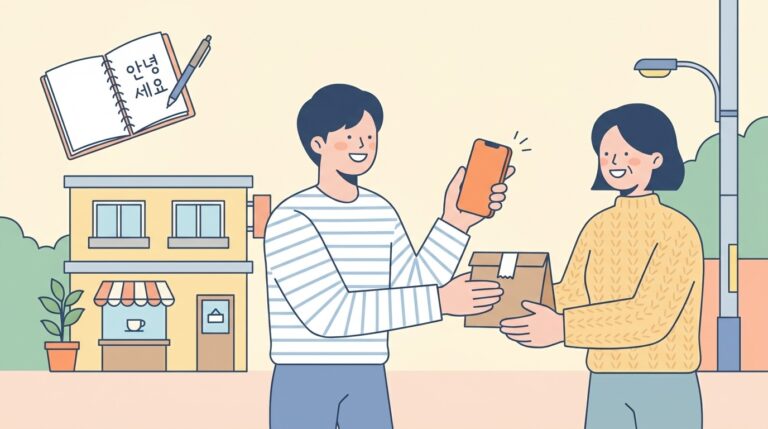
Unlock Local Secrets: Master Karrot Market (당근마켓) Manners and Sound Like a Korean Pro
안녕하세요! Welcome back to Daily Hangul. I’m your senior editor and local cultural navigator. If you have been living in Korea for more than a minute, or if you devour slice-of-life K-Dramas, you have definitely seen that iconic bright orange carrot icon. Yes, we are talking about Karrot Market (당긴라께ᄃ – Danggeun Market), the absolute king of local community trading in Korea.
But here is the catch: trading with neighbors isn’t just a financial transaction; it’s a social art form. Many intermediate (B2) learners reach out to me confessing, “I found the perfect vintage coat on Karrot, but I’m terrified of messaging the seller! What if I sound rude? What if I break an unwritten cultural rule?”
Don’t worry! Today, we are going to dive deep into the real-world etiquette, secret linguistic shortcuts, and cultural nuances of Korean secondhand trading. By the end of this guide, you won’t just know how to ask for a discount—you will do it with so much grace that the seller might just throw in some freebies!
Let’s get started on boosting your Manner Temperature (매너온도)!
Phase 2: Deep Dive into 3 Core Karrot Expressions
To navigate the app like a pro, you need to master these three golden phrases. They strike the perfect balance between polite respect and transactional efficiency.
1. 호시 네고 가닝한가요? (호시 네거 가낭한가요?)
- Pronunciation: Hok-si ne-go ga-neung-han-ga-yo? / [Sound-alike: Hoke-shee neh-go gah-neung-hahn-gah-yo?]
- Meaning:
- Literal: “By any chance, is negotiation possible?”
- Real-world Nuance: “I am highly interested in buying this, but would you be open to a tiny, friendly discount?”
- K-Culture Moment: You will hear this phrase used in various K-Dramas when characters try to save money for their dream projects. It is the polite way to ask for a price drop without sounding like a demanding bargain hunter.
- Editor’s Insight: The magic word here is 호시 (hok-si – by any chance). In Korean culture, jumping straight into a request can feel aggressive. Prefacing with 호시 softens your stance and gives the seller a comfortable space to say no if they can’t lower the price.
- Situation Spectrum:
- Casual (Friends): ✅ (Though you would say 네거 대?)
- Semi-formal (Karrot Sellers/Strangers): ✅ (Perfect, respectful, and standard)
- Formal (Boss/Elderly): ⚠️ (Generally acceptable in trade, but use caution with actual elders)
- ἱ Think About It: Notice how Koreans use the English word “negotiation” shortened to “네거 (ne-go)”. Why do you think loanwords are sometimes preferred in casual business or trading contexts over native Korean words?
2. 쿨거래 언해요 (쿨거래 런해요)
- Pronunciation: Kul-geo-rae won-hae-yo / [Sound-alike: Cool-guh-reh won-heh-yo]
- Meaning:
- Literal: “I want a cool transaction.”
- Real-world Nuance: “I promise not to ask annoying questions, haggle unnecessarily, or waste your time. Let’s make this trade quick and painless!”
- K-Culture Moment: In modern Korean society, where life moves at a lightning-fast pace (Ppalli-ppalli culture), being a “cool seller” or “cool buyer” is highly respected.
- Editor’s Insight: Promising a 쿨거래 is the ultimate green flag. Sellers love this because it means the buyer won’t inspect the item for 20 minutes under a magnifying glass at the meeting spot.
- Situation Spectrum:
- Casual (Karrot chat): ✅ (Very natural and appreciated)
- Semi-formal (Business): Ὣ1 (Too casual for professional contracts)
- Formal (Elders): Ὣ1 (May sound slightly immature)
3. 지거래 선허합니다 (지거래 선허합니다)
- Pronunciation: Jik-geo-rae seon-ho-ham-ni-da / [Sound-alike: Jeek-guh-reh suhn-ho-hahm-nee-dah]
- Meaning:
- Literal: “I prefer direct transaction.”
- Real-world Nuance: “I want to meet up in person to trade rather than using postal mail.”
- K-Culture Moment: Because Korean neighborhoods are highly concentrated, almost 90% of Karrot trades happen within a 15-minute walking distance, usually right outside subway exits or convenience stores.
- Editor’s Insight: Opting for 지거래 is incredibly safe in Korea. It eliminates shipping costs and allows both parties to verify the item on the spot.
- Situation Spectrum:
- Casual (Chat): ✅
- Semi-formal (Business): ✅
- Formal: ✅ (Highly polite and clear)
Phase 3: Textbook Korean vs. Real-World Korean
When we learn Korean from textbooks, we are often taught highly structural, dry sentences. Let’s look at how native speakers actually text on Karrot Market to sound warm, natural, and polite.
Scenario 1: Initiating a purchase
- 훠과서 한구거 (Textbook style):
- 이거슬 사궈 십스헌다. (I-geos-eul sa-go sip-seun-ni-da. – “I want to buy this.”)
- Why it’s awkward: It sounds like an automated robot making a transaction request. It lacks neighborly warmth.
- 진자 한구거 (Real-World style):
- 안냥하새요! 호시 구매 가닝한가요? 리 🙂 (An-nyeong-ha-se-yo! Hok-si gu-mae ga-neung-han-ga-yo? 🙂 – “Hello! Is this purchase possible by any chance? :)”)
- Why it works: It starts with a friendly greeting, uses the softening “호시,” and adds a light emoticon (리 or 🙂 ) to create an instant friendly connection.
Scenario 2: Proposing a meeting time
- 훠과서 한구거 (Textbook style):
- 뫠치간나구나깨 시간을 정하시ᄇ시오. (Myeot-si-e man-nal-ji si-gan-eul jeong-ha-sip-si-o. – “Decide what time we shall meet.”)
- Why it’s awkward: It sounds incredibly demanding and imperative, almost like an interrogation!
- 진자 한구거 (Real-World style):
- 푼하신 시간마스매주시매런, 재가 마추거나! (Pyeon-ha-sin si-gan mal-sseum-hae-ju-si-myeon, je-ga mat-chu-gess-seup-ni-da! – “If you let me know your preferred time, I’ll adjust to match yours!”)
- Why it works: It demonstrates massive respect and consideration for the seller’s schedule, making them highly motivated to leave you an excellent review.
Phase 4: K-Culture Deep Dive & Non-Verbal Manners
4-1. Nunchi (눈치) & Body Language at the Trade Spot
When you finally meet the seller at the designated spot (usually in front of a landmark like a subway exit), verbal communication is only 50% of the game. Here is how to show perfect Nunchi (societal situational awareness):
- The Double-Handed Handoff: When giving the money (if paying cash) or receiving the item, always use two hands. This is a foundational sign of respect in Korean culture. If one hand is busy, place your left hand gently under your right forearm or wrist while handing over the item.
- The Polite Bow: A slight 15-to-30-degree bow while saying “가마사하ᄇ니다” (gam-sa-hap-ni-da) does wonders. It establishes you as a polite and cultured individual.
4-2. The “Karrot Culture” Phenomenon
In many Western countries, meeting strangers from the internet can feel sketchy. However, in Korea, “당긴하다 (Danggeun-hada – to do Karrot)” has become a wholesome daily routine. Because Korea is a high-trust society with high-density living, people frequently trade items with next-door neighbors.
It’s not uncommon for busy sellers to say: “I will leave the item in the apartment’s guard office (경비실), please drop the cash in my mailbox.” This level of community trust is unique and beautiful. Respecting this trust by being on time and paying exact amounts is paramount.
Phase 5: Real-Life Roleplay Scenario
Let’s test your skills in a simulated trade!
The Setting
It is 7:30 PM on a crisp Friday evening. You are standing outside Mapo Station Exit 3 (마포역 3번 출구) under the warm glow of the streetlights. You are meeting Min-ji, a top-tier seller with a stellar Manner Temperature of 41.5°C, to buy a vintage film camera.
[Min-ji is waiting, holding a small paper shopping bag.]
The Dialogue
- Min-ji: 호시… 당긴개… 이신가요?
(Hok-si… Dang-geun-mae-geut… i-sin-ga-yo?)
“By any chance… are you… the Karrot Market buyer?”
(🎭 Stage Direction: Min-ji peers at you shyly but with a friendly smile.) -
You: 아, 내! 마자요! 아냥하새요!
(Ah, ne! Ma-ja-yo! An-nyeong-ha-se-yo!)
“Ah, yes! That’s correct! Hello!”
(🎭 Stage Direction: You bow politely at a 30-degree angle.) -
Min-ji: 아냥하새요! 가매라 어기 이스니다. 한번 화거런해보새요!
(An-nyeong-ha-se-yo! Kae-me-ra yeo-gi is-seup-ni-da. Han-beon hwa-gin-hae-bo-se-yo!)
“Hello! Here is the camera. Please feel free to check it!”
(🎭 Stage Direction: Min-ji hands over the paper bag using both hands.) -
You: 아, 가마사하ᄇ니다!
(Ah, gam-sa-hap-ni-da!)
“Ah, thank you!”
(🎭 Stage Direction: You carefully receive the bag with both hands and peek inside to see the gorgeous retro camera.) -
Min-ji: 자ᄳ대 자ᄃ하죠? 배터리더 새 거로 너허어더랴더서 바러 쓰시매둬요.
(Sat-sat-i jak-dong-ha-jyo? Bae-teo-ri-deo sae geo-ro neo-eo-dree-eot-eo-seo ba-ro sseu-si-myeon dwoe-yo.)
“It works perfectly, right? I also put in a fresh battery, so you can use it right away.” -
You: 와, 정마료? 세심하개 채겨주샤어서 정마루 가마사하ᄇ니다.
(Wa, jeong-mal-yo? Se-sim-hae-gae chae-gyeo-ju-syeo-seo jeong-mal-lo gam-sa-hap-ni-da.)
“Wow, really? Thank you so much for being so thoughtful and taking care of details!” -
Min-ji: 아니애요, 저더 아끼더나 가매라라 조흔 분깨 가개 둬어서 기퐤요.
(An-i-e-yo, jeo-do a-kki-deon kae-me-ra-ra jo-eun bun-kke ga-gae dwoe-eo-seo gi-bbyeo-yo.)
“No problem, I cherished this camera, so I am glad it’s going to a good person.”
🔀 Decision Point!
Now, you need to pay her. You agreed on 50,000 KRW. How do you handle this?
- Choice A: You hand her 45,000 KRW in cash and say: “호시 지금 5햔워ᄂ마내 가까주시매런 아내둬요?” (Can you drop 5,000 KRW off right now?)
- Choice B: You hand her exactly 50,000 KRW with both hands and say: “어기 마추어서 5만 워ᄂ이스니다. 정마료 잘 쓸개요!”
- Choice C: You pull out your phone and ask: “호시 개쟈소건 소금 가닝한가요?”
💡 Analysis of Choices
- Best Choice: Choice B or C (depending on pre-agreement). Doing a “surprise negotiation” at the meeting spot (Choice A) is considered incredibly rude in Korea. If you want to transfer via phone/app (Choice C), it is polite to ask for the account details (계좌번호) beforehand. Giving exact cash (Choice B) is the gold standard of “Cool Trade” (쿨거래)!
Phase 6: 10-Second Emotional Shadowing Drill
To make your Korean sound incredibly warm and natural, let’s practice adding emotion to your voice. Pay attention to the pauses (/) and the emotional cues!
- [😊 Expressing deep appreciation with excitement]
- 와! / 정마료? / 너무 / 가마사하ᄇ니다! / 잘 / 쓸개요!
- Wa! / Jeong-mal-yo? / Neo-mu / gam-sa-hap-ni-da! / Jal / sseul-ge-yo!
- “Wow! Really? Thank you so much! I will use it really well!”
- [🥺 Softly asking for a little favor/discount]
- 호시… / 아주 / 조금마내 / 네거 / 가닝하눠요…?
- Hok-si… / a-ju / jo-geum-man / ne-go / ga-neung-hae-yo…?
- “By any chance… is a tiny, little discount possible…?”
Phase 7: K-Culture Mini-Dictionary
| Word (Hangeul + Romanization) | English Translation | Real-world Cultural Context |
|---|---|---|
| 매너온도 (Mae-neo-on-do) | Manner Temperature | Karrot Market’s rating system. It starts at 36.5°C (normal human body temp). Friendly users go up; rude users drop to freezing levels. |
| 당긴하다 (Dang-geun-ha-da) | To do Karrot | A newly coined verb meaning to buy, sell, or trade secondhand goods nearby. |
| 반가ᄇ해ᄀ배 (Ban-gaps-taek-bae) | Half-price delivery | A brilliant system where convenience store trucks deliver packages from one convenience store to another for about half the price of normal mail. |
| 네거 (Ne-go) | Nego / Haggling | Short for negotiation. On Karrot, if a post says “네거 불가” (No Nego), it means the price is strictly non-negotiable. |
Phase 8: Traveler’s Survival Kit
Even if you are in Korea for a short time, you might need to buy an emergency umbrella, a transit card, or a adapter. Here are three quick phrases for survival:
Survival Expressions Card
- “어디서 마날가요?” (Eod-i-seo man-nal-ka-yo?)
- Pro Tip: Perfect for asking the seller to pick a safe, public spot like a subway exit.
- “반가ᄇ해ᄀ배 가닝한가요?” (Ban-gaps-taek-bae ga-neung-han-ga-yo?)
- Pro Tip: If meeting in person is too difficult, use this to get it shipped to your nearest GS25 or CU store for under 2,000 KRW.
- “정마루 가마사하ᄇ니다, 잘 쓸개요!” (Jeong-mal-lo gam-sa-hap-ni-da, jal sseul-ge-yo!)
- Pro Tip: The ultimate closing text message to send right after the trade. It guarantees a 5-star review!
Ὅ Editor’s Travel Note:
To navigate to your trade spot flawlessly, avoid using Google Maps in Korea as it lacks detail. Instead, use the KakaoMap App Download Page or the Naver Map App Store to find local subway exits and landmarks. Also, keep some cash handy or set up Toss/Kakao Pay for easy wire transfers!
Phase 9: Deep Thoughts — “Going Deeper”
Why is Karrot Market so uniquely successful in Korea? The answer lies in the traditional Korean concept of 정 (Jeong)—the feeling of deep attachment, warm-heartedness, and community bond. Historically, Korean neighborhoods shared everything, from kimchi-making (Gimjang) to household tools.
Karrot Market successfully digitalized this feeling of local trust. When trading, it’s common to receive a small candy, a warm beverage, or a kind handwritten note inside the bag. It turns a cold, transactional commercial exchange into a brief, heartwarming human connection.
💬 Your Turn: How does peer-to-peer secondhand trading look in your home country? Do people prioritize fast shipping, haggling, or meeting up? Let us know in the comments below!
Phase 10: FAQ & Mistake Prevention
Q: Can I negotiate the price on any item?
A: No. If the listing has the label “네거 불가” (No Nego), or if the price is already extremely low, asking for a discount is considered impolite. Always check the post carefully before asking!
Q: What if I am running late for the in-person meeting?
A: Inform the seller immediately. Korean people value punctuality immensely. A simple text like: “조금 뉴저서 죠송하ᄂ다! 10푼 디애 도차ᄀ해요.” (I’m sorry for being late! I’ll arrive in 10 minutes) will preserve your Manner Temperature.
Q: Is it okay to test the item in front of the seller?
A: Yes, absolutely! It is expected. However, do it quickly and politely. Don’t take too long or act overly suspicious of the seller.
🚨 Common Mistakes Warning Board
- The Ghosting Mistake: Asking “Is this available?” and then never replying again. This is a quick way to get blocked.
- The Late Negotiation: Asking to lower the price after you meet in person. This is highly frowned upon.
- Using Banmal (반마루): Even if the seller seems younger, never use casual language. Always use polite honorifics (존대퇘마루) to maintain boundaries.
Phase 11: Action Missions
- 호놴즈 (Bronze): Go to the mirror and practice saying: “어디서 마나런 푼하신가요?” out loud 5 times with a bright smile.
- 은 (Silver): Find a secondhand listing app or website, draft a mock inquiry using “호시 구매 가닝한가요?”, and write it down in your study notebook.
- 그먼 (Gold): Next time you need something in Korea, download the Karrot App and complete a real-life “Cool Trade” using only Korean!
- 게임 (K-Culture Mission): Watch any recent realistic Korean drama (like Our Blues or My Liberating Notes), spot a secondhand trading scene, and note down what terms they use!
Phase 12: Interactive Quiz Challenge
1. Situation Judgment
You want to ask for a discount, but the listing doesn’t mention anything about negotiations. Which message is the most polite?
* A) “가까주새요.” (Discount it for me.)
* B) “호시 네거 조금마내 가닝한가요?”
* C) “돈이 어ᄇ서요, 더 사개 해주새요.” (I don’t have money, make it cheaper.)
Click to see Answer
Correct Answer: B. It uses ‘Hok-si’ and ‘Nego’ with a polite honorific ending, making it respectful and culturally acceptable.
2. Fill in the Blank
Complete the sentence for a direct meeting request:
“Subway exit 3 아패서 (__________ – let’s meet)!”
Click to see Answer
Correct Answer: 마나요 (man-na-yo) or 봐요 (bwa-yo).
3. True or False?
True or False: If you are late, it is okay to not text the seller because they will wait anyway.
Click to see Answer
Correct Answer: False! Punctuality is extremely critical in Korean community trading. Always text immediately if you are running late.







