

Discover Korea’s Coolest Treasures: Your Guide to Navigating the National Museum of Korea Gift Shop Like a Pro
안녕하세요! (An-nyeong-ha-se-yo!) Hello, my dear language learners! It’s your favorite premium editor from Daily Hangul.
Have you ever walked into a souvenir shop abroad and felt completely overwhelmed? Not just by the beautiful items, but by the sudden dread of wanting to ask a question and realizing you don’t have the words?
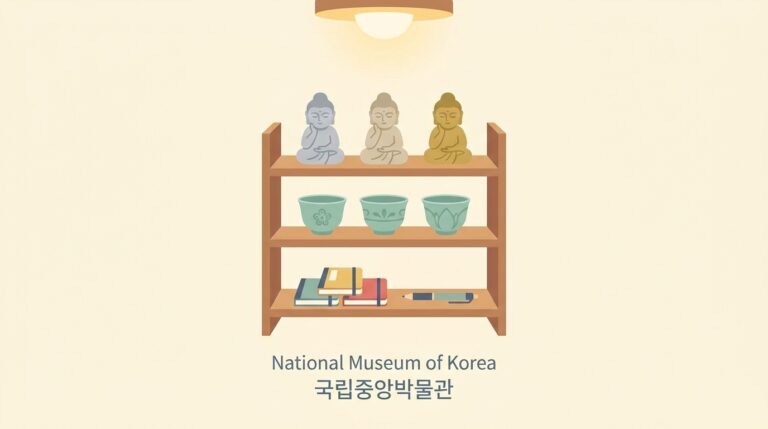
Picture this: You are standing in the sleek, warm-lit gift shop of the National Museum of Korea (국립중앙박물관 – Guk-lip-jung-ang-bang-mul-gwan). Around you are exquisite miniature Pensive Bodhisattvas in pastel colors—the exact ones made famous by BTS’s RM! You want to buy one for your desk, but you also want a beautifully wrapped Goryeo Celadon glass cup for your mother. You see a gorgeous flower pattern on a modern phone grip, and you wonder, “What does this mean? Is it a symbol of good luck?”
You turn to the polite staff member, but your mind goes blank. “Uh… this… wrapping?”
Don’t worry! Today, we are going to unlock the exact conversational keys to make your museum shop exploration smooth, culturally respectful, and incredibly rewarding. Buying a piece of Korean history should feel like an adventure, not a test. Let’s dive in!
1. Core Expressions Deep Dive
Here are three essential expressions that will immediately elevate your shopping experience from a silent transaction to a meaningful cultural exchange.
① 이 문양은 어떤 의미가 있나요? (What does this pattern mean?)
- Pronunciation: I mun-yang-eun eo-tteon ui-mi-ga in-na-yo? / [Ee moon-yahng-eun uh-tteon wee-mee-gah een-nah-yo?]
- Meaning: What kind of meaning does this pattern/design hold?
- K-Culture Moment: In many historical K-dramas, royal garments and folding screens are covered in symbols like peonies (wealth) or cranes (long life). This phrase lets you uncover those hidden stories behind the items.
- Editor’s Insight: Korean traditional designs are rarely “just pretty.” Almost every flower, animal, and geometric line represents a wish for health, prosperity, or protection. Asking this shows the staff that you truly respect Korean heritage.
- Situation Spectrum:
- Casual (Friends): ⚠️ (Too formal for friends, but okay if talking about art)
- Semi-formal (Staff/Colleague): ✅ (Perfect and highly polite)
- Formal (Elderly/Boss): ✅ (Shows great manners)
- 🤔 Think About It: In Korea, art and daily life have always been deeply connected. How does your culture use symbols in everyday objects or decorations?
② 선물용으로 포장해 주실 수 있나요? (Could you wrap this as a gift?)
- Pronunciation: Seon-mul-yong-eu-ro po-jang-hae ju-sil su in-na-yo? / [Sun-mool-yong-eu-ro poh-jahng-hae joo-shil soo een-nah-yo?]
- Meaning: Can you wrap this for gift purposes?
- K-Culture Moment: Gift-giving is a major social ritual in Korea. The museum shop is famous for using beautiful bojagi (traditional wrapping cloth) or elegant, minimalist paper boxes.
- Editor’s Insight: While some basic wrapping is free, premium traditional wrapping might have an extra fee. If they ask “포장비가 추가되는데 괜찮으세요?” (There is an extra fee for wrapping, is that okay?), you can simply nod and say, “네, 괜찮아요.” (Yes, that’s fine.)
- Situation Spectrum:
- Casual (Friends): 🚫 (Too stiff)
- Semi-formal (Staff/Colleague): ✅ (The ideal polite way to request service)
- Formal (Elderly/Boss): ✅ (Highly appropriate)
③ 이거 요즘 제일 인기 있는 상품인가요? (Is this the most popular item these days?)
- Pronunciation: I-geo yo-jeum je-il in-gi in-neun sang-pum-in-ga-yo? / [Ee-guh yo-jeum jay-eel een-ghee een-neun sahng-poom-een-gah-yo?]
- Meaning: Is this the most popular product lately?
- K-Culture Moment: Trendy Koreans love what they call “Muzshop Goods” (뮤즈숍 굿즈). Items like the “Celadon-patterned Tumblr” or “Joseon Dynasty Glasses” often go viral on Instagram and sell out instantly.
- Editor’s Insight: If you are overwhelmed by the choices, just ask this! The staff will proudly point out the current viral trend.
- Situation Spectrum:
- Casual (Friends): ⚠️ (Better to say “이거 요즘 제일 잘 나가?” to a close friend)
- Semi-formal (Staff/Colleague): ✅ (Natural and friendly)
- Formal (Elderly/Boss): ✅ (Perfect)
2. Textbook Korean vs. Real Korean
Let’s look at how textbooks teach you to shop versus how real Koreans actually talk. Keeping it natural will save you from sounding like a translation app!
Situation 1: Asking if they have more stock
- 📖 Textbook Korean: “이 상품의 재고가 존재합니까?” (I sang-pum-ui jae-go-ga jon-jae-hap-ni-ka? – Does the inventory of this product exist?)
- 🗣️ Real Korean: “이거 혹시 새 상품으로 또 있어요?” (I-geo hok-si sae sang-pum-eu-ro tto is-seo-yo? – By any chance, do you have another brand-new one of this?)
- 💡 Why is it different? The textbook version sounds like a warehouse manager doing an audit. In real life, asking for a “new one” (새 상품) is the warmest and most natural way to get a fresh box from the back.
Situation 2: Politely declining help when you just want to browse
- 📖 Textbook Korean: “아니요, 저는 단지 구경하고 있습니다.” (A-ni-yo, jeo-neun dan-ji gu-gyeong-ha-go is-seup-ni-da. – No, I am merely spectating.)
- 🗣️ Real Korean: “그냥 좀 둘러볼게요!” (Geu-nyang jom dul-leo-bol-ge-yo! – I’ll just look around a bit!)
- 💡 Why is it different? The textbook phrase sounds cold and defensive. Adding “그냥” (just) and “둘러볼게요” (will look around) with a gentle smile makes you sound incredibly friendly and relaxed.
3. K-Culture Deep Dive & Non-verbal Manners
3-1. The “Two-Hand” Golden Rule (두 손)
When paying or receiving your wrapped souvenir, always use both hands. In Korea, receiving an item, card, or change with only one hand can look casual or even slightly dismissive. You don’t need to bow deeply; just a slight tilt of your head while using both hands to accept your shopping bag shows that you understand Korean etiquette.
3-2. The “Muzshop” Craze
The National Museum of Korea Gift Shop is not your average, dusty souvenir store. Koreans call it the “Muzshop” (뮤즈숍), and it has become a lifestyle brand. By redesigning traditional motifs (like Goryeo Celadon or Joseon Baekja) into modern items like wireless chargers, colored drinking glasses, and sensory incense holders, they bridged the gap between history and hip Gen-Z lifestyle. It’s a prime example of the “Newtro” (New + Retro) trend in Korea!
4. Interactive Roleplay Scenario
Imagine you are inside the beautiful main gift shop on the first floor of the museum.
- Setting: Soft classical-modern fusion music plays in the background. The shelves gleam with lacquerware and pastel ceramics.
- Cast: You (an excited collector) and Minji (the helpful, warm museum shop guide).
Minji: (🎭 Smiling warmly as you approach the display)
       안녕하세요! 도움이 필요하시면 말씀해 주세요.
       (Hello! Please let me know if you need any help.)

You: (🎭 Pointing politely at a beautiful incense burner with a traditional roof tile pattern)
     저기요, 이거 혹시 새 상품으로 또 있어요?
     (Excuse me, do you have another brand-new one of this?)

Minji: (🎭 Checking the cabinet beneath the shelf)
       아, 네! 마침 딱 하나 더 남아 있네요. 여기 있습니다.
       (Ah, yes! We happen to have exactly one left. Here it is.)

You: (🎭 Holding it carefully with both hands)
     감사합니다. 혹시 이 문양은 어떤 의미가 있나요?
     (Thank you. By the way, what does this pattern mean?)

Minji: (🎭 Pointing to the circular design on the side)
       이건 귀면와(Gwimyeonwa) 문양이에요. 나쁜 기운을 막아주는 뜻을 가지고 있어요.
       (This is the Gwimyeonwa pattern. It has the meaning of blocking bad energy.)

You: (🎭 Nodes in fascination)
     와, 정말 멋지네요! 선물용으로 포장해 주실 수 있나요?
     (Wow, that's really cool! Could you wrap this as a gift?)

Minji: (🎭 Nodding politely)
       그럼요! 리본 포장과 상자 포장이 있는데, 어떤 걸로 해 드릴까요?
       (Of course! We have ribbon wrapping and box wrapping. Which one would you prefer?)
🔀 Decision Point!
How should you respond to Minji?
- Option A: “아무거나 해주세요.” (A-mu-geo-na hae-ju-se-yo. – Just do whatever.)
- 🚨 Editor’s Feedback: “아무거나” means “whatever,” which can sound indifferent or slightly lazy in Korean. Avoid this!
- Option B: “상자 포장으로 부탁드려요!” (Sang-ja po-jang-eu-ro bu-tak-deu-ryeo-yo! – Box wrapping, please!)
- 🏆 Editor’s Feedback: Excellent! Clear, polite, and uses the magic respectful phrase “부탁드려요” (I request of you).
- Option C: “그냥 포장 안 할래요.” (Geu-nyang po-jang an hal-rae-yo. – Actually, I won’t do wrapping.)
- ⚠️ Editor’s Feedback: Grammatically fine, but a bit abrupt. A softer way to say this is “그냥 그냥 주셔도 돼요” (You can just give it to me as is).
5. 10-Second Shadowing Drill
Let’s practice speaking with real Korean emotion! Try to mimic the pauses marked by the / and match the emotional cues.
- [😊 Expressing deep appreciation]
우와, / 진짜 / 영롱하네요!
(U-wa, / jin-ja / yeong-rong-ha-ne-yo!)
“Wow, it’s truly gorgeous/sparkling!” -
[🙏 Making a polite request]
선물포장 / 혹시 / 가능할까요?
(Seon-mul-po-jang / hok-si / ga-neung-hal-ka-yo?)
“Would gift wrapping, by any chance, be possible?”
6. K-Culture Mini Dictionary
- 반가사유상 (Ban-ga-sa-yu-sang / Pensive Bodhisattva): Korea’s National Treasure No. 83, featuring a deeply peaceful meditating statue. Its miniatures are the ultimate “it-item” for modern office desks.
- 자개 (Ja-gae / Mother-of-pearl): Iridescent lining of shells used to decorate lacquerware. It catches the light beautifully and is featured on modern tumblers and cardholders.
- 고려청자 (Go-ryeo-cheong-ja / Goryeo Celadon): Famous pale green ceramic ware from the Goryeo Dynasty, known for its soft jade color.
- 굿즈 (Gut-zeu / Goods): A loanword from “goods,” used universally in Korea to mean merchandise, especially trendy museum or idol souvenirs.
7. Traveler’s Survival Kit
Top 3 Survival Phrases
- “이거 깨지기 쉬운가요?” (I-geo kkae-ji-gi swi-un-ga-yo? – Is this fragile?)
- Pro Tip: Use this for ceramic or glass souvenirs so the staff can add extra bubble wrap.
- “택배 발송도 되나요?” (Taek-bae bal-song-do doe-na-yo? – Do you offer shipping/delivery?)
- Pro Tip: If you buy a larger item like a traditional mini-table (소반), they can ship it directly to your hotel.
- “면세 혜택 받을 수 있나요?” (Myeon-se hye-taek ba-deul su in-na-yo? – Can I get tax-free benefits?)
- Pro Tip: Keep your passport ready for instant tax refunds on eligible purchases!
📌 Editor’s Travel Note: Don’t get lost on your way! Always check the Naver Map app store download page to easily navigate Seoul’s public transit. You can find up-to-date hours and exhibition schedules on the National Museum of Korea Official Website.
8. Deep Thought: “Newtro” and Gen-Z Heritage
Why did Korean Gen-Z suddenly fall in love with traditional museum souvenirs? Historically, museum gift shops were seen as places only for older tourists. However, through clever modern design, young Koreans realized that their history isn’t static—it’s incredibly stylish. By blending historic aesthetics with modern utility, they found a unique way to express their identity.
💬 Your Turn: Does your country have a historical symbol or craft that has recently become trendy among younger generations? Tell me in the comments below!
9. FAQ & Avoiding Common Mistakes
Q: Can I pay with foreign credit cards at the museum shop?
A: Yes! Visa, Mastercard, and JCB are widely accepted. However, having some local currency or a local mobile payment system is always handy for smaller street vendors outside.
Q: Are the items in the National Museum of Korea Gift Shop handmade?
A: It depends. The premium ceramic replicas are handmade by master craftsmen, while smaller stationery items are manufactured. The price tag usually reflects this difference clearly.
Q: Is the gift shop open even if I don’t buy an exhibition ticket?
A: Yes! The main gift shop is located in the free-entry lobby area, so you can walk right in just to browse the beautiful goods.
🚨 Common Mistakes Warning Board
- Mistake: Pointing with one finger aggressively while shouting “이거!” (This!)
- Correct Action: Keep your hand open and gesture gently toward the item, saying “이거 보여주세요” (Please show me this one).
- Mistake: Using casual language (반말) to staff, like saying “포장해줘” (Wrap it).
- Correct Action: Keep the respectful “-요” ending: “포장해 주세요” (Please wrap it).
- Mistake: Forgetting to ask for bubble wrap for plane travel.
- Correct Action: Say, “비행기 탈 건데 포장 튼튼히 해주세요” (I am boarding a plane, so please wrap it securely).
10. Action Mission Challenge
- 🥉 Bronze (At Home): Record yourself saying “이 문양은 어떤 의미가 있나요?” three times in a friendly, curious voice.
- 🥈 Silver (Social Media): Post a picture of your favorite traditional design on Instagram and tag us with the Korean word #자개 or #고려청자.
- 🥇 Gold (In Real Life): Visit the next museum on your itinerary and successfully ask the staff: “이거 요즘 제일 인기 있는 상품인가요?”
11. Interactive Quiz
Let’s test your memory before you head out shopping!
Q1. Which phrase means “Can you wrap this as a gift?”
- A) 이거 할인해 주세요.
- B) 선물용으로 포장해 주실 수 있나요?
- C) 그냥 좀 둘러볼게요.
Q2. True or False: You should hand your credit card to the cashier using only your index and middle finger to show efficiency.
- True / False
🎉 Click here to reveal the answers!
- A1: B is correct! (A means “Please give me a discount,” and C means “I’ll just look around.”)
- A2: False! Always use two hands to give and receive cards, money, or items to show respect.
Now you are fully prepared to shop like a true cultural connoisseur at the National Museum of Korea! Happy exploring, and see you in the next lesson! 다음에 또 만나요! (Dae-eum-e tto man-na-yo!)







