

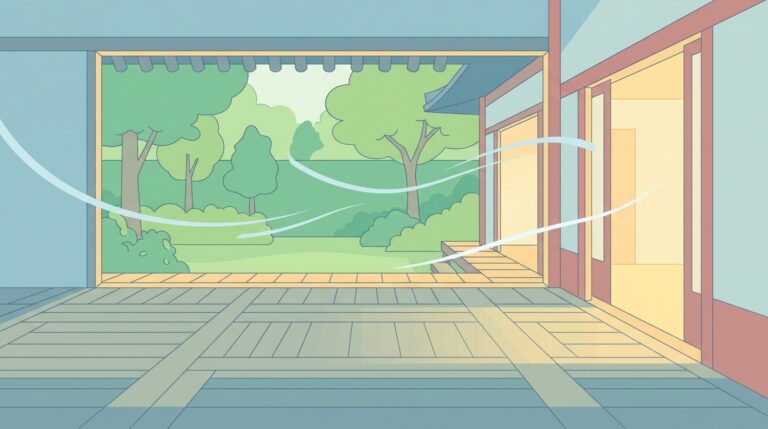
The Silent Science of the Breeze: Unlocking the Secret of Hanok’s Daecheongmaru (대청마루)
안녕하세요! (Annyeonghaseyo!) I’m your Daily Hangul Senior Editor and cultural navigator. If you have ever watched a historical K-Drama or a healing variety show set in a rural traditional village, you have probably seen characters lounging peacefully on a spacious wooden floor, slicing a chilled watermelon (수박), and looking incredibly refreshed—even in the dead of summer without a single air conditioner in sight.
How is that possible? Welcome to the genius of the 한옥 (Hanok – Traditional Korean House) and its crown jewel of passive cooling: the 대청마루 (Daecheongmaru). Today, we are not just going to learn vocabulary; we are going to dive deep into the cultural philosophy and thermodynamics of Korean architecture. By the end of this guide, you will be able to discuss Korean spatial design at a C1 (Advanced) level, leaving your Korean friends thoroughly impressed!
Phase 1: The Magic of the Wind Path (공감)
Imagine this: It is a scorching August afternoon in Seoul. You are exploring the historic Bukchon Hanok Village. The asphalt is radiating heat, and your handheld mini-fan is doing absolutely nothing but blowing warm air into your face. You feel exhausted.
Then, you step inside a traditional Hanok-turned-cafe. The host invites you to remove your shoes and step onto the elevated wooden floor—the 대청마루 (Daecheongmaru). The moment you sit down, a miraculously cool, crisp breeze sweeps across the room, instantly drying your sweat. There is no AC running, yet it feels significantly cooler than the modern street outside.
This is not magic; it is a meticulously calculated architectural masterclass in ventilation. This experience inspired my former student, Julian, an architecture major from Munich. He knew the word “시원하다” (to be cool), but when he wanted to explain why the Hanok felt so breezy to his Korean homestay hosts, he lacked the sophisticated vocabulary to do so. Let’s make sure you never find yourself in Julian’s shoes!
Phase 2: Core Expressions Deep Dive (핵심 표현 심층 분석)
To talk about Hanok like a true cultural connoisseur, you need to master these three advanced terms.
1. 대청마루 (Dae-cheong-ma-ru)
- Pronunciation: [Dae-cheong-ma-ru] / Sound-alike: “Day-chung-mah-roo”
- Meaning: The grand, open-hall wooden floor that serves as the central hub of a traditional Hanok.
- K-Culture Moment: In the hit healing drama Summer Strike (아무것도 하고 싶지 않아), the characters often gather on the wooden floor to share food, stargaze, and seek respite from their chaotic lives.
- Editor’s Insight: It is not a “balcony” or a “porch.” The Daecheongmaru is a fluid, semi-communal space that bridges the private inner rooms (안방) and the public outdoor courtyard (마당). It serves as a natural air conditioner in summer and a sunny lounge in spring and autumn.
- Situation Spectrum:
- Casual: ✅
- Semi-formal: ✅
- Formal: ✅
- 🤔 Think About It: Unlike Western homes that clearly partition the “inside” from the “outside” with thick walls and locked doors, why does traditional Korean architecture favor this open, transitional space? How does this reflect the Korean ideal of living in harmony with nature?
2. 맞바람이 불다 (Mat-ba-ram-i bul-da)
- Pronunciation: [Mat-ba-ram-i bul-da] / Sound-alike: “Maht-bah-rahm-ee bool-dah”
- Meaning: Literal: “Opposing winds blow.” Real-world Nuance: A cross-breeze or cross-ventilation.
- K-Culture Moment: On the popular outdoor reality show Three Meals a Day (삼시세끼), the cast members immediately open both the front sliding doors and the tiny back windows of their Hanok, declaring, “맞바람이 불어서 에어컨이 필요 없네!” (The cross-breeze is blowing, so we don’t even need AC!)
- Editor’s Insight: The physics behind this are fascinating. Hanok courtyards are intentionally left empty with bare clay, which heats up rapidly under the sun, creating low pressure. Meanwhile, the backyard behind the house is filled with shaded greenery and trees, creating high pressure. The cool air from the shaded backyard naturally rushes forward toward the hot front courtyard, creating a continuous, refreshing mat-baram across the wooden floor.
- Situation Spectrum:
- Casual: ✅
- Semi-formal: ✅
- Formal: ✅
- 🤔 Think About It: In English, “headwind” or “opposing wind” often carries a negative, obstructive connotation. Why do you think Korean culture embraces mat-baram as a highly positive, welcoming phenomenon?
3. 배산임수 (Bae-san-im-su)
- Pronunciation: [Bae-san-im-su] / Sound-alike: “Beh-sahn-eem-soo”
- Meaning: “Backed by mountains and facing water.” The classic Korean four-character idiom (사자성어) representing the ideal geographical positioning of a house.
- K-Culture Moment: You will hear this term constantly in historical dramas (사극) whenever a royal geomancer or Feng Shui expert (풍수지리설사) is choosing the site for a new palace or noble mansion.
- Editor’s Insight: This is a high-level idiom that instantly elevates your Korean. Bae-san-im-su is not just about aesthetics; it is the ultimate macro-design for wind control. The mountain at the back blocks freezing winter winds from Siberia, while the open water in the front channels cool summer breezes directly into the house’s wind paths.
- Situation Spectrum:
- Casual: ⚠️ (A bit too literary for casual texting, but fantastic for deep conversations)
- Semi-formal: ✅
- Formal: ✅
- 🤔 Think About It: Do modern skyscrapers and apartment complexes in your city consider natural topography, or do they rely entirely on artificial climate control?
Phase 3: Textbook Korean vs. Real Korean (실전 한국어 쇼케이스)
Let’s look at how textbook Korean compares to the vibrant, natural language used by native speakers when discussing comfort and space.
Situation 1: Expressing how cool the breeze is inside a building
- 📖 Textbook Korean: “바람이 양방향에서 통과하여 시원합니다.” (The wind passes through from both directions, so it is cool.)
- 🗣️ Real Korean: “와, 맞바람이 장난 아니게 불어서 진짜 시원하네요!” (Wow, the cross-breeze is no joke, it’s so incredibly cool!)
- 💡 Why is it different?: C1 speakers use idiomatic amplifiers like “장난 아니다” (no joke/incredible) combined with precise atmospheric terms like mat-baram to convey genuine sensory delight, rather than reciting a physics textbook.
Situation 2: Commenting on a beautifully ventilated modern room
- 📖 Textbook Korean: “이 방은 통풍이 잘 되는 구조를 가지고 있습니다.” (This room has a structure that ventilates well.)
- 🗣️ Real Korean: “우와, 여기 바람 길이 제대로 열렸네요!” (Wow, the wind path is truly wide open here!)
- 💡 Why is it different?: Native speakers poetically refer to the flow of air as a “바람 길” (wind path/trail). Using this metaphor shows a highly advanced, intuitive grasp of the Korean spatial mindset.
Phase 4: K-Culture Deep Dive & Non-verbal Manners
4-1. Nunchi (눈치) & Body Language: Stepping on the Daecheongmaru
Stepping onto a Hanok’s wooden floor requires a specific physical etiquette that demonstrates your cultural maturity:
1. Align Your Shoes: When you slip off your shoes at the stone step (디딤돌), do not leave them facing the room. Turn them around so that the toes point outward toward the yard. This makes it seamless to step back into them when you leave and shows respect for the order of the household.
2. Mind the Door Sill (문지방): Never, under any circumstances, step on the wooden door threshold (문지방 – munjibang). Culturally, the threshold represents the boundary between the living world and the spirit world, and stepping on it is believed to bring bad luck. Always step cleanly over it.
4-2. K-Travel Context: “Mung-ttaerigi” (멍때리기)
In modern Korea, there is a massive wellness trend called 멍때리기 (mung-ttaerigi), which translates to “zoning out” or “clearing one’s mind.” When you travel to places like Jeonju Hanok Village or historical temples in Gyeongju, you will see Koreans sitting on the edge of the Daecheongmaru, silently staring at the courtyard or listening to the wind-chimes (풍경). Doing this on a breezy afternoon is considered the ultimate form of natural meditation.
Phase 5: Gyeongju Guesthouse Roleplay (실전 롤플레이)
Setting: A golden mid-summer afternoon at a historic Hanok guesthouse in Gyeongju. The air is warm, cicadas are buzzing in the distance, and the wooden pillars smell faintly of pine and aged earth. You have just checked in.
Cast:
* You (An advanced traveler eager to experience Hanok culture)
* Min-woo (민우) (The friendly, culture-proud guesthouse owner in his early 30s)
Min-woo: 어서 오세요! 오시느라 정말 고생 많으셨어요. 오늘 날씨가 정말 덥죠?
        (Welcome! Thank you so much for traveling all this way. It's incredibly hot today, right?)

You: (🎭 Wiping sweat from your forehead) 네, 골목길에서 걸어오는데 땀이 뻘뻘 났어요.
     (Yes, walking through the alleyways, I was sweating buckets.)

Min-woo: (🎭 Gesturing warmly toward the elevated floor) 얼른 이 대청마루로 올라오세요. 여기에 앉으시면 금방 시원해질 거예요.
        (Quickly, come up onto this Daecheongmaru. If you sit here, you'll cool down in no time.)

You: (🎭 Stepping over the 문지방 and sitting down gracefully) 우와... 신기하네요. 에어컨도 안 켰는데 사방에서 시원한 바람이 불어와요!
     (Wow... this is amazing. You haven't even turned on the AC, but a cool breeze is blowing from all directions!)

Min-woo: (🎭 Smiling proudly) 하하, 맞아요! 이게 바로 한옥의 비밀이랍니다. 앞마당과 뒷마당의 기온 차이 덕분이죠.
        (Haha, exactly! This is the secret of the Hanok. It's thanks to the temperature difference between the front yard and the backyard.)

You: 아, 그게 과학적인 통풍 구조, 즉 '맞바람'의 원리군요! 책으로만 보던 걸 직접 느끼니까 정말 신기해요.
     (Ah, so that's the scientific ventilation structure—the principle of 'mat-baram'! Experiencing what I only read about in books is truly fascinating.)

Min-woo: 와, '맞바람'이라는 단어도 아시네요! 맞아요. 저희 한옥이 완벽한 '배산임수' 지형에 있어서 바람 길이 제대로 열려 있거든요.
        (Wow, you even know the word 'mat-baram'! You're right. Our Hanok is located in a perfect 'Bae-san-im-su' topography, so the wind path is beautifully open.)

You: 과연 선조들의 지혜가 돋보이네요. 인공적인 바람보다 훨씬 머리가 맑아지는 느낌이에요.
     (Indeed, the wisdom of the ancestors stands out. My head feels much clearer compared to artificial wind.)

Min-woo: 그렇게 말씀해 주시니 정말 뿌듯하네요. 참, 시원한 오미자차 한 잔 드릴까요? 뒷문을 활짝 열면 바람이 더 잘 통할 겁니다.
        (Hearing you say that makes me so proud. By the way, would you like a cold glass of Omija tea? If I open the back door wide, the wind will flow even better.)
🔀 Decision Point: How will you respond to Min-woo?
- Option A: “네, 뒷문도 열어주세요! 맞바람이 더 세게 불면 진짜 시원할 것 같아요.”
- Option B: “아니요, 문 열면 더운 공기가 들어오니까 그냥 에어컨 좀 세게 켜주세요.”
- Option C: “네, 좋은데 벌레나 모기가 들어오면 어떡하죠?”
💡 Editor’s Choice Analysis:
- Best Choice: Option A. This shows you fully comprehend the physics of mat-baram and appreciate the natural cooling cycle of the Hanok. Min-woo will be delighted to open the wooden latches of the rear window for you.
- Risk Choice: Option B. While practical, it completely disrupts the romantic, cultural flow of the Hanok experience. Hanok hosts take great pride in their natural temperature control; asking for high AC immediately might feel slightly dismissive of the home’s architecture.
- Neutral Choice: Option C. A very logical concern! However, traditional Hanoks use fine hemp screens (모시창) to let wind in while keeping bugs out, so you don’t need to worry too much.
Phase 6: 10-Second Emotion Shadowing Drill (감정 섀도잉)
To sound natural, you must master the rhythmic pauses (/) and emotional tone of advanced conversational Korean. Let’s practice!
Drill 1: Expressing spontaneous awe
- Emotion: [😊 Extravagantly amazed & refreshed]
- Spoken Phrase: “와 / 대청마루에 앉으니까 / 바람 길이 / 제대로 열렸네요!”
- Pronunciation: Wa / dae-cheong-ma-ru-e an-jeu-ni-kka / ba-ram gi-ri / je-dae-ro yeol-lyeon-nae-yo!
Drill 2: Comparing artificial and natural cooling
- Emotion: [😌 Calm, deeply satisfied, and content]
- Spoken Phrase: “에어컨 바람보다 / 역시 한옥 맞바람이 / 훨씬 자연스럽고 / 시원해요.”
- Pronunciation: E-eo-keon ba-ram-bo-da / yeok-si han-ok mat-ba-ram-i / hwol-sin ja-yeon-seu-rop-go / si-won-hae-yo.
Phase 7: K-Culture Mini-Dictionary (미니 사전)
| Word (한글/Romanization) | Translation | Cultural & Structural Context |
|---|---|---|
| 온돌 (Ondol) | Underfloor heating system | The winter counterpart to the cooling Daecheongmaru. Hanok balances thermodynamic cooling in summer with the Ondol clay pipes that heat the granite floor in winter. |
| 처마 (Cheoma) | Deep, curved roof eaves | Scientifically angled to block the steep, hot summer sun from entering the rooms, while allowing the low-angled winter sun to penetrate deep inside for warmth. |
| 창호지 (Changhoji) | Traditional mulberry paper | Placed on doors and windows. It functions like a natural humidifier and purifier, letting fresh air breathe through microscopic pores while blocking drafts. |
| 차경 (Chagyeong) | “Borrowing scenery” | Rather than building high walls or painting scenery, Hanok windows frame the natural mountain and garden outside as a living painting. |
Phase 8: Traveler’s Survival Kit (여행자용 가이드)
Survival Phrases for Hanok Exploration
- “신발을 벗고 들어가야 하나요?”
- Pronunciation: [Sin-bal-eul beot-go deul-eo-ga-ya ha-na-yo?]
- Translation: Do I need to take off my shoes?
- Pro Tip: Essential when entering any traditional wooden structure, temple hall, or premium Hanok café.
- “대청마루에 잠시 앉아서 쉬어가도 괜찮을까요?”
- Pronunciation: [Dae-cheong-ma-ru-e jam-si an-ja-seo swi-eo-ga-do gwen-chan-eul-kka-yo?]
- Translation: May I sit on the Daecheongmaru and rest for a moment?
- Pro Tip: Use this polite phrase when exploring non-commercial historical residential compounds.
- “에어컨 대신 창문만 열어두어도 시원하네요.”
- Pronunciation: [E-eo-keon dae-sin chang-mun-man yeol-eo-du-eo-do si-won-hae-yo.]
- Translation: It is cool enough just keeping the windows open instead of using the air conditioner.
- Pro Tip: A beautiful compliment to pay a traditional guesthouse host.
📌 Editor’s Travel Note: To find authentic, architectural award-winning Hanok cafes and guesthouses tucked away in the alleyways of Seoul, download the Naver Map App Download Page before your trip, as global navigation services are often unoptimized in Korea’s historic quarters.
Phase 9: One Step Deeper — The Philosophy of Emptiness (인문학적 통찰)
In Western architecture, space is often defined by what fills it—grand pillars, heavy furniture, and dividing walls. However, the Hanok is defined by what is left empty.
The Daecheongmaru and the Madang (courtyard) are intentionally kept empty. This void is not a design oversight; it is a “living lung.” The empty spaces allow the air to change speed, rise, fall, and flow. It is a spatial philosophy deeply rooted in Daoism and Buddhism—the idea that only by emptying ourselves can we truly receive the abundance of nature.
As the world faces severe climate change, modern sustainable architects are returning to the Hanok to study how to build houses that breathe naturally without relying solely on heavy electricity grids.
💬 Your Turn: How does your culture historically keep homes cool during intense summers? Do you have a space similar to the Daecheongmaru? Let’s discuss in the comments below!
Phase 10: FAQ & Misconceptions (FAQ Schema)
Q: Isn’t a Daecheongmaru freezing cold in the winter?
A: Yes, if left open! However, Hanoks feature an ingenious folding door system called 들어열개문 (Deul-yeol-gae-mun). In the winter, these large wooden doors are lowered and latched shut to seal off the wind, while the underfloor Ondol heating warms up the interior rooms.
Q: Is the word “맞바람” (mat-ba-ram) used only in architecture?
A: Primarily, yes! However, in everyday colloquial Korean, the prefix “맞-” means “facing each other” or “mutual.” For example, “맞대면” means face-to-face meeting. Just note that “바람” can also colloquially mean “an affair/cheating,” so be sure to keep “맞바람” strictly in the context of weather and wind to avoid any funny misunderstandings!
Q: Can I sit on any Daecheongmaru I see in historic sites?
A: Generally, at designated UNESCO sites or museums, look out for signs saying “올라가지 마시오” (Do not step up/climb). If there is no sign, and it is an open tourist house (like in Namsangol Hanok Village), you are welcome to sit down and enjoy the breeze!
Phase 11: Action Missions (액션 미션)
- 🥉 Bronze (At-Home Challenge): Record a voice note of yourself saying: “맞바람이 장난 아니게 시원하네요!” Pay close attention to the emotional sigh of relief in your voice.
- 🥈 Silver (Network Challenge): Next time you find a perfectly ventilated spot, take a picture, post it, and tag us with the caption: “오늘의 바람 길” (Today’s wind path).
- 🥇 Gold (Real-world Challenge): Visit a traditional Korean tea house. Ask the server: “대청마루 자리에 앉아도 되나요?” and see the appreciative smile on their face when they hear you use the exact architectural term.
Phase 12: Interactive Quiz Challenge (인터랙티브 퀴즈)
Test your knowledge of the Hanok’s natural ventilation system and cultural manners!
1. Which thermodynamic phenomenon creates the natural breeze on the Daecheongmaru?
- A) The altitude of the mountains at the back.
- B) The temperature difference between the hot, empty front courtyard and the cool, shaded backyard.
- C) The water flow from nearby rivers entering the home.
2. Translate this C1-level natural phrase: “Wow, sitting here, the wind path is truly wide open!”
- A) 와, 여기 앉으니까 통풍이 참 좋네요.
- B) 와, 여기 앉으니까 바람 길이 제대로 열렸네요!
- C) 와, 여기 앉으니까 공기가 잘 통해요.
3. True or False: You should always step firmly on the 문지방 (door sill) to show you are entering with confidence.
- True / False
🔍 Click here to reveal the answers and explanations!
- Answer: B. The temperature differential creates a natural pressure draft that draws the cool, shaded air forward, causing a refreshing cross-breeze (mat-baram).
- Answer: B. While A and C are grammatically correct, B uses the advanced and beautifully poetic “바람 길이 제대로 열렸다” expression.
- Answer: False. Stepping on the 문지방 (door sill) is traditionally considered taboo and bad luck. Always step cleanly over it!







