

Busking on the Streets of Seoul: Navigating Permits, Public Diplomacy, and the Dreaded “Noise Complaint”
Phase 1: Empathy & The Unfiltered Reality of Seoul’s Street Stage
안녕하세요! Welcome back to another Masterclass edit of Daily Hangul (매일한글). I’m your senior editor and cultural navigator.
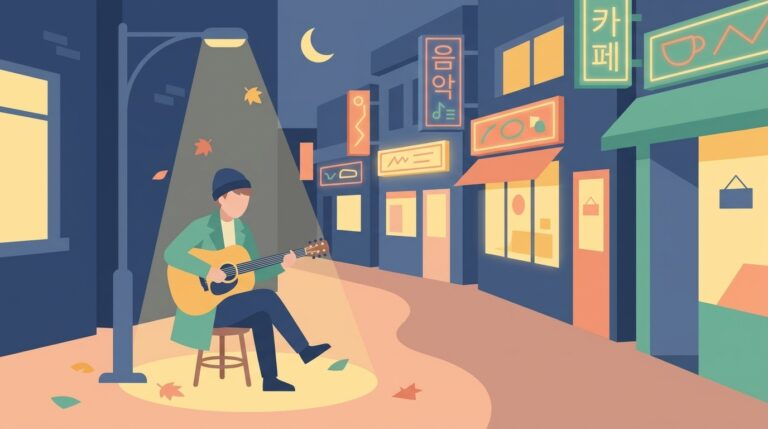
Picture this: It’s a crisp Friday evening in Hongdae (홍대). The neon signs of vintage shops and karaoke rooms cast a surreal, cyber-punk glow over the asphalt. You’ve set up your acoustic guitar, fine-tuned your wireless mic, and a warm, expectant crowd is beginning to form a tight semi-circle around you. You strike the first chord of a mesmerizing indie ballad. The crowd gasps; you feel like the protagonist of a critically acclaimed K-Drama.
But just as you reach the bridge, a uniform-clad officer from the Mapo District Office (마포구청) approaches, accompanied by a local shop owner who looks less than pleased. The officer taps their notepad and utters a phrase that instantly breaks your artistic trance: “민원이 들어와서요…” (We’ve received a civil complaint…)
For foreign musicians and performance enthusiasts in Korea, the line between an unforgettable street performance and an administrative violation is incredibly thin. Seoul is a hyper-dense metropolis where residential blocks, commercial storefronts, and vibrant art zones exist on top of one another. To survive and thrive as an artist here, you must master more than just your scales—you must master the delicate linguistic and bureaucratic dance of street busking permits (거리 공연 허가) and noise complaints (소음 민원).
Today, we aren’t just teaching you textbook vocabulary. We are diving into the high-context, emotionally nuanced language that will help you negotiate with city officials, appease grumpy shopkeepers, and keep your street show alive with the grace of a true cultural insider.
Phase 2: Core Expressions — Deep Dive for Advanced Communicators
In the C2 domain, you must understand not just the literal definition of words, but the administrative weight and social friction they carry. Here are three critical expressions you need to master:
1. 거리 공연 허가를 받다 (Geori gong-eon heo-ga-reul bat-da)
- Pronunciation: [gʌ.ɾi ɡoŋ.ʌn hʌ.ɡa.ɾɯl bat.t͈a] / Sound-alike: “Guh-ree gong-uhn huh-gah-reul baht-dah”
- Meaning: To obtain a street performance (busking) permit.
- K-Culture Moment: If you’ve watched the healing travel show Begin Again (비긴어게인), you’ve seen legendary Korean musicians performing abroad. In Korea, however, spaces like Hongdae’s Pedestrian-Friendly Street or the Han River parks require rigorous online reservations or physical permits managed by local district offices (구청).
- Editor’s Insight: 허가 (Heoga) is a formal legal term. When talking to officials, using this word shows you respect local municipal laws rather than assuming you can simply “plug and play.”
- Situation Spectrum:
- Casual (Friends): ⚠️ Too formal. Better to say “길거리 공연 신청하다” (gil-geo-ri gong-eon sin-cheong-ha-da).
- Semi-formal (Colleagues/Other artists): ✅
- Formal (Authorities/Gucheong): ✅
- 🤔 Think About It: Why does Korea use the word “허가” (explicit permission/authorization) instead of just “등록” (registration) for busking in major tourist zones? Consider how the limited urban real estate of Seoul forces the government to act as a strict curator of public spaces.
2. 소음 민원이 들어오다 (So-eum min-won-i deul-eo-o-da)
- Pronunciation: [so.ɯm min.wʌn-i dɯl.ʌ.o.da] / Sound-alike: “Soh-eum meen-won-ee deul-uh-oh-dah”
- Meaning: To receive a noise complaint (filed by a citizen).
- K-Culture Moment: This is the ultimate buzzkill phrase in Korean nightlife and indie culture. It’s frequently referenced by indie bands in documentaries when discussing their early garage days or outdoor gigs.
- Editor’s Insight: 민원 (Minwon) translates to “civil application” or “citizen petition,” but in the context of noise, it almost always means a formal complaint lodged to the police or district office. When an officer says “민원이 들어왔다,” they are gently shifting the blame away from themselves; they are practically saying, “Personally, I don’t mind your music, but a local resident is forcing my hand.”
- Situation Spectrum:
- Casual: ✅
- Semi-formal: ✅
- Formal: ✅
- 🤔 Think About It: In many Western countries, a noise complaint might result in a direct, confrontational visit from a neighbor. In Korea, why do people almost exclusively go through the Gucheong (district office) or 112 (police) to file a 민원 instead of speaking to you directly?
3. 볼륨을 줄이다 / 협조해주시다 (Bol-ryum-eul jul-i-da / Heop-jo-hae-ju-si-da)
- Pronunciation: [bol.ɾjum-ɯl tɕu.ɾi.da / hʌp.tɕo.ɦɛ.dʑu.ɕi.da] / Sound-alike: “Bol-lyum-eul jool-ee-dah / Hyup-joh-hae-joo-shee-dah”
- Meaning: To turn down the volume / to cooperate (polite administrative request).
- K-Culture Moment: This pair of expressions represents the polite but firm linguistic shield used by authority figures in Korea.
- Editor’s Insight: When an official asks for your 협조 (cooperation), it is technically phrased as a request (“협조해 주세요”), but in reality, it is a polite command. Refusing to 협조 transitions you from a peaceful artist to a non-compliant public nuisance.
- Situation Spectrum:
- Casual (To bandmates): Use “볼륨 좀 낮춰” (bol-ryum jom nat-chwo).
- Semi-formal: ✅
- Formal: ✅
Phase 3: Textbook Korean vs. Real-World Korean
To sound like a native C2 speaker, you need to abandon clunky textbook translations and adopt natural, socially intelligent phrasing.
Scenario 1: Inquiring about busking regulations in a specific area
- 📖 Textbook: 여기서 길거리 공연을 하는 것이 법적으로 허용됩니까? (Is street performance legally permitted here?)
- Why it’s awkward: It sounds like you are an academic conducting legal research or an undercover cop.
- 🗣️ Real Korean: 혹시 여기서 그냥 버스킹 해도 돼요? 아니면 따로 구청에 허가 받아야 하나요? (Can we just busk here? Or do we need to get a separate permit from the district office?)
- Why it works: It uses the conversational loanword 버스킹 (busking) and correctly identifies the 구청 (Gucheong) as the governing body, showing practical cultural awareness.
Scenario 2: De-escalating a noise complaint with a local shop owner
- 📖 Textbook: 죄송합니다. 소음 강도를 낮추겠습니다. (I apologize. I will lower the intensity of the noise.)
- Why it’s awkward: “소음 강도” (noise intensity) is highly clinical. It sounds robotic and insincere.
- 🗣️ Real Korean: 아, 죄송합니다 사장님! 저희가 노래에 집중하다 보니 볼륨이 너무 커졌나 봐요. 조금만 줄여서 진행할게요. 양해 부탁드립니다! (Ah, sorry boss! We must have let the volume get too high while focusing on the song. We’ll turn it down a bit. We appreciate your understanding!)
- Why it works: Addressing the store owner as 사장님 (Sajangnim/Boss) builds instant rapport. Explaining why it happened (“we got too into the song”) shows passion, not malice, and 양해 부탁드립니다 is the gold standard of polite public apologies.
Phase 4: K-Culture Deep Dive & Non-Verbal Etiquette
4-1. Nunchi (눈치) & The Non-Verbal Art of “Administrative De-escalation”
When dealing with a noise complaint in Korea, your physical posture is just as important as your spoken vocabulary.
- The Double-Hand Handshake/Handover: If a district official or police officer asks for your ID or permit, never slide it over with one hand or fling it toward them. Hand it over using both hands, with a slight bow of the head. This signals immediate compliance and respect for their authority.
- The 15-Degree Apology Bow: If a business owner complains, do not stand with your hands in your pockets or arms crossed. Clasp your hands in front of your waist (공수 자세), tilt your upper body forward by 15 degrees, and look apologetic. This instantly disarms anger.
4-2. The Evolution of Hongdae’s Busking Ecosystem
Busking in Seoul is no longer a wild-west affair. In the early 2010s, you could set up an amp anywhere in Hongdae and perform. Today, due to an explosion of commercial properties and residential gentrification, the Mapo-gu government has designated official, numbered “Busking Zones” along the Hongdae Pedestrian-Friendly Street (걷고싶은거리).
These zones must be reserved in advance through the official Mapo District Office Website (Search term: 마포구 버스킹 예약). If you perform outside these designated zones with an amplifier, you are almost guaranteed to face a 소음 민원 (noise complaint) within ten minutes.
Phase 5: The Hongdae Stand-off — Interactive Roleplay Scenario
The Setting: It is 8:30 PM on a Saturday. You are busking in a designated zone in Hongdae. However, your guitar amp is facing toward a cosmetics shop across the street. A representative from the district office, holding a decibel meter, walks into your performance space.
The Characters:
* You: An ambitious, culturally savvy foreign busker.
* Min-seo (민서): A polite but stressed-out Mapo-gu civil servant who has processed five noise complaints tonight.
Dialogue
- 민서: (🎭 Holding up a clipboard, speaking politely but firmly) 저기, 안녕하세요. 말씀 중에 죄송한데 잠시만 음악 좀 멈춰 주시겠어요?
- Jeo-gi, an-nyeong-ha-se-yo. Mal-sseum jung-e joe-song-han-de jam-si-man eum-ak jom meom-chwo ju-si-get-eo-yo?
- “Excuse me, hello. I’m sorry to interrupt your words, but could you please stop the music for a moment?”
- You: (🎭 Turning down the master volume on the amp immediately, bowing slightly) 아, 네! 무슨 일이신가요?
- Ah, ne! Mu-seun il-i-sin-ga-yo?
- “Ah, yes! What seems to be the matter?”
- 민서: (🎭 Pointing to the cosmetics store across the street) 다름이 아니라, 맞은편 매장에서 소음 민원이 들어와서요. 데시벨을 측정해 보니까 기준치를 조금 초과하셨어요.
- Da-reum-i an-i-ra, maj-eun-pyeon mae-jang-e-seo so-eum min-won-i deul-eo-wa-seo-yo. De-si-bel-eul cheuk-jeong-hae bo-ni-kka gi-jun-chi-reul jo-geum cho-gwa-ha-syeot-eo-yo?
- “To be precise, a noise complaint came in from the shop across the street. We measured the decibels, and you have slightly exceeded the legal limit.”
- You: (🎭 Showing a polite expression, nodding in understanding) 아, 그러셨군요. 저희가 오늘 여기 사용 허가받고 정식으로 등록해서 진행하는 건데도 문제가 되나요?
- Ah, geu-reo-syeot-gun-yo. Jeo-hui-ga o-neul yeo-gi sa-yong heo-ga-bat-go jeong-sik-eu-ro deung-rok-hae-seo jin-haeng-ha-neun geon-de-do mun-jae-ga doe-na-yo?
- “Ah, I see. Even though we obtained a usage permit for this spot today and registered formally, is it still an issue?”
- 민서: (🎭 Sighing softly, looking appreciative of your polite tone) 네, 허가를 받으셨어도 상가 구역이라 저녁 시간대에는 데시벨 기준이 더 엄격해지거든요. 상인분들 영업에 지장이 있다고 하셔서요.
- Ne, heo-ga-reul bat-eu-syeot-eo-do sang-ga gu-yeok-i-ra jeo-nyeok si-gan-dae-e-neun de-si-bel gi-jun-i deo eom-gyeok-hae-ji-geon-deun-yo. Sang-in-bun-deul yeong-eob-e ji-jang-i it-da-go ha-syeo-seo-yo.
- “Yes, even with a permit, this is a commercial zone, so the decibel limits become stricter during the evening hours. The merchants say it is interfering with their business operations.”
- You: (🎭 Displaying empathetic concern) 아, 매장 영업에 방해가 되었다면 정말 죄송합니다. 저희가 앰프 방향을 길거리 쪽으로 조금 돌리고, 볼륨도 전체적으로 낮추면 괜찮을까요?
- Ah, mae-jang yeong-eob-e bang-hae-ga doe-eot-da-myeon jeong-mal joe-song-ham-ni-da. Jeo-hui-ga aem-peu bang-hyang-eul gil-geo-ri jjok-eu-ro jo-geum dol-ri-go, bol-ryum-do jeon-che-jeok-eu-ro nat-chu-myeon gwaen-chan-eul-kka-yo?
- “Ah, I am truly sorry if we interfered with their business. Would it be alright if we rotate the amp slightly toward the street side and lower the overall volume?”
- 민서: (🎭 Smiling slightly, relieved by your cooperation) 그렇게 협조해 주시면 정말 감사하죠. 저희도 단속만 하려는 건 아니니까요. 지금 볼륨에서 20%만 줄여서 세팅해 주세요.
- Geu-reot-ge heop-jo-hae ju-si-myeon jeong-mal gam-sa-ha-jyo. Jeo-hui-do dan-sok-man ha-ryeo-neun geon a-ni-kka-yo. Ji-geum bol-ryum-e-seo i-sip-pro-man jul-yeo-seo se-ting-hae ju-se-yo.
- “If you could cooperate with us in that way, we would be very grateful. It’s not our goal to just crack down on everyone. Please set the volume about 20% lower than it is now.”
- You: (🎭 Nodding vigorously while adjusting the amp knobs) 알겠습니다! 바로 조절했습니다. 데시벨 한번 다시 확인해 주시겠어요?
- Al-get-sam-ni-da! Ba-ro jo-jeol-haet-sam-ni-da. De-si-bel han-beon da-si hwa-gin-hae ju-si-get-eo-yo?
- “Got it! Adjusted it right away. Could you please check the decibel levels one more time?”
- 민서: (🎭 Checking her decibel meter device) 네, 지금 딱 좋습니다! 이 정도 볼륨만 유지해 주시면 민원 제기한 매장 쪽에도 제가 잘 말씀드릴게요.
- Ne, ji-geum ttak jop-seum-ni-da! I jeong-do bol-ryum-man yu-ji-hae ju-si-myeon min-won je-gi-han mae-jang jjok-e-do je-ga jal mal-sseum-deu-ril-ge-yo.
- “Yes, it’s perfect right now! If you just maintain this level of volume, I will speak nicely with the shop that filed the complaint.”
- You: (🎭 Bowing gracefully) 신경 써 주셔서 감사합니다! 남은 시간 동안 조심히 공연 마칠게요.
- Sin-gyeong sseo ju-syeo-seo gam-sa-ham-ni-da! Nam-eun si-gan dong-an jo-sim-hi gong-eon ma-chil-ge-yo.
- “Thank you for your assistance and care! We will finish up our remaining performance time carefully.”
🔀 Decision Point: The Grumpy Shopkeeper Approaches
Suddenly, the owner of the cosmetics store storms out, looking directly at you. She says: “시끄러워서 장사를 못 하겠네 진짜!” (It’s so loud I can’t do business, seriously!)
How do you handle this high-stress moment?
- Option A: “저희 정식으로 구청 허가받고 하는 건데요? 법대로 하세요!” (We got an official permit from the district office. Go by the book!)
- Option B: “죄송합니다, 사장님! 볼륨 방금 다 낮췄고요, 앰프 방향도 돌렸습니다. 혹시 지금도 많이 시끄러우시면 조금만 더 조절할게요. 넓은 마음으로 양해 부탁드립니다.” (I’m sorry, boss! We just lowered the volume and turned the amp. If it’s still too loud, we will adjust it a bit more. We ask for your generous understanding.)
- Option C: (Ignore her completely, close your eyes, and sing your song with emotional intensity to block out her voice.)
🏆 Best Choice: Option B
- Why: In Korea, administrative permits do not exempt you from the social obligation of maintaining harmony with local business owners. Option B uses high-level relational grammar (사장님, 양해 부탁드립니다). Acknowledging her distress immediately and offering a negotiable solution maintains your social currency and prevents her from calling the police (who can fine you for noise regardless of your street permit).
❌ Worst Choice: Option A & C
- Why Option A Fails: Standing on “legal rights” (법대로 하세요) in Korea is viewed as highly aggressive and socially tone-deaf (눈치 없는 행동). It practically guarantees the business owner will find other legal loopholes to stop your performance.
- Why Option C Fails: Active ignoring is considered a massive insult. It will lead to an immediate physical confrontation or the power outlet of your amp being pulled out.
Phase 6: 10-Second Emotion Shadowing Drill
To sound convincing, you must master the rhythm, pauses (/), and emotional micro-intonation of these phrases.
Drill 1: [🥺 Sincerely Apologetic & Courteous]
- The Phrase: 아, 죄송합니다 사장님! / 저희가 오늘 첫 공연이라 / 볼륨 조절이 조금 미숙했습니다. / 바로 낮출게요!
- Pronunciation: Ah, joe-song-ham-ni-da sa-jang-nim! / Jeo-hui-ga o-neul cheot gong-eon-i-ra / bol-ryum jo-jeol-i jo-geum mi-suk-haet-sam-ni-da. / Ba-ro nat-chul-ge-yo!
- Rhythm Guide: Pause slightly after 사장님 and 공연이라. Deliver the apology with a soft, downward pitch at the end to show humility.
Drill 2: [😤 Polite yet Assertive to an Official]
- The Phrase: 허가증 확인해 주시겠어요? / 저희 시간당 소음 기준치 / 철저히 지키면서 하고 있습니다.
- Pronunciation: Heo-ga-jeung hwa-gin-hae ju-si-get-eo-yo? / Jeo-hui si-gan-dang so-eum gi-jun-chi / cheol-jeo-hi ji-ki-myeon-seo ha-go it-sam-ni-da.
- Rhythm Guide: Pronounce 철저히 (thoroughly) with clear, crisp articulation to project confidence and compliance.
Phase 7: K-Culture Mini Dictionary
| Word (Hangul / Romanized) | English Equivalent | Contextual & Socio-Cultural Usage |
|---|---|---|
| 단속 (Dan-sok) | Crackdown / Regulation enforcement | Used when municipal authorities enforce street rules. “단속 나왔다” is a common warning whispered among street vendors and buskers alike. |
| 민원인 (Min-won-in) | Civil complainant | The anonymous citizen who lodged the complaint. Officials must protect their anonymity, so they will refer to them abstractly as “민원인 분께서…” |
| 상생 (Sang-saeng) | Win-win / Co-existence | A highly favored governmental buzzword in Korea. It refers to the philosophy that street artists and local shopkeepers must cooperate so everyone can profit. |
| 버블건 (Beo-beul-geon) | Bubble gun | A staple accessory of Korean buskers. Often, singers have partners blowing bubbles into the crowd to create a dreamy, photogenic aesthetic for Instagram reels. |
Phase 8: Traveler’s Survival Kit
If you find yourself performing or supporting friends on the streets of Seoul, keep these three survival cards handy:
Survival Cards
+-------------------------------------------------------------+
| 💳 CARD 1: Asking if a spot is open                         |
| 혹시 여기 버스킹 예약된 자리인가요?                        |
| (Hok-si yeo-gi beo-seu-king ye-yak-doen ja-ri-in-ga-yo?)    |
| "Excuse me, is this spot already reserved for busking?"     |
+-------------------------------------------------------------+
+-------------------------------------------------------------+
| 💳 CARD 2: Apologizing to local police officers            |
| 민원 들어온 건 바로 조치하겠습니다. 조금만 봐주세요!      |
| (Min-won deul-eo-on geon ba-ro jo-chi-ha-get-sam-ni-da.)   |
| "We'll address the noise complaint immediately. Please go    |
| easy on us!"                                                |
+-------------------------------------------------------------+
+-------------------------------------------------------------+
| 💳 CARD 3: Checking volume acceptability with neighbors      |
| 사장님, 이 정도 볼륨이면 영업하시는 데 지장 없을까요?       |
| (Sajangnim, i jeongdo bollyum-imyeon yeong-eob-hasineun de?) |
| "Boss, with this level of volume, will it be okay for your  |
| business?"                                                  |
+-------------------------------------------------------------+
📌 Editor’s Travel Note
When traveling and planning to perform, do not rely on Google Maps to find city administrative offices or public squares. Use the Naver Map App Download Page to locate local Gucheong (구청) offices or police boxes (파출소). Additionally, you can check public noise limits and space policies on the official Seoul Metropolitan Government Portal to ensure you remain fully compliant with regional bylaws.
Phase 9: Deep Reflection — “One Step Deeper”
In many Western cultures, public spaces are viewed as forums for absolute free expression where the auditory landscape is shared organically. In Korea, public space is governed by a collectivist ethos focused on “decent order” and the prevention of 피해 (pi-hae / damage or inconvenience) to others.
An artist’s right to perform is rarely seen as superior to a store owner’s right to conduct business or a resident’s right to peaceful rest. This balance of 상생 (co-existence) explains why the Korean public is highly supportive of busking when it is neat, organized, and compliant, but remarkably swift in reporting artists who exceed their boundaries. True cultural fluency in Korea means recognizing that your performance is not just an artistic act, but a temporary lease of shared public peace.
💬 Your Turn: How does your home country handle street performance permits? Is it more legally bureaucratic, or is it based on informal community boundaries? Let’s discuss in the comments below!
Phase 10: FAQ & Common Mistakes (FAQ Schema Optimized)
Q: Can a tourist on a visa-free waiver or tourist visa legally busk in Korea?
A: Strictly speaking, no. While casual busking without receiving money might sit in a legal grey area, receiving financial donations (e.g., displaying a 팁 박스/tip box or a QR code for bank transfers) under a tourist status is a violation of the Immigration Act (illegal work). If you want to perform legally, always register with cultural exchange organizations or perform strictly for free without any solicitation of tips.
Q: What is the official decibel limit for street performances in Seoul?
A: In major tourist areas like Mapo-gu, the day-time noise limit (before 6 PM) is typically 65 dB, which drops to 60 dB after 6 PM, and 55 dB after 10 PM. For comparison, 60 dB is equivalent to the volume of a normal conversational voice. Therefore, street amplification must be kept extremely moderate.
Q: What happens if I ignore a police officer’s request to shut down?
A: Under Article 3 of the Minor Offenses Act (경범죄처벌법), failure to comply with noise control orders from a police officer can lead to an on-the-spot fine (범칙금) or even detention for repeated defiance. Always cooperate instantly!
🚨 Common Mistakes Alert
- The “Tip Box” Trap: Placing a donation bucket without having a legal performance registration that allows commercial collection. This is highly scrutinized in tourist-heavy zones.
- Using “Banmal” (반말/Informal Language) under pressure: When foreign buskers get frustrated by noise complaints, they sometimes drop their honorifics. Saying “왜 그래?” (Why are you being like this?) instead of “왜 그러시나요?” to an officer or store owner turns an administrative check into a personal insult.
- Assuming “Busking Zone” means “Free Sound Zone”: Assuming that being inside a designated zone gives you a free pass to blast subwoofers. Remember: noise level regulations apply everywhere, including active zones.
- Blocking Pedestrian Flows: Setting up your equipment in a way that forces pedestrians to walk on the active vehicular road. Even without noise, this will trigger an immediate safety complaint.
Phase 11: Action Missions
🥉 Bronze (The Mirror rehearsal)
Record yourself saying the following phrase three times in the mirror, maintaining a polite 15-degree bow:
“불편을 드려 죄송합니다. 볼륨 바로 낮추겠습니다!”
(Bul-pyeon-eul deu-ryeo joe-song-ham-ni-da. Bol-ryum ba-ro nat-chu-get-sam-ni-da!)
🥈 Silver (The Digital Map Hunt)
Find the Mapo-gu Office (마포구청) website online and locate the “Culture and Tourism” section to find the guidelines for street performances in Hongdae. Take a screenshot of the decibel limits.
🥇 Gold (The Field Observation Mission)
On your next trip to a busking hub (Hongdae, Sinchon, or Yeouido), observe the performers. Count how many of them have an official reservation badge displayed on their equipment, and observe how they orient their speakers to avoid complaints from nearby storefronts.
🎮 K-Culture Mission
Watch an episode of the music show Begin Again (비긴어게인) or the drama Do Do Sol Sol La La Sol. Pay attention to how street performances are set up and how the local authorities interact with the artists.
Phase 12: Interactive Quiz Challenge
Test your situational mastery of Korean street performance ethics with this quick quiz!
1. Situational Judgment
You are performing and an elder resident from the apartments nearby approaches you, yelling angrily about the noise. Which of the following responses shows the highest level of Korean social intelligence (눈치)?
* A) “여기는 법적으로 허가된 공간입니다. 저기 안내판 안 보이세요?”
* B) “아, 어르신! 저희 음악 때문에 많이 시끄러우셨죠? 정말 죄송합니다. 이제 마지막 곡이라 이것만 하고 얼른 정리하겠습니다. 조금만 양해해 주시면 감사하겠습니다.”
* C) “경찰에 신고하세요. 제가 잘못한 게 없으니까요.”
🔍 Reveal Answer & Explanation
Correct Answer: B
Addressing an elder respectfully as 어르신 (Eoreushin/Honored Elder) and explaining that it’s your last song (마지막 곡) while apologizing sincerely de-escalates tension 99% of the time. Option A and C are confrontational and violate societal expectations regarding respect for elders, which will likely result in the elder taking extreme measures to halt your gig.
2. Fill-in-the-Blank
Complete the dialogue of a busker apologizing to an officer:
- Busker: “소음 [ ] 들어왔다고 들었습니다. 볼륨을 조금 더 [ ].”
- Translation: “I heard a noise complaint came in. I will lower the volume a bit more.”
🔍 Reveal Answer
Correct Answer: 민원이 / 줄이겠습니다 (or 낮추겠습니다)
Full sentence: “소음 민원이 들어왔다고 들었습니다. 볼륨을 조금 더 줄이겠습니다.”
3. True or False
Statement: If you have registered your busking session through the Gucheong portal, local business owners cannot legally lodge a noise complaint against you during your reserved hours.
🔍 Reveal Answer
Answer: FALSE
Even with an official reservation, if your performance exceeds the statutory decibel limits for that hour or zone, any store owner or citizen can file a valid 소음 민원 (noise complaint), and you are legally required to lower your volume or face administrative action.
Keep your music beautiful, your amps turned down to the perfect decibel, and your social interactions polished. See you in the next premium edition of Daily Hangul!







