

Navigating Seoul’s E-Scooter Revolution: Your Ultimate C2 Guide to Shared Kickboard Safety, Parking Rules, and Crucial Korean Slang
안녕하세요! (Annyeonghaseyo!) Hello, dear friends and fellow explorers! It’s your chief editor from Daily Hangul (매일한글). Having lived in the heart of Seoul for over a decade, I’ve watched this city transform into a sci-fi utopia of mobility.
But let’s paint a picture. You’ve just finished a sizzling round of K-BBQ with your local friends in Gangnam. You see a row of sleek, neon-colored shared e-scooters—locally known as 공유 킥보드 (gongyu kikbodeu). You think, “Perfect! Just like in my favorite K-dramas, I’ll breeze past the traffic!”
But as you step closer, you notice a police officer ticketing a rider for not wearing a helmet, while nearby, a shop owner is angrily pointing at a scooter blocking their entrance, shouting about “무단 방치” (mudan bangchi – unauthorized abandonment). Suddenly, your romanticized K-mobility dream feels like a legal minefield.
Today, we aren’t just learning textbook words. We are diving deep into Korea’s cutting-edge Personal Mobility (PM) laws, the socio-cultural dynamics of public space, and the actual sophisticated Korean expressions you need to sound like a culturally fluent, high-society local who respects the shared space of Seoul.
Phase 2: Deep Dive into 3 Core Advanced Expressions
1. 주차 무단 방치 (Jucha Mudan Bangchi)
- Pronunciation: [Jucha mudan bangchi] / (Sound-alike: Joo-chah moo-dahn bahng-chee)
- Meaning: Unauthorized Abandonment of Parking (Haphazard/Illegal Parking of Personal Mobility devices).
- K-Culture Moment: In modern slice-of-life K-dramas, you often see characters grumbling as they trip over a carelessly left scooter on their way to a convenience store. It represents the clash between hyper-convenience and civic duty.
- Editor’s Insight: This isn’t just “bad parking.” Calling it 무단 방치 (unauthorized neglect/abandonment) assigns a strong sense of social irresponsibility to the act. It is a highly active vocabulary word used in local neighborhood complaints and news broadcasts.
- Situation Spectrum:
- Friends/Casual: ✅ (Used when complaining about others: “누가 여기다 또 무단 방치해놨네!”)
- Workplace/Business: ✅
- Formal/Official: ✅
- 🤔 Think About It: Korea’s high population density requires an incredibly high level of mutual consideration (배려 – baeryeo). Why do you think the line between personal convenience and public nuisance is so sharply drawn in Korean administrative language?
2. 원동기 면허 필수 및 헬멧 착용 규정 (Wondonggi Myeonheo Pilsu mit Helmet Chagyong Gyujeong)
- Pronunciation: [Wondonggi myeonheo pilsu meet hel-met chah-gyong gyu-jeong] / (Sound-alike: Won-dong-ghee myun-huh peel-soo meet hel-met chahg-yong gyoo-jung)
- Meaning: Mandatory Motorized Bicycle License & Compulsory Helmet Wearing Regulation.
- K-Culture Moment: Picture a K-Pop idol doing a city vlog, diligently snapping on a safety helmet before riding a scooter along the Han River. Safety-consciousness has become a key part of maintaining a positive public image in Korea.
- Editor’s Insight: Since the revision of the Road Traffic Act, you cannot legally ride a shared kickboard in Korea without at least a Motorized Bicycle License (원동기장치자전거 면허). Riding without a helmet triggers an immediate fine.
- Situation Spectrum:
- Friends/Casual: ⚠️ (Sounds slightly formal; in casual talk, we say “헬멧 꼭 써야 돼, 단속해!”)
- Workplace/Business: ✅
- Formal/Official: ✅
- 🤔 Think About It: How does the rapid pace of technological innovation outrun legislative frameworks, and how do languages adapt to capture these sudden regulatory shifts?
3. 견인 조치 및 과태료 부과 (Gyeon-in Jochi mit Gwataeryo Bugwa)
- Pronunciation: [Gyeon-in jo-chi meet gwa-tae-ryo boo-gwa] / (Sound-alike: Gyun-een joh-chee meet gwah-teh-ryoh boo-gwah)
- Meaning: Towing Measures and Imposition of Administrative Fines.
- K-Culture Moment: Imagine a realistic office-life K-drama scene where a rookie employee sighs over losing their lunch budget because their illegally parked scooter got towed within minutes by the district office.
- Editor’s Insight: 견인 (towing) was historically reserved for cars. Applying this term to kickboards shows how aggressively the Seoul Metropolitan Government is acting to keep sidewalks clear for pedestrians.
- Situation Spectrum:
- Friends/Casual: ✅
- Workplace/Business: ✅
- Formal/Official: ✅
- 🤔 Think About It: Korean administrative terms heavily rely on Sino-Korean roots (Hanja) to convey authority. Let’s analyze the Hanja characters behind “견인” (牽引 – to pull and lead) and “범칙금” (罰則金 – penalty money).
Phase 3: Textbook Korean vs. Real-World Korean
Situation 1: Explaining where you parked your scooter to a friend
- 📖 Textbook Korean: “저는 길가에 공유 킥보드를 주차해 두었습니다.” (I have parked the shared kickboard on the roadside.)
- 🗣️ Real Korean: “보행자들 방해 안 되게 길모퉁이 구석에 잘 대놨어.” (I tucked it away nicely in the corner of the street so it wouldn’t block pedestrians.)
- 💡 Why the difference?: Real Koreans rarely use the heavy word “주차” (parking) for small kickboards in casual conversation. Instead, they use the verb 대다 (to park/place) and emphasize 보행자 방해 안 되게 (not blocking pedestrians), showing high social awareness.
Situation 2: Warning a friend about sudden police crackdowns
- 📖 Textbook Korean: “경찰관이 헬멧 미착용을 단속하고 있으니 조심하십시오.” (Please be careful as police officers are crackdowns on helmet non-wearing.)
- 🗣️ Real Korean: “요즘 킥보드 단속 진짜 빡세서 헬멧 안 쓰면 바로 딱지 끊겨.” (They are cracking down so hard on kickboards these days; if you don’t wear a helmet, you’ll get ticketed instantly.)
- 💡 Why the difference?: Advanced casual Korean relies on vivid expressions like 빡세다 (extremely tough/hard) and 딱지를 끊기다 (to get ticketed/fined) to express urgency among peers.
Phase 4: K-Culture Deep Dive & Non-Verbal Manners
4-1. Nunchi (눈치) and Pedestrian Etiquette
In Korea, Nunchi (눈치 – situational intuition) is your ultimate guide. When parking a shared kickboard, never block the yellow tactile paving blocks (점자블록 – jeomja beullok) designed for the visually impaired. Leaving a scooter there is considered a major 민폐 (minpye – public nuisance).
If you are pulled over by a police officer for a safety check, immediately take off your helmet before speaking, bow slightly (폴더 인사 – folder bow), and display an apologetic, cooperative attitude. This non-verbal respect often influences how leniently you are treated.
4-2. The “Ppalli-Ppalli” (빨리빨리) vs. “Safety First” Clash
Korea’s famous 빨리빨리 (Ppalli-Ppalli – fast-paced) culture birthed the rapid adoption of shared kickboards. They are the perfect “last-mile” solution for catching a subway train. However, this need for speed has clashed with Korea’s strict cultural demand for public order. This friction has turned micro-mobility regulation into one of the most hotly debated civic issues in modern Seoul.
Phase 5: Interactive Roleplay Scenario
The Setting: A bustling, neon-lit street outside Exit 3 of Gangnam Station on a breezy Friday evening. You are walking with your Korean colleague, Min-jun (민준).
1. 민준: (Looking at his watch anxiously)
        아, 지하철 타러 가기에는 시간이 좀 애매하네. 킥보드 탈까?
        (Ah, the timing is a bit awkward to walk to the subway. Shall we ride a kickboard?)

2. 나 (You): (Nodding, looking around)
        좋은 생각이야! 근데 우리 둘 다 헬멧 있어?
        (Great idea! But do both of us have helmets?)

3. 민준: (Scratching his head)
        아... 맞다. 깜빡했네. 요즘 단속 진짜 빡센데.
        (Ah... right. I forgot. The crackdowns are really intense lately.)

4. 나 (You): (Pointing at a nearby row of scooters)
        저기 봐! 어떤 브랜드는 손잡이에 헬멧이 같이 달려 있어.
        (Look over there! Some brands have helmets attached to the handlebars.)

5. 민준: (Relieved)
        다행이다! 그걸로 타자. 근데 여기 지하철역 바로 앞에는 주차하면 안 되지?
        (Thank goodness! Let's ride those. But we can't park right in front of the subway exit, right?)

6. 나 (You): (Knowledgably)
        응, 지하철역 출입구 앞은 즉시 견인 구역이야. 과태료 폭탄 맞을 수 있어.
        (Yeah, the subway exit area is an instant-towing zone. We could get hit with a bomb of fines.)

7. 민준: (Impressed)
        우와, 한국 교통 법규 진짜 잘 아네! 그럼 어디에 주차해야 해?
        (Wow, you really know Korean traffic laws well! Then where should we park?)

8. 나 (You): (Pointing to a designated zone)
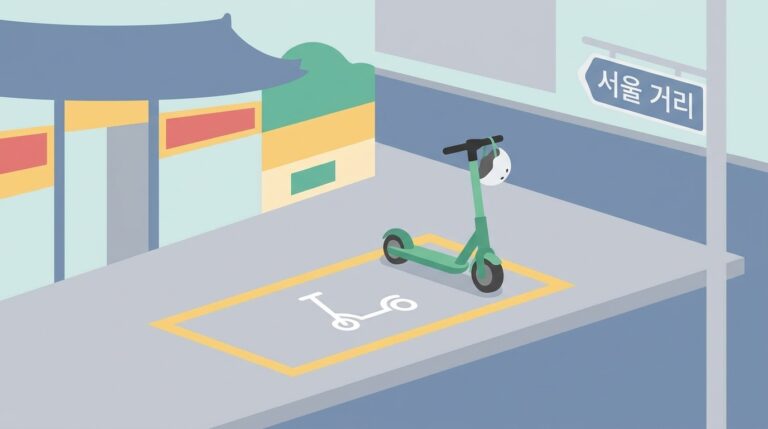
        저기 노란색으로 그려진 '킥보드 전용 주차구역'에 대면 안전해.
        (If we park in that yellow 'Kickboard Exclusive Parking Zone' over there, we are safe.)

9. 민준: (Smiling)
        완벽하다. 그럼 얼른 대고 늦지 않게 가자!
        (Perfect. Let's park quickly and go so we aren't late!)

10. 나 (You): (Buckling the helmet helmet securely)
         안전제일! 출발하자!
         (Safety first! Let's go!)
🔀 Decision Point: What do you do when you reach your destination but the designated parking zone is 100 meters away and you’re late?
- A) Leave it neatly against a storefront window.
- Feedback: 🚫 Bad Choice! This is a classic case of 무단 방치 (illegal abandonment). Store owners can report it immediately, and the towing fee will be charged directly to your app account.
- B) Park it in the yellow-painted ‘Kick Zone’ (킥존) even if it means walking back.
- Feedback: 🏆 Best Choice! This shows perfect civic awareness and protects you from any post-ride administrative fines.
- C) Turn off the app and hide it behind a large tree on the dirt path.
- Feedback: ⚠️ Risk Choice! The GPS tracker will still pinpoint the location, and you might get flagged by the company for parking in an inaccessible zone.
Phase 6: 10-Second Emotion Shadowing Drill
Practice these sentences with the exact emotional nuance to sound like an authentic Seoulite!
- [😤 Urgent and Warning]
“거기다 대면 / 바로 견인당하니까 / 저쪽 구석에 대자!”
(Geo-gi-da dae-myeon / ba-ro gyeon-in-dang-ha-ni-kka / jeo-jjok gu-seok-e dae-ja!)
“If you park there, it’ll get towed instantly, so let’s park it in that corner over there!” -
[😊 Reassuring and Friendly]
“걱정 마, / 이 앱으로 보면 / 전용 주차구역이 / 어딘지 다 나와!”
(Geok-jeong ma, / i aep-eu-ro bo-myeon / jeon-yong ju-cha-gu-yeok-i / eo-din-ji da na-wa!)
“Don’t worry, if you look at this app, it shows exactly where the designated parking zones are!”
Phase 7: K-Culture Mini Dictionary
- 따릉이 (Ttareungyi): Seoul’s incredibly popular official public bicycle sharing system. It is often contrasted with electric kickboards as a safer, cheaper alternative.
- 킥라니 (Kikrany): A portmanteau of “Kickboard” and “Gorani” (고라니 – water deer, known for darting into roads). It is a satirical slang term for reckless e-scooter riders who pop out of nowhere.
- 민폐 (Minpye): Actions that cause harm, annoyance, or inconvenience to a collective group. Avoiding 민폐 is a core pillar of modern Korean social etiquette.
- 반납 (Bannap): The act of returning a rented item (like a scooter or bike) through the app. “반납 완료” means return complete.
Phase 8: Traveler’s Survival Kit
Top 3 Crucial Survival Phrases
- “여기 킥보드 주차해도 돼요?” (Yeo-gi kik-bo-deu ju-cha-hae-do dwae-yo?)
- Pro Tip: Ask this to nearby shop staff if you’re unsure if a spot is a towing zone.
- “헬멧 대여도 같이 되나요?” (Hel-met dae-yeo-do ga-chi dwo-na-yo?)
- Pro Tip: Use this when asking if the scooter rental service includes an integrated helmet.
- “반납처리가 안 돼요.” (Ban-nap-cheo-ri-ga an dwae-yo.)
- Pro Tip: Use this if the app glitched and won’t let you complete your ride.
📌 Editor’s Travel Note: When navigating Korea, native maps like the Naver Map App are vastly superior to Google Maps. They display precise micro-mobility parking zones, local bicycle paths, and real-time public transit status.
Phase 9: Deep Thoughts — “Going a Step Deeper”
The debate surrounding shared kickboards in South Korea is a fascinating window into the national psyche. It represents a constant tug-of-war between hyper-efficiency (빨리빨리) and communal harmony (공동체 의식). While technology allows us to move faster than ever, Korean society swiftly implements rules to ensure that the vulnerable—such as the elderly and visually impaired—are not compromised by this progress.
💬 Your Turn: How does your hometown balance the convenience of modern micro-mobility with pedestrian safety? Let us know your thoughts in the comments below!
Phase 10: FAQ & Avoiding Common Mistakes
Q: Can I ride a shared kickboard on the sidewalk in Korea?
A: No. Under Korean law, personal mobility devices must be ridden on bicycle paths. If there are no bicycle paths, you must ride on the right side of the road. Riding on sidewalks can result in heavy fines.
Q: Do police officers actually fine foreigners for not wearing a helmet?
A: Yes, absolutely. There is no exemption for tourists. Officers regularly conduct random crackdowns near busy subway stations and popular nightlife districts.
Q: What happens if my rented kickboard gets towed?
A: The district office will charge the rental company a towing fee (usually around 40,000 to 50,000 KRW), which the company will automatically charge to the credit card registered on your app.
🚨 Common Mistakes Warning Board
- Mistake 1: Riding double. (Two people on one scooter is strictly illegal and highly dangerous. Fine: 40,000 KRW).
- Mistake 2: Riding after a beer. (Riding a kickboard under the influence carries the same severe legal penalties as drunk driving a car, including license suspension).
- Mistake 3: Parking in front of yellow braille blocks. (Always look at the floor before hitting ‘Complete Return’ on your app!).
Phase 11: Action Mission!
- 🥉 Bronze (At-Home Challenge): Practice saying the phrase “주차 무단 방치” five times in front of the mirror with an expressive, civic-minded frown.
- 🥈 Silver (Social Challenge): Take a screenshot of a Korean K-drama or vlog showing a kickboard, and tag us on Instagram
@DailyHangulexplaining the safety rules you spotted! - 🥇 Gold (Real-World Challenge): The next time you are in Korea, open a mobility app, find a designated yellow ‘Kick Zone’, and successfully park a scooter there while taking a verification photo.
Phase 12: Interactive Quiz Challenge
1. Situational Judgment
Q: You are riding a kickboard in Hongdae and see a police officer ahead. You realize you forgot to strap your helmet on. What is the most culturally appropriate and legal action?
* A) Speed past the officer quickly.
* B) Dismount immediately, turn off the motor, and walk the scooter politely on the sidewalk.
* C) Hide behind a street tree until they leave.
Reveal Answer & Explanation
Correct Answer: B
Dismounting and walking your device turns you legally into a pedestrian. It shows immediate compliance and respect for safety laws, avoiding a fine.
2. Fill-in-the-Blanks
Q: Fill in the missing administrative term: “여기에 킥보드를 ______________ 하면 다른 사람들이 통행할 수 없어서 견인됩니다.”
(If you ______________ park and abandon the kickboard here, others cannot pass, so it will be towed.)
Reveal Answer & Explanation
Correct Answer: 무단 방치 (Mudan bangchi)
3. True or False
Q: You do not need a driver’s license to ride an electric shared kickboard in Korea as long as you are over 18. (True / False)
Reveal Answer & Explanation
Correct Answer: False
You must possess at least a motorized bicycle license (원동기 면허) or a regular driver’s license to ride legally in South Korea.






