

AM or PM? Never Miss Your K-Beauty Appointment with This Simple Time Guide
안녕하세요! (Annyeonghaseyo! – Hello!) I’m your lead editor at Daily Hangul, your cozy Korean tutor and local culture navigator.
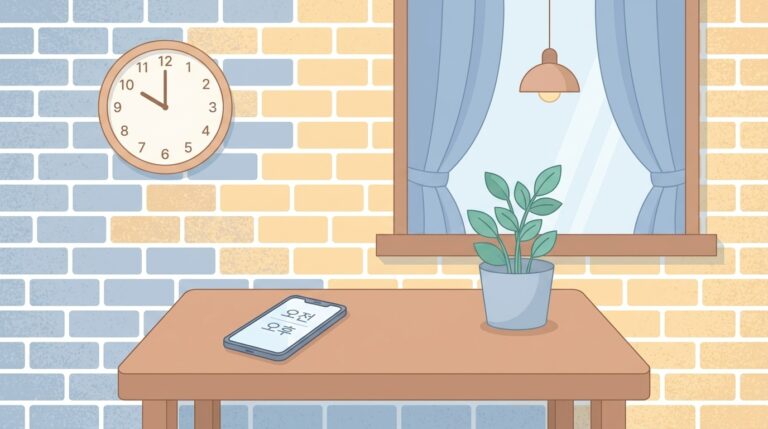
Imagine this: You finally arrived in Seoul, and you have a coveted appointment at a trendy K-beauty salon in Hongdae. You want that gorgeous, glass-skin facial treatment. You hop onto the booking app, and you see two choices: 오전 10시 and 오후 10시.
You click one, thinking it’s 10:00 AM. But when you arrive at the salon at 10:00 AM, the doors are locked, and the staff is nowhere to be found! You realize, with a sinking heart, that you booked it for 10:00 PM—long after the salon has closed. 😱
This is one of the most common slip-ups our students make! In Korean, mixing up AM (오전) and PM (오후) can turn a dream day of pampering into a confusing adventure. But don’t worry! Today, we are going to master how to tell morning from afternoon in Korean so you can navigate your trip like an absolute pro.
Phase 2: Three Core Time Expressions You Need Today
To keep you from getting lost in time, let’s look at the three most essential time terms in Korea.
1. 오전 (Ojeon) – AM / Morning
- Pronunciation: [oh-jeon] / Sound-alike: Think of saying “Oh, John!” quickly in the morning.
- Meaning: AM / Morning (Literal: “Before Noon”).
- K-Culture Moment: You will see this on cafe doors showing their opening hours, like 오전 7:00 (AM 7:00), when the rich aroma of freshly brewed coffee starts filling the streets of Seoul.
- Editor’s Insight: If you see 오전 on a ticket or a reservation app, it always refers to the first half of the day. Put this before the hour!
- Situation Spectrum:
- Friends/Casual: ✅
- Business/Semi-formal: ✅
- Formal/Elders: ✅
- 🤔 Think About It: Why does Korean put the time marker (오전) before the number, unlike English which puts “AM” after (e.g., 9 AM)? How does this reflect the Korean way of looking at the big picture before the details?
2. 오후 (Ohu)
- Pronunciation: [oh-hoo] / Sound-alike: Sounds like a cheerful “Oh, who?” when you meet a friend in the afternoon.
- Meaning: PM / Afternoon (Literal: “After Noon”).
- K-Culture Moment: This is the magic hour when K-pop merchandise stores get busy, or when you meet up for a late-afternoon sweet treat like Bingsu (shaved ice) at 오후 3시 (3:00 PM).
- Editor’s Insight: Just like 오전, 오후 always sits proudly before the hour. If you want to meet a friend at 2:00 PM, you say 오후 2시.
- Situation Spectrum:
- Friends/Casual: ✅
- Business/Semi-formal: ✅
- Formal/Elders: ✅
- 🤔 Think About It: In many English-speaking countries, we often use military time (14:00) to avoid PM mistakes. How do you usually write your afternoon plans?
3. 아침 (Achim) / 저녁 (Jeonyeok)
- Pronunciation: [ah-chim] / [jeo-nyeok] / Sound-alike: “Ah-team” for morning, and “Geo-nyeok” for evening.
- Meaning: Morning / Evening (Natural daylight terms).
- K-Culture Moment: When a K-drama character calls their crush to ask, “Did you eat breakfast?”, they will use 아침 (breakfast/morning) instead of the formal 오전.
- Editor’s Insight: While 오전 and 오후 are official, dictionary-style words, Koreans in daily life prefer using 아침 (morning) and 저녁 (evening/night) when chatting casually.
- Situation Spectrum:
- Friends/Casual: ✅
- Business/Semi-formal: ⚠️ (A bit too casual for formal contracts, but fine with friendly coworkers)
- Formal/Elders: ✅ (Polite when paired with polite endings)
- 🤔 Think About It: Why do you think native speakers prefer organic words like “morning” and “evening” over technical terms like “AM” and “PM” when talking to loved ones?
Phase 3: Textbook Korean vs. Real-World Korean
Let’s see how school books compare to real life on the streets of Seoul!
Situation 1: Inviting a Friend to Lunch
- 📖 Textbook Korean: “우리 오후 1시에 만납시다.” (Woo-ri ohu han-si-e man-nap-si-da.)
- Translation: “Let us meet at 1:00 PM.”
- 🗣️ Real Korean: “우리 낮 1시에 만나자!” (Woo-ri nat han-si-e man-na-ja!)
- Translation: “Let’s meet at 1:00 in the afternoon!”
- 💡 Why is it different? While “오후” is correct, Koreans love using 낮 (nat – daytime/noon) for casual midday plans. It feels much warmer and friendlier!
Situation 2: Asking When a Store Opens
- 📖 Textbook Korean: “이 가게는 오전 9시에 개점합니까?” (I ga-ge-neun ojeon ahop-si-e gae-jeom-hap-ni-kka?)
- Translation: “Does this shop open at 9:00 AM?”
- 🗣️ Real Korean: “여기 아침 9시에 열어요?” (Yeo-gi achim ahop-si-e yeol-eo-yo?)
- Translation: “Do you open here at 9 in the morning?”
- 💡 Why is it different? “개점하다” (to open a shop) is very formal and robotic. Real locals use the easy verb 열다 (yeolda – to open) combined with 아침 (morning) for an easy, natural flow.
Phase 4: K-Culture Deep Dive & Non-Verbal Manners
4-1. The 24-Hour Clock & Your Nunchi (눈치)
If you are traveling in Korea, you need to use your Nunchi (눈치 – situational quick-wittedness). While Koreans use 오전 and 오후 when speaking, they almost always use the 24-hour clock (military time) for official schedules, train tickets (KTX), and concert bookings.
If your K-pop idol concert is scheduled for 20:00, don’t panic looking for 8:00 AM! Quickly subtract 12 to find that it’s 오후 8시 (8:00 PM). Always double-check your tickets for 24-hour formats so you don’t miss a single beat!
4-2. The Late-Night Culture (야식 – Yasik)
Why is PM so important in Korea? Because Korea is a country that truly comes alive after dark! The culture of 야식 (yasik – late-night snacks) means you can order crispy fried chicken or spicy tteokbokki at 오후 11시 (11:00 PM) or even 새벽 2시 (2:00 AM). Knowing your PMs helps you participate in this delicious midnight lifestyle!
Phase 5: Interactive Roleplay — Booking a K-Beauty Salon
Setting: A beautiful, sunlit cafe in Seoul. You are talking to Minjun, the friendly receptionist at a popular hair salon.
Your Role: A excited traveler wanting to book a quick hair trim.
Minjun: "안녕하세요! 머리 예약 도와드릴까요?"
        (An-nyeong-ha-se-yo! Meo-ri ye-yak do-wa-deu-ril-kka-yo?)
        🎭 [Smiling warmly, holding an iPad reservation screen]
        "Hello! May I help you with a hair reservation?"

You:    "네! 예약하고 싶어요."
        (Ne! Ye-yak-ha-go si-peo-yo.)
        🎭 [Nodding enthusiastically]
        "Yes! I want to make a reservation."

Minjun: "언제가 좋으세요?"
        (Eon-je-ga jo-eu-se-yo?)
        🎭 [Tapping the screen to show available times]
        "When would you like?"

You:    "내일 시간 있어요?"
        (Nae-il si-gan is-seo-yo?)
        🎭 [Looking hopeful]
        "Do you have time tomorrow?"

Minjun: "네, 내일 두 타임 비어 있어요."
        (Ne, nae-il du ta-im bi-eo is-seo-yo.)
        🎭 [Pointing to the morning and night slots]
        "Yes, we have two slots open tomorrow."

Minjun: "오전 10시하고 오후 8시 있어요."
        (Ojeon yeol-si-ha-go ohu yeo-deol-si is-seo-yo.)
        🎭 [Showing the options: 10:00 AM and 8:00 PM]
        "We have 10:00 AM and 8:00 PM."
🔀 Decision Point! How do you reply?
- Option A: “오후 10시로 해주세요!” (Ohu yeol-si-ro hae-ju-se-yo!)
- Option B: “오전 10시로 해주세요!” (Ojeon yeol-si-ro hae-ju-se-yo!)
- Option C: “아무 때나 괜찮아요!” (A-mu ttae-na gwaen-chan-ha-yo!)
💡 Choices Analysis:
- Best Choice – Option B: Perfect! You booked 오전 10시 (10:00 AM). This is the best time to get your hair done, leaving you the whole afternoon to explore Seoul!
- Risk Choice – Option A: Oh no! You said 오후 10시 (10:00 PM). The salon closes at 9:00 PM, so this time isn’t actually available or might lead to a funny misunderstanding!
- Lazy Choice – Option C: “Anytime is fine!” It’s polite, but Minjun might get confused trying to choose for you. It’s always best to be clear with your time!
Phase 6: 10-Second Emotion Shadowing Drill
Let’s practice saying these out loud with feeling! Speak at the slash / marks.
1. [😊 Excited & Bright]
- “오전 / 10시에 / 가요!”
- (O-jeon / yeol-si-e / ga-yo!)
- “I am going / at 10 / AM!”
2. [🥺 Worried & Soft]
- “오후 / 8시는 / 너무 늦어요?”
- (O-hu / yeo-deol-si-neun / neo-mu neuj-eo-yo?)
- “Is 8 / PM / too late?”
Phase 7: K-Culture Mini Dictionary
| Word (Korean/Romanized) | English Meaning | Cultural Context |
|---|---|---|
| 야식 (Yasik) | Late-night snack | The beloved Korean habit of eating delicious food (like chicken or ramen) late at night. |
| 브런치 (Beureonchi) | Brunch | A very popular weekend trend in Seoul, usually enjoyed around 오전 11시 (11:00 AM). |
| 퇴근 (Toegeun) | Leaving work | The glorious moment at 오후 6시 (6:00 PM) when offices empty out and dinners begin. |
| 새벽배송 (Saebyeok-baesong) | Dawn Delivery | Korea’s ultra-fast delivery system that drops fresh groceries at your door by 오전 7시 (7:00 AM). |
Phase 8: Traveler’s Survival Kit
Keep these three emergency phrases in your pocket for your next trip!
- “지금 몇 시예요?” (Ji-geum myeot si-ye-yo?)
- Meaning: What time is it now?
- Pro Tip: Perfect when your phone battery dies while wandering around Bukchon Hanok Village.
- “오전으로 예약할게요.” (O-jeon-eu-ro ye-yak-hal-ge-yo.)
- Meaning: I will book for the morning (AM).
- Pro Tip: Use this when you want to clarify your booking time easily.
- “몇 시에 문 열어요?” (Myeot si-e mun yeol-eo-yo?)
- Meaning: What time do you open the door?
- Pro Tip: Ask this at cute local cafes that don’t have English signs.
📌 Editor’s Travel Note: To navigate smoothly like a local, make sure to download the Naver Map App instead of relying solely on Google Maps, which can sometimes be outdated in Korea.
Phase 9: One Step Deeper — The Diligent Morning & Night
Korea is famous for its “Ppalli-Ppalli” (빨리빨리 – fast-fast) culture, but it is also a land of incredible time diligence. Recently, the “Miracle Morning” (미라클 모닝) trend took young Koreans by storm. Thousands of people wake up at 새벽 4시 30분 (4:30 AM) to study, do yoga, or read before starting their work day.
At the same time, Korea’s safe and brightly lit streets make late-night study sessions or night markets extremely popular. Time in Korea is highly respected and beautifully split between active mornings and sparkling nights.
💬 Your Turn: Do you prefer morning activities (오전) or late-night adventures (오후)? Let us know in the comments below! We love reading your stories.
Phase 10: FAQ & Common Mistakes
Q: Can I just use numbers without saying “오전” or “오후”?
A: Yes, but only if the context is extremely clear! If you ask a friend to meet at “8시” (8:00) for dinner, they will easily know you mean PM. But for flight tickets, salon bookings, or doctor appointments, always use 오전 or 오후 to avoid tears!
Q: Is “12 PM” 오전 or 오후 in Korea?
A: This is tricky for everyone! 12:00 PM (noon) is officially written as 오후 12시 in Korea. To make things simple and avoid any mistakes, you can just say 낮 12시 (noon 12:00) or 점심 (Jeomsim – lunch time).
🚨 The “Oops!” Board: Common Beginner Mistakes
- Putting the time marker after the number: Saying “9시 오전” (❌) instead of “오전 9시” (✅).
- Confusing AM and PM on KakaoTalk: Sending “오후 7시” to meet for morning coffee instead of “오전 7시”.
- Forgetting daylight hours: Saying “새벽 3시” (3:00 AM) when you actually meant “오후 3시” (3:00 PM) for your shopping trip!
Phase 11: Your Daily Hangul Action Mission
Ready to put your skills to the test? Complete these three missions!
- 🥉 Bronze Mission: Look at a clock right now. Say the current time in Korean using 오전 or 오후 out loud three times!
- 🥈 Silver Mission: Write a comment below telling us what time you usually wake up using the formula:
[오전/오후] [Hour]시에 일어나요. - 🥇 Gold Mission: Next time you watch your favorite K-drama, listen closely to see if they say 아침 (morning) or 저녁 (evening) when planning a date!
Phase 12: Interactive Quiz Challenge
1. Situational Challenge
You want to catch the early morning train to Busan. Which ticket should you buy?
* A) 오후 6:00
* B) 오전 6:00
* C) 오후 18:00
2. Fill in the Blanks
“Let’s meet tomorrow at 2:00 PM!”
* 내일 _____ 2시에 만나자! (Hint: Look for the PM word!)
Click here to check the answers! 🎉
Answers:
- B) 오전 6:00 (AM 6:00 is perfect for an early morning trip! Option A and C are both evening times).
- 오후 (Ohu – PM). Complete sentence: “내일 오후 2시에 만나자!”







