

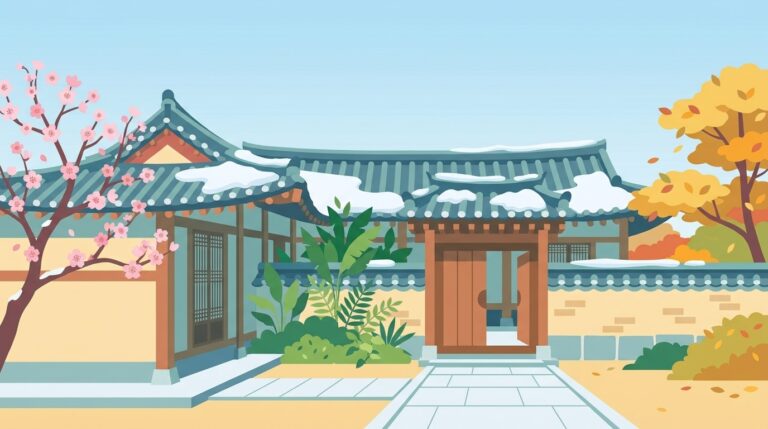
Speak Like a Local: How to Describe Korea’s Beautiful Four Seasons in Korean (A2 Guide)
안녕하세요! (An-nyeong-ha-se-yo!) Hello! I am your senior editor at Daily Hangul. As your warm Korean friend and local cultural navigator, I have spent over a decade wandering through Korea’s cherry blossom streets, surviving its steamy summers, hiking its golden autumn mountains, and eating hot sweet potatoes during freezing winters.
Phase 1: Empathy & The Real-World Struggle
Have you ever tried to describe the weather to a Korean friend? You probably learned standard textbook phrases like “봄은 따뜻합니다” (Spring is warm) or “겨울은 춥습니다” (Winter is cold). But when you actually step out of Incheon International Airport in July, or when you are watching your favorite K-Drama characters walk through falling snow, those textbook sentences feel… empty.
One of my elementary students, Emma, once told me: “Teacher, I wanted to tell my Korean coworker that the summer weather made me feel like a melting ice cream cone, but all I could remember was ‘날씨가 더워요’ (The weather is hot). It sounded so boring!”
Don’t worry, Emma! Today, we are going to unlock the real, emotional, and expressive way Koreans describe their gorgeous four seasons. Once you master these, your Korean friends won’t just say “Your Korean is good”—they will say, “Wow, you sound like a real Seoulite!”
Phase 2: Three Core Seasonal Expressions Deep Dive
Let’s look at the three most common and expressive phrases that locals use every single day.
1. 봄바람이 불어서 설레요 (Bom-ba-ram-i bul-eo-yo)
- Pronunciation: [bom-ba-ram-i bur-eo-seo seol-le-yo] / Sound-alike: “Bohm-bah-rahm-ee buhl-uh-suh suhl-leh-yo”
- Meaning: “The spring breeze is blowing, making my heart flutter.”
- K-Culture Moment: Think of those iconic romantic scenes in K-dramas where pink cherry blossom petals fall gently onto the main characters’ hair. This is the exact emotion of this phrase!
- Editor’s Insight: The word “설레다” (seol-le-da) means “to flutter with excitement.” Koreans rarely just say “Spring is warm.” They connect the spring wind (봄바람) directly to their emotions.
- Situation Spectrum:
- Casual (Friends): ✅ (봄바람 불어서 설레!)
- Semi-formal (Coworkers): ✅ (봄바람이 불어서 설레요.)
- Formal (Boss/Elderly): ⚠️ (Avoid using “설레요” with a strict boss; instead say “날씨가 참 따뜻해졌습니다” – The weather has become very warm.)
- 🤔 Think About It: In many Western cultures, spring is just a temperature change. Why do you think Korean culture links the wind of spring so deeply to romantic feelings and new beginnings?
2. 날씨가 푹푹 쪄요 (Nal-ssi-ga puk-puk jjeo-yo)
- Pronunciation: [nal-ssi-ga puk-puk jjeo-yo] / Sound-alike: “Nahl-shee-gah pook-pook jjuh-yo”
- Meaning: “The weather is boiling hot (steaming like a dumpling).”
- K-Culture Moment: Walking out of a cool, air-conditioned Hanok cafe in Insadong during August and instantly feeling the thick, humid air of Seoul wrap around you.
- Editor’s Insight: “푹푹” (puk-puk) is an onomatopoeia mimicking the sound of steam rising inside a giant metal pot. When you say this, you are playfully comparing yourself to a delicious dumpling being steamed alive. It’s lighthearted and very expressive!
- Situation Spectrum:
- Casual (Friends): ✅ (오늘 진짜 푹푹 찐다!)
- Semi-formal (Coworkers): ✅ (오늘 날씨가 진짜 푹푹 쪄요.)
- Formal (Boss/Elderly): ✅ (날씨가 많이 덥고 습하네요.)
- 🤔 Think About It: Humid summers are hard, but they brought Koreans together to eat cold dishes like Naengmyeon (cold noodles) and Patbingsu (shaved ice). How does your culture cope with intense heat?
3. 날씨가 쌀쌀해졌어요 (Nal-ssi-ga ssal-ssal-hae-jyeot-eo-yo)
- Pronunciation: [nal-ssi-ga ssal-ssal-hae-jyeot-eo-yo] / Sound-alike: “Nahl-shee-gah sahl-sahl-heh-jyut-uh-yo”
- Meaning: “The weather has gotten chilly.”
- K-Culture Moment: Autumn in Korea is famously short but beautiful. This is when Koreans bring out their stylish trench coats (called “trench coat season”) to walk through streets covered in golden ginkgo leaves.
- Editor’s Insight: The word “쌀쌀하다” (ssal-ssal-ha-da) represents that sudden shivering sensation when a cool autumn wind hits your neck. It’s the perfect cue to ask someone if they want to get a hot latte.
- Situation Spectrum:
- Casual (Friends): ✅ (갑자기 쌀쌀해졌어.)
- Semi-formal (Coworkers): ✅ (날씨가 쌀쌀해졌어요.)
- Formal (Boss/Elderly): ✅ (날씨가 쌀쌀해졌으니 감기 조심하세요 – It has gotten chilly, so please be careful not to catch a cold.)
- 🤔 Think About It: Why do you think autumn is called “the season of reading and loneliness” in Korea? How does the rapid temperature change affect our moods?
Phase 3: Textbook Korean vs. Real Korean
Let’s compare what the textbooks teach you versus what Koreans actually say on the streets of Seoul!
Situation 1: Describing a very cold winter day
- 📖 Textbook Korean: 겨울은 아주 춥습니다. (Winter is very cold.)
- 🗣️ Real Korean: 칼바람이 불어서 진짜 추워요! (The knife-wind is blowing, so it’s crazy cold!)
- 💡 Why it’s different: Koreans call the freezing winter wind a “칼바람” (kal-ba-ram) which literally translates to “knife wind.” It perfectly describes that freezing wind that feels like it’s cutting through your jacket!
Situation 2: Describing a refreshing autumn day
- 📖 Textbook Korean: 가을 날씨는 좋습니다. (Autumn weather is good.)
- 🗣️ Real Korean: 날씨가 아주 선선해요. (The weather is so crisp and cool.)
- 💡 Why it’s different: “좋다” (to be good) is too generic. “선선하다” (seon-seon-ha-da) captures the clean, dry, and cool air that makes autumn the absolute best season for hiking in Korea.
Phase 4: K-Culture Deep Dive & Non-Verbal Manners
4-1. Nunchi (눈치) & Body Language
In Korea, describing the weather isn’t just about words; it’s about sharing a physical experience.
* The Summer Fan (부채질): When complaining about heat, fan your face with your hand while letting out a gentle sigh “아~ 덥다” (Ah~ it’s hot). This shows you are sharing the collective struggle of the summer humidity.
* The Winter Huddle (웅크리기): When walking in winter, slightly pull your shoulders in and tuck your neck into your scarf. Saying “춥다, 춥다” (It’s cold, it’s cold) in a rhythmic way with friends is a fun, bonding ritual!
4-2. The K-Food & K-Travel Connection
Each season in Korea dictates exactly what you should eat and where you should go:
* Spring: Grab some strawberry desserts and head to the Han River for a picnic.
* Summer: Eat boiling hot Samgyetang (ginseng chicken soup) on the hottest days to fight fire with fire (이열치열 – i-yeol-chi-yeol), or get a cold, icy beer!
* Autumn: Go leaf-peeping (단풍놀이 – dan-pung-nol-i) at Namsan Tower.
* Winter: Stop by a street food cart to eat hot Eomuk (fish cake) and drink the warm broth out of a paper cup.
Phase 5: Interactive Roleplay — A Crisp Autumn Day in Insadong
The Setting: You are walking with Minho, your friendly Korean guide, along the stone wall path of Deoksugung Palace. Yellow ginkgo leaves are falling slowly around you, and there is a sweet smell of toasted chestnuts in the air.
The Cast:
* You (A2 Korean Learner): Excited to practice your Korean seasonal words.
* Minho (Local Friend): An energetic Seoulite who loves taking photos and drinking hot coffee.
1. Minho: (Sighs happily while looking at the trees)
          우와, 벌써 가을이네요! 날씨가 정말 선선해요.
          [U-wa, beol-sseo ga-eul-i-ne-yo! Nal-ssi-ga jeong-mal seon-seon-hae-yo.]
          (Wow, it’s already autumn! The weather is so wonderfully crisp.)

2. You: 🎭 (Smiling, wrapping your scarf tighter)
       네, 맞아요. 조금 쌀쌀해졌어요.
       [Ne, ma-ja-yo. Jo-geum ssal-ssal-hae-jyeot-eo-yo.]
       (Yes, that's right. It has gotten a little chilly.)

3. Minho: 🎭 (Nodding eagerly)
          그쵸? 한국은 가을이 진짜 짧아서 아쉬워요. 금방 겨울이 올 거예요.
          [Geu-chyo? Han-guk-eun ga-eul-i jin-cha jjal-ba-seo a-swi-wo-yo. Geum-bang gyeo-ul-i ol geo-ye-yo.]
          (Right? It’s a pity autumn is so short in Korea. Winter will be here in no time.)

4. You: 🎭 (Curious)
       한국 겨울은 많이 추워요?
       [Han-guk gyeo-ul-eun ma-ni chu-wo-yo?]
       (Is winter in Korea very cold?)

5. Minho: 🎭 (Shivering playfully)
          네! 바람이 많이 불어서 진짜 칼바람이에요. 롱패딩 필수예요!
          [Ne! Ba-ram-i ma-ni bur-eo-seo jin-cha kal-ba-ram-i-e-yo. Rong-pae-ding pil-su-ye-yo!]
          (Yes! The wind blows so much, it’s a real knife-wind. Long padded coats are a must!)

6. You: 🎭 (Laughing)
       롱패딩이요? 저도 하나 사야겠어요!
       [Rong-pae-ding-i-yo? Jeo-do ha-na sa-ya-get-eo-yo!]
       (A long padded coat? I should buy one too!)

7. Minho: 🎭 (Pointing to a beautiful yellow tree)
          여기서 사진 찍어드릴게요! 저기 단풍 나무 밑에 서보세요.
          [Yeo-gi-seo sa-jin jjig-eo-deu-ril-ge-yo! Jeo-gi dan-pung na-mu mit-e seo-bo-se-yo.]
          (I'll take a photo of you here! Stand under that maple tree over there.)

8. You: 🎭 (Posing happily)
       감사합니다! 가을 단풍이 정말 예뻐요.
       [Gam-sa-ham-ni-da! Ga-eul dan-pung-i jeong-mal ye-ppeo-yo.]
       (Thank you! The autumn foliage is truly beautiful.)

9. Minho: 🎭 (Taking the photo)
          나이스! 아주 잘 나왔어요. 이제 우리 따뜻한 커피 마실까요?
          [Na-i-seu! A-ju jal na-wat-eo-yo. I-je u-ri tta-tteut-han keo-pi ma-sil-kka-yo?]
          (Nice! It came out great. Shall we go drink some warm coffee now?)

10. You: 🎭 (Rubbing your hands together excitedly)
        좋아요! 따뜻한 라떼 마시고 싶어요.
        [Jo-a-yo! Tta-tteut-han ra-tte ma-si-go sip-eo-yo.]
        (Sounds great! I want to drink a hot latte.)
🔀 Decision Point!
Minho asks you: “혹시 무슨 계절을 가장 좋아해요?” (By the way, which season do you like the most?)
- Choice A: “저는 봄을 좋아해요. 봄바람이 불어서 설레요!” (I like spring. Because the spring breeze makes my heart flutter!)
- 👉 Best Choice! Minho will be amazed by your natural emotional vocabulary. It opens up a great conversation about flowers and warm weather.
- Choice B: “가을이 좋습니다. 아주 시원합니다.” (Autumn is good. It is very cool.)
- 👉 Safe but Dry. It’s grammatically correct, but sounds like a robotic reading comprehension test. Try using “선선해서 좋아요” (I like it because it’s crisp) instead!
- Choice C: “저는 여름이 싫어요. 날씨가 푹푹 쪄요!” (I hate summer. The weather is boiling hot!)
- 👉 Expressive & Cute! Complaining about the hot summer with “푹푹 쪄요” is a super local way to express frustration. Minho will laugh and agree with you instantly!
Phase 6: 10-Second Emotion Shadowing Drill
Let’s train your emotional intonation. Read these aloud by pausing at the / and putting real feeling into your voice!
- [😊 Filled with Fluttering Excitement]
- 봄바람이 / 불어서 / 진짜 / 설레요!
- [Bom-ba-ram-i / bur-eo-seo / jin-cha / seol-le-yo!]
- [🥵 Exhausted by the Humid Heat]
- 날씨가 / 푹푹 / 쪄서 / 죽겠어요.
- [Nal-ssi-ga / puk-puk / jjeo-seo / juk-get-eo-yo.] (It’s so steamy, I’m dying!)
- [🥶 Shivering in the Icy Wind]
- 칼바람이 / 불어서 / 너무 / 추워요!
- [Kal-ba-ram-i / bur-eo-seo / neo-mu / chu-wo-yo!]
Phase 7: K-Culture Mini Dictionary
| Word (Korean + Romanization) | English Meaning | Cultural Context & Usage |
|---|---|---|
| 꽃샘추위 (Kkot-saem-chu-wi) | Flower-jealous cold | A sudden cold snap in early spring. Koreans poetically say “winter is jealous of the blooming flowers.” |
| 단풍 (Dan-pung) | Autumn foliage | The beautiful red and yellow changing leaves. Every autumn, news channels report the “peak foliage map” for hikers. |
| 이열치열 (I-yeol-chi-yeol) | Fight fire with fire | The practice of eating boiling hot, nutritious food during the peak summer heat to sweat out the warmth. |
| 롱패딩 (Rong-pae-ding) | Long padded coat | The unofficial winter uniform of South Korea. Without one, surviving the Seoul subway winter wind is nearly impossible! |
| 치맥 (Chi-maek) | Chicken & Beer | The ultimate food pairing for warm spring and summer nights beside the Han River. |
Phase 8: Traveler’s Survival Kit
Here are three absolute survival phrases you can use when traveling through the seasons in Korea:
- Card 1 (Spring/Autumn): “피크닉 가기 딱 좋은 날씨네요!” (Pi-keu-nik ga-gi ttak jo-eun nal-ssi-ne-yo!)
- Pro Tip: Use this when the sky is clear and the temperature is mild. It means “It’s the perfect weather to go on a picnic!”
- Card 2 (Summer): “에어컨 조금만 세게 틀어주실 수 있나요?” (E-eo-keon jo-geum-man se-ge teul-eo-ju-sil su in-na-yo?)
- Pro Tip: Use this polite phrase inside cafes or taxis to ask “Could you turn up the air conditioner a little bit?”
- Card 3 (Winter): “오늘 한파 경보래요! 따뜻하게 입으세요.” (O-neul han-pa gyeong-bo-rae-yo! Tta-tteut-ha-ge ib-eu-se-yo.)
- Pro Tip: Impress your guesthouse host by telling them “They say there is a cold wave warning today! Dress warmly.”
📌 Editor’s Travel Note: Always download the Naver Weather App or check local weather portals. Unlike global apps, Naver provides hyper-local humidity levels and microdust (미세먼지 – mi-se-meon-ji) forecasts which are crucial for planning outdoor trips in Korea.
Phase 9: Deep Reflection — “The Flow of the Seasons”
Korea’s geography is surrounded by water on three sides and covered in mountains. This unique environment creates highly distinct, dramatic changes in each of the four seasons. Because of this, Korean culture developed a beautiful philosophy of impermanence and anticipation.
We cherish the spring cherry blossoms precisely because they disappear in a week. We look forward to winter because it brings the warmth of street-cart community snacks. Life in Korea is deeply synchronized with the rhythms of the earth.
💬 Your Turn: How do you feel when the seasons change in your home country? Do you have unique words for the wind or the heat like “꽃샘추위” or “푹푹 찌다”? Let me know in the comments below!
Phase 10: FAQ & Common Mistakes
Q: Can I use “선선하다” (seon-seon-ha-da) to describe spring weather?
A: Generally, no. While both spring and autumn can feel cool, 선선하다 specifically carries a dry, crisp feeling associated with autumn. For spring, use 따뜻하다 (warm) or 화창하다 (sunny/bright).
Q: What is the difference between “춥다” (chup-da) and “쌀쌀하다” (ssal-ssal-ha-da)?
A: “쌀쌀하다” is chilly (think autumn morning where a light sweater is enough). “춥다” is cold (thick jacket needed). Saying “오늘 진짜 쌀쌀해요” in the middle of January will make Koreans look at you in shock!
Q: Is “푹푹 쪄요” polite enough to say to a stranger?
A: Yes! While it uses a playful onomatopoeia, saying “날씨가 푹푹 쪄요” (adding the polite ending ‘-요’) is perfectly friendly and acceptable when making small talk with taxi drivers or restaurant owners.
🚨 Common Mistakes Alert!
- Mistake 1: Saying “날씨가 아주 뜨거워요” (The weather is very hot/burning).
- Correct Action: In Korean, objects are “뜨겁다” (like hot tea), but weather is “덥다” or “푹푹 쪄요”.
- Mistake 2: Saying “비가 많이 와서 아주 습해요” directly to a boss without polite particles.
- Correct Action: Keep it polite: “비가 와서 많이 습하네요.” (It’s very humid since it’s raining.)
Phase 11: Action Missions!
Now, let’s put your skills to the test! Here are three fun missions:
- 🥉 Bronze (Room Challenge): Look in the mirror, make a cold expression, and say “칼바람이 불어서 진짜 추워요!” three times.
- 🥈 Silver (Network Challenge): Find a photo of your favorite season in Korea (or your home country) and post it on social media with the caption: “날씨가 참 [insert seasonal word]!”
- 🥇 Gold (Real-world Challenge): Next time you talk to a Korean language partner or message a friend, start the conversation by describing today’s weather using one of our deep-dive phrases instead of just “오늘 날씨 좋아요.”
🎮 K-Culture Bonus Mission: Open Spotify or YouTube, search for the song “벚꽃 엔딩” (Cherry Blossom Ending) by Busker Busker, and listen to it while whispering “봄바람이 불어서 설레요.” Feel the vibes!
Phase 12: Interactive Quiz Challenge
Test your season mastery below!
1. Situational Judgment
You are visiting Seoul in late July. You step outside and feel like you are walking through a hot soup. What should you say to your friend?
* A) 오늘 참 쌀쌀하네요!
* B) 오늘 진짜 푹푹 쪄요!
* C) 오늘 칼바람이 불어요!
🔍 Reveal Answer & Explanation
Correct Answer: B!
* “푹푹 쪄요” describes that humid, steaming-pot feeling of July.
* (A) means “It’s chilly!” and (C) means “The winter knife-wind is blowing!”
2. Fill in the Blanks
Complete this short conversation:
* Minho: “내일 명동에 갈래요?”
* You: “좋아요! 그런데 내일 날씨가 조금
__________. 따뜻하게 입고 오세요.”
🔍 Reveal Answer & Explanation
Correct Answer: 쌀쌀해요 (or 쌀쌀해졌어요 / 춥대요)
* Because the next sentence warns to “wear something warm” (따뜻하게 입고 오세요), the blank must describe cold or chilly weather!
3. True or False
- Question: “꽃샘추위” refers to the period in autumn when the maple leaves turn yellow and red.
🔍 Reveal Answer & Explanation
Correct Answer: False!
* “꽃샘추위” is the early spring cold snap when winter is “jealous” of the new flowers blooming. The autumn leaves phenomenon is called “단풍” (dan-pung).







