

Stay Safe and Calm: Your C1 Guide to Earthquake Safety in Korea
안녕하세요! (Annyeonghaseyo!) It’s your trusted senior editor and local navigator from Daily Hangul.
Imagine this: You are sitting in a gorgeous, centuries-old Hanok (한옥) cafe in Gyeongju—the historic cultural capital of Korea. You are sipping a beautifully vibrant Omija (오미자, five-flavor berry) tea, enjoying the quiet rustle of bamboo outside. Suddenly, the ceramic cup rattles. The floor beneath you gives a sudden, heavy shake. Your phone bursts into life with a loud, warbling siren—the unmistakable sound of a K-Government emergency alert.
For many expats and travelers, this is the ultimate moment of panic. Earthquake safety is not something we think about daily in Korea, but when the ground rumbles, knowing exactly how to react in the local language can save lives. Today, we aren’t just memorizing vocabulary; we are mastering survival psychology, high-stakes Korean safety protocols, and the cultural context behind Korea’s disaster response.
1. Core Safety Expressions Deep Dive
Let’s break down the three most vital, high-frequency phrases you will hear or need to say during a seismic event.
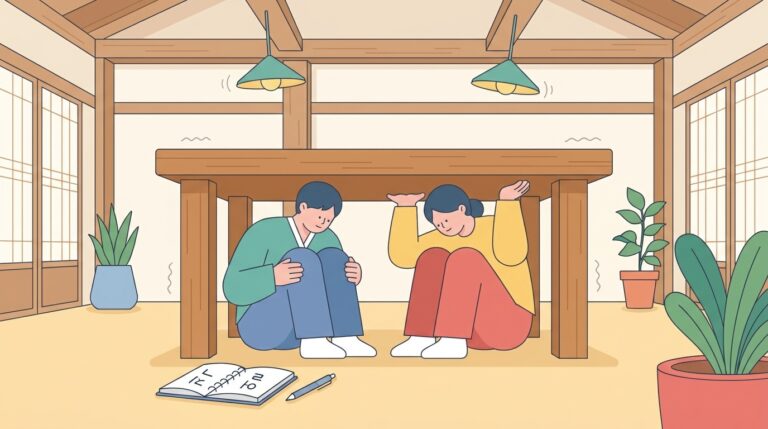
1. 머리를 보호하고 테이블 밑으로 들어가세요
- Pronunciation: Meori-reul boho-hago teibul mit-euro deureoga-seyo / [meo-ree-reul bo-ho-ha-go tay-bool meet-eu-ro deu-reo-ga-seh-yo]
- Meaning: “Protect your head and get under the table.”
- K-Culture Moment: This is the golden rule broadcasted instantly on Korean public networks (like KBS) and subway screens during emergency drills.
- Editor’s Insight: Notice the polite but authoritative imperative marker -세요 (-seyo). Even in high-emergency broadcast systems, Korean maintains a level of formal respect while conveying absolute urgency.
- Situation Spectrum:
- Casual/Friends: ⚠️ “머리 가리고 테이블 밑으로 들어가!” (Meori garigo teibul mit-euro deureoga!)
- Business/Semi-formal: ✅ “머리를 보호하고 테이블 밑으로 들어가세요.”
- Formal/Broadcast: ✅ “머리를 보호하고 테이블 아래로 대피하시기 바랍니다.” (Please evacuate under the table to protect your head.)
- 🤔 Think About It: Why does Korean retain honorific endings even in disaster alerts? It’s because public announcements must project calm, structured authority. Clear honorifics prevent chaotic panic by establishing a steady, reliable voice of instruction.
2. 침착하게 계단을 통해 대피하세요
- Pronunciation: Chimchak-hage gyedan-eul tong-hae daepi-haseyo / [cheem-chak-ha-ge gyeh-dan-eul tong-hae dae-pee-ha-seh-yo]
- Meaning: “Calmly evacuate via the stairs.”
- K-Culture Moment: Think of survival dramas like D-Day or the movie Concrete Utopia, where characters scream at citizens to avoid elevators during aftershocks. Elevators are absolute deathtraps during earthquakes due to potential power cuts.
- Editor’s Insight: The word 대피 (daepi) translates to “evacuation” or “refuge,” derived from Hanja (대 – avoid, 피 – escape). C1 learners should distinguish this from simple 피하다 (to avoid); 대피 is used specifically for moving to an officially designated safe zone.
- Situation Spectrum:
- Casual/Friends: ⚠️ “엘리베이터 타지 말고 계단으로 가!” (Don’t take the elevator, use the stairs!)
- Business/Semi-formal: ✅ “침착하게 계단을 통해 대피하세요.”
- Formal/Broadcast: ✅ “승강기 이용을 금하며 계단으로 대피하십시오.” (Do not use elevators; please evacuate via the stairs.)
- 🤔 Think About It: The adverb 침착하게 (chimchak-hage – calmly) reflects the societal expectation of collective composure. In Korean safety manuals, individual speed is secondary to collective order.
3. 넓은 공터나 공원으로 가야 해요
- Pronunciation: Neolbeun gongteo-na gongwon-euro gaya haeyo / [neol-beun gong-teo-na gong-won-eu-ro gah-yah hae-yo]
- Meaning: “You must go to an open space or a park.”
- K-Culture Moment: In K-survival cinema, wide-open public squares like the Yeouido Han River Park become makeshift sanctuaries because there are no falling glass shards or collapsing brick facades.
- Editor’s Insight: 공터 (gongteo) is an excellent advanced vocabulary word meaning an empty, flat, open plot of land. It’s safer than narrow streets lined with tall villa (빌라) buildings.
- Situation Spectrum:
- Casual/Friends: ✅ “넓은 데로 가야 돼.” (We need to go somewhere wide open.)
- Business/Semi-formal: ✅ “넓은 공터나 공원으로 가야 해요.”
- Formal/Broadcast: 🚫 (Too conversational. Broadcasts use “운동장이나 공원 등 넓은 공간으로 대피하십시오.”)
- 🤔 Think About It: How does urban planning in densely packed cities like Seoul influence emergency vocabulary? Words like 공터 (gongteo) and 운동장 (undongjang – school playground) are crucial because they represent rare, precious open spaces amidst high-rises.
2. Textbook Korean vs. Real-World Korean
When disaster strikes, the polished sentences from your college textbooks vanish. You need to understand the raw, fast-paced language spoken by locals on the ground.
Situation 1: Reacting to the Emergency Siren
- 📖 Textbook Korean: “지진 경보가 발생하였으니 안전한 장소로 이동하십시오.” (A seismic warning has occurred, please move to a safe location.)
- 🗣️ Real Korean: “헐, 대박! 재난 문자 왔어! 빨리 나가자!” (Oh my god, look! A disaster text came! Let’s get out fast!)
- 💡 Why it’s different: In real life, locals refer to government warnings simply as 재난 문자 (jaenan munja – disaster text). Understanding this slangy, fast-paced shorthand helps you react instantly without translating formal grammar in your head.
Situation 2: Directing Someone Away From danger
- 📖 Textbook Korean: “엘리베이터를 탑승하는 것은 위험하오니 삼가 주시기 바랍니다.” (Please refrain from boarding the elevator as it is dangerous.)
- 🗣️ Real Korean: “엘리베이터 타면 안 돼요! 계단으로 가요!” (You can’t take the elevator! Go to the stairs!)
- 💡 Why it’s different: Under stress, complex passive verbs like 삼가다 (refrain from) are dropped for high-impact negative structures like -(으)면 안 돼요 (you must not), which clear up any ambiguity instantly.
3. K-Culture Deep Dive & Non-Verbal Manners
3-1. “Nunchi” (눈치) in Times of Crisis
In Korea, non-verbal situational awareness, or Nunchi (눈치), is your ultimate survival tool. If a tremor begins, look around. Koreans are highly attuned to collective behavior. If shopkeepers or subway conductors remain still, they are likely assessing if it’s a minor tremor (which happens occasionally due to distant offshore activity). However, if you see staff pointing toward exits, do not wait for an English translation—follow their physical cues immediately.
3-2. The Reality of Korean Infrastructure
Unlike the exaggerated apocalyptic scenes in K-dramas, Korea’s modern buildings (especially those built after the late 1980s) have strict seismic design standards (내진설계 – naejinseolgye). If you are inside a modern high-rise or a major subway station, the structure itself is incredibly resilient. Your biggest hazard isn’t the building collapsing; it is falling ceiling tiles, glass windows, or heavy shelves. Thus, staying put under a sturdy table until the shaking stops is far safer than running wildly into the street.
4. Interactive Roleplay: Escape from Gyeongju
Let’s test your wits. You are hanging out with your Korean friend, Ji-a, in a wooden cafe in Gyeongju when a sudden 4.8 magnitude earthquake strikes.

- Ji-a: (🎭 Looking worried as her iced latte shakes) 민수야, 방금 땅이 흔들린 것 같지 않아? (Minsu-ya, banggeum ttang-i heundeullin geot gatji ana?)
- Minsu (You): (🎭 Looking around, confused) 응? 테이블이 조금 흔들렸는데… 기분 탓인가? (Eung? Teibul-i jogeum heundeullyeonneunde… gibun tasinga?)
- Ji-a: (🎭 Suddenly gasping as a loud alarm blares on both phones) 어! 재난 문자 왔어! 진짜 지진이야! (Eo! Jaenan munja wasseo! Jinjja jijin-iya!)
- Minsu (You): (🎭 Heart racing, looking at the Korean text on his screen) 대피하라고 써 있네. 어떻게 해야 돼? (Daepiharago sseo inne. Eotteoke haeya dwae?)
- Ji-a: (🎭 Pointing under the heavy wooden table) 일단 머리부터 보호해야 돼! 이 테이블 밑으로 들어와! (Ildan meori-buteo boho-haeya dwae! I teibul mit-euro deureowa!)
- Minsu (You): (🎭 Ducking under the table quickly, holding his head) 지진이 멈출 때까지 기다려야 하는 거지? (Jijin-i meomchul ttae-kkaji gidaryeoya haneun geoji?)
- Ji-a: (🎭 Nodding while holding the table leg tightly) 맞아. 진동이 멈추면 바로 밖으로 나가야 돼. (Maja. Jindong-i meomchumyeon baro bakk-euro nagaya dwae.)
- Minsu (You): (🎭 Feeling the shaking subside) 어, 이제 조금 조용해진 것 같아. 지금 나갈까? (Eo, ije jogeum joyong-haejin geot gata. Jigeum nagalkka?)
- Ji-a: (🎭 Peeking out from under the table) 응, 지금이야! 가방으로 머리 가리고 조심히 기어나와! (Eung, jigeumiya! Gabang-euro meori garigo josimhi gieonawa!)
- Minsu (You): (🎭 Standing up, heading toward the exit) 엘리베이터는 타면 안 되지? 계단으로 가자! (Ellibeiteo-neun tamyeon an doeji? Gyedan-euro gaja!)
🔀 Decision Point
You both make it out of the cafe building. The street is narrow, with old tiled roofs on one side and tall commercial buildings with glass windows on the other. What do you do?
- Option A: Stand under the eaves of the traditional Hanok cafe for shelter.
- Option B: Run instantly to the nearest open school playground (운동장) or park.
- Option C: Wave down a taxi immediately to drive away from Gyeongju.
Best Choice: Option B
Why? Open spaces (공터) like school playgrounds are the gold standard for earthquake evacuation in Korea. Hanok roof tiles (기와) can easily slip off and cause severe head injuries, and traffic jams will trap you inside a taxi during a crisis.
5. 10-Second Emotion Shadowing Drill
Let’s practice speaking these lines with genuine, life-like urgency. Pay close attention to the pause markers (/) and emotional cues.
- [🥺 Frightened but urgent]
- “재난 문자 왔어! / 빨리 테이블 밑으로 들어가!”
- Jaenan munja wasseo! / Ppalli teibul mit-euro deureoga!
- “The emergency text is here! / Get under the table, fast!”
- [😤 Determined and reassuring]
- “당황하지 말고 / 계단을 통해 / 조심히 내려가요.”
- Danghwang-haji malgo / gyedan-eul tong-hae / josimhi naeryeogayo.
- “Don’t panic / use the stairs / go down carefully.”
6. K-Culture Mini Dictionary
| Word | Romanization | Real-World Context |
|---|---|---|
| 재난 문자 | Jaenan Munja | Government emergency alert texts. They are incredibly fast and localized down to your neighborhood district. |
| 대피소 | Daepiso | An official evacuation shelter. Often located in public schools, sports complexes, or underground subway stations. |
| 지진 | Jijin | Earthquake. From Sino-Korean words for “earth” (지) and “shaking” (진). |
| 안전벨트 | Anjeonbelteu | Literally “safety belt,” but colloquially used as a metaphor for being prepared or securing one’s belongings. |
| 내진설계 | Naejinseolgye | Seismic-resistant architectural design. Most modern Korean buildings boast high grades of this. |
7. Traveler’s Survival Kit
If you find yourself in Korea during an emergency, keep these cards ready on your phone!
- Card 1: Emergency Location Request
- Expression: “가장 가까운 지진 대피소가 어디예요?”
- Romanization: Gajang gakkaun jijin daepiso-ga eodi-yeyo?
- Translation: “Where is the nearest earthquake shelter?”
- Card 2: Empathy & Check-in
- Expression: “다치신 데는 없으세요?”
- Romanization: Dachisin de-neun eopseuseyo?
- Translation: “Are you hurt anywhere?” (A highly respectful way to check on elders or strangers around you.)
- Card 3: Urgency
- Expression: “도와주세요! 밖으로 나갈 수가 없어요!”
- Romanization: Dowajuseyo! Bakk-euro nagal suga eopseoyo!
- Translation: “Help me! I can’t get outside!”
📌 Editor’s Travel Note
Before you step out of your hotel, download the Emergency Ready App (안전디딤돌), the official government application that provides real-time disaster alerts in English. Additionally, use the Naver Map App to search for nearby “지진대피소” (Earthquake Shelters) ahead of time. Knowing where these are can turn a terrifying moment into a controlled, safe experience.
8. Deep Reflection:
Frequently Asked Questions (FAQ)
Q: What does "침착하게 계단을 통해 대피하세요" mean in Korean and how do you pronounce it?
A: In Korean, "침착하게 계단을 통해 대피하세요" is pronounced [Chimchak-hage gyedan-eul tong-hae daepi-haseyo / [cheem-chak-ha-ge gyeh-dan-eul tong-hae dae-pee-ha-seh-yo] and means: "Calmly evacuate via the stairs."
Q: What does "넓은 공터나 공원으로 가야 해요" mean in Korean and how do you pronounce it?
A: In Korean, "넓은 공터나 공원으로 가야 해요" is pronounced [Neolbeun gongteo-na gongwon-euro gaya haeyo / [neol-beun gong-teo-na gong-won-eu-ro gah-yah hae-yo] and means: "You must go to an open space or a park."







