

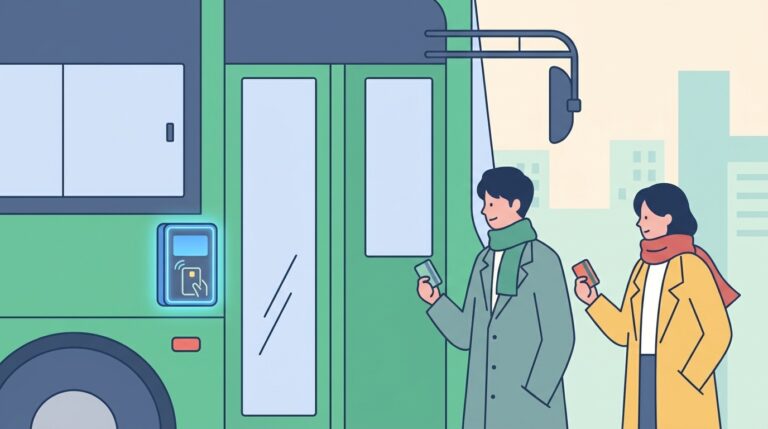
Don’t Panic on Seoul Buses: The Ultimate Guide to Tapping On and Off Like a Born-and-Bred Seoulite
Phase 1: Empathy (An Absolute Commuter’s Dilemma)
안녕하세요! Welcome back to another masterclass with Daily Hangul. I’m your senior editor and cultural navigator.
Imagine this: You are standing at a bustling bus stop in Sinchon. The neon lights of Seoul are reflecting off the wet pavement after a sudden evening shower. You see your bus—the green 7016—rolling up. The doors slide open, and a wave of fast-paced Seoulites moves like a synchronized dance troupe, tapping their cards with a satisfying pbi-bik (삐빅) sound.
But as you step up, your heart rate spikes. You hold up your wallet, tap it against the reader, and instead of a friendly beep, a stern, robotic voice echoes through the bus:
“카드를 다시 대 주세요” (Please tap your card again).
Behind you, five busy commuters silently shift their weight, their collective Nunchi (눈치 – intuitive cultural sensing) pressing against your back. You panic. Do you tap again? Do you run? Do you apologize?
If you’ve ever felt intimidated by Korea’s hyper-efficient public transit system, you are not alone. In this C1-level guide, we are going to demystify the subtle art of the 시내버스 승하차 태그 (City Bus Boarding & Alighting Tagging). By the end of this article, you won’t just navigate the bus system flawlessly; you’ll do it with the effortless cool of a K-drama lead commuting home after a dramatic day. Let’s dive deep!
Phase 2: Deep Dive into 3 Core Expressions
To master the bus ride, you must first master the language of the card terminal and the unspoken rules around it.
1. 카드를 대 주세요 (Ka-deu-reul dae ju-se-yo)
- Pronunciation: [ka-deu-reul dae ju-se-yo] / Sound-alike: “Day” as in “Day-by-day” for “대”
- Meaning: Please apply/press/tap your card.
- K-Culture Moment: This is the most common automated voice command you will hear in Seoul. In K-Dramas, when a broke character’s transit card shows “잔액이 부족합니다” (Insufficient balance), this prompt is followed by a chivalrous love interest stepping in and tapping their card instead, saying, “Two people, please” (두 명요).
- Editor’s Insight: The verb 대다 here means “to touch” or “to bring close to.” It is a soft command. While it sounds polite due to “주세요,” the context of transit means you need to do it swiftly to keep the flow of passengers moving.
- Situation Spectrum:
- Friends & Casual: 🚫 (Too formal for private chats; you’d say “카드 찍어” instead)
- Semi-formal: ✅ (Perfect for polite instructions to peers)
- Formal: ✅ (Used by official transit terminals and drivers)
- 🤔 Think About It: Why does Korean use the verb 대다 (to apply/touch) rather than 접촉하다 (to make contact) in everyday speech? Think about how physical gestures shape Korean verbal efficiency. Korean prefers short, tactile native verbs over heavy Sino-Korean words in high-speed, practical environments.
2. 하차 태그 안 하면 추가 요금 나와요 (Ha-cha tae-geu an ha-myeon chu-ga yo-geum na-wa-yo)
- Pronunciation: [ha-cha tae-geu an ha-myeon chu-ga yo-geum na-wa-yo] / Sound-alike: “Ha-cha” sounds like a martial artist’s shout!
- Meaning: If you don’t tag off, an additional fee will be charged.
- K-Culture Moment: You’ll hear this advice from local friends, university seniors, or helpful older citizens (Ajumma or Ajeossi) if they see you heading for the exit without tapping your card. It’s the ultimate “life hack” warning in Korea’s transit survival guide.
- Editor’s Insight: 하차 (Alighting/Getting off) is paired with the English loanword 태그 (Tag). The phrase uses the conditional -면 (if), making it a logical warning. In Korea, distance-based pricing means forgetting to tag off results in the maximum default fare on your next ride.
-
Situation Spectrum:
- Friends & Casual: ✅ (Perfect to warn your traveling friends)
- Semi-formal: ✅ (Polite enough for colleagues)
- Formal: ⚠️ (A bit conversational; bus signs will use “하차태그 필수” instead)
- 🤔 Think About It: Korea’s bus-to-subway transfer system is highly integrated. How does this communal structure reflect Korea’s societal emphasis on collective resource sharing and trust?
3. 환승입니다 (Hwan-seung-im-ni-da)
- Pronunciation: [hwan-seung-im-ni-da] / Sound-alike: “Hwan” like the first syllable of ‘Wand’ without the ‘d’
- Meaning: Transfer approved (Literally: “It is a transfer”).
- K-Culture Moment: Hearing this cheerful, high-pitched chime from the terminal is a satisfying daily victory. It means your transition from the subway to the bus (or vice-versa) was completed within the 30-minute grace period, saving you at least 1,250 KRW!
- Editor’s Insight: 환승 (Transfer) is a compound of 환 (change/exchange) and 승 (ride). It is always delivered in the formal -입니다 style because it is a system-generated statement of fact.
-
Situation Spectrum:
- Friends & Casual: 🚫 (You wouldn’t say this to friends unless joking)
- Semi-formal: 🚫
- Formal: ✅ (Standard system audio)
- 🤔 Think About It: Unlike some countries where transfers require paper receipts or manual checks, Korea’s system is entirely automated and card-dependent. How does this seamless automation influence the daily stress levels and pacing of Seoul commuters?
Phase 3: Textbook Korean vs. Real Korean
When you study standard textbooks, the Korean can sound like a government manual. On the streets of Seoul, speed is king. Let’s look at the stark contrast between the classroom and the concrete jungle.
Scenario 1: Tapping your card upon boarding
- 📖 Textbook Korean: “교통카드를 단말기에 접촉해 주시기 바랍니다.”
(Please contact your transportation card to the terminal.) - 🗣️ Real Korean: “카드 찍어주세요.” or just “카드요!”
(Tap your card. / Card, please!) - 💡 Why is it different? The verb 찍다 (to stamp/print/take a photo) is used colloquially for tapping transit cards because it mimics the quick, striking motion of stamping a document. No one uses “접촉” (contact) in casual conversation unless they are writing a technical manual.
Scenario 2: Reminding someone to tag off before exiting
- 📖 Textbook Korean: “내리실 때 단말기에 태그를 하셔야 환승 할인을 받으실 수 있습니다.”
(You must tag the terminal when getting off to receive the transfer discount.) - 🗣️ Real Korean: “내릴 때 찍어야 돼! 안 그러면 돈 더 나가.”
(You gotta tap when getting off! Otherwise, you’ll pay more.) - 💡 Why is it different? C1 learners should note the use of 돈 더 나가다 (more money goes out/is spent), which is the natural idiomatic way to express losing money or being overcharged, compared to the stiff “환승 할인 적용” (application of transfer discount).
Phase 4: K-Culture Deep Dive & Non-verbal Manners
To move like a local, you must understand the body language and the spatial psychology of a Seoul bus.
4-1. The Art of the “Nunchi” Exit (눈치 하차)
In Seoul, you do not wait for the bus to come to a complete stop before standing up to exit. If you do, the bus might already be accelerating to the next stop, and you will have to awkwardly yell “내려요!” (I’m getting off!).
- The Protocol: When the bus voice announces, “이번 정류소는…” (This stop is…), and starts naming your destination, that is your cue. Stand up, hold the handrails firmly (the drivers can be aggressive around curves!), and walk toward the back door while the bus is slowing down.
- The Non-Verbal Alignment: Line up at the back door. Hold your T-money card in your hand—not tucked away in your bag. If there is a person in front of you who is slow, give them a tiny, polite head nod or a soft shoulder shift to signal you are ready to tap behind them.
4-2. The “Single-Card” Dilemma
Never tap your entire wallet if it contains multiple RFID cards (like two credit cards and a transit card). The terminal will scream: “카드를 한 장만 대 주세요” (Please tap only one card). To avoid this ultimate social faux pas, carry your transit card in an easily accessible outer slot or use your smartphone’s mobile transit feature (Samsung Pay/Apple Pay where supported).
+-------------------------------------------------------------+
|                   [ SEOUL BUS TERMINAL ]                    |
|                                                             |
|                      +-----------------+                    |
|                      |     (( 삐 ))    |                    |
|                      |    환승입니다   |                    |
|                      +-----------------+                    |
|                                                             |
|                    [ Please Tap One Card ]                  |
+-------------------------------------------------------------+
Alt Text: A minimal vector illustration of a green Seoul bus card terminal showing the digital text ‘환승입니다’ with a glowing blue light, representing clean and efficient public transportation.
Phase 5: The Sinchon Rainy Night Bus Scenario
The Setting: It is 10:30 PM on a Friday. You are heading home from a barbecue dinner with your Korean colleagues. The bus is a green 721, tightly packed with university students and tired salarymen. The windows are foggy from the rain.
The Cast:
* You (A sophisticated C1 explorer determined to look like a resident)
* Min-jun (민준) (Your friendly Korean colleague who treats Seoul transit like an Olympic sport)
[The bus swerves slightly as it approaches the bustling stop near Ewha Womans University.]

민준: (Holding the strap overhead, looking at his phone)
      어, 이번 정류장 다음이 우리 내릴 데네. 슬슬 문 앞으로 가자.
      [Eo, i-beon jeong-ryu-jang da-eum-i u-ri nae-ril de-ne. Seul-seul mun ap-eu-ro ga-ja.]
      (Oh, the stop after this is where we get off. Let's gradually head to the door.)

You: (Grabbing the yellow handrail carefully)
     그래, 사람 진짜 많다. 지금 움직여야 내릴 수 있겠어.
     [Geu-rae, sa-ram jin-짜 man-da. Ji-geum um-jik-yeo-ya nae-ril su it-get-eo.]
     (Yeah, it's really crowded. We need to move now to be able to get off.)

민준: (Squeezing through the crowd with expert agility)
      잠시만요, 내리겠습니다~ 실례합니다...
      [Jam-si-man-yo, nae-ri-get-seum-ni-da~ sil-lye-hap-ni-da...]
      (Excuse me, getting off~ Pardon me...)

You: (Following closely behind him, keeping your T-money card ready)
     민준 씨, 나 오늘 버스 오랜만에 타서 그러는데, 하차 태그 꼭 해야 되지?
     [Min-jun ssi, na o-neul beo-seu o-raen-man-e ta-seo geu-reun-de, ha-cha tae-geu kkok hae-ya doe-ji?]
     (Min-jun, I haven't taken the bus in a while... I definitely have to tag off, right?)

민준: (Turned around, whispering intensely)
      당연하지! 서울 버스는 하차 태그 안 하면 다음 탈 때 독박 써. 최대 요금으로 떼인다고.
      [Dang-yeon-ha-ji! Seo-ul beo-seu-neun ha-cha tae-geu an ha-myeon da-eum tal ttae dok-bak sseo. Choe-dae yo-geum-eu-ro tte-in-da-go.]
      (Of course! If you don't tag off on Seoul buses, you get hit with a penalty next time. They rip you off with the maximum fare.)

[The bus stops. The back doors slide open. The reader is right in front of you.]
🔀 Decision Point!
What is your next move as a highly skilled C1 speaker?
- Choice A: Stand in front of the terminal, searching through your deep backpack for your wallet while saying: “잠시만요, 제 카드가 어디 있는지 모르겠어요.”
- Choice B: Confidently step up, tap your card swiftly, hear the pbi-bik sound, and step off while nodding to the driver.
- Choice C: Panic because you think your card didn’t register, block the exit door, and try to tap it three more times just to be safe.
🏆 Best Choice: B
- Why: Seoul transit waits for no one. Having your card in hand before reaching the door is the ultimate sign of respect for your fellow passengers. A single swift tap shows you understand the rhythm of the city.
⚠️ Risky Choice: A & C
- Why: Choice A will trigger collective heavy sighs from the tired commuters behind you. Choice C will cause the card terminal to error out with “이미 처리된 카드입니다” (Already processed card), making you lose your cool.
Phase 6: 10-Second Shadowing Drill
Let’s train your emotional delivery. Don’t speak like a robot; speak with the precise feelings of a local.
1. The Robotic System Standard (Polite & Precise)
>
Frequently Asked Questions (FAQ)
Q: What does "카드를 대 주세요 (Ka-deu-reul dae ju-se-yo)" mean in Korean and how do you pronounce it?
A: In Korean, "카드를 대 주세요 (Ka-deu-reul dae ju-se-yo)" is pronounced [ka-deu-reul dae ju-se-yo] and means: Please apply/press/tap your card.
Q: What does "하차 태그 안 하면 추가 요금 나와요 (Ha-cha tae-geu an ha-myeon chu-ga yo-geum na-wa-yo)" mean in Korean and how do you pronounce it?
A: In Korean, "하차 태그 안 하면 추가 요금 나와요 (Ha-cha tae-geu an ha-myeon chu-ga yo-geum na-wa-yo)" is pronounced [ha-cha tae-geu an ha-myeon chu-ga yo-geum na-wa-yo] and means: If you don't tag off, an additional fee will be charged.
Q: What does "환승입니다 (Hwan-seung-im-ni-da)" mean in Korean and how do you pronounce it?
A: In Korean, "환승입니다 (Hwan-seung-im-ni-da)" is pronounced [hwan-seung-im-ni-da] and means: Transfer approved (Literally: "It is a transfer").







