

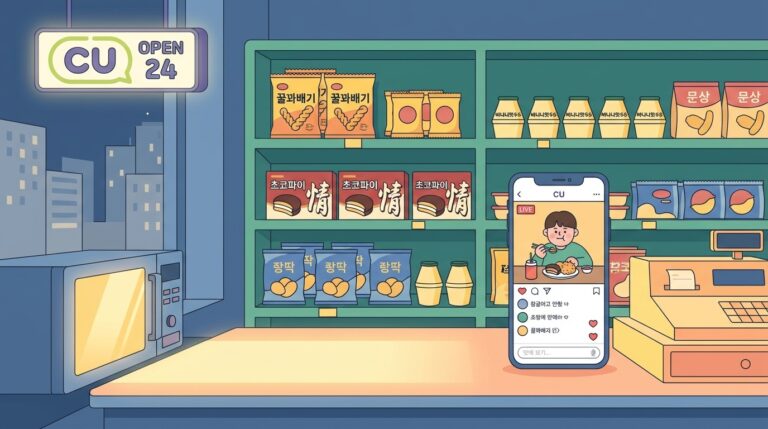
Riding the Korean Convenience Store ‘New Item’ Wave: How to Review Viral Snack Trends Like a Seoul Local
Phase 1: Empathy (스토리 몰입형 오프닝)
안녕하세요! (Annyeonghaseyo!) It’s your favorite senior editor from Daily Hangul here, your trusted guide to the vibrant, fast-paced heartbeat of Seoul’s lifestyle.
Imagine this: It’s 11:30 PM. You are walking through the neon-drenched streets of Hongdae after a long, exhilarating day of exploring. Your feet are tired, but your culinary curiosity is just waking up. You step into a brightly lit GS25 or CU convenience store. Suddenly, you find yourself staring at a wall of vibrant, eccentric packaging: mint-chocolate-flavored ramen, truffle-infused tteokbokki, and cream buns stacked so high they look like fluffy clouds.
You pull out your phone, open Instagram or TikTok, and see everyone—from top K-Pop idols to local college students—filming their legendary “Convenience Store New Item Raids” (편의점 신상 털기 – pyeon-ui-jeom sinsang teolgi). You want to join the conversation, to share your own thoughts on these wild flavor combinations, but you find yourself tongue-tied. How do you describe these complex, fleeting flavor profiles without sounding like a dry textbook? How do you capture the sheer, collective hype that defines K-convenience store culture?
If you’ve ever felt overwhelmed by the lightning-fast rotation of Korean snack trends or hesitated to post your own review because you lacked the authentic cultural vocabulary, you are in the right place. Today, we are diving deep into the linguistics of Korea’s viral snack reviews, tailored for C2-level connoisseurs who want to articulate taste, trend, and cultural nuance like a true Seoulite. This guide is built on actual feedback from our global community of foodies and language learners who wanted to go beyond simple phrases and truly understand the cultural engine behind the viral trends.
Phase 2: Core Expressions Deep Dive (핵심 표현 3선 심층 분석)
To confidently dissect the latest convenience store creations, you need vocabulary that carries weight, nuance, and cultural relevance. Let’s analyze three pillar expressions that will instantly elevate your review game.
1. 신상 털기 (Sinsang Teolgi)
- Pronunciation: [sinsang teolgi] / Sound-alike: “seen-sang tuhl-gee”
- Meaning: Literally “looting or dusting off new arrivals.” In real-world context, it refers to the act of exhaustively purchasing and reviewing newly released products (usually at a convenience store or fashion outlet) as soon as they hit the shelves.
- K-Culture Moment: You will see this all over YouTube thumbnails where mukbang creators buy every single item from a newly launched collaborative series (like the Yonsei University Cream Bread variants) and rank them on camera.
- Editor’s Insight: Though “털기” (looting/robbing) sounds aggressive, it actually denotes a passionate, exhaustive curiosity. It showcases the fast-paced nature of Korean consumerism where being first to try a product is a badge of honor.
- Situation Spectrum:
- Friends/Casual: ✅ (Perfect for social media captions and chat rooms)
- Colleagues/Semi-formal: ⚠️ (Use when discussing internet trends in a relaxed office environment)
- Superiors/Formal: 🚫 (Too colloquial for serious corporate reports)
- 🤔 Think About It: Why does Korean consumer culture place such an immense premium on “newness” (신상)? How does this rapid cycle of consumption reflect the broader “Pali-Pali” (fast-fast) lifestyle of modern Korea? Have you noticed a similar obsession with micro-trends in your own country?
2. 꿀조합 (Kkul-johap)
- Pronunciation: [kkul-johap] / Sound-alike: “cool-joh-hahp”
- Meaning: Literally “honey combination.” It refers to the ultimate, heavenly, or unexpectedly perfect flavor combination created by mixing two or more distinct products (often combining instant ramen, cheese, and convenience store sausages).
- K-Culture Moment: The famous “Mark Triad” (마크정식 – Makeu jeongsik), a viral convenience store recipe created by a fan of the K-Pop group GOT7’s member Mark, which combines instant spaghetti, giant tteokbokki, string cheese, and smoked sausage.
- Editor’s Insight: In Korean, the prefix “꿀” (honey) is used colloquially to denote anything of exceptionally high quality, ease, or deliciousness (e.g., 꿀팁 for a great tip, 꿀알바 for an easy, high-paying job).
- Situation Spectrum:
- Friends/Casual: ✅ (The absolute standard word for foodie discussions)
- Colleagues/Semi-formal: ✅ (Very common when sharing lunch hacks at work)
- Superiors/Formal: ⚠️ (Can be used in casual business presentations about consumer behavior, but keep it structured)
- 🤔 Think About It: Traditionally, dining was defined by chef-prescribed menus. The rise of “꿀조합” represents a shift toward consumer autonomy, where the customer becomes the chef. How does this DIY culinary philosophy compare to your country’s convenience store habits?
3. 내돈내산 (Nae-don-nae-san)
- Pronunciation: [nae-don-nae-san] / Sound-alike: “neh-don-neh-sahn”
- Meaning: An acronym for “내 돈 주고 내가 산” (Bought with my own money). It serves as a vital declaration of authenticity and transparency, proving that a review is 100% genuine and not sponsored by a brand.
- K-Culture Moment: Following several high-profile scandals involving undeclared paid promotions (뒷광고 – dwit-gwanggo) among Korean influencers, “내돈내산” became a mandatory badge of trust in video titles and blog posts.
- Editor’s Insight: Using “내돈내산” isn’t just a legal disclaimer; it’s a powerful social statement that values integrity, fairness, and mutual respect between content creators and their audience.
- Situation Spectrum:
- Friends/Casual: ✅ (Great for reassuring friends that a product is actually worth their money)
- Colleagues/Semi-formal: ✅ (Often used in office product recommendations)
- Superiors/Formal: ⚠️ (While understood, it is better to use formal terms like “직접 구매한” [directly purchased] in formal reports)
- 🤔 Think About It: The demand for “내돈내산” reflects a deep-seated value of transparency in the highly digitized Korean society. Why do you think modern consumers are so sensitive to hidden sponsorships, and how has this changed the way you trust online recommendations?
Phase 3: Textbook Korean vs. Real Korean (실전 비교 Showcase)
Let’s look at how the sterile language of standard textbooks compares to the vibrant, living vernacular of the streets of Seoul.
Situation 1: Asking if a new convenience store product is actually worth the hype.
- 📖 Textbook Korean: “이 신제품은 대중에게 인기가 많습니까?” (Is this new product popular among the general public?)
- 🗣️ Real Korean: “이거 요즘 SNS에서 엄청 핫한 신상 맞아요? 벌써 품절 대란이라던데!” (Is this the new item that is super hot on SNS right now? I heard it’s already causing a sell-out frenzy!)
- 💡 Why it’s different: Textbook Korean uses clinical, academic phrases like “대중” (general public) and “신제품” (new product). Real-life Korean immediately taps into social media relevance (“SNS에서 엄청 핫한”) and utilizes consumer culture idioms like “품절 대란” (sell-out crisis/frenzy) to express urgent popularity.
Situation 2: Commenting on a unique, self-made convenience store combination.
- 📖 Textbook Korean: “다른 두 가지 음식을 섞어서 먹으면 맛이 조화를 이룹니다.” (If you mix and eat two different foods, the flavors form a harmony.)
- 🗣️ Real Korean: “이거 완전 맛도리 꿀조합인데요? 단짠단짠의 정석이에요!” (This is an absolute flavor-bomb honey combination! It’s the textbook definition of sweet-and-salty!)
- 💡 Why it’s different: Instead of the overly poetic “맛이 조화를 이룹니다” (flavors form a harmony), locals use the trendy slang “맛도리” (flavor bomb / delicious thing) and the classic food-texture compound word “단짠단짠” (sweet-salty-sweet-salty) to describe the exact sensory experience of modern street food.
Phase 4: K-Culture Deep Dive & Non-Verbal Etiquette
4-1. Nunchi (눈치) and Convenience Store Etiquette
In Korea, convenience stores are highly optimized, compact environments. Executing a successful “new item raid” requires a keen sense of 눈치 (social sensing/tact).
* The Space Barrier: K-convenience stores can be incredibly tight. If you are hunting for a newly dropped item, do not block the narrow aisles while checking your phone for reference pictures. Step aside to let other customers pass.
* Alba-saeng (알바생) Respect: The part-time workers at convenience stores are often working high-stress, fast-paced shifts. Don’t ask them to check the back storage for a viral item unless you can do so politely and briefly. A warm “혹시 이거 들어왔나요?” (hoksi igeo deureowannayo? – “By any chance, did this come in?”) accompanied by a slight nod of the head works wonders.
4-2. The Cultural Code: “So-Hwak-Haeng” (소확행)
Why is reviewing convenience store snacks so insanely popular in Korea? It traces back to the concept of 소확행 (Small but Certain Happiness – 소소하지만 확실한 행복). In a hyper-competitive, high-stress society where buying a house or securing a high-paying job feels increasingly out of reach, spending 3,000 KRW ($2.50 USD) on a viral, limited-edition dessert offers instant, low-risk emotional gratification. Sharing this experience online creates a sense of shared community and accessible joy.
Phase 5: Interactive Roleplay Scenario (실전 롤플레이)
The Setting: You are inside a sleek, neon-lit CU convenience store in Mapo-gu at midnight. The rain is pattering gently outside, and the hum of the drink coolers fills the air. You are standing with Ji-su (지수), your trend-obsessed Korean friend who runs a popular street food review channel.
Cast:
- 지수 (Ji-su): A charismatic, fast-talking foodie influencer.
- 나 (You): A culturally fluent, adventurous foodie ready to put C2 skills to the test.
- 지수: (🎭 Waving her phone excitedly in front of the open refrigerator shelf) 대박! 너 저기 삼각김밥 코너 봤어? 요즘 유튜브 쇼츠에서 완전 품절 대란 난 그 ‘마라 크림 우동’ 드디어 재고 들어왔나 봐!
(Dae-bak! Neo jeogi samgak-gimbap koneo bwasseo? Yojeom youtube shorts-eseo wan-jeon pum-jeol dae-ran nan geu ‘mara keurim udong’ deu-di-eo jae-go deul-eo-wannabwa!)
“Oh my god! Did you see the triangle kimbap corner over there? It looks like the ‘Mala Cream Udon’ that has been causing a massive sell-out frenzy on YouTube Shorts is finally back in stock!” -
나: (🎭 Looking closely at the shelf, checking the packaging) 와, 진짜네! 이거 저번에 출시되자마자 온 동네 편의점 다 뒤져도 못 구했던 그 레어템이잖아!
(Wa, jin-jja-ne! Igeo jeo-beon-e chul-si-doe-ja-ma-ja on dong-ne pyeon-ui-jeom da dwi-jyeo-do mot gu-haet-deon geu re-eo-tem-i-ja-na!)
“Wow, it really is! This is that rare item we couldn’t find even after searching every single convenience store in the neighborhood right after it launched!” -
지수: (🎭 Grabbing two packages and thrusting one into your hands) 오늘이야말로 우리 ‘신상 털기’ 제대로 해볼 타이밍이지! 우리 이거 그냥 따로 먹을까, 아니면 뭐 신박한 ‘꿀조합’ 레시피 없을까?
(O-neul-i-ya-mal-lo u-ri ‘sin-sang teolgi’ je-dae-ro hae-bol ta-i-ming-i-ji! U-ri i-geo geu-nyang tta-ro meog-eul-kka, a-ni-myeon mwo sin-bak-han ‘kkul-johap’ re-si-pi eops-eul-kka?)
“Tonight is the perfect night for us to do a proper ‘new item raid’! Should we just eat this as it is, or is there some ingenious ‘honey combo’ recipe we could try?” -
나: (🎭 Smiling mischievously as you point to the cheese and hot bar section) 흐음, 당연히 조합을 만들어야지! 저기 스트링 치즈랑 매운 불닭 핫바 넣어서 전자레인지에 돌리면 완전 환상일 것 같아.
(Heu-eum, dang-yeon-hi jo-hap-eul man-deul-eot-ya-ji! Jeo-gi seu-teu-ring chi-jeu-rang mae-un bul-dak hat-ba neo-eoh-seo jeon-ja-re-in-ji-e dol-ri-myeon wan-jeon hwan-sang-il geot ga-ta.)
“Hmm, of course we have to create a combination! If we add that string cheese and a spicy Buldak hot bar over there, then microwave it, it’s going to be absolute heaven.” -
지수: (🎭 Eyes widening in pure admiration) 대박… 너 진짜 배우신 분이구나? 완전 ‘모디슈머’ 다 됐네! 이거 무조건 찍어야 해. 내 채널에 올릴 리뷰 찍을 테니까 솔직한 ‘내돈내산’ 평가 부탁해!
(Dae-bak… Neo jin-jja bae-u-sin bun-i-gu-na? Wan-jeon ‘modisumer’ da dwaet-ne! Igeo mu-jo-geon jjig-eot-ya hae. Nae chae-neol-e ol-ril ri-byu jjig-eul te-ni-ka sol-jik-han ‘nae-don-nae-san’ pyeong-ga bu-tak-hae!)
“Amazing… You really are a person of high culture, aren’t you? You’ve become a complete ‘modisumer’! We absolutely have to film this. I’ll shoot a review for my channel, so please give me your honest, ‘bought-with-my-own-money’ review!”
🔀 Decision Point (의사결정의 순간)
Ji-su presses record on her phone camera, pointing it right at you as you take your first bite of the hot, steaming, cheese-pull-heavy Mala Cream Udon combination. What is your move?
- Option A: “음, 생각보다 부드럽고 매콤해서 아주 조화로운 맛이에요.” (Hmm, it’s softer and spicier than I thought, so it’s a very harmonious taste.)
- Option B: “와… 이거 진짜 미쳤어요! 크림의 부드러움이랑 마라의 알싸함이 치즈랑 만나서 완전 미친 맛도리 꿀조합이에요. 뒷광고 일절 없는 솔직한 내돈내산 평점은 5점 만점에 5점입니다!” (Wow… this is truly insane! The smoothness of the cream and the numbing spice of the mala meet the cheese to create an absolutely crazy flavor-bomb honey combo. My honest, zero-sponsorship ‘bought-with-my-own-money’ score is 5 out of 5!)
- Option C: “너무 맵고 짜네요. 건강에 좋지 않을 것 같아서 제 스타일은 아닙니다.” (It is too spicy and salty. It doesn’t seem healthy, so it’s not my style.)
🔍 Choice Analysis:
- Best Choice: Option B! This option brilliantly utilizes high-level colloquial expressions (“완전 미친 맛도리”, “꿀조합”, “내돈내산”) with natural emotional delivery. It perfectly matches the enthusiastic, expressive vibe of Korean food review channels and validates Ji-su’s creative spirit.
- Risky/Awkward Choice: Option A. While grammatically flawless, it sounds incredibly dry and academic—like a food scientist writing a chemical report. It dampens the high-energy atmosphere of a spontaneous late-night convenience store review.
- Worst Choice: Option C. While honesty is valued in “내돈내산” reviews, being overly critical about health standards in a late-night convenience store context kills the fun vibe. It shows a slight mismatch in cultural expectations regarding street-style cheat meals.
Phase 6: 10-Second Emotion Shadowing Drill (10초 감정 섀도잉 드릴)
To make your Korean sound truly native, you must master the emotional contour of Korean speech. Practice the following sentences, paying close attention to the pause markers (/) and emotional cues.
1. [😊 Pure, Unfiltered Excitement]
“와! / 드디어 구했다! / 요즘 인스타에서 / 난리 난 / 대란템인데 / 진짜 기대된다!”
* Romanization: Wa! / Deu-di-eo gu-haet-da! / Yo-jeom in-seu-ta-e-seo / nal-ri nan / dae-ran-tem-in-de / jin-jja gi-dae-doen-da!
* English: “Wow! I finally got it! It’s that viral item that’s been causing a massive frenzy on Instagram lately—I am so incredibly excited!”
2. [🥺 Deeply Impressed & Cozy]
“이 조합은 / 진짜 반칙이지… / 크림이랑 마라가 / 어쩜 이렇게 / 찰떡궁합이지?”
* Romanization: I jo-hab-eun / jin-jja ban-chik-i-ji… / Keu-rim-i-rang ma-ra-ga / eo-jjeom i-reoh-ge / chal-tteok-gung-hap-i-ji?
* English: “This combination is honestly cheating… How do cream and mala match together so absolutely perfectly?”
3. [😤 Bold, Unapologetic Transparency]
“협찬 / 진짜 1도 없는 / 100% 리얼 / 내돈내산 후기니까 / 믿고 가셔도 됩니다!”
* Romanization: Hyeop-chan / jin-jja il-do eomp-neun / baek-pro ri-eol / nae-don-nae-san hu-gi-ni-ka / mit-go ga-syeo-do doem-ni-da!
* English: “With absolutely zero sponsorship, this is a 100% real ‘bought-with-my-own-money’ review, so you can absolutely trust me on this!”
Phase 7: K-Culture Mini Dictionary (K-Culture 미니 사전)
| Word (Hangul / Romanized) | English Translation | Cultural Context & Usage |
|---|---|---|
| 모디슈머 (Modisumer) | Modisumer (Modify + Consumer) | A portmanteau for consumers who do not follow standard recipes, but instead modify and combine products to create personal culinary masterpieces. |
| 편스토랑 (Pyeonsuto-rang) | “Pyeon-staurant” | A blend of “convenience store” (편의점) and “restaurant” (레스토랑). Popularized by a famous TV show where celebrities compete to create dishes that are later mass-produced and sold at CU convenience stores nationwide. |
| 오픈런 (Open Run) | Open Run / Door Busting | The phenomenon where customers line up outside a store early in the morning, ready to sprint the moment the doors open to secure extremely limited items. |
| 점바점 (Jeom-ba-jeom) | Branch by Branch | A compound of “점포” (store branch) and “by” (바). Used to describe how stock availability, service quality, or even the execution of fresh food varies wildly depending on which specific store branch you visit. |
Phase 8: Traveler’s Survival Kit (여행자를 위한 생존 키트)
No matter where you travel in Korea, a convenience store is always within a 2-minute walking distance. Here are three survival expressions to carry in your pocket:
Survival Cards
- “혹시 이거 오늘 물량 들어왔나요?”
- Pronunciation: [Hok-si i-geo o-neul mul-ryang deul-eo-wannayo?]
- Meaning: “By any chance, did today’s stock for this item come in yet?”
- Pro Tip: Use this when looking for viral items that sell out early in the morning.
- “2+1(투 플러스 원) 행사 적용되는 거 맞아요?”
- Pronunciation: [Tu-peul-reo-seu-won haeng-sa jeok-yong-doe-neun geo ma-ja-yo?]
- Meaning: “Is this eligible for the 2+1 promotion?”
- Pro Tip: Korean convenience stores have massive buy-two-get-one-free promos. Always check the labels!
- “전자레인지 몇 초 돌려야 돼요?”
- Pronunciation: [Jeon-ja-re-in-ji myeot cho dol-ryeo-ya dwae-yo?]
- Meaning: “How many seconds should I microwave this for?”
- Pro Tip: Look at the packaging for “매장용” (Store Use) wattage times, or ask the friendly clerk if the text is too small.
📌 Editor’s Travel Note:
To take your convenience store lifestyle to the absolute expert level, download the Pocket CU Official App for iOS or the Pocket CU on Google Play Store. These apps allow you to check live product stock at nearby branches in real-time. No more walking to five different locations in the freezing cold looking for that viral cream bread!
Phase 9: Deep Reflection — “Going One Step Deeper” (한 발 더 깊이)
The modern Korean convenience store (편의점) has evolved far past its original western identity of being a simple pit-stop for emergency goods. Today, it stands as a cultural incubator—a hyper-dynamic, democratic culinary playground. In Korea, where real estate is incredibly expensive and living alone (일인 가구 – il-in gagu) is the fastest-growing demographic, the convenience store has become a living room, a dining hall, and a creative studio. It represents the democratization of gastronomy, where luxurious ingredients like black truffles, sea urchin, and artisanal cream are repackaged into affordable, accessible micro-luxuries. It shows how the linguistic landscape adapts to consumer-led innovation, turning everyday eating into a highly participatory social media game.
💬 Your Turn: How do convenience stores in your country compare to Korea’s highly interactive, trend-driven “pyeon-ui-jeom” culture? Have you ever tried creating your own food combinations at a local store? Share your thoughts and your country’s favorite late-night snacks in the comments below!
Phase 10: FAQ & Avoiding Misunderstandings (FAQ Schema Optimized)
Q: Are the viral “honey combinations” (꿀조합) actually cheap, or do they end up costing more than a regular restaurant meal?
A: It depends on how creative you get! While a single convenience store item is cheap (typically 1,500 to 4,500 KRW), if you start combining multiple premium items—like adding a hot bar, string cheese, and an imported drink—the total bill can easily reach 8,000 to 12,000 KRW. This is close to the price of a standard meal at a casual Korean restaurant. However, people pay for the novelty, convenience, and the fun of creation rather than pure cost-efficiency.
Q: Can I actually sit inside the convenience store and eat my food?
A: Yes, absolutely! Most Korean convenience stores feature an indoor eating counter (시식대) complete with microwaves, hot water dispensers, and trash cans. Many branches also set up plastic tables and chairs outside during the spring, summer, and autumn. Just make sure to clean up after yourself—sorting trash into recyclables, food waste (음식물 쓰레기), and general waste is a non-negotiable social rule in Korea.
Q: I want to film a short TikTok or YouTube review inside a Korean convenience store. Is that allowed?
A: Generally, taking a quick photo of a product is fine. However, setting up a tripod, speaking loudly, or filming other customers and the staff without permission is considered a major violation of privacy and 눈치 (social etiquette). If you want to review items, it is highly recommended to purchase them, take them back to your accommodation, and film your “신상 털기” review in a private space.
🚨 Common Mistakes Alert (흔한 실수 경고판)
- Assuming All Branches Have the Same Stock: Don’t assume a viral item will be at every store. Convenience stores are 점바점 (branch-by-branch). Check neighborhood-specific branches or use store apps to avoid disappointment.
- Ignoring Microwave Power Differences: Convenience store microwaves are industrial-grade (typically 1000W – 1400W), which is much stronger than household microwaves (700W). If you take your convenience store food home, you need to heat it for about 20-30 seconds longer than the “convenience store standard” printed on the package.
- Mixing Food Waste with Plastic Packaging: When throwing away your leftover convenience store creations, you must discard the leftover soup/food into the designated liquid food waste bin before throwing the plastic container into the recycling bin.
Phase 11: Action Missions (액션 미션)
🥉 Bronze Mission (The Solo Challenge)
Go to a Korean convenience store (or an Asian supermarket in your home country), find one product with a “신상품” (New Product) or “NEW” tag, take a photo, and write a one-sentence review using the word 신상 on your private notes.
🥈 Silver Mission (The Network Challenge)
Create a post on your favorite social media platform featuring a photo of a unique snack combination. Write a caption using the word 꿀조합 and ask your friends to rate your creation.
🥇 Gold Mission (The Real-World Challenge)
Walk into a local Korean convenience store, find a viral trend item, and politely ask the clerk: “혹시 이거 요즘 엄청 핫한 신상 맞아요?” then purchase it to complete your own authentic 내돈내산 review!
🎮 K-Culture Mission
Watch a clip of the popular Korean variety show “편스토랑” (Stars’ Top Recipe at Fun-Staurant) on YouTube. Try to spot how many times the celebrity hosts use the words “꿀조합” and “신상” when pitching their culinary creations to the judges!
Phase 12: Interactive Quiz Challenge (인터랙티브 퀴즈)
Test your cultural fluency and linguistic precision with this quick interactive quiz!
1. Situational Judgement
You want to post a video review of a brand-new spicy ramen that you bought with your own hard-earned money to prove to your audience that you are not sponsored. Which phrase should you put in your video thumbnail?
– A) 광고협찬 대박 (Awesome Paid Sponsorship)
– B) 100% 리얼 내돈내산 (100% Real Bought-With-My-Own-Money)
– C) 점바점 랜덤 박스 (Branch-by-Branch Random Box)
2. Fill in the Blanks
“어제 삼각김밥이랑 불닭볶음면을 같이 섞어 먹어봤는데, 진짜 역대급 [ _ _ _ ]을 찾았어요! 단짠단짠 대박이에요.”
– A) 꿀조합 (Honey Combination)
– B) 오픈런 (Open Run)
– C) 알바생 (Store Clerk)
3. True or False
True or False: In Korea, the term “점바점” (Jeom-ba-jeom) refers to the act of running into a store the second it opens to secure a limited-edition product.
Click here for answers & detailed explanations!
1. Correct Answer: B
Explanation: “내돈내산” is the golden shield of authenticity in Korean creator culture. It instantly reassures your audience that your review is unbiased and trustworthy.
2. Correct Answer: A
Explanation: Since the speaker is talking about mixing triangle kimbap and fiery chicken ramen to create an amazingly delicious flavor profile, they are describing a classic “꿀조합” (honey combination).
3. Correct Answer: FALSE
Explanation: This is false! “점바점” means “branch-by-branch” (how things vary from store to store). The act of rushing into a store as soon as it opens to grab rare items is called an “오픈런” (Open Run).







