

Light Up the Night: Master Korean at the Jinju Lantern Festival
안녕하세요! (An-nyeong-ha-se-yo!) Hello there! I’m your Senior Editor at Daily Hangul, and your trusty local culture navigator.
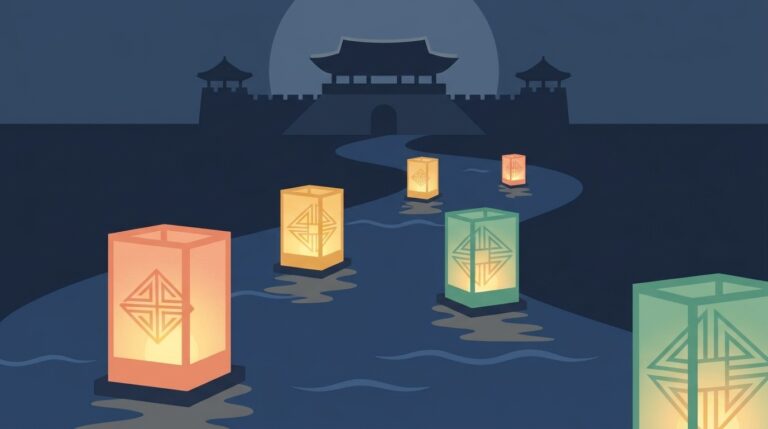
Imagine this: It’s a crisp October evening in Jinju. The majestic Namgang River is shimmering, not from the moonlight, but from thousands of glowing, hand-crafted lanterns floating on its waters. You are surrounded by laughter, the sweet aroma of beondegi (번데기 – silkworm pupae) and grilled skewers, and the soft, warm light reflecting off the faces of locals.
Suddenly, your Korean friend turns to you and says, “우와, 대박이다!” (U-wa, dae-bak-i-da! – Wow, amazing!) You want to respond with something deeper than just a simple “예뻐요” (Ye-ppeo-yo – It’s pretty), but your tongue feels tied.
If you’ve ever felt the gap between textbook grammar and the emotional weight of a real-life Korean night scene, you are not alone. Today, we are diving deep into the magical vocabulary of the Jinju Namgang Yudeung Festival (진주 남강 유등 축제). By the end of this guide, you won’t just describe the view—you will connect with the locals on a heart-to-heart level.
Phase 2: 3 Key Expressions Deep Dive
Let’s unpack three powerful expressions that will make you sound incredibly natural and culturally perceptive while gazing at the lanterns.
1. 눈이 부시게 아름답다 (Nun-i bu-si-ge a-reum-dap-da)
- Pronunciation: [Nun-i bu-si-ge a-reum-dap-da] / Sound-alike guide: “Noon-ee boo-she-geh ah-reum-dap-dah”
- Meaning: Blindingly beautiful / Dazzlingly gorgeous
- K-Culture Moment: This expression is so poetic that it was used as the title of the famous, tear-jerking K-Drama The Light in Your Eyes (눈이 부시게). It describes beauty so intense that you literally have to squint your eyes.
- Editor’s Insight: Use this when the sheer volume of lanterns on the river overwhelms your senses. It carries an elegant, romantic weight that “예뻐요” (It’s pretty) simply cannot match.
- Situation Spectrum:
- Friends/Casual: ✅
- Co-workers/Semi-formal: ✅
- Bosses/Elders (Formal): ✅ (Just add “-요” at the end: 눈이 부시게 아름다워요)
- 🤔 Think About It: Why does Korean use physical sensations (like eyes being blinded) to describe emotional awe? How does your native language physicalize extreme beauty?
2. 물에 비친 불빛 (Mul-e bi-chin bul-bit)
- Pronunciation: [Mul-ae bi-chin bool-bit] / Sound-alike guide: “Mool-eh bee-chin bool-beet”
- Meaning: The lights reflected on the water
- K-Culture Moment: If you watch any historical K-Drama (사극 – Sa-geuk) where the main characters walk across a stone bridge at night, you will see mul-e bi-chin bul-bit setting the romantic mood in the background.
- Editor’s Insight: Notice the modifier form “비친” (reflected). This shows how Korean speakers focus heavily on the relationship between objects—here, how the light interacts with the water to create a secondary beauty.
- Situation Spectrum:
- Friends/Casual: ✅
- Co-workers/Semi-formal: ✅
- Bosses/Elders (Formal): ✅
- 🤔 Think About It: In Korean, “불빛” (bul-bit) combines “불” (fire/light) and “빛” (glow/beam). It represents warmth and hope. How does combining two simple words create a deeper poetic meaning in your mind?
3. 소원을 빌다 (So-won-eul bil-da)
- Pronunciation: [So-won-eul bil-da] / Sound-alike guide: “So-won-eul beel-dah”
- Meaning: To make a wish / To pray for a desire
- K-Culture Moment: During the Jinju Festival, thousands of people write their deepest desires on small paper strips and launch floating lanterns. This act of “소원을 빌다” is a core ritual.
- Editor’s Insight: The verb “빌다” can mean both “to beg” and “to pray.” When you make a wish on a lantern, you are humbly asking the universe (or the river) to carry your hope safely to fruition.
- Situation Spectrum:
- Friends/Casual: ✅
- Co-workers/Semi-formal: ✅
- Bosses/Elders (Formal): ✅ (Use “소원을 빌어요” or “소원을 빕니다”)
- 🤔 Think About It: Making wishes in Korea is often a communal activity rather than a solitary, secret one. Why do you think Koreans enjoy sharing this moment of hope with thousands of strangers?
Phase 3: Textbook Korean vs. Real Korean
When you study with academic textbooks, you learn grammatically perfect but socially stiff phrases. Let’s look at how native Koreans actually talk at a festival.
Situation 1: Expressing awe at the night view
- 📖 Textbook Korean: “야경이 아주 아름답습니다.” (Ya-gyeong-i a-ju a-reum-dap-seup-ni-da. – The night view is very beautiful.)
- 🗣️ Real Korean: “야경 진짜 미쳤다!” (Ya-gyeong jin-jja mi-chyeot-da! – This night view is literally crazy/insane!)
- 💡 Why the difference? Modern Koreans use “미쳤다” (to be crazy) to express ultimate admiration. It shows genuine excitement rather than a passive observation.
Situation 2: Suggesting to write a wish on a lantern
- 📖 Textbook Korean: “우리 소원을 적어서 강에 띄웁시다.” (U-ri so-won-eul jeok-eo-seo gang-e tti-up-si-da. – Let us write our wishes and float them on the river.)
- 🗣️ Real Korean: “우리도 소원 하나 적어서 날려 볼까?” (U-ri-do so-won ha-na jeok-eo-seo nal-lyeo bol-kka? – Shall we also write a wish and send it off?)
- 💡 Why the difference? The real version uses “날려 보다” (to try flying/sending off), which sounds much more active, casual, and inviting to a friend.
Phase 4: K-Culture Deep Dive & Non-verbal Manners
4-1. Nunchi (눈치) & Body Language at the Festival
When launching your wish lantern, it is common to hold the lantern with both hands as a sign of respect for your own hopes and the tradition itself. When making your wish, bowing your head slightly with closed eyes for about 3 seconds demonstrates a beautiful sincerity that locals will appreciate.
4-2. The Hidden History: From War to Peace
The Jinju Namgang Yudeung Festival isn’t just a pretty light show. Its roots trace back to the Imjin War (1592). When the Japanese forces besieged Jinju Fortress, the Korean military used floating lanterns on the river as military signals to communicate with family members outside the fortress and to prevent enemy crossings. Today, those signals of survival and longing have transformed into peaceful messages of hope.
Phase 5: Interactive Roleplay Scenario
Setting: You are walking along the crowded banks of the Namgang River. The cool wind blows, carrying the smell of delicious street food. Hundreds of red, blue, and yellow lanterns illuminate your face.
Characters:
* You (A curious traveler trying to practice Korean)
* Min-jun (민준) (Your friendly local guide who loves Jinju history)
- Min-jun: 🎭 (Pointing toward the river with a proud smile) 어때요? 실제로 보니까 진짜 다르죠?
(Eo-ttae-yo? Sil-je-ro bo-ni-ka jin-jja da-reu-jyo?)
“How is it? Seeing it in person is really different, right?” -
You: 🎭 (Eyes wide open with admiration) 와… 진짜 눈이 부시게 아름다워요. 대박이에요!
(Wa… jin-jja nun-i bu-si-ge a-reum-da-weo-yo. Dae-bak-i-e-yo!)
“Wow… it is seriously dazzlingly beautiful. It’s awesome!” -
Min-jun: 🎭 (Nodding happily) 그쵸? 저기 물에 비친 불빛들 좀 보세요. 예술이지 않아요?
(Geu-chyo? Jeo-gi mul-e bi-chin bul-bit-deul jom bo-se-yo. Ye-sul-i-ji an-a-yo?)
“Right? Look at those lights reflected on the water over there. Isn’t it like art?” -
You: 🎭 (Leaning closer to see) 네, 진짜 예술이네요. 물 위에 꽃이 핀 것 같아요.
(Ne, jin-jja ye-sul-i-ne-yo. Mul wi-e kkot-i pin geot gat-a-yo.)
“Yes, it really is art. It looks like flowers have bloomed on the water.” -
Min-jun: 🎭 (Tapping your shoulder gently) 우리 저기서 소원 적는 종이 사서, 유등 한번 띄워볼래요?
(U-ri jeo-gi-seo so-won jeok-neun jong-i sa-seo, yu-deung han-beon tti-weo-bol-lae-yo?)
“Shall we buy some wish paper over there and float a lantern?” -
You: 🎭 (Nervously clutching your wallet) 네, 좋아요! 근데… 소원 쓰는데 얼마예요?
(Ne, jo-a-yo! Geun-de… so-won sseu-neun-de eol-ma-yeo?)
“Yes, I’d love to! But… how much is it to write a wish?” -
Min-jun: 🎭 (Laughing warmly) 하하, 얼마 안 해요! 제가 살게요. 가요!
(Ha-ha, eol-ma an hae-yo! Je-ga sal-ge-yo. Ga-yo!)
“Haha, it doesn’t cost much! I’ll buy it. Let’s go!”
🔀 Decision Point!
Min-jun hands you the wish paper. What do you write on it to show your intermediate Korean skills?
- Option A: “돈 많이 벌게 해주세요.” (Please make me earn a lot of money.)
- Option B: “우리 가족 모두 건강하고 행복하게 해주세요.” (Please keep my whole family healthy and happy.)
- Option C: “한국어 공부 포기하지 않게 해주세요!” (Please help me not give up on my Korean studies!)
Best Choice Analysis:
- Option B is the most culturally warm and standard wish in Korea. Family (가족) wellbeing is the ultimate wish during these festivals.
- Option C will touch Min-jun’s heart! He will probably offer to buy you dinner to support your studies.
- Option A is realistic and funny, but might sound a bit too dry for a romantic lantern festival!
Phase 6: 10-Second Shadowing Drill
Practice saying these lines with the right emotional rhythm. The / indicates a slight pause to catch your breath.
- [😊 Full of Excitement & Awe]
물에 / 비친 불빛이 / 진짜 예술이에요!
(Mul-e / bi-chin bul-bit-i / jin-jja ye-sul-i-e-yo!)
“The lights / reflected on the water / are truly a work of art!” -
[🥺 Sincere & Hopeful]
올해는 / 꼭 / 제 소원이 / 이루어지면 좋겠어요.
(Ol-hae-neun / kkok / je so-won-i / i-ru-eo-ji-myeon jo-ket-seo-yo.)
“This year, / definitely, / my wish / I hope it comes true.”
Phase 7: K-Culture Mini Dictionary
| Word (Korean + Romanization) | English Meaning | Cultural Context |
|---|---|---|
| 야경 (Ya-gyeong) | Night View | Koreans are obsessed with ya-gyeong. Cities like Seoul and Busan have designated “Night View Spots” for couples. |
| 유등 (Yu-deung) | Floating Lantern | A historical term specifically referring to oil-based lanterns made to float on rivers during festivals. |
| 소원지 (So-won-ji) | Wish Paper | The small, colorful paper slips where you write your heart’s desires before attaching them to lanterns or walls. |
| 길거리 음식 (Gil-geor-i eum-sik) | Street Food | No Korean festival is complete without street food like eomuk (fishcakes) and hot tteokbokki to warm you up. |
Phase 8: Traveler’s Survival Kit
Survival Phrases TOP 3
- 여기 사진 잘 나오는 명당이 어디예요?
(Yeo-gi sa-jin jal na-o-neun myeong-dang-i eo-di-yeo-yo?)- Tip: “Where is the best spot here to take good photos?” (Myeong-dang means a lucky or perfect location!)
- 사람이 너무 많아서 잃어버릴 것 같아요.
(Sa-ram-i neo-mu man-a-seo il-eo-beo-ril geot gat-a-yo.)- Tip: “There are too many people, I feel like I might get lost.”
- 유등 띄우기 체험 어디서 신청해요?
(Yu-deung tti-u-gi chae-heom eo-di-seo sin-cheong-hae-yo?)- Tip: “Where do I sign up for the lantern floating experience?”
📌 Editor’s Travel Note
- Navigation: Google Maps does not work well in Korea. Download the Naver Map App Download Page to navigate the winding streets of Jinju.
- Weather Warning: October nights in Jinju get incredibly chilly due to the river wind. Bring a light padded jacket or a thick cardigan!
Phase 9: One Step Deeper
In many Western cultures, wishes are kept secret so they “don’t lose their magic.” In Korea, however, wishes are written in bold letters on giant walls or floated openly on rivers for all to see. This stems from a deep-rooted sense of Jeong (정) and community. By sharing our vulnerabilities and dreams on the water, we acknowledge that we are all floating together in the same river of life.
💬 Your Turn:
What would you write on your so-won-ji (wish paper) if you visited Jinju tonight? Share your wish in the comments below!
Phase 10: FAQ & Avoiding Mistakes
Q: Can I visit the Jinju Festival during the day?
A: Yes, but the real magic starts after 6:00 PM when the sun sets. The daytime exhibits are interesting, but the ya-gyeong (night view) is the actual main event. Plan to arrive around 4:30 PM to get a good spot.
Q: Is the festival expensive to enter?
A: Admission to the festival grounds is actually free! However, crossing the special floating bridges or purchasing a lantern floating experience costs a small fee (around 2,000 to 10,000 KRW).
Q: What is the biggest language mistake foreigners make here?
A: Saying “소원을 원해요” (I want a wish). In Korean, you do not want a wish; you pray/beg for a wish using the verb 빌다 (bil-da). Always say “소원을 빌어요.”
Phase 11: Action Missions
- 🥉 Bronze: Record yourself saying “물에 비친 불빛이 정말 아름다워요” on your phone and listen to your pitch.
- 🥈 Silver: Go to Instagram or Twitter, search the hashtag
#진주남강유등축제, and leave a friendly comment in Korean on a local’s photo using today’s phrases. - 🥇 Gold: The next time you see a beautiful night view (even in your hometown), take a photo, post it online, and caption it: “눈이 부시게 아름다운 밤 ✨”
Phase 12: Interactive Quiz Challenge
Test your knowledge before you pack your bags!
1. Which word means “dazzlingly” or “blindingly”?
- A) 아주 (A-ju)
- B) 눈이 부시게 (Nun-i bu-si-ge)
- C) 진짜 (Jin-jja)
2. Fill in the blank: “강에 유등을
______.”
* A) 빌어요 (bi-reo-yo)
* B) 띄워요 (tti-weo-yo)
* C) 비쳐요 (bi-chyeo-yo)
🔍 Click here to reveal the answers!
- Answer: B. “눈이 부시게” literally means your eyes are dazzled by the light.
- Answer: B. “띄워요” (from 띄우다) means to float something on water. You float (띄워요) the lantern, and you pray (빌어요) for the wish!







