

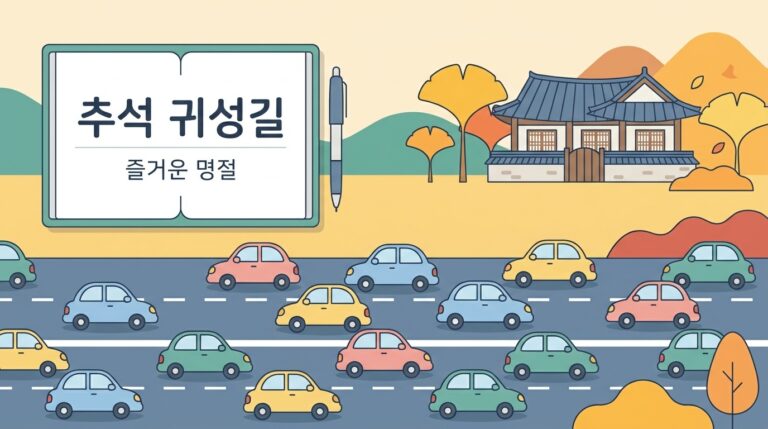
Surviving the Great Holiday Migration: How to Describe Korea\’s Legendary Traffic Jams Like a Native
안녕하세요! Welcome back to another cozy session with Daily Hangul. I\’m your chief editor and local cultural guide. If you\’ve ever spent autumn or early spring in Korea, you\’ve probably heard about the massive national migrations called Chuseok (추석 – Mid-autumn Festival) and Seollal (설날 – Lunar New Year).
Imagine this: you\’re cozying up on the couch watching a K-Drama. The main character is staring out of a car window, clutching a box of premium Spam or Hanwoo beef, looking absolutely exhausted. Outside, a sea of red taillights stretches endlessly into the horizon. This is the infamous Gwiseonggil (귀성길)—the road back to one\’s hometown.
For language learners, describing this epic cultural phenomenon goes beyond just saying “교통이 나빠요” (The traffic is bad). Today, we are upgrading your vocabulary to B2 (Intermediate) level so you can complain, gossip, and laugh about holiday traffic just like a real Korean. Ready? Let\’s dive in!
1. Three Core Expressions for the Epic Traffic Jam
To talk like an intermediate speaker, you need vivid metaphors. Here are three native-approved expressions to describe the holiday standstill.
① 귀성길 (Gwiseonggil)
- Pronunciation: Gwi-seong-gil / [Gwee-seong-geel]
(Sound Analogy: Think of ‘Gwee’ like “we” with a soft ‘G’, ‘seong’ rhyming with “song” but with a shorter ‘uh’ sound, and ‘gil’ sounding like “geese” but ending with a light ‘L’.) - Meaning: The journey/road back to one\’s hometown during traditional holidays.
- K-Culture Moment: This is the ultimate setting for K-Drama family conflicts. It\’s the long drive where families sit in a cramped space for 8 hours, sharing snacks and getting asked, “So, when are you getting married?”
- Editor\’s Insight: “Gwi” (귀) means to return, and “seong” (성) refers to one\’s holy ancestral home. It carries a heavy sense of nostalgia, duty, and—let\’s be honest—a little bit of travel dread.
- Situation Spectrum:
- Friends & Casual: ✅
- Coworkers & Semi-formal: ✅
- Boss & Formal: ✅
- 🤔 Think About It: In many Western cultures, holiday travel is spread out over weeks. In Korea, millions of people hit the road on the exact same morning. Why do you think physically visiting family remains so non-negotiable in Korean culture despite the painful traffic?
② 차가 꽉 막히다 (Chaga kkwak makhida)
- Pronunciation: Cha-ga kkwak mak-hi-da / [Cha-gah kkwahk mahk-hee-dah]
(Sound Analogy: Make the ‘kkwak’ sound tight and explosive, like the “qu” in “quick” but pronounced from the back of your throat with no extra breath.) - Meaning: To be completely, tightly bumper-to-bumper in traffic.
- K-Culture Moment: If you watch Korean YouTube travel vlogs during the holidays, you\’ll hear this phrase repeated like a mantra as creators show screens displaying “Seoul to Busan: 9 hours.”
- Editor\’s Insight: “Kkwak” (꽉) is an adverb meaning “tightly” or “completely.” Adding “kkwak” to “막히다” (to be blocked) instantly visualizes a highway packed like a can of tightly squeezed sardines.
- Situation Spectrum:
- Friends & Casual: ✅
- Coworkers & Semi-formal: ✅
- Boss & Formal: ⚠️ (Use “교통 체증이 매우 심합니다” instead for a highly polite, written tone.)
- 🤔 Think About It: How does adding sensory words like “꽉” (kkwak) make Korean feel more dynamic and expressive compared to simple descriptors?
③ 주차장을 방불케 하다 (Juchajangeul bangbulkke hada)
- Pronunciation: Ju-cha-jang-eul bang-bul-ke ha-da / [Joo-chah-jahng-eul bahng-bool-keh hah-dah]
- Meaning: To look virtually identical to a parking lot (describing a frozen highway).
- K-Culture Moment: You\’ll hear this dramatic phrase used by news anchors on SBS or MBC news broadcasts during holiday traffic updates.
- Editor\’s Insight: “방불케 하다” is an advanced grammatical structure meaning “to remind one of” or “to resemble closely.” Saying the highway “resembles a parking lot” is the ultimate witty hyperbole.
- Situation Spectrum:
- Friends & Casual: ✅ (Used playfully)
- Coworkers & Semi-formal: ✅
- Boss & Formal: ✅
- 🤔 Think About It: Does your native language use a parking lot metaphor to describe bad traffic? Why do you think this visual is so universally understood across different cultures?
2. Textbook Korean vs. Real Korean
Let\’s bridge the gap between classroom Korean and the actual words that fly out of a Korean driver\’s mouth when they\’re stuck on the expressway.
Scenario 1: Describing the frozen highway to a friend
- 📖 Textbook Korean: “고속도로에 교통 체증이 아주 심합니다.” (The traffic jam on the highway is very severe.)
- 🗣️ Real Korean: “고속도로가 아예 주차장이에요.” (The highway is literally a parking lot right now.)
- 💡 Why the difference?: Koreans value fast-paced, highly visual communication. Saying the road “is a parking lot” (주차장이에요) gets the point across with way more spice and empathy.
Scenario 2: Expressing deep physical exhaustion after driving
- 📖 Textbook Korean: “운전을 오래 해서 피곤합니다.” (I am tired because I drove for a long time.)
- 🗣️ Real Korean: “운전하다가 진짜 진이 다 빠졌어요.” (I seriously lost all my vital energy while driving.)
- 💡 Why the difference?: “진이 빠지다” (to have one\’s sap/vital energy drained) is a beautiful idiom that captures the soul-crushing fatigue of crawling at 10 km/h for hours. It sounds much more natural and mature than just “피곤해요” (I\’m tired).
3. K-Culture Deep Dive: Rest Area Manners & Survival
3-1. The Art of the “Nunchi” (눈치) in the Rest Area
When you are stuck in holiday traffic, the highway Hyugeso (휴게소 – Rest Area) is your oasis. But during Chuseok or Seollal, these rest areas are battlefields.
- The Non-verbal Strategy: If you are traveling with a partner, one person must immediately sprint to secure a table in the food court while the other queues for food. If you see a table with a bag or a pack of tissues on it, that space is claimed! Respect the “tissue-claim” rule—it\’s a silent pact of trust in Korean society.
3-2. The Highway Culinary Oasis
In the West, highway rest areas might offer sad burgers and stale coffee. In Korea, they are gourmet destinations!
* Sotteok Sotteok (소떡소떡): A glorious, alternating skewer of fried sausage and chewy rice cakes coated in sweet-spicy sauce. Made viral by comedian Lee Young-ja, it\’s a must-eat.
* Al-gamja (알감자): Round, buttery, salt-and-sugar-dusted roasted baby potatoes. Perfect for eating with toothpicks while crawling through traffic.
4. Real-life Roleplay Scenario: Stuck on the Gyeongbu Expressway
The Setting: You are in a Hyundai sedan with your Korean friend, Minho. You\’ve been on the Gyeongbu Expressway for 4 hours, trying to get to Busan for Chuseok. Outside, a light autumn drizzle is falling, and the GPS ETA keeps climbing.
- Cast:
- Minho (민호): The driver, highly stressed but trying to be a polite host.
- You (우진/Emma): The supportive passenger trying to keep the mood light.
1.  Minho: 🎭 (Sighing deeply while tapping the steering wheel)
           "아... 진짜 차가 꽉 막혔네. 벌써 네 시간째야."
           (Ah... the traffic is seriously packed. It\'s already been four hours.)

2.  You:   🎭 (Looking at the endless red lights ahead)
           "그러게요. 고속도로가 아주 주차장을 방불케 하네요."
           (I know. The highway literally resembles a parking lot.)

3.  Minho: 🎭 (Surprised and chuckling at your advanced Korean)
           "하하, 주차장 맞아요! 이 정도면 시동 끄고 걸어가는 게 빠르겠어요."
           (Haha, you\'re right! At this rate, turning off the engine and walking would be faster.)

4.  You:   🎭 (Adjusting the GPS navigation on your phone)
           "민호 씨, 많이 힘들죠? 혹시 운전하다가 진 빠진 거 아니에요?"
           (Minho, you must be so tired. Has your energy been completely drained from driving?)

5.  You:   🎭 (Anxiously checking the next rest area distance)
           "다음 휴게소까지 5킬로미터 남았는데, 잠깐 들를까요?"
           (There are 5 kilometers left until the next rest area. Shall we stop by for a bit?)

6.  Minho: 🎭 (Biting his lip, looking at the slow-moving lane)
           "들르면 좋은데, 휴게소 들어가는 입구도 엄청 밀릴 것 같아서 걱정이에요."
           (It\'s a good idea, but I\'m worried the entrance to the rest area will also be super backed up.)

7.  You:   🎭 (Patting Minho\'s shoulder gently to comfort him)
           "그래도 쉬어가야죠! 졸음운전 하면 안 되잖아요. 가서 소떡소떡 먹어요!"
           (Still, we need to take a break! You shouldn\'t drive while drowsy. Let\'s go get some Sotteok Sotteok!)

8.  Minho: 🎭 (Brightening up at the mention of snacks)
           "와, 소떡소떡은 못 참죠! 알겠어요. 다음 휴게소로 진입해 볼게요."
           (Wow, I can\'t resist Sotteok Sotteok! Alright. I\'ll try to steer into the next rest area.)

9.  You:   🎭 (Smiling warmly)
           "좋아요! 제가 시원한 아메리카노 쏠게요!"
           (Great! I\'ll treat you to a cool Americano!)

10. Minho: 🎭 (Relaxing his shoulders with a smile)
           "우진 씨 덕분에 귀성길이 정말 즐겁네요. 고마워요!"
           (Thanks to you, this homecoming journey is actually really fun. Thank you!)
🔀 Decision Point: Minho asks if you want to skip the rest area to save 20 minutes.
- Option A: “네, 그냥 빨리 가요. 참을 수 있어요.” (Yes, let\’s just go fast. I can hold it.)
- Risk analysis: While polite, this might lead to dangerous drowsiness (졸음운전) for Minho. Plus, you\’ll miss out on delicious food!
- Option B: “휴게소 들러서 쉬다 가요. 쉬어야 안전하죠!” (Let\’s stop by the rest area and rest. We must rest to be safe!)
- Best Choice! This shows high emotional intelligence (눈치). It prioritizes the driver\’s safety and opens up a fun shared snack experience.
- Option C: “도대체 언제 도착하는 거예요? 너무 지루해요.” (When on earth are we arriving? I\’m so bored.)
- Danger! This increases the driver\’s stress exponentially. Remember, Minho is doing all the physical labor here!
5. 10-Second Emotion Shadowing Drill
Let\’s practice speaking with real soul and emotion. Mimic the slash marks (/) for natural pauses!
- [😤 Annoyed & Tired]
“차가 / 너무 막혀서 / 아주 / 기가 막혀요!”
(Cha-ga / neo-mu mak-hyeo-seo / a-ju / gi-ga mak-hyeo-yo!)
-> The traffic is so blocked, it\’s absolutely mind-blowing! -
[🥺 Sweet & Persuasive]
“우리 / 휴게소 들러서 / 소떡소떡 / 먹고 가면 안 돼요?”
(U-ri / hyu-ge-so deul-leo-seo / so-tteok-so-tteok / meok-go ga-myeon an dwae-yo?)
-> Can\’t we please stop by the rest area and eat Sotteok Sotteok before we keep going?
6. K-Culture Mini Dictionary
| Word (Korean + Romanization) | English Translation | Real-world Contextual Usage |
|---|---|---|
| 역귀성 (Yeok-gwiseong) | Reverse Homecoming | Instead of children traveling to their hometowns, elderly parents travel up to Seoul to avoid the heavy southbound traffic. |
| 휴게소 맛집 (Hyugeso Matjib) | Rest Area Gourmet Spot | Rest areas that have become famous on social media for serving exceptionally delicious regional dishes. |
| 명절 증후군 (Myeongjeol Jeunghugun) | Holiday Syndrome | The physical and mental stress resulting from intense holiday labor, long drives, and cooking. |
| 눈치 싸움 (Nunchi Ssaum) | Wit Battle / Timing Game | The silent strategic game of deciding exactly what time to leave (e.g., 3:00 AM) to beat the holiday traffic. |
7. Traveler\’s Survival Kit
🚨 Top 3 Emergency Expressions
- “가장 가까운 휴게소가 얼마나 남았어요?”
(Ga-jang ga-kka-un hyu-ge-so-ga ol-ma-na nam-as-seo-yo?)
-> How much further is the nearest rest area? - “길이 너무 밀리네요.”
(Gi-ri neo-mu mil-li-ne-yo.)
-> The road is extremely backed up. - “버스 전용 차선으로 가고 싶어요.”
(Beo-seu jeon-yong cha-seon-eu-ro ga-go sip-eo-yo.)
-> I wish we could go via the bus-only lane. (On holidays, buses have a dedicated fast lane!)
📌 Editor\’s Travel Note
- App Recommendation: When navigating through Korean holiday traffic, Google Maps won\’t help you much due to local security regulations. Download the Naver Map App Download Page or T-map for live, incredibly accurate traffic forecasts.
- Ticket Alert: If you want to bypass the traffic entirely, you must participate in the “Ticketing War” (티케팅 전쟁) for KTX trains, which usually opens up a month in advance. Be ready to click exactly at 7:00 AM!
8. Deep Thoughts: “Jeong” (정) on the Asphalt
Why do millions of Koreans willingly endure what is essentially a 10-hour crawl on asphalt twice a year? In Western cultures, individualism might prioritize personal comfort. However, in Korea, the underlying force is Jeong (정)—a deep, collective emotional bond.
Getting together to perform ancestral rites (차례 – Charye), eating songpyeon, and physically showing up for your parents is the ultimate manifestation of filial piety and familial love. It is a beautiful, chaotic, and exhausting dance that defines the warmth of Korean society.
💬 Your Turn: How does your home country handle holiday travel? Do you have your own version of “Gwiseonggil”? Share your stories with me in the comments below!
9. FAQ & Avoiding Common Mistakes
Q: Can I use the word “교통 체증” (Gyotong chejeung) when talking to my friends?
A: Strictly speaking, Yes, but it sounds very formal—like you are reading a newspaper. In casual conversations, always go with “차가 밀리다” or “차가 막히다”.
Q: Is “막히다” (makhida) and “밀리다” (millida) the exact same thing?
A: Depends! “막히다” means “blocked” (static standstill), whereas “밀리다” means “pushed back/delayed” (moving, but incredibly slowly). Practically, they are used interchangeably to describe bad traffic.
Q: Can I travel comfortably as a foreign tourist during Chuseok or Seollal?
A: No! Unless you stay within Seoul (which actually becomes peaceful and empty!), long-distance travel without a pre-booked KTX train ticket is highly discouraged.
🚨 Common Mistakes Alert!
- Mistake 1: Pronouncing “막혀요” as [mak-hyeo-yo].
- Correction: Because of Korean sound-linkage rules, it is pronounced as [ma-kyeo-yo]. Keep it smooth!
- Mistake 2: Saying “차가 죽었어요” (The car is dead) to mean traffic is stopped.
- Correction: In Korean, “차가 죽다” means the car engine literally broke down. Use “차가 서 있어요” (The cars are standing still) instead.
10. Daily Hangul Action Missions
- 🥉 Bronze: Record a voice note saying: “차가 꽉 막혀서 아주 주차장이에요!” with your best dramatic sigh.
- 🥈 Silver: Post an image of a traffic jam in your city on social media and tag it with
#귀성길and#차가꽉막힘. - 🥇 Gold: Next time you take a taxi in Korea, ask the driver: “기사님, 이번 명절에 귀성길 많이 막히겠죠?” (Driver, the holiday road back home will be super packed, right?) and watch them share their legendary highway stories!
11. Interactive Quiz Challenge
Test your holiday traffic survival skills!
Q1. Which expression dramatically describes a highway that has completely stopped moving?
- 차가 아주 예쁩니다
- 주차장을 방불케 합니다
- 고속도로가 넓습니다
Reveal Answer & Explanation
Answer: 2
“주차장을 방불케 하다” literally means “to closely resemble a parking lot,” which is the perfect dramatic description for a frozen highway.
Q2. Complete the sentence: “운전을 너무 오래 해서 ________ 빠졌어요.”
- 밥이
- 주스가
- 진이
Reveal Answer & Explanation
Answer: 3
“진이 빠지다” is the idiomatic expression for having your energy completely drained. “진” refers to the vital sap or energy of a person.
Q3. True or False: “Yeok-gwiseong” (역귀성) means children traveling down to the countryside to meet their parents.
Reveal Answer & Explanation
Answer: False
“Yeok-gwiseong” (역 – reverse) means the parents traveling up to the big cities (like Seoul) to see their children to avoid the heavy southbound traffic.
Keep driving forward in your Korean learning journey! 다음 시간에 또 만나요! (See you next time!)







