

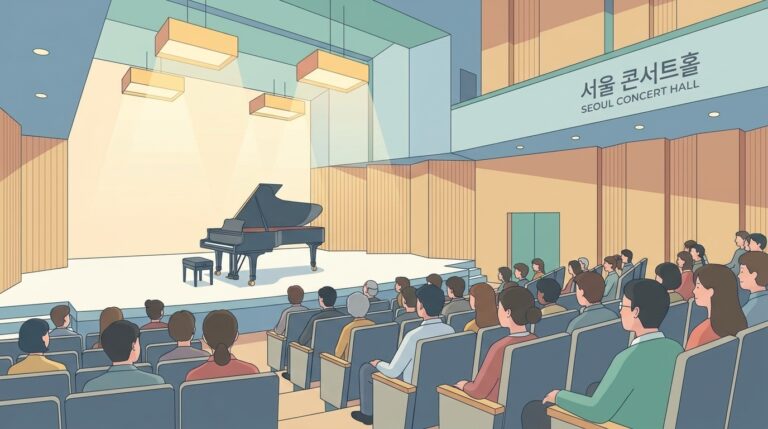
Master Korean Classical Concert Etiquette: Blend In Like a True Seoulite
Phase 1: Empathy (스토리 몰입형 오프닝)
안녕하세요! (Annyeonghaseyo!) Hello! It’s your favorite Korean culture navigator and senior editor at Daily Hangul.
Imagine this: You’re walking through the sleek, illuminated plaza of the Seoul Arts Center (예술의전당) on a crisp Friday evening. You just booked tickets to see a world-renowned pianist like Cho Seong-jin (조성진) or Lim Yunchan (임윤찬)—an experience you’ve dreamed of ever since watching the emotional K-Drama Do You Like Brahms? (브람스를 좋아하세요?).
You enter the concert hall, find your seat, and notice something striking: the atmosphere is electric yet incredibly disciplined. People are whispering in hushed tones, adjusting their coats with absolute silence. Suddenly, the music starts. During a dramatic pause between the first and second movements, you feel an overwhelming urge to clap. You raise your hands, but a silent, invisible force stops you. You look around, and everyone is frozen in deep concentration. One wrong move, and you might receive the dreaded collective “shh” or a barrage of side-eyes (눈총 – nunchong).
If you’ve ever felt intimidated by the unspoken rules of Korean performing arts spaces, you are not alone! Many of my intermediate students ask: “Why are Korean concert halls so quiet?” or “When is it actually okay to clap?”
In Korea, classical music isn’t just a niche hobby; it’s treated with a passionate, almost K-pop-like fandom energy, yet governed by ultra-refined manners. Learning these cultural nuances won’t just save you from an awkward social blunder; it will earn you the deep respect of your Korean friends and make you feel like a true local connoisseur. This guide is built from real-world questions and cultural insights to help you navigate your next night out in Seoul with absolute confidence.
Phase 2: 핵심 표현 3선 심층 분석 (3 Core Expressions Deep Dive)
Let’s look at three essential expressions that capture the spirit of Korean classical music culture.
1. 안다박수 (Anda-baksu)
- Pronunciation: An-da-bak-su / [Sound-alike: “Ahn-dah-bahk-soo”]
- Meaning: Lit. “I-know clap” / Real-world Nuance: Premature clapping started by an audience member who wants to show off that they “know” when the piece is ending, often ruining the delicate silence at the end of a performance.
- K-Culture Moment: In Korean classical music forums and classical fan communities, anda-baksu is the ultimate pet peeve. It’s that cringeworthy moment when the last note of a symphony is still echoing in the hall, and one eager person claps instantly, breaking the magic.
- Editor’s Insight: Silence in Korean performing arts is considered an extension of the music itself. True veterans wait until the conductor’s hands completely drop to their sides before initiating applause.
- Situation Spectrum:
- Casual (Friends): ✅ (You can use this jokingly: “아까 그 사람 안다박수 진짜 에바였어.” – That person’s premature clapping was totally too much.)
- Semi-formal (Coworkers): ⚠️ (Keep it light.)
- Formal (Elders/Teachers): 🚫 (Too colloquial for formal speech.)
- 🤔 Think About It: Why do you think Korean audiences value the silence after the music so intensely? How does this compare to the immediate, boisterous cheering often found in Western concert halls?
2. 기립 박수 (Girip-baksu)
- Pronunciation: Gi-rip-bak-su / [Sound-alike: “Gee-reep-bahk-soo”]
- Meaning: Lit. “Standing clap” / Real-world Nuance: A standing ovation.
- K-Culture Moment: If you watch videos of pianist Lim Yunchan’s performances in Seoul, the entire hall rises in unison to deliver a thunderous girip-baksu. It is the highest form of respect an audience can pay to an artist.
- Editor’s Insight: While Koreans are generally reserved, they are incredibly passionate when moved. If a performance touches your heart, don’t hesitate to stand up and join the girip-baksu!
- Situation Spectrum:
- Casual: ✅
- Semi-formal: ✅
- Formal: ✅
- 🤔 Think About It: In some cultures, standing ovations are given easily. In Korea, they are earned through pristine execution. Does your country have a high barrier for standing ovations?
3. 숨소리도 안 들린다 (Sumsorido an deullinda)
- Pronunciation: Sum-so-ri-do ahn deul-lin-da / [Sound-alike: “Soom-so-ree-doh ahn deul-leen-dah”]
- Meaning: Lit. “Not even the sound of breathing is heard” / Real-world Nuance: A state of absolute, pin-drop silence born out of deep respect and concentration.
- K-Culture Moment: You will hear classical commentators describe a legendary concert by saying: “공연장에 숨소리도 안 들렸어요” (You couldn’t even hear a breath in the concert hall).
- Editor’s Insight: This phrase highlights the collective concentration of Korean audiences. It’s not about restriction; it’s about sharing a deep, focused emotional state with the performer.
- Situation Spectrum:
- Casual: ✅
- Semi-formal: ✅
- Formal: ✅
- 🤔 Think About It: How does this level of collective silence reflect the Korean concept of Nunchi (social sensing and mindfulness of others)?
Phase 3: 교과서 한국어 vs 진짜 한국어 (Real Korean Showcase)
Let’s compare the stiff textbook phrases with the dynamic, real-world expressions used by actual Korean concertgoers.
Situation 1: Describing the silent atmosphere inside the concert hall
- 📖 Textbook Korean: “공연장이 아주 조용합니다.” (The concert hall is very quiet.)
- 🗣️ Real Korean: “공연장 분위기가 완전 숨죽이고 감상하는 분위기였어요.” (The concert hall atmosphere was completely ‘holding our breath and appreciating.’ – capturing the intense focus.)
- 💡 Why the difference?: “조용하다” is a generic term for silence. “숨죽이고 감상하다” (holding one’s breath to listen) conveys a respectful, active silence that honors the musicians.
Situation 2: Securing a ticket to a popular concert
- 📖 Textbook Korean: “티켓을 예매하기가 매우 어렵습니다.” (It is very difficult to book a ticket.)
- 🗣️ Real Korean: “이번 조성진 콘서트 완전히 피케팅이었어요!” (This Cho Seong-jin concert was absolute blood-ticketing!)
- 💡 Why the difference?: “피케팅” (Piketing) is a portmanteau of “피” (blood) and “티케팅” (ticketing). It describes the high-intensity war of trying to secure a seat for top classical stars, which sell out in seconds.
Phase 4: K-Culture 딥다이브 & 비언어적 매너 (Deep Dive & Body Language)
4-1. 눈치 (Nunchi) and Non-verbal Etiquette in the Concert Hall
To blend in perfectly, you need to practice Concert Hall Nunchi. Here are some physical manners unique to the Korean classical scene:
* The Coughing Protocol: Coughing or clearing your throat during quiet movements is highly discouraged. If you absolutely must cough, wait for the tutti (the loud part of the orchestra) or the pause between movements, and always muffle it with a tissue or your sleeve.
* The Program Book Lean: Avoid leaning forward in your seat. Leaning forward blocks the view of the person sitting behind you. Keep your back pressed firmly against the seatback throughout the performance.
* The Glowing Screen Offense: Keeping your phone on silent (vibrate) is not enough. The vibration hum is highly audible in a “숨소리도 안 들리는” hall. Turn your phone completely off or put it in Do Not Disturb/Silent mode (not vibrate).
4-2. Classical Music as the New K-Pop Fandom
Historically, classical music in the West has been associated with an older demographic. In Korea, however, classical concerts are flooded with young people in their 20s and 30s. Fans carry custom-made banners, buy concert program books like K-pop albums, and wait in long lines for the “퇴근길” (toigeungil – watching the artist leave the venue after the show). This bridge between classical high-art and fandom culture makes the Korean classical scene uniquely vibrant.
Phase 5: 실전 롤플레이 시나리오 (Interactive Roleplay Scenario)
The Setting: You are at the prestigious Lotte Concert Hall (롯데콘서트홀) in Seoul with Minjun (민준), your classical-music-loving Korean friend. The orchestra has just finished a breathtaking, quiet violin solo.
Cast:
- You (The Learner): Eager to show your appreciation but conscious of the rules.
- Minjun (NPC): A seasoned concertgoer who values concert hall etiquette.
1.  Minjun: (🎭 Whispering softly) 오늘 연주 진짜 대박이죠? 바이올린 소리가 예술이에요.
    (Oneul yeon-ju jin-jja dae-bak-i-jyo? Ba-i-ol-lin so-ri-ga ye-sul-i-e-yo.)
    (Wow, today's performance is amazing, right? The violin sound is pure art.)

2.  You: (🎭 Nodding in agreement, whispering) 네, 정말 소름 돋았어요. 숨소리도 안 들리네요.
    (Ne, jeong-mal so-reum dod-as-seo-yo. Sum-so-ri-do ahn deul-li-nae-yo.)
    (Yes, I literally got goosebumps. You can't even hear a breath in here.)

3.  Minjun: (🎭 Pointing slightly at the stage) 맞아요. 관객들 집중력이 엄청나요. 이제 1악장이 끝났네요.
    (Ma-ja-yo. Gwan-gaek-deul jip-jung-nyeok-i eom-cheong-na-yo. I-je il-ak-jang-i kkeut-nan-nae-yo.)
    (Indeed. The audience's focus is incredible. Now, the first movement is over.)

4.  You: (🎭 Sensing the silence, lifting hands slightly) 아, 그럼 지금 박수 쳐야 하나요?
    (Ah, geu-reom ji-geum bak-su cheo-ya ha-na-yo?)
    (Ah, so should we clap now?)

5.  Minjun: (🎭 Gently catching your wrist with a smile) 아! 잠깐만요! 지금 치면 안 돼요!
    (Ah! Jam-kkan-man-yo! Ji-geum chi-myeon ahn dwae-yo!)
    (Ah! Wait a second! You shouldn't clap now!)

6.  You: (🎭 Surprised, lowering hands) 왜요? 음악이 멈췄는데요?
    (Wae-yo? Eum-ak-i meom-chwot-neun-de-yo?)
    (Why? The music stopped?)

7.  Minjun: (🎭 Explaining warmly) 이건 교향곡이라 악장 사이에는 박수를 치지 않아요. 전체 곡이 완전히 끝날 때까지 기다려야 해요.
    (I-geon gyo-hyang-gok-i-ra ak-jang sa-i-e-neun bak-su-reul chi-ji ahn-ah-yo. Jeon-che gok-i wan-jeon-hi kkeut-nal ttae-kka-ji gi-da-ryeo-ya hae-yo.)
    (This is a symphony, so we don't clap between movements. We have to wait until the entire piece is completely finished.)

8.  You: (🎭 Realizing) 아하! 하마터면 '안다박수'를 칠 뻔했네요!
    (A-ha! Ha-ma-teo-myeon 'an-da-bak-su'-reul chil ppeon-haet-nae-yo!)
    (Aha! I almost did an 'anda-baksu' (premature clap)!)

9.  Minjun: (🎭 Chuckling quietly) 하하, 맞아요. 지휘자가 손을 내리고 완전히 돌아설 때 치면 완벽해요.
    (Ha-ha, ma-ja-yo. Ji-hwi-ja-ga son-eul nae-ri-go wan-jeon-hi dol-ah-seol ttae chi-myeon wan-byeok-hae-yo.)
    (Haha, exactly. It's perfect if you clap when the conductor lowers their hands and fully turns around.)

10. You: (🎭 Keeping eyes on the stage) 알겠어요. 지휘자 손만 쳐다보고 있을게요!
    (Al-get-seo-yo. Ji-hwi-ja son-man cheo-da-bo-go is-seol-ge-yo!)
    (Got it. I'll just keep my eyes glued to the conductor's hands!)
🔀 Decision Point!
The final movement finishes. The final chord rings out, and the conductor holds his hands up in the air for a dramatic three seconds of silence. What do you do?
- Choice A: Immediately stand up and yell “WOOOOO!” to show your enthusiasm.
- Choice B: Wait quietly in your seat, watching the conductor. Once his hands drop completely and he relaxes his shoulders, begin clapping enthusiastically.
- Choice C: Start clapping immediately to show everyone that you knew the song was over.
🏆 Best Choice: B
- Why: This shows perfect respect for the art and the silence. Waiting for the conductor’s signal ensures you don’t commit an anda-baksu. Once the clapping starts, you can comfortably join in with great energy!
🚫 Risk Choice: A or C
- Why: Choice A is too disruptive for a classical concert setting (save the cheering for K-pop!). Choice C is the classic definition of anda-baksu, which will make other concertgoers cringe.
Phase 6: 10초 감정 섀도잉 드릴 (Interactive Shadowing Drill)
Let’s practice speaking these emotional lines with natural Korean cadence and feeling.
- Sentence 1 (With pure awe and admiration):
- “와, 진짜 / 소름 돋았어요!”
- Wa, jin-jja / so-reum dod-as-seo-yo!
- [😊 Moved and amazed] / “Wow, I literally got goosebumps!”
- Sentence 2 (Firmly reminding a friend to wait):
- “지휘자 손이 / 내려갈 때까지 / 기다려야 해요.”
- Ji-hwi-ja son-i / nae-ryeo-gal ttae-kka-ji / gi-da-ryeo-ya hae-yo.
- [😤 Polite but firm] / “You have to wait until the conductor’s hands go down.”
Phase 7: K-Culture 미니 사전 (Mini Dictionary)
| Word (Korean + Romanization) | English Translation | Real-world Contextual Usage |
|---|---|---|
| 피케팅 (Piketing) | Blood-ticketing | Used to describe the absolute war of securing tickets for highly popular performances (classical or pop). |
| 연주 (Yeonju) | Musical Performance | Refers specifically to instrumental music playing (e.g., 피아노 연주 – piano performance). |
| 관객 (Gwangwaek) | Audience / Spectators | Refers to the collective group of people watching a show, movie, or concert. |
| 관람 매너 (Gwanram Maeneo) | Viewing Etiquette | The set of polite behaviors expected of spectators in theaters, galleries, and concert halls. |
Phase 8: 여행자를 위한 생존 키트 (Traveler’s Survival Kit)
If you are attending a performance in Korea soon, keep these three survival phrases handy!
Survival Cards
- “예매한 티켓 어디서 받아요?”
- Ye-mae-han ti-ket eo-di-seo ba-da-yo?
- Pro Tip: “Where do I pick up my booked tickets?” Walk up to the ticket box (티켓 박스) and show your reservation screen along with this phrase.
- “물품 보관소는 어디에 있나요?”
- Mul-pum bo-gwan-so-neun eo-di-e in-na-yo?
- Pro Tip: “Where is the cloakroom/baggage storage?” Heavy winter puffer jackets (패딩) make loud rustling noises during performances. Deposit them here!
- “프로그램북은 어디서 구매해요?”
- Peu-ro-geu-raem-buk-eun eo-di-seo gu-mae-hae-yo?
- Pro Tip: “Where can I buy the program book?” Most major concerts sell detailed program booklets at a separate desk in the lobby.
📌 Editor’s Travel Note
Before heading out, make sure to download the Naver Map App to find the best routes to iconic venues like the Seoul Arts Center or Lotte Concert Hall. Please note that ticketing for major classical events is typically handled through Interpark Ticket or the venue’s official site. Note: Ticketing schedules and seating charts may change depending on the concert organizer.
Phase 9: 깊이 있는 생각 질문 — “한 발 더 깊이” (Deep Reflection)
In many Western countries, classical music audiences are historically associated with high society and structured formality. In South Korea, however, classical music has experienced a democratic rebirth. It is treated as an emotional sanctuary for stressed students and young professionals. The absolute silence they maintain is not just about following rules; it is a collective agreement to protect this sanctuary of sound. By remaining perfectly quiet, Korean audiences show a deep sense of shared community—what Koreans call 정 (Jeong)—by prioritizing the collective experience over individual expression.
💬 Your Turn: How is classical music perceived in your home country? Is the audience demographic mostly young or old? Do people clap between movements? Let us know in the comments below!
Phase 10: FAQ & 오해 방지 (FAQ Schema Optimized)
Q: Can I take photos or videos during a classical concert in Korea?
A: No. Photography and videography are strictly prohibited during the performance. However, rules for the “curtain call” (커튼콜) vary. Some concerts allow you to take photos when the artists return to bow, while others forbid it entirely. Watch the crowd: if others pull out their phones during curtain call, you are safe to do so. If not, keep your phone away.
Q: What is the dress code for classical concerts in Seoul?
A: Smart Casual. You do not need a tuxedo or an evening gown. However, avoid overly casual wear like slippers, flip-flops, or gym shorts. A neat sweater, a blouse, or trousers are perfect. Crucial tip: Avoid wearing noisy fabrics like loud nylon windbreakers or heavy puffers into the hall.
Q: What should I do if I get a sudden coughing fit during the music?
A: If you feel a mild cough coming on, try to suppress it until a loud orchestral passage or a movement break. If you have an uncontrollable coughing fit, it is polite to quietly exit the hall to the lobby. The ushers will assist you in re-entering during an appropriate break.
🚨 Common Mistakes Alert!
- Mistake 1: Setting your phone to vibrate. The high-frequency vibration against concert hall seats is incredibly loud in a silent hall. Turn it off completely.
- Mistake 2: Rustling candy wrappers. Trying to unwrap a throat lozenge “slowly” actually makes a long, painful squeaking noise. Do it before the music starts!
- Mistake 3: Clapping when the conductor raises their baton. Sometimes conductors pause between movements with their batons raised to maintain suspense. Do not clap yet!
Phase 11: 액션 미션 및 참여 유도 (Action Missions)
- 🥉 Bronze (At-Home Challenge): Watch a video of a classical concert. Practice holding your applause for exactly 3 seconds after the final note ends.
- 🥈 Silver (Social Challenge): Share your favorite classical piece or artist on social media using the terms #연주 (performance) and #관람매너 (concert etiquette).
- 🥇 Gold (Real-world Challenge): Next time you attend any performance (theater, musical, or concert), practice “Concert Hall Nunchi” by actively matching your physical movements to the quietest parts of the show.
🎮 K-Culture Bonus Mission: Go to YouTube and search for “Lim Yunchan Rachmaninoff Piano Concerto No. 3”. Read the Korean comments under the video and try to find the word 소름 (goosebumps) or 눈물 (tears)!
Phase 12: 인터랙티브 퀴즈 챌린지 (Interactive Quiz)
Test your knowledge of Korean concert etiquette!
1. What does the term “안다박수” (Anda-baksu) refer to?
- A) Applause given with standing ovation.
- B) Premature clapping started by someone who wants to show they know the song.
- C) Polite rhythmic clapping during encores.
2. Fill in the blank: If you want to say the concert hall was so quiet you couldn’t even hear breathing, you say: “공연장에 _________ 안 들렸어요.”
- A) 소리도 (sorido)
- B) 숨소리도 (sumsorido)
- C) 음악도 (eumakdo)
3. True or False: It is completely fine to keep your phone on vibration mode during a Korean classical concert.
🔍 Check the Answers & Explanations
- Answer: B. Anda-baksu is the premature clapping that interrupts the artistic silence. Avoid it to be a polite concertgoer!
- Answer: B. 숨소리도 (sumsorido). The full phrase is “숨소리도 안 들린다” (Not even the sound of breathing is heard).
- Answer: False. Phone vibrations can be easily heard in a silent hall. Always switch your phone to complete silence or turn it off.
Happy concertgoing! May your next musical experience in Korea be filled with beautiful sounds, perfect silence, and respectful applause!







