

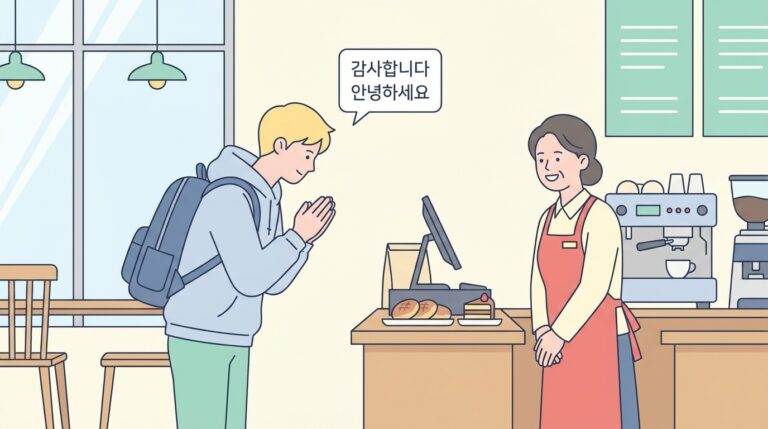
Master the First Impression: How to Greet Your Future Korean Boss (Sajangnim) with Confidence
안녕하세요! (Annyeonghaseyo!) I’m your lead editor and your trusty Korean friend from Daily Hangul.
Imagine this: You are walking down a charming street in Hongdae. You see a beautiful, cozy cafe with a sign on the window: “알바 구함” (Part-time Job Wanted). Your heart starts racing. This is your chance to work in Korea, practice your Korean daily, and make awesome local friends!
You open the door. The tiny bell chimes. Behind the counter stands a warm but busy-looking person—the 사장님 (Sajangnim – Boss/Owner).
Suddenly, your mind goes blank. “How do I say hello without sounding like a textbook robot? How do I show them I’m polite, energetic, and ready to work?”
Don’t panic! Today, we are going to learn exactly how to greet a Korean boss like a seasoned local. By the end of this guide, you will walk into any shop, bow like a pro, and leave a lasting, positive impression that makes them want to hire you on the spot!
Phase 2: Three Core Greetings for Your Future Boss
Let’s dive into the three most powerful phrases you need when applying for a part-time job (아르바이트 / Alba).
1. 안녕하세요! 아르바이트 구인 광고 보고 왔습니다.
- Pronunciation: An-nyeong-ha-se-yo! Ah-reu-ba-i-teu gu-in gwang-go bo-go wass-eum-ni-da.
- Sound-alike Guide: “Ahn-nyung-hah-seh-yo! Ah-roo-bah-ee-too goo-een gwang-goh boh-goh wah-soom-nee-dah.”
- Meaning: “Hello! I came here after seeing your job advertisement.”
- K-Culture Moment: You have probably seen this in dramas like Backstreet Rookie or Record of Youth, where the ambitious main character walks into a convenience store or a library looking for work with a bright smile.
- Editor’s Insight: Even though young locals shorten “part-time job” to 알바 (Alba), using the full formal word 아르바이트 (Areubaiteu) in your first greeting shows deep respect and professionalism.
- Situation Spectrum:
- Casual (Friends): 🚫
- Semi-formal (Coworkers): ⚠️
- Formal (Boss/Sajangnim): ✅
- 🤔 Think About It: Did you know “아르바이트” comes from the German word “Arbeit” (work)? It entered the Korean language decades ago through academic circles and became the standard word for part-time work. How does your native language adopt foreign words for everyday life?
2. 처음 뵙겠습니다. 잘 부탁드립니다!
- Pronunciation: Cheo-eum boep-gess-eum-ni-da. Jal bu-tak-deu-rim-ni-da!
- Sound-alike Guide: “Chuh-um bohp-get-soom-nee-dah. Jal boo-tahk-doo-reem-nee-dah!”
- Meaning: “Nice to meet you (for the first time). Please look after me kindly!”
- K-Culture Moment: This is the ultimate “golden key” phrase of Korean society. When K-Pop idols debut or join a new variety show, they always bow 90 degrees and shout this phrase with high energy.
- Editor’s Insight: There is no direct translation for “잘 부탁드립니다” in English. It roughly means “I trust myself in your hands, so please treat me well.” It immediately highlights your humility and cooperative spirit.
- Situation Spectrum:
- Casual (Friends): 🚫
- Semi-formal (Coworkers): ⚠️
- Formal (Boss/Sajangnim): ✅
- 🤔 Think About It: Korean culture values “communal harmony.” Saying “잘 부탁드립니다” acknowledges that you are entering their community and want to build a harmonious relationship. Does your culture have a special phrase to show humility when joining a new group?
3. 열심히 하겠습니다!
- Pronunciation: Yeol-sim-hi ha-gess-eum-ni-da!
- Sound-alike Guide: “Yuhl-seem-hee hah-get-soom-nee-dah!”
- Meaning: “I will work hard! / I will do my absolute best!”
- K-Culture Moment: This is the classic, enthusiastic line said with a determined fist-clench in office dramas like Misaeng or Business Proposal.
- Editor’s Insight: For A2 learners, perfect Korean grammar is not expected. What bosses care about most is your 태도 (Taedo – Attitude). Saying this with a loud, confident voice can easily win over any Sajangnim!
- Situation Spectrum:
- Casual (Friends): ⚠️ (Sounds too dramatic among close friends, but can be used as a joke!)
- Semi-formal (Coworkers): ✅
- Formal (Boss/Sajangnim): ✅
- 🤔 Think About It: Why do you think showing passion and a willingness to learn is sometimes valued more than prior experience in Korean entry-level jobs?
Phase 3: Textbook Korean vs. Real-World Korean
When you study with a textbook, you often learn sentences that are grammatically perfect but sound incredibly stiff—almost robotic. Let’s look at how to soften your speech to sound natural yet highly polite!
Scenario 1: Asking if the owner is at the shop
- 📖 Textbook Korean: “사장님이 계십니까?” (Sajang-nim-i gye-sim-ni-ka? – “Is the owner present?” / Sounds like a police officer asking a question.)
- 🗣️ Real-World Korean: “저… 혹시 사장님 계신가요?” (Jeo… hok-si Sajang-nim gye-sin-ga-yo? – “Excuse me… is the owner in by any chance?” / Much softer, friendly, and natural.)
- 💡 Why the difference? Starting with “저…” (Uh/Excuse me) and using the ending “-ㄴ가요?” softens the sentence, making you sound polite and approachable rather than demanding.
Scenario 2: Expressing your reason for visiting
- 📖 Textbook Korean: “저는 일을 하고 싶습니다.” (Jeo-neun il-eul ha-go sip-seum-ni-da. – “I want to do work.” / Sounds very stiff and overly dramatic.)
- 🗣️ Real-World Korean: “알바 문의하러 왔는데요!” (Al-ba mun-ui-ha-reo wass-neun-de-yo! – “I came to ask about the part-time job!” / Direct, clear, and perfectly natural.)
- 💡 Why the difference? “알바 문의” (Alba inquiries) is the common, professional phrase used in modern commercial areas in Korea.
Phase 4: K-Culture Deep Dive & Non-verbal Manners
In Korea, communication is only 50% words. The other 50% lies in 눈치 (Nunchi – the art of reading the room) and body language!
4-1. The Art of the “Alba Greeting” Bow
When you meet a Sajangnim, follow this physical checklist:
1. Do not shake hands first: In Korea, the older or higher-status person must initiate a handshake. Shaking hands first can seem too forward.
2. The 30-Degree Angle: Stand straight with your hands placed neatly in front of your stomach (this hand position is called 공수 – Gongsu). Bow from your waist at about a 30 to 45-degree angle.
3. Eye Contact Timing: Keep your eyes downcast during the bow. Do not try to maintain eye contact while bowing. Look up and smile warmly after you stand back up!
4-2. The K-Drama Cliché vs. Reality
In dramas, protagonists sometimes land part-time jobs by dramatically arguing with the boss or performing a funny dance. In reality, Sajangnims love three simple traits: punctuality (시간 엄수), a bright smile (밝은 미소), and hygiene (위생). If you show up looking neat and energetic, you are already halfway to being hired!
Phase 5: Interactive Roleplay Scenario
Put yourself in the shoes of an applicant! Let’s practice a real conversation inside a beautiful flower shop in Mapo-gu, Seoul. Meet Sajangnim, a kind-looking woman in her late 40s wearing a linen apron.
[Setting: You hear the gentle hum of indie music playing. The shop smells like fresh roses. Sajangnim is trimming stems at the counter.]

You: (🎭 Bowing politely) 안녕하세요!
      (An-nyeong-ha-se-yo!)
      "Hello!"

Sajangnim: (🎭 Looking up with a warm smile) 어서 오세요! 꽃 사러 오셨어요?
           (Eo-seo o-se-yo! Kkot sa-reo o-syeoss-eo-yo?)
           "Welcome! Are you here to buy flowers?"

You: (🎭 Shaking head gently with a smile) 아뇨, 아르바이트 구인 광고 보고 왔습니다!
      (A-nyo, ah-reu-ba-i-teu gu-in gwang-go bo-go wass-eum-ni-da!)
      "No, I actually came after seeing your part-time job ad!"

Sajangnim: (🎭 Surprised but interested) 아, 알바요! 잠깐 여기 앉으세요. 한국어 잘해요?
           (Ah, al-ba-yo! Jam-kan yeo-gi an-jeu-se-yo. Han-guk-eo jal-hae-yo?)
           "Oh, the part-time job! Please take a seat here for a moment. Do you speak Korean well?"
🔀 Decision Point: What is your response?
- Choice A: “아니요, 저 한국어 못해요.” (A-ni-yo, jeo han-guk-eo mot-hae-yo. – “No, I can’t speak Korean.” / 🚫 Too negative! It kills the conversation.)
- Choice B: “네! 완벽하게 잘합니다!” (Ne! Wan-byeok-ha-ge jal-ham-ni-da! – “Yes! I speak it perfectly!” / ⚠️ Overconfident, especially if you might make mistakes later.)
- Choice C: “아직 조금 서툴지만, 열심히 배우고 있습니다!” (Ah-jik jo-geum seo-tul-ji-man, yeol-sim-hi bae-u-go iss-eum-ni-da! – “I’m still a bit clumsy, but I am learning hard!” / Best Choice!)
Editor’s Choice Analysis: Choice C is absolutely perfect. It shows humility, honesty, and a fantastic work ethic. This answer instantly wins trust in Korean work culture!
Phase 6: 10-Second Emotional Shadowing Drill
Let’s practice saying these lines with the correct rhythm and emotional tone! Use the slash (/) marks to pause slightly, and speak with feeling.
- [😤 Confident & Energetic]
- 안녕하세요! / 아르바이트 / 광고 보고 왔습니다!
- An-nyeong-ha-se-yo! / Ah-reu-ba-i-teu / gwang-go bo-go wass-eum-ni-da!
- [😊 Warm & Polite]
- 처음 뵙겠습니다! / 잘 부탁드립니다!
- Cheo-eum boep-gess-eum-ni-da! / Jal bu-tak-deu-rim-ni-da!
- [🔥 Passionate & Earnest]
- 아주 서툴지만, / 열심히 하겠습니다!
- Ah-ju seo-tul-ji-man, / yeol-sim-hi ha-gess-eum-ni-da!
Phase 7: K-Culture Mini Dictionary
| Word (Korean) | Romanization | English Meaning | Cultural Insight |
|---|---|---|---|
| 사장님 | Sajangnim | Boss / Owner | Used to address any shop owner or restaurant manager with respect. |
| 알바 | Alba | Part-time job | Short for 아르바이트. It is the lifestyle cornerstone for Korean university students. |
| 이력서 | Iryeokseo | Resume / CV | Usually a simple, one-page document you can buy at any convenience store. |
| 시급 | Sigeup | Hourly wage | Korea has a strictly regulated minimum wage updated every year. |
Phase 8: Traveler’s Survival Kit
Even if you are just traveling in Korea, these emergency phrases will save you if you want to ask about casual helper work or volunteer work at a guesthouse!
- 여기 이력서 가져왔습니다.
- Yeo-gi i-ryeok-seo ga-jyeo-wass-eum-ni-da.
- “I brought my resume here.”
- 언제부터 일할 수 있습니까?
- Eon-je-bu-teo il-hal su iss-eum-ni-ka?
- “When am I able to start working?”
- 연락처 남겨도 될까요?
- Yeol-lak-cheo nam-gyeo-do doel-kka-yo?
- “May I leave my contact number?”
📌 Editor’s Travel Note: To search for part-time jobs like a true local, download the official Alba Heaven (알바천국) App or Albamon (알바몬) App. To find the exact locations of your interview cafes, use the KakaoMap App instead of Google Maps, which is much more accurate inside Korea.
Phase 9: Deep Thoughts — “Looking Beyond the Word ‘Sajangnim'”
In English-speaking countries, you might call a store manager “sir,” “ma’am,” or simply by their first name once you get comfortable. In Korea, however, you will almost never call your boss by their first name. Even if you become very close, they will always remain your 사장님 (Sajangnim).
This reflects Korea’s deep-rooted respect for social roles and hierarchical age structures. Calling someone by their title is not a sign of cold distance; rather, it is a warm boundary that protects mutual respect.
💬 Your Turn: How do you address small business owners or your managers in your home country? Is it common to use first names, or do you have a formal title like “Sajangnim”? Let us know in the comments below!
Phase 10: FAQ & Common Mistakes
Q: Can I use “안녕” (Annyeong) if the Sajangnim looks very young?
A: Definitely NO. Even if the boss looks younger than you, always use 존댓말 (Jondetmal – polite/formal Korean). Age does not override professional hierarchy in Korea. Always start with “안녕하세요!”
Q: What should I wear when going to ask about a part-time job?
A: Clean casual is best. You don’t need a full business suit, but avoid slippers, sweatpants, or hats. Dressing neatly shows you respect the business.
Q: Is it okay to bow while shaking hands?
A: No, avoid doing both at the same time. Bowing while shaking hands can look physically awkward and clumsy. Bow first to show respect, then accept a handshake if they offer it!
🚨 Common Mistakes Alert:
- Using Banmal (Casual Language): Saying “고마워” (Gomawo – thanks) instead of “감사합니다” (Gamsahamnida) to your boss. Keep it formal!
- Mumbling: Bosses love bright and clear communication. Speak up!
- Looking at the Floor: Keep an open, friendly posture. Even if you are nervous, look at their shoulder level or make gentle eye contact.
Phase 11: Action Mission
- 🥉 Bronze Mission (Mirror Challenge): Stand in front of a mirror. Practice a neat 30-degree bow while saying: “안녕하세요! 처음 뵙겠습니다.” with a bright smile.
- 🥈 Silver Mission (Writing Challenge): Imagine you are applying for a cafe job. Write a short, mock text message to a Sajangnim introducing yourself in the comments below!
- 🥇 Gold Mission (Real-world Challenge): Next time you visit a local Korean restaurant or grocery store, bow politely and say “감사합니다! 잘 먹었습니다!” (Thank you! I ate well!) to the owner at the cash register.
Phase 12: Interactive Quiz Challenge
Test your knowledge to see if you are ready to get hired!
Q1. Which of the following is the most natural way to tell a boss that you want to apply for a job?
- A) 나 일하고 싶어! (Na il-ha-go sip-eo!)
- B) 알바 문의하러 왔는데요!
- C) 사장님, 돈 벌러 왔어요. (Sajangnim, don beol-reo wass-eo-yo.)
Answer: B
Explanation: “알바 문의하러 왔는데요!” is natural and highly polite for an applicant. Choice A is too casual (banmal), and Choice C is too blunt (“I came to make money”).
Q2. True or False: You should bow at a 90-degree angle while vigorously shaking the Sajangnim’s hand first.
Answer: False
Explanation: You should bow first neatly, and wait for the boss to offer a handshake. Shaking hands while bowing looks awkward and is not standard Korean etiquette.
Q3. Fill in the blank: “처음 뵙겠습니다. 잘 ________!” (Nice to meet you. Please look after me!)
- A) 부탁드립니다 (butakdeurimnida)
- B) 고마워 (gomawo)
- C) 안녕 (annyeong)
Answer: A
Explanation: “잘 부탁드립니다” is the complete polite set phrase for first-time introductions.







