

Warm Up Your Korean Winter: How to Order Roasted Chestnuts Like a Local
Phase 1: Empathy (Cozy Winter Opening)
안녕하세요! (An-nyeong-ha-se-yo!) Hello! I am your lead editor at Daily Hangul, your native Korean friend who is always ready to share the warm, cozy secrets of Seoul.
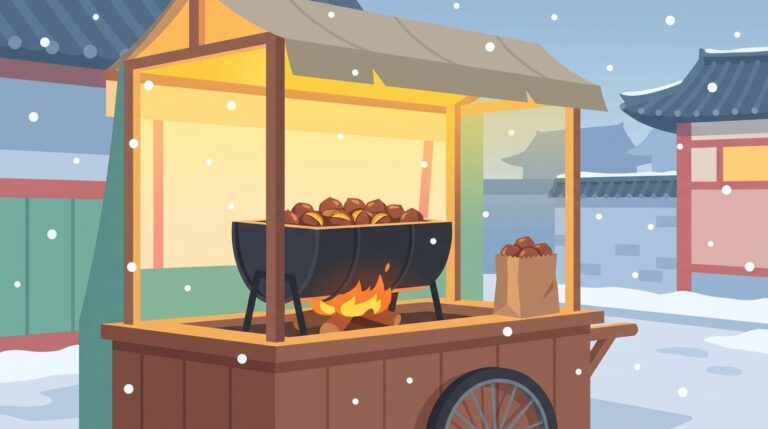
Imagine this: It is a freezing December evening in Seoul. Beautiful snowflakes are starting to drift down under the warm orange glow of a street lamp. Suddenly, a sweet, earthy, smoky aroma fills the air. You follow your nose and find a kindly vendor standing next to a big, spinning black metal drum. Inside, plump chestnuts are roasting over hot coals, popping with a cheerful sizzle.
This is the classic Korean winter scene you have seen in countless K-Dramas like Goblin or Crash Landing on You. You want to buy a warm paper bag of these roasted chestnuts (군밤 – gun-bam) to warm your frozen hands, but suddenly your mind goes blank. “How do I order? Do I sound too formal? Will they understand me?”
One of my Chicago-born students, Sarah, faced this exact situation last winter in Insadong. She stood near the cart for ten minutes, too shy to speak, before walking away empty-handed. We practiced the simple phrases below, and the next day, she successfully bought a piping hot bag, even getting a few extra chestnuts from the vendor who was charmed by her natural Korean! This guide is built from real-world student experiences to make sure you never miss out on this cozy winter magic.
Phase 2: Three Key Expressions Deep Dive
1. 군밤 한 봉지 주세요 (Gun-bam han bong-ji ju-se-yo)
- Pronunciation: [goon-bam han bong-jee joo-seh-yo] / Sound-alike: “goon-bahm” (rhymes with balm) + “han” + “bong-gee” (like key with a B) + “joo-say-yo”.
- Meaning: Literal: “Please give me one paper bag of roasted chestnuts.” / Real Nuance: “I’d like a bag of roasted chestnuts, please.”
- K-Culture Moment: This is the ultimate winter line. In dramas, you often see a cute couple sharing one bag of chestnuts, peeling them for each other inside a warm bus shelter.
- Editor’s Insight: “한 봉지” (han bong-ji) refers to the traditional brown paper bag used for street snacks. Using this term instead of just “이거” (i-geo – this) immediately makes you sound like a local who understands Korean street food culture!
- Situation Spectrum:
- Casual (Friends): ⚠️ (Slightly formal, but okay)
- Semi-formal (Vendor/Staff): ✅ (Perfect! Polite and friendly)
- Formal (Business): 🚫 (Too casual for a boardroom, but perfect for the street!)
- 🤔 Think About It: Why does Korean have different words for “bag” depending on the material? A plastic bag is “비닐봉지” (bi-nil-bong-ji), while a paper bag is often just “봉지” (bong-ji). Paying attention to these small details shows deep respect for the language!
2. 따뜻할 때 드세요 (Tta-tteut-hal ttae deu-se-yo)
- Pronunciation: [ttah-tteut-hal ttae deu-seh-yo] / Sound-alike: “tah-teut-hal” + “teh” + “deu-say-yo” (the “deu” sounds like the “du” in “gurney”).
- Meaning: Literal: “Eat it when it is warm.” / Real Nuance: “Enjoy them while they are nice and hot!”
- K-Culture Moment: The vendor will often hand you the bag and say this with a warm smile. It is a phrase packed with “정” (Jeong) – the unique Korean concept of warm-hearted affection and caring for others.
- Editor’s Insight: While the vendor says this to you, you can also say this to your friends when you hand them a hot snack. It shows you care about their eating experience!
- Situation Spectrum:
- Casual (Friends): ⚠️ (Better to use “따뜻할 때 먹어” [tta-tteut-hal ttae meog-eo])
- Semi-formal (Co-workers/Elderly): ✅ (Extremely polite and caring)
- Formal (Boss): ✅ (Shows wonderful manners)
- 🤔 Think About It: Korean culture places a huge emphasis on sharing food at its optimal temperature. Why do you think sharing warm food is such an important way of showing love in Korea?
3. 얼마예요? (Eol-ma-ye-yo?)
- Pronunciation: [uhl-mah-yeh-yo] / Sound-alike: “uhl-mah” + “yay-yo”.
- Meaning: Literal & Real: “How much is it?”
- K-Culture Moment: Essential for any street market adventure, from Myeongdong to local neighborhood corners.
- Editor’s Insight: Simple, short, and impossible to get wrong. Always end with “요” (yo) to keep it polite!
- Situation Spectrum:
- Casual (Friends): 🚫 (Use “얼마야?” [eol-ma-ya])
- Semi-formal (Vendors): ✅ (Perfect and standard)
- Formal (Business): ✅ (Standard and polite)
- 🤔 Think About It: Unlike English where we might ask “How much does this cost?”, Korean directly asks “How much is it?”. It is direct, fast, and highly efficient.
Phase 3: Textbook Korean vs. Real Korean
Let\’s look at how textbooks sometimes make us sound like robots, and what real Koreans actually say on the street!
Situation 1: Ordering your chestnuts
- 📖 Textbook Korean: 군밤을 판매하십니까? (Gun-bam-eul pan-mae-ha-ship-ni-ka?) – “Do you sell roasted chestnuts?”
- 🗣️ Real Korean: 군밤 한 봉지 주세요! (Gun-bam han bong-ji ju-se-yo!) – “One bag of roasted chestnuts, please!”
- 💡 Why the difference?: Street food carts obviously sell what is on display! Asking if they sell it sounds overly formal and robotic. Jump straight to asking for a bag with a big smile.
Situation 2: Reacting to the hot chestnut
- 📖 Textbook Korean: 이것은 매우 뜨거우니 조심하십시오. (I-geot-eun mae-u tteu-geo-u-ni jo-shim-ha-ship-si-o.) – “Please be careful as this is very hot.”
- 🗣️ Real Korean: 아, 뜨거! 조심해요! (Ah, tteu-geo! Jo-shim-hae-yo!) – “Oh, hot! Be careful!”
- 💡 Why the difference?: Real-life reactions are fast and filled with emotion. When a chestnut is burning your fingertips, a short “아, 뜨거!” (Ah, tteu-geo!) is natural and lively.
Phase 4: K-Culture Deep Dive & Non-Verbal Manners
4-1. Physical Manners (How to behave at the cart)
When you receive your warm bag of chestnuts, never grab it with just one hand. In Korea, receiving items—especially food or money—with two hands (두 손 – du son) is a crucial sign of respect.
- How to do it: Reach out with both hands, cup the warm paper bag, bow your head slightly, and say “감사합니다!” (Gam-sa-ham-ni-da! – Thank you!). The vendor will absolutely love your polite manners!
4-2. The Cozy Anatomy of Korean Winter Street Food
Unlike modern fast food, roasted chestnuts represent nostalgia. They are sold by weight or in standard portions (usually around 5,000 to 10,000 KRW). Inside your paper bag, you will find a small wooden toothpick (이쑤시개 – i-ssu-si-gae).
- Pro Tip: Use the toothpick to prick and lift the chestnuts out of their cracked shells so your hands do not get covered in black soot!
Phase 5: Interactive Roleplay Scenario
- The Setting: It is 8 PM on a Friday. The temperature is -3°C. You are walking near Hyehwa Station. You see a cozy wooden cart surrounded by steam. A friendly grandmother (Halmoni) is roasting fresh chestnuts.
- Your Role: A cold but hungry traveler looking for a warm snack.
- 할머니 (Halmoni): (🎭 Smiling warmly through the steam) 어서 오세요! 추우시죠?
(Eo-seo o-se-yo! Chu-u-si-jyo? / Welcome! It’s cold, right?) -
You: (🎭 Nodding and rubbing your hands together) 네, 진짜 추워요!
(Ne, jin-짜 chu-wo-yo! / Yes, it’s really cold!) -
할머니 (Halmoni): (🎭 Pointing at the rotating chestnut drum) 우리 군밤 진짜 맛있어. 따끈따끈해요.
(U-ri gun-bam jin-jja ma-si-sseo. Tta-keun-tta-keun-hae-yo. / Our roasted chestnuts are really delicious. They are piping hot.) -
You: (🎭 Pointing at the paper bags) 군밤 한 봉지 주세요.
(Gun-bam han bong-ji ju-se-yo. / Please give me one bag of roasted chestnuts.) -
할머니 (Halmoni): (🎭 Scooping chestnuts into a brown bag) 그래요, 가득 담아 줄게요.
(Geu-rae-yo, ga-deuk dam-a jul-ge-yo. / Sure, I will pack it full for you.) -
You: (🎭 Reaching into your pocket) 얼마예요?
(Eol-ma-ye-yo? / How much is it?) -
할머니 (Halmoni): (🎭 Handing over the bag) 오천 원이에요.
(O-cheon won-i-e-yo. / It is 5,000 won.) -
You: (🎭 Handing her the cash with both hands) 여기 있습니다.
(Yeo-gi is-seum-ni-da. / Here it is.) -
할머니 (Halmoni): (🎭 Dropping two extra chestnuts into your bag) 서비스야! 따뜻할 때 드세요!
(Seo-bi-seu-ya! Tat-teut-hal ttae deu-se-yo! / This is on the house (free service)! Eat them while they are warm!) -
You: (🎭 Bowing with a happy smile) 우와, 감사합니다! 잘 먹겠습니다!
(U-wa, gam-sa-ham-ni-da! Jal meok-ge-seum-ni-da! / Wow, thank you! I will eat well!)
🔀 Decision Point: The Grand Mother offers “Service” (Extra Free Chestnuts)!
How do you respond to show the best Korean manners?
- Option A: “돈 더 드려야 해요?” (Don deo deu-ryeo-ya hae-yo? – Do I need to pay more money?)
- Option B: “우와, 감사합니다! 잘 먹겠습니다!” (U-wa, gam-sa-ham-ni-da! Jal meok-ge-seum-ni-da! – Wow, thank you! I will eat well!)
- Option C: “이거 안 샀는데요?” (I-geo an san-neun-de-yo? – I didn’t buy this?)
🏆 Best Choice: Option B!
In Korea, “서비스” (seo-bi-seu / service) means “free gift from the host.” Accepting it with a joyful “감사합니다!” and saying “잘 먹겠습니다” (I will eat well) is the ultimate way to show appreciation for their kindness. Option A breaks the friendly mood, and Option C sounds like you are accusing them of making a mistake!
Phase 6: 10-Second Emotion Shadowing Drill
Practice speaking like a real Korean by injecting emotion. Use the / marks to pause slightly!
- [🥺 Cold and shivering]
- 아 / 진짜 / 추워요! (Ah / jin-jja / chu-wo-yo!)
- “Oh… it is / really / cold!”
- [😊 Excited and polite]
- 군밤 / 한 봉지 / 주세요! (Gun-bam / han bong-ji / ju-se-yo!)
- “Roasted chestnuts / one bag / please!”
- [💖 Grateful and happy]
- 우와 / 감사합니다 / 잘 먹겠습니다! (U-wa / gam-sa-ham-ni-da / jal meok-ge-seum-ni-da!)
- “Wow / thank you / I will enjoy this food!”
Phase 7: K-Culture Mini Dictionary
- 군밤 (Gun-bam): Roasted chestnuts. A traditional winter street snack roasted in large rotating drum containers.
- 정 (Jeong): A deep feeling of affection, attachment, and community kindness that connects Korean people together.
- 서비스 (Seo-bi-seu): Free food, drinks, or extra items given by a business owner as a gesture of goodwill.
- 호호 (Ho-ho): An onomatopoeia describing the sound/action of blowing hot air from your mouth to cool down hot food.
Phase 8: Traveler’s Survival Kit
Top 3 Street Food Survival Phrases
| Korean (한글) | Romanization | English Translation | Pro Tip |
|---|---|---|---|
| 카드 돼요? | Ka-deu dwae-yo? | Can I use a card? | Small carts often prefer cash, but many now accept cards or bank transfers! |
| 계좌이체 돼요? | Gye-jwa-i-che dwae-yo? | Can I do a bank transfer? | Perfect for travelers with a Korean bank account or local digital payment cards. |
| 덜 맵게 해주세요. | Deol maep-ge hae-ju-se-yo. | Please make it less spicy. | Great for other street foods like Tteokbokki if you have a low spice tolerance! |
📌 Editor’s Travel Note
When hunting for winter street snacks in Seoul, download the Naver Map App for Android or check out the Naver Map App for iOS to navigate neighborhood alleyways. Keep some 1,000 won and 5,000 won paper bills in your pocket—street vendors appreciate cash, and it makes your transactions super fast and smooth!
Phase 9: Deepening Thought — “한 발 더 깊이” (Step Closer)
In many Western cultures, transactions are purely business. You hand over money, and you receive exactly what you paid for. However, in Korea, winter street food is an exchange of warmth. When an elderly vendor drops two extra chestnuts into your bag, they are sharing “정” (Jeong). They see a cold traveler and want to give you a little extra warmth. This tiny gesture turns a cold street corner into a welcoming home.
💬 Your Turn: Does your country have a street snack that brings people together in the winter? How do you show appreciation to local street vendors in your hometown? Let us know in the comments below!
Phase 10: FAQ & Common Mistakes
Q: Can I find roasted chestnuts in Korea during the summer?
A: Generally no. Roasted chestnuts are strictly a seasonal winter food (usually available from late October to February). During summer, street carts switch to cold snacks or ice cream!
Q: Is it rude to eat chestnuts while walking on the street in Korea?
A: It is totally acceptable! Street foods are meant to be enjoyed on the go. However, be careful not to drop the shells on the street—keep them in your paper bag until you find a trash can.
Q: Do I need to tip the street vendors?
A: No. Korea has absolutely no tipping culture. Paying the exact amount shown or requested is the most polite thing to do.
🚨 Common Mistakes Alert!
- Mistake: Trying to peel the chestnut shell with your teeth.
- Correct Action: Use the wooden toothpick provided to gently pry the yellow nut out of its pre-cracked shell.
- Mistake: Handing money with one hand while looking at your phone.
- Correct Action: Put your phone down, make eye contact, and hand over the cash with both hands.
- Mistake: Saying “맛있어요” (It is delicious) before actually tasting it.
- Correct Action: Say “잘 먹겠습니다” (I will eat well) before you eat, and “정말 맛있어요!” (It is really delicious!) after your first bite!
Phase 11: Action Missions
- 🥉 Bronze (At-Home Challenge): Record yourself saying “군밤 한 봉지 주세요” (Gun-bam han bong-ji ju-se-yo) on your phone. Focus on making the “juseyo” sound soft and polite!
- 🥈 Silver (Social Challenge): Take a picture of your favorite cozy winter snack, post it on Instagram, and tag us at
@DailyHangulwith the hashtag#DailyHangulWinter! - 🥇 Gold (Real-World Challenge): Visit your local Asian supermarket or a Korean street food vendor, order your food entirely in Korean, and make sure to receive your bag using two hands!
🎮 K-Culture Treasure Hunt: Watch the next winter episode of any K-Drama. Spot the brown paper bag! Write down what street food the characters are eating in the drama.
Phase 12: Interactive Quiz Challenge
1. Situational Quiz
You want to order one bag of chestnuts and pay with cash. Which sentence is the most natural and polite?
* A) 군밤 줘. (Gun-bam jwo.)
* B) 군밤 한 봉지 주세요. (Gun-bam han bong-ji ju-se-yo.)
* C) 저기요, 이거 얼마예요? (Jeo-gi-yo, i-geo eol-ma-ye-yo?)
🔍 Click here to check the Answer!
Correct Answer: B
* Explanation: “군밤 한 봉지 주세요” is polite and specific. A is too casual (rude to a vendor), and C is just asking for the price of something else!
2. Fill in the Blank
Complete the dialogue:
* Vendor: “따뜻할 때
__________.” (Eat them while they are warm.)
* You: “감사합니다!”
🔍 Click here to check the Answer!
Correct Answer: 드세요 (deu-se-yo)
* Explanation: “드세요” is the polite honorific form of “먹다” (to eat), perfect for a vendor wishing a customer a warm meal.
3. True or False
- True or False: It is considered polite to accept your bag of chestnuts with only one hand if you are in a hurry.
🔍 Click here to check the Answer!
Correct Answer: False
* Explanation: No matter how busy you are, always use two hands (두 손) to show respect when receiving food or items in Korea!







