

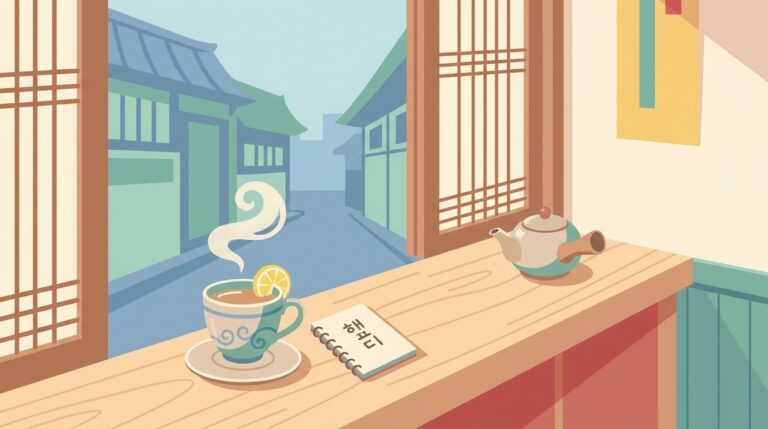
Surviving the Rush: How to Politely Say “Slow Down” in Korea
안녕하세요 (An-nyeong-ha-se-yo)! Welcome back to Daily Hangul. I’m your senior editor and veteran Korean tutor.
If you have ever stepped foot in Seoul, you know that the city moves at lightning speed. From the instant noodles cooking in three minutes to the subway doors closing in the blink of an eye, Korea is governed by a magical, high-energy cultural concept called 빨리빨리 (Pballi-Pballi) — “Hurry, Hurry!”
But what happens when you are a beginner Korean learner, standing at a busy café counter in Hongdae, and the barista fires a series of questions at you like a K-Pop rap star?
“Do you have a membership card? Hot or iced? Takeout or dine-in?”
Your mind goes completely blank. You want to ask them to slow down, but you don’t want to sound rude or ruin their flow. Today, we are going to learn how to gently tap the brakes on Korea’s fast pace. Let’s master the art of asking someone to “slow down” with warmth, politeness, and perfect Korean manners!
1. Three Core Expressions to Slow Things Down
Here are the absolute best, most natural ways to ask someone to slow down. Each expression serves a slightly different situation.
① 천천히 해 주세요 (Cheon-cheon-hi hae ju-se-yo)
- Pronunciation: Cheon-cheon-hi hae ju-se-yo (Sound-alike: “Chun-chun-hee hay joo-seh-yo”)
- Meaning: “Please do it slowly” or “Take your time, please.”
- K-Culture Moment: You are checking out at a busy convenience store, trying to open your mobile payment app, and the cashier is already reaching for the next customer’s items. You say this with a warm smile to ease the pressure.
- Editor’s Insight: The word 천천히 (cheon-cheon-hi) means “slowly.” Adding 해 주세요 (hae ju-se-yo) (“please do for me”) turns it into a very polite request. It doesn’t sound like a complaint; it sounds like a friendly ask.
- Situation Spectrum:
- Friends & Casual (반말): ⚠️ 천천히 해 (Cheon-cheon-hi hae) – Only use with close friends!
- Workplace / Daily Life (존댓말): ✅ 천천히 해 주세요 (Cheon-cheon-hi hae ju-se-yo) – Perfect!
- Formal / Elders: ✅ 천천히 해 주시기 바랍니다 (Cheon-cheon-hi hae ju-si-gi ba-ram-ni-da) – Highly formal.
- 🤔 Think About It: In many Western cultures, asking someone to slow down might feel like you are criticizing their speed. But in Korea, asking for “천천히” politely is viewed as a natural way to communicate your current learning level. Why do you think Korean society values this direct yet polite communication of personal limits?
② 조금만 천천히 말씀해 주세요 (Jo-geum-man cheon-cheon-hi mal-sseum-hae ju-se-yo)
- Pronunciation: Jo-geum-man cheon-cheon-hi mal-sseum-hae ju-se-yo (Sound-alike: “Joe-goom-mahn chun-chun-hee mahl-sseum-hay joo-seh-yo”)
- Meaning: “Please speak just a little bit slower.”
- K-Culture Moment: You are asking for directions to a famous K-Beauty shop in Myeongdong. A friendly passerby gives you super-fast directions. You want to understand them perfectly, so you gently request this.
- Editor’s Insight: 조금만 (jo-geum-man) means “just a little bit.” Adding this to the front of your sentence acts as a linguistic “softener.” It makes your request sound incredibly gentle and polite.
- Situation Spectrum:
- Friends & Casual (반말): ⚠️ 천천히 말해줘 (Cheon-cheon-hi mal-hae-jwo)
- Workplace / Daily Life (존댓말): ✅ 조금만 천천히 말씀해 주세요 (Jo-geum-man cheon-cheon-hi mal-sseum-hae ju-se-yo)
- Formal / Elders: ✅ 조금만 천천히 말씀해 주시겠어요? (Jo-geum-man cheon-cheon-hi mal-sseum-hae ju-si-ges-seo-yo?) – Extra polite!
③ 괜찮으니까 천천히 하세요 (Gwen-cha-neu-ni-kka cheon-cheon-hi ha-se-yo)
- Pronunciation: Gwen-cha-neu-ni-kka cheon-cheon-hi ha-se-yo (Sound-alike: “Gwen-chahn-oo-nee-kka chun-chun-hee hah-seh-yo”)
- Meaning: “It’s okay, so please take your time / do it slowly.”
- K-Culture Moment: You are at a local Korean market (시장). The elderly grandmother (할머니) running the food stall is flustered trying to pack your delicious spicy rice cakes (떡볶이) while managing other customers. You say this to comfort her.
- Editor’s Insight: This is a beautiful phrase of empathy. Instead of asking someone to slow down for your benefit, you are telling them not to worry or rush. It is a wonderful way to show your warm Korean heart (정 – Jeong).
- Situation Spectrum:
- Friends & Casual (반말): ⚠️ 괜찮으니까 천천히 해 (Gwen-cha-neu-ni-kka cheon-cheon-hi hae)
- Workplace / Daily Life (존댓말): ✅ 괜찮으니까 천천히 하세요 (Gwen-cha-neu-ni-kka cheon-cheon-hi ha-se-yo)
- Formal / Elders: ✅ 괜찮으니 천천히 하셔도 됩니다 (Gwen-cha-neu-ni cheon-cheon-hi ha-syeo-do doem-ni-da)
2. Textbook Korean vs. Real-World Korean
Sometimes, standard textbook phrases sound incredibly awkward, stiff, or even slightly aggressive in real-life Korean social dynamics. Let’s look at the difference!
Scenario A: Your taxi driver is driving a bit too fast on the highway
- 📖 Textbook Korean: “운전을 속히 멈추고 천천히 운행하십시오.” (Drive slowly and stop speeding immediately – Sounds like a police command!)
- 🗣️ Real Korean: “기사님, 조금만 천천히 가 주세요.” (Driver, please go just a little slower. – Warm, clear, and perfectly respectful.)
- 💡 Why is it different? Addressing the driver as 기사님 (Gi-sa-nim – Driver-nim) acknowledges their profession with respect, and “가 주세요” (please go) is the natural way to talk about vehicle movement.
Scenario B: A staff member is scanning your items too fast
- 📖 Textbook Korean: “행동을 느리게 해 주십시오.” (Please make your actions slow – Sounds unnatural and cold.)
- 🗣️ Real Korean: “천천히 해 주셔도 돼요!” (You can do it slowly! / No need to rush!)
- 💡 Why is it different? The grammar -도 돼요 (-do dwae-yo) means “it is okay to…” or “you may…” It acts as a polite permission, taking the pressure off the busy worker.
3. Cultural Deep Dive: Eye Contact, Gestures & “Nunchi”
In Korea, communication is only 50% spoken words. The other 50% relies on 눈치 (Nunchi – social intuition) and body language.
🖐️ The “Calm Down” Gesture
When saying “천천히 해 주세요”, never point or shake your head aggressively. Instead, lift your hand slightly (palm facing downwards) and make a very gentle, slow downward patting motion in the air. This universal gesture instantly signals a friendly, relaxed pace.
👀 Smiling with Your Eyes
Since you might be wearing a mask or speaking across a busy counter, make sure to crinkle your eyes in a warm, apologetic smile. It communicates: “I am a happy learner trying my best, not a complaining customer!” Koreans are incredibly supportive of learners who show this warm attitude.
4. Real-Life Roleplay: The Insadong Teahouse Encounter
Let’s practice! Imagine you are at a cozy, traditional teahouse in Insadong, Seoul. It is bustling with locals, and you are trying to order. You are a bit nervous.
- The Setting: Smells of warm cinnamon and roasted tea. The wooden counter is busy.
- The Cast: You (A2 Korean Learner) & Min-ji (The friendly, fast-talking teahouse host)
1. Min-ji (Host): 어서 오세요! 따뜻한 차 드릴까요, 시원한 차 드릴까요?
   (Eo-seo o-se-yo! Tta-tteut-han cha deu-ril-kka-yo, si-won-han cha deu-ril-kka-yo?)
   🎭 [Smiles quickly and gestures to the menu]
   "Welcome! Would you like hot tea or cold tea?"

2. You (Player): 어... 저기... 조금만 천천히 말씀해 주세요.
   (Eo... jeo-gi... jo-geum-man cheon-cheon-hi mal-sseum-hae ju-se-yo.)
   🎭 [Blinks politely, using the gentle downward hand gesture]
   "Uh... excuse me... please speak just a little bit slower."

3. Min-ji (Host): 아, 죄송해요! 천천히 고르셔도 됩니다. 어떤 차를 좋아하세요?
   (A, joe-song-hae-yo! Cheon-cheon-hi go-reu-syeo-do doem-ni-da. Eo-tteon cha-reul jo-a-ha-se-yo?)
   🎭 [Nods warmly, slowing down her speaking speed]
   "Ah, I am sorry! You can take your time choosing. What kind of tea do you like?"

4. You (Player): 유자차 하나 주세요. 그리고... 카드로 할게요.
   (Yu-ja-cha ha-na ju-se-yo. Geu-ri-go... ka-deu-ro hal-ge-yo.)
   🎭 [Points to the Sweet Citron Tea on the menu]
   "One citron tea, please. And... I will pay by card."

5. Min-ji (Host): 네, 카드는 이쪽에 직접 꽂아 주시면 감사하겠습니다!
   (Ne, ka-deu-neun i-jjok-e jik-jeop kko-ja ju-si-myeon gam-sa-ha-get-seum-ni-da!)
   🎭 [Points to a complicated card reader terminal]
   "Great, please insert your card directly right here!"

6. You (Player): (Trying to insert the card the wrong way) 어... 잘 안 돼요...
   (Eo... jal an dwae-yo...)
   🎭 [Looking confused and apologetic]
   "Uh... it's not working well..."

7. Min-ji (Host): 천천히 하세요, 괜찮아요. 칩이 위로 오게 넣어 주세요.
   (Cheon-cheon-hi ha-se-yo, gwen-cha-na-yo. Chip-i wi-ro o-ge neo-eo ju-se-yo.)
   🎭 [Helps guide your hand with a friendly laugh]
   "Take your time, it is okay! Please insert it with the chip facing up."

8. You (Player): 아! 됐어요. 천천히 기다려 주셔서 감사합니다.
   (Ah! Dwaes-seo-yo. Cheon-cheon-hi gi-da-ryeo ju-syeo-seo gam-sa-ham-ni-da.)
   🎭 [Sighs with relief as the payment goes through]
   "Ah! It worked. Thank you for waiting slowly for me."

9. Min-ji (Host): 아닙니다! 맛있게 만들어 드릴게요. 진동벨 가지고 잠시만 기다려 주세요.
   (A-nim-ni-da! Mas-it-ge man-deu-reo deu-ril-ge-yo. Jin-dong-bel ga-ji-go jam-si-man gi-da-ryeo ju-se-yo.)
   🎭 [Hands over a buzzing order pager]
   "Not at all! We will make it delicious. Take this buzzer and wait a moment."

10. You (Player): 네, 감사합니다!
    (Ne, gam-sa-ham-ni-da!)
    🎭 [Bows politely and takes a seat]
    "Yes, thank you!"
🔀 Decision Point!
What should you do if the card reader still doesn’t work and a line starts forming behind you?
- Option A: Say “빨리빨리 해 주세요!” (Hurry up!) to the cashier.
- 🚫 Bad Choice! This is demanding and rude. It tells the cashier they are the ones slow, not you!
- Option B: Panic, leave your card, and run away out of the store.
- 🚫 Risk Choice! You’ll lose your card and miss out on delicious hot tea!
- Option C: Smile and say: “죄송해요, 조금만 천천히 할게요.” (I’m sorry, I’ll do it slowly.)
- ✅ Best Choice! It shows you are actively working on it, politely apologizes for the brief delay, and keeps the atmosphere perfectly peaceful.
5. The 10-Second Emotional Shadowing Drill
To sound like a native, you need to add the right emotion! Try shadowing these phrases using the slash / marks as natural breathing pauses.
- [🥺 Apologetic & Polite – Soft Voice]
- 조금만 / 천천히 / 말씀해 / 주세요.
- Jo-geum-man / cheon-cheon-hi / mal-sseum-hae / ju-se-yo.
- [😊 Reassuring & Friendly – Warm Smile]
- 괜찮으니까 / 천천히 / 하세요!
- Gwen-cha-neu-ni-kka / cheon-cheon-hi / ha-se-yo!
6. Daily Hangul’s Mini K-Culture Dictionary
| Word (한글) | Romanization | English Translation & Context |
|---|---|---|
| 빨리빨리 | Pballi-pballi | “Hurry, hurry!” The heartbeat of modern Korea’s fast efficiency. |
| 여유 | Yeoyu | “Leisure” or “breathing room.” The beautiful opposite of Pballi-pballi. |
| 정 | Jeong | Deep, warm emotional attachment and kindness shared between people. |
| 기사님 | Gi-sa-nim | Respectful title used for taxi, bus, or professional drivers. |
7. Traveler’s Survival Kit
If you are traveling around Korea, keep these three golden phrases ready in your pocket!
- Card 1: When buying tickets at a station
- Phrase: 천천히 말씀해 주셔도 괜찮아요. (Cheon-cheon-hi mal-sseum-hae ju-syeo-do gwen-cha-na-yo.)
- Pro-tip: Use this when a ticket agent is speaking very fast. It tells them they don’t have to stress about the long line behind you.
- Card 2: When a waiter asks for your order too quickly
- Phrase: 조금만 이따가 주문할게요. (Jo-geum-man i-tta-ga ju-mun-hal-ge-yo.)
- Pro-tip: Means “I’ll order in just a bit.” Gives you precious time to read the menu!
- Card 3: In a taxi during peak hours
- Phrase: 안 급해요. 천천히 가 주세요. (An geup-hae-yo. Cheon-cheon-hi ga- joo-se-yo.)
- Pro-tip: Means “I am not in a hurry. Please go slowly.” Drivers love hearing this because it reduces their traffic stress!
📌 Editor’s Travel Note: When navigating the fast subways of Seoul, make sure to download the Naver Map App instead of relying solely on general international maps. It provides highly accurate real-time transit paths so you never have to rush under pressure!
8. One Step Deeper: The Balance of Fast & Slow
Korea is internationally famous for its rapid development and “Pballi-Pballi” lifestyle. This speed created fast trains, quick deliveries, and incredible safety. However, because life moves so fast, Koreans deeply appreciate and respect moments of 여유 (Yeoyu – leisure).
When you ask someone to slow down politely, you are not breaking the rules of Korean society. Instead, you are inviting them to join you in a moment of “Yeoyu.” This gentle pause creates an authentic connection.
💬 Your Turn: How does your home country handle fast paces? Do people get stressed when asked to slow down? Let us know your thoughts in the comments below!
9. FAQ & Avoiding Common Mistakes
Q: Can I just say “천천히” (Cheon-cheon-hi)?
A: No, unless you are speaking to a close child or a very intimate friend of the same age. Saying just “천천히” is casual speech (반말 – Banmal) and can sound like a rude command to store staff or taxi drivers. Always add “해 주세요” (hae ju-se-yo) or “하세요” (ha-se-yo)!
Q: Is asking a taxi driver to slow down considered rude?
A: Not at all! Just make sure to use “기사님” (Gi-sa-nim) at the beginning and say “천천히 가 주세요” (Cheon-cheon-hi ga ju-se-yo). It shows you care about safety.
Q: What if they keep speaking fast even after I ask?
A: Smile warmly, point to your ear, and say “한국어 초보예요” (Han-guk-eo cho-bo-yeo-yo), which means “I am a Korean beginner.” This magic phrase works wonders!
🚨 The 3 Common Mistakes to Avoid
- Shouting “Stop!” (정지! – Jeong-ji!): This sounds like you are stopping a vehicle in an emergency. Always use 천천히.
- Forgetting Eye Contact: Looking down coldly while asking someone to slow down can seem displeased. Maintain friendly eye contact!
- Using English words aggressively: Instead of saying “Slow! Slow!”, try using your new A2 phrase: “천천히 해주세요!”
10. Daily Hangul’s 3-Step Action Mission
- 🥉 Bronze Mission (The Mirror Challenge): Stand in front of your mirror. Make the gentle downward hand gesture and practice saying “조금만 천천히 말씀해 주세요” three times with a bright, friendly smile.
- 🥈 Silver Mission (Social Connection): Copy your favorite phrase from today’s lesson, write it down, and share it on Instagram or Twitter tagging #DailyHangul. Tell us which situation you want to use it in!
- 🥇 Gold Mission (Real Life Practice): The next time you visit a Korean restaurant or talk to a language exchange partner online, wait for them to speak fast, and confidently use “천천히 말씀해 주세요”!
11. Interactive Quiz Challenge
Test your knowledge to see if you are ready to handle the fast-paced streets of Korea!
Q1. What is the most polite way to tell a busy barista to take their time?
- A) 빨리빨리 하세요! (Pballi-pballi ha-se-yo!)
- B) 괜찮으니까 천천히 하세요. (Gwen-cha-neu-ni-kka cheon-cheon-hi ha-se-yo.)
- C) 천천히 해! (Cheon-cheon-hi hae!)
Q2. Fill in the blank to ask someone to speak slower:
“조금만 __________ 말씀해 주세요.”
Q3. True or False:
Using the word “기사님” (Gi-sa-nim) is a polite way to address a waiter in a restaurant. (True / False)
Click here to see the answers & explanations!
- A1 Answer: B
- Explanation: Option B is highly empathetic and polite. Option A tells them to hurry up, and Option C is too casual (반말) for a café worker!
- A2 Answer: 천천히 (cheon-cheon-hi)
- Explanation: The full sentence becomes “조금만 천천히 말씀해 주세요” (Please speak just a little slower).
- A3 Answer: False
- Explanation: “기사님” is specifically for professional drivers (taxi, bus). For restaurant staff, you should use “여기요” (Yeo-gi-yo – Over here) or “사장님” (Sa-jang-nim – Owner/Boss)!
- Explanation: “기사님” is specifically for professional drivers (taxi, bus). For restaurant staff, you should use “여기요” (Yeo-gi-yo – Over here) or “사장님” (Sa-jang-nim – Owner/Boss)!
Keep practicing at your own pace! 천천히 하셔도 괜찮습니다 (It’s okay to do it slowly)! See you in our next lesson!







