

Lost in Seoul? How to Ask for a Pharmacy in Korean (A2 Guide)
Phase 1: Empathy – A Sudden Headache in Hongdae?
안녕하세요! (An-nyeong-ha-se-yo!) Hello! It’s your favorite Korean tutor and local guide from Daily Hangul.
Imagine this: You are having the time of your life in Seoul. You just ate a delicious, spicy plate of Tteokbokki (떡볶이) in Hongdae, or maybe you spent hours dancing to your favorite K-Pop tracks. Suddenly, your stomach starts to ache, or a throbbing headache kicks in.
You open Google Maps, but wait—Google Maps doesn’t show walking directions well in Korea due to local map regulations! You look around, feeling a bit lost and unwell. In K-Dramas, this is the moment a caring friend suddenly appears with medicine. But in real life, you need to find a pharmacy (약국 – Yak-guk) yourself.
Don’t panic! Asking for a pharmacy is one of the most useful survival skills you can learn. Today, you will learn how to ask for a pharmacy in natural, polite Korean. By the end of this guide, you will feel confident enough to walk up to any local and get the help you need.
Phase 2: Deep Dive into 3 Core Expressions
Let’s look at the three most common and practical ways to ask for a pharmacy. Since you are at the A2 (Elementary) level, we will keep the structures simple but natural.
1. 약국이 어디에 있어요? (Where is the pharmacy?)
- Pronunciation: [Yak-guk-i eo-di-e is-seo-yo?]
- Sound-alike guide: Think of “Yak” like “yack” (as in yakking), “guk” like “gook” (rhymes with book), “eodi” like “aw-dee”, and “isseoyo” like “ees-suh-yo”.
- Meaning: Literally, “Where is the pharmacy?”
- K-Culture Moment: This is the most standard, polite way to ask. It is exactly what you hear in K-Dramas when a character runs out to get a band-aid (대역 – dae-yeok) for their friend.
- Editor’s Insight: This is your safest bet. It uses the polite ending “~요” (~yo), making it perfect for strangers on the street.
- Situation Spectrum:
- Casual (Friends): ⚠️ (A bit too polite, but okay)
- Semi-formal (Co-workers): ✅
- Formal (Elderly/Strangers): ✅
- 🤔 Think About It: Notice how we don’t say “Excuse me, where is the pharmacy for me?” Korean sentences often drop personal pronouns like “I” or “you” because the context makes it obvious. How does this compare to your native language?
2. 근처에 약국 있어요? (Is there a pharmacy nearby?)
- Pronunciation: [Geun-cheo-e yak-guk is-seo-yo?]
- Sound-alike guide: “Geun-cheo” sounds like “guhn-chuh” (rhymes with picture).
- Meaning: “Is there a pharmacy nearby?”
- K-Culture Moment: You might say this when standing near a busy subway station exit, looking around helplessly.
- Editor’s Insight: This is highly practical. It asks about the existence of a pharmacy close to your current location rather than the exact coordinates.
- Situation Spectrum:
- Casual: ✅
- Semi-formal: ✅
- Formal: ✅
3. 가장 가까운 약국이 어디예요? (Where is the closest pharmacy?)
- Pronunciation: [Ga-jang ga-kka-un yak-guk-i eo-di-ye-yo?]
- Sound-alike guide: “Ga-jang” like “gah-jahng”, “ga-kka-un” like “gah-kkah-oon”.
- Meaning: “Where is the closest pharmacy?”
- K-Culture Moment: Useful in urgent moments—like when you need digestive medicine (소화제 – so-hwa-je) immediately after eating too much Korean BBQ!
- Editor’s Insight: “가장” (ga-jang) means “most” and “가까운” (ga-kka-un) means “close/nearby”. Together, they mean “the closest.”
- Situation Spectrum:
- Casual: ⚠️
- Semi-formal: ✅
- Formal: ✅
Phase 3: Textbook Korean vs. Real Korean
Sometimes, what you learn in academic textbooks sounds a bit robotic to actual Koreans. Let’s see how locals really talk on the streets of Seoul.
Scenario 1: Asking a passerby on the street
- 📖 Textbook Korean: 실례합니다만, 약국이 어디에 위치해 있습니까? (Excuse me, where is the pharmacy located?)
- 🗣️ Real Korean: 저기요, 혹시 근처에 약국 있어요? (Excuse me, by any chance, is there a pharmacy nearby?)
- 💡 Why the difference? The textbook version is grammatically correct but sounds like a GPS navigation voice. Real Koreans use 혹시 (hok-si – by any chance) to soften the question and sound much friendlier!
Scenario 2: Asking a convenience store clerk
- 📖 Textbook Korean: 약국을 찾고 싶습니다. (I want to find a pharmacy.)
- 🗣️ Real Korean: 약국 어디로 가야 돼요? (Which way should I go for the pharmacy?)
- 💡 Why the difference? Instead of stating your desires (which can feel a bit blunt in Korean), asking for the direction (어디로 가야 돼요 – where should I go) is much more natural and invites a helpful hand gesture from the local.
Phase 4: K-Culture Deep Dive & Non-verbal Manners
4-1. “Nunchi” (눈치) and Body Language
When asking for directions in Korea, non-verbal cues are just as important as the words you speak:
* The Head Tilt & Soft Bow: Before speaking, tilt your head slightly and give a small bow. This shows instant respect.
* Using Both Hands: If someone points or shows you a map on their phone, look at it attentively. If you need to write something down or take a business card, receive it with both hands.
* Pointing Manners: When pointing towards a direction, try to use your open palm instead of a single index finger. Pointing with one finger can sometimes feel aggressive to older Koreans.
4-2. Understanding the Korean “Yakguk” (약국)
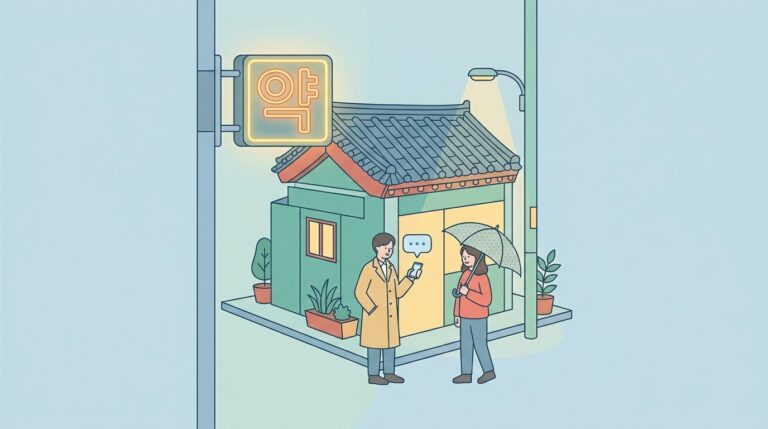
In Korea, pharmacies are marked by a very distinct, bright sign with a single, bold Korean character: 약 (Yak) (which means “medicine”).
- Survival Tip: While convenience stores (편의점 – pyeon-ui-jeom) sell basic painkillers like Tylenol, they do not carry stronger digestives, cold medicines, or specific ointments. For those, you must find a real 약국.
- Operating Hours: Many pharmacies close on Sundays. However, Korea has a system called “Holiday Pharmacies” (휴일지킴이약국). If you are in a pinch, look for this term online!
Phase 5: Real-world Roleplay Scenario
The Setting: A slightly chilly, rainy evening near Hongdae. Your friend has a sudden stomachache. You see a kind-looking local waiting under a bus shelter holding a yellow umbrella.
Characters:
- You (A caring friend)
- Min-jun (A helpful Seoul local)
Dialogue:
- You: 🎭 (Approaching politely with a slight bow)
저기요, 혹시 근처에 약국 있어요?
(Jeo-gi-yo, hok-si geun-cheo-e yak-guk is-seo-yo?)
“Excuse me, by any chance is there a pharmacy nearby?” -
Min-jun: 🎭 (Smiling warmly)
아, 약국요? 네, 있어요. 걸어서 5분 정도 걸려요.
(Ah, yak-guk-yo? Ne, is-seo-yo. Geol-eo-seo o-bun jeong-do geol-lyeo-yo.)
“Oh, a pharmacy? Yes, there is. It takes about 5 minutes on foot.” -
You: 🎭 (Looking relieved)
아, 다행이다! 어디로 가야 돼요?
(Ah, da-haeng-i-da! Eo-di-ro ga-ya dwae-yo?)
“Oh, thank goodness! Which way should I go?” -
Min-jun: 🎭 (Pointing down the street with an open hand)
이 길로 똑바로 가세요. 사거리에서 우회전하세요.
(I gil-lo ttok-ba-ro ga-se-yo. Sa-geo-ri-e-seo u-hoe-jeon-ha-se-yo.)
“Go straight down this street. Turn right at the four-way intersection.” -
You: 🎭 (Nodding to show you understand)
사거리에서 오른쪽이요?
(Sa-geo-ri-e-seo o-reun-jjok-i-yo?)
“To the right at the intersection?” -
Min-jun:
네, 맞아요. 올리브영 옆에 바로 있어요.
(Ne, maj-a-yo. Ol-li-beu-yeong yeop-e ba-ro is-seo-yo.)
“Yes, correct. It is right next to the Olive Young store.” -
You:
가장 가까운 약국이 거기예요?
(Ga-jang ga-kka-un yak-guk-i geo-gi-ye-yo?)
“Is that the closest pharmacy?” -
Min-jun:
네, 거기가 가장 가까워요. 지금 문 열려 있어요.
(Ne, geo-gi-ga ga-jang ga-kka-wo-yo. Ji-geum mun yeol-lyeo is-seo-yo.)
“Yes, that one is the closest. It is open right now.” -
You: 🎭 (Bowing gratefully)
정말 감사합니다! 도움이 많이 됐어요.
(Jeong-mal gam-sa-hap-ni-da! Do-um-i man-i dwaes-seo-yo.)
“Thank you so much! That was very helpful.” -
Min-jun:
아니에요. 조심히 가세요!
(An-i-e-yo. Jo-sim-hi ga-se-yo!)
“No problem. Go safely!”
🔀 Decision Point!
What should you do if Min-jun points and says a word you don’t understand?
- A) Just nod, pretend to understand, and walk away in a random direction.
- Feedback: 🚫 Oh no! You might end up even more lost, and your friend’s stomachache will get worse!
- B) Say “한 번만 더 말씀해 주세요” (Han beon-man deo mal-sseum-hae ju-se-yo – Please say it one more time) while showing your phone map.
- Feedback: ✅ Best Choice! Koreans are incredibly helpful and will gladly point to the location directly on your screen.
- C) Start speaking loud English hoping they understand.
- Feedback: ⚠️ This might startle the local, and they might walk away out of shyness!
Phase 6: 10-Second Emotion Shadowing Drill
Let’s practice speaking with real emotion! Do not just read the letters—feel the situation.
- [🥺 Urgent & Polite]
저기요… / 혹시 근처에 / 약국 있어요?
(Jeo-gi-yo… / hok-si geun-cheo-e / yak-guk is-seo-yo?) -
[😊 Grateful & Relieved]
아! / 정말 / 감사합니다!
(Ah! / jeong-mal / gam-sa-hap-ni-da!) -
[🤒 Hurt & Tired]
머리가 / 너무 / 아파요.
(Meo-ri-ga / neo-mu / a-pa-yo.)
Phase 7: K-Culture Mini Dictionary
| Word | Pronunciation | English Translation | Real-world Context |
|---|---|---|---|
| 약국 (Yak-guk) | [Yak-gook] | Pharmacy | Your go-to place for all health emergencies in Korea. |
| 처방전 (Cheo-bang-jeon) | [Chuh-bahng-juhn] | Prescription | You need this from a Korean clinic to get stronger medicines. |
| 소화제 (So-hwa-je) | [So-hwa-jeh] | Digestive Medicine | Absolute must-have after trying spicy Korean food! |
| 대역 / 밴드 (Baen-deu) | [Baen-deu] | Band-aid / Plaster | Ask for “밴드 주세요” (Baen-deu ju-se-yo) for blisters from walking. |
Phase 8: Traveler’s Survival Kit
Top 3 Travel Emergency Cards
-
Card 1: For Headaches
- KR: 타이레놀 있어요?
- Romanization: [Ta-i-re-nol is-seo-yo?]
- ENG: Do you have Tylenol?
- Card 2: For Stomach aches
- KR: 배가 아파요. 소화제 주세요.
- Romanization: [Bae-ga a-pa-yo. So-hwa-je ju-se-yo.]
- ENG: My stomach hurts. Please give me digestive medicine.
- Card 3: Asking for English help
- KR: 영어로 설명해 주실 수 있어요?
- Romanization: [Yeong-eo-ro seol-myeong-hae ju-sil su is-seo-yo?]
- ENG: Can you explain in English?
📌 Editor’s Travel Note:
Before you pack your bags, make sure to download the Naver Map App Download Page on your smartphone. Google Maps does not work well for walking paths in Korea. Also, keep in mind that tipping is not practiced in Korea, so never leave extra cash for the pharmacist or helper!
Phase 9: Deep Thoughts — “One Step Deeper”
Have you ever noticed how many pharmacies exist in Korean cities? Sometimes you can see three or four on a single street block! This reflects Korea’s famous “Ppalli-Ppalli” (빨리빨리 – Hurry, Hurry) culture. Koreans value efficiency and quick health recovery highly. Instead of waiting days to see a doctor, locals prefer to quickly visit a neighborhood clinic and get their medicine within minutes.
💬 Your Turn: Is it easy to find a pharmacy in your home country? Do you need a prescription for basic medicines? Let us know in the comments below!
Phase 10: FAQ & Avoiding Misunderstandings
Q: Can I buy painkillers like Ibuprofen at a Korean convenience store?
A: Yes, but only basic types. Convenience stores sell standard Tylenol and basic cold relief tablets, but for stronger doses or liquid gel capsules, you must visit a 약국.
Q: Do Korean pharmacists speak English?
A: It depends. In tourist hotspots like Myeongdong, Itaewon, or Hongdae, most pharmacists speak basic English. In quieter neighborhoods, using our A2 key phrases will make communication much smoother!
Q: What should I say if I need something for a bug bite?
A: You can point to the bite and say, “모기 약 주세요” (Mo-gi yak ju-se-yo), which means “Please give me mosquito medicine.”
🚨 Common Mistakes Warning Board
- Mistake: Pronouncing “약국” as “Ya-guk”.
- Correct Action: Make sure to pronounce the bottom ‘k’ sound (받침 – Batchim): Yak-guk.
- Mistake: Asking “약국 어디예요?” to an elder without saying “저기요” (Excuse me) first.
- Correct Action: Always start with a polite “저기요” to show manners.
Phase 11: Action Missions
- 🥉 Bronze Mission (Home Practice): Stand in front of a mirror and say “약국이 어디에 있어요?” three times out loud with a polite head tilt.
- 🥈 Silver Mission (Social Media): Share this post on your feed or write a comment below using the word 근처에 (nearby) in a sentence.
- 🥇 Gold Mission (Real World): The next time you walk around a Korean neighborhood (or explore Seoul on street view), find a sign with the character 약 and take a screenshot!
Phase 12: Interactive Quiz Challenge
Test your skills before you head out!
1. Which word means “the closest” in Korean?
- A) 근처 (Geun-cheo)
- B) 가장 가까운 (Ga-jang ga-kka-un)
- C) 어디에 (Eo-di-e)
Click to reveal the Answer!
Correct Answer: B) 가장 가까운
* Explanation: “근처” means “nearby”, while “가장 가까운” means “the closest”.
2. Fill in the blank:
저기요, 혹시 근처에 약국 ________?
* A) 있어요 (is-seo-yo)
* B) 가세요 (ga-se-yo)
Click to reveal the Answer!
Correct Answer: A) 있어요 (is-seo-yo)
* Explanation: “있어요” means “is there/exists”. “가세요” means “go”.







