

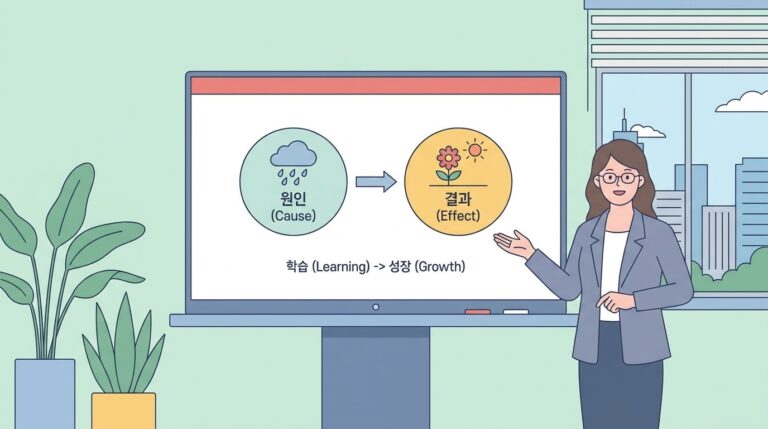
Master the Art of Korean Logic: How to Connect Cause and Effect in Presentations
안녕하세요! (Annyeonghaseyo!) Welcome back to Daily Hangul. It’s your favorite senior editor and Korean culture navigator here! Over my years of coaching expats, international students, and global business professionals in Seoul, I’ve noticed a major milestone that separates intermediate speakers from fluent ones: how they explain why things happen.
Phase 1: The Presentation Dilemma (Why ‘Geuraeseo’ is Holding You Back)
Imagine you are standing in a sleek, glass-walled conference room in Yeouido—the financial heart of Seoul. You’re pitching a brilliant marketing campaign for a new K-Beauty brand to senior executives. Your slides are stunning, and your data is flawless. But as you explain the correlation between a recent viral TikTok trend and a sudden surge in sales, you find yourself repeating the same patterns:
- “K-Beauty가 유행했어요. 그래서 매출이 늘었어요.” (K-Beauty became popular. So sales increased.)
- “트렌드 때문에 성공했어요.” (It was successful because of the trend.)
While grammatically correct, relying solely on 그래서 (geuraeseo) and 때문에 (ttaemune) makes your presentation sound like a elementary school essay. It lacks the professional, structured flow expected at a B2 (intermediate-high) level. In a Korean business or academic setting, presenting logical cause-and-effect with nuance isn’t just about grammar; it’s about establishing 신뢰성 (silloiseong – credibility).
Today, we’re going to upgrade your logical toolkit. You’ll learn how to seamlessly weave cause and effect together so that your Korean colleagues aren’t just listening—they’re nodding in agreement.
Phase 2: Deep Dive into the Top 3 Logical Connectors
Let’s unpack the three powerhouse structures that will instantly professionalize your spoken and written Korean.
1. -(으)로 인해(서) [-(eu)ro inhae(seo)]
- Pronunciation: [-(eu)ro in-hae-seo] / Sound-alike: “row in-hae-seo”
- Meaning: “Due to…” / “As a result of…” (Formal, objective, and highly professional)
- K-Culture Moment: This is the absolute star of Korean evening news reports and corporate boardrooms. If a flight is delayed at Incheon Airport, or if a tech giant’s stock price rises, you will hear this expression.
- Editor’s Insight: This connector links a major external cause to a significant, often measurable result. Keep it for formal settings, pitch decks, or essays. Avoid using it for trivial personal issues like “I was late due to eating ramyun.”
Situation Spectrum:
- Casual (친구/사석): 🚫 (Too stiff!)
- Semi-formal (직장 동료): ⚠️ (Use when discussing official work issues)
- Formal (직장 상사/발표): ✅ (Perfect!)
-
🤔 Think About It: Why does Korean have a completely different set of connectors for formal situations compared to English, which often uses “because” in both casual and formal speech? How does this reflect the Korean cultural distinction between public presentation (공석) and private life (사석)?
2. -(으)ㅁ에 따라 [-(eu)m-e ttara]
- Pronunciation: [-(eu)m-e tta-ra] / Sound-alike: “eum-eh tah-rah”
- Meaning: “As [A] happens, [B] consequently follows…” / “In accordance with…”
- K-Culture Moment: Think of this as the “correlation connector.” You’ll see this constantly in trend analysis videos, economic K-Dramas like Start-Up, or when discussing shifting K-Pop demographic trends.
- Editor’s Insight: This is used when a gradual change in the cause leads to a parallel change in the effect. It shows you understand trends and dynamic movement, which is highly appreciated in business strategy meetings.
Situation Spectrum:
- Casual (친구/사석): 🚫
- Semi-formal (직장 동료): ⚠️
-
Formal (직장 상사/발표): ✅
-
🤔 Think About It: Reflect on how describing change as a continuous flow rather than a static, one-time event alters the persuasiveness of your argument. How does this connect to the fast-paced, constantly adapting nature of Korean society?
3. -는 바람에 [-neun baram-e]
- Pronunciation: [-neun ba-ram-e] / Sound-alike: “noon bah-rahm-eh”
- Meaning: “Because of [sudden/unexpected event]…” (Always followed by an unintended, negative result)
- K-Culture Moment: The ultimate excuse-maker in K-Dramas! When a character is late to a blind date because their taxi broke down, they will breathlessly say this expression.
- Editor’s Insight: Literally translating to “in the wind of,” this grammatical structure signals that an unexpected external factor blew in and ruined your plans. Use it in presentations when explaining sudden market crashes, shipping delays, or system crashes to soften your personal responsibility.
Situation Spectrum:
- Casual (친구/사석): ✅
- Semi-formal (직장 동료): ✅
-
Formal (직장 상사/발표): ⚠️ (Acceptable when explaining unexpected setbacks professionally)
-
🤔 Think About It: Why does Korean have a grammar point dedicated specifically to unintentional, negative causes? How does this help speakers save face (체면) in a socially conscious community?
Phase 3: Textbook Korean vs. Real Korean
Let’s look at how transforming basic textbook phrasing into natural, logical Korean changes the entire vibe of your communication.
Scenario 1: Explaining a presentation delay
- 📖 Textbook Korean: “비가 많이 와서 늦었습니다.” (Bi-ga mani wa-seo neuj-eoss-seub-nida.)
- Translation: “It rained a lot, so I was late.” (Sounds like a weak excuse a student might give to a teacher.)
- 🗣️ Real Korean: “갑작스러운 폭우로 인해 지연되었습니다.” (Gap-jak-seu-reo-un pog-u-ro in-hae ji-yeon-do-eoss-seub-nida.)
- Translation: “It has been delayed due to the sudden torrential rain.” (Sounds professional, objective, and focuses on the facts rather than personal fault.)
- 💡 Why is it different? Dropping “-아서/어서” (so/because) and upgrading to “-로 인해” changes the focus from your personal action of being late to the external phenomenon of the delay, maintaining your professional composure.
Scenario 2: Connecting consumer trends to sales success
- 📖 Textbook Korean: “K-Pop이 인기가 아주 많기 때문에 화장품이 잘 팔립니다.” (K-Pop-i in-gi-ga a-ju manh-gi ttae-mun-e hwa-jang-pum-i jal pal-lim-nida.)
- Translation: “Because K-Pop is very popular, cosmetics sell well.” (Too simplistic; lacks logical elegance.)
- 🗣️ Real Korean: “K-Culture의 글로벌 위상이 높아짐에 따라, 뷰티 제품의 매출도 함께 상승하고 있습니다.” (K-Culture-ui geul-lo-beol wi-sang-i nop-a-jim-e ttara, byu-ti je-pum-ui mae-chul-do ham-kke sang-seung-ha-go iss-seub-nida.)
- Translation: “As the global status of K-Culture rises, sales of beauty products are rising along with it.”
- 💡 Why is it different? By using “-ㅁ에 따라” (as… so…), you present a dynamic, sophisticated correlation that sounds like an expert market analysis rather than a simple opinion.
Phase 4: K-Culture Deep Dive & Non-Verbal Manners
4-1. Nunchi & Presentation Body Language
In Korea, logic isn’t just delivered through your tongue; it’s delivered through your posture and eyes. When presenting cause and effect, you must balance 눈치 (Nunchi – situational awareness) with confidence.
- The Open-Palm Gesture: When introducing a cause, use an open, upward palm gesture toward your presentation screen rather than pointing aggressively with a single finger. Pointing with a finger can feel confrontational in Korean business settings.
- The Head Nod: When stating the effect, make eye contact with the key decision-maker in the room and give a slow, deliberate nod. This non-verbal cue invites them to align with your logical conclusion.
4-2. The “Dugwalsik” (두괄식) Mindset
Western presentations often build up a long list of causes and reveal the result at the end (suspense style). In contrast, modern Korean business culture heavily favors 두괄식 (Dugwalsik – conclusion-first delivery). Because of the fast-paced “Pali-Pali” (빨리빨리 – hurry-hurry) lifestyle, executives want the result (effect) first, followed by a logical, structured breakdown of the reasons (causes).
Phase 5: Live Boardroom Roleplay
- The Setting: You are inside the headquarters of “Hallyu Media” in Gangnam. You are pitching a new K-Pop global audition project. The air conditioning is humming, and the coffee on the table is cold.
- The Cast: You (the ambitious Project Manager) and Team Leader Kim (김 팀장님 – a sharp, detail-oriented executive).
1. 김 팀장님: 이번 글로벌 오디션 프로젝트의 예산이 초과된 구체적인 원인이 무엇인가요?
   (Ibeon geul-lo-beol o-di-syeon peu-ro-jek-teu-ui ye-san-i cho-gwa-doen gu-che-jeok-in won-in-i mu-eot-in-ga-yo?)
   "What is the specific cause behind the budget overrun for this global audition project?"

2. 나: (🎭 Taking a deep breath, looking confidently at the slide)
   네, 해외 참가자들의 급증으로 인해 현지 대관 비가 대폭 상승했습니다.
   (Ne, hae-oe cham-ga-ja-deul-ui geup-jeung-u-ro in-hae hyeon-ji dae-gwan-bi-ga dae-pok sang-seung-haess-seub-nida.)
   "Yes, due to the sudden surge of overseas participants, local venue rental costs rose drastically."

3. 김 팀장님: (🎭 Frowning slightly, reviewing the document)
   미리 예측할 수 없었나요? 왜 사전 대비가 부족했죠?
   (Mi-ri ye-cheuk-hal su eops-eoss-na-yo? Wae sa-jeon dae-bi-ga bu-jok-haet-jyo?)
   "Couldn't this have been predicted in advance? Why was there a lack of preparation?"

4. 나: (🎭 Keeping composure, using an open-palm gesture toward the data chart)
   K-Pop 트렌드가 동남아 지역에서 급격히 확장됨에 따라, 지원자 수가 예상치의 세 배를 넘게 되었습니다.
   (K-Pop teu-ren-deu-ga dong-nam-a ji-yeok-e-seo geup-gyeok-hi hwak-jang-deom-e ttara, ji-won-ja su-ga ye-sang-chi-ui se bae-reul neom-ge doe-eoss-seub-nida.)
   "As the K-Pop trend expanded rapidly in Southeast Asia, the number of applicants exceeded three times our projection."

5. 김 팀장님: 그렇다면, 일본 마케팅 프로모션은 왜 예정대로 진행되지 못했습니까?
   (Geu-reot-ha-myeon, il-bon ma-ke-ting peu-ro-mo-syeon-eun wae ye-jeong-dae-ro jin-haeng-doe-ji mot-haess-seub-ni-kka?)
   "In that case, why wasn't the Japanese marketing promotion carried out as scheduled?"

6. 나: (🎭 Softening voice slightly to show regret)
   현지 대행사와의 커뮤니케이션에 차질이 생기는 바람에 일정이 조금 지연되었습니다.
   (Hyeon-ji dae-haeng-sa-wa-ui keo-myu-ni-kei-syeon-e cha-jil-i saeng-gi-neun ba-ram-e il-jeong-i jo-geum ji-yeon-doe-eoss-seub-nida.)
   "Due to an unexpected miscommunication with our local agency, the schedule was slightly delayed."

7. 김 팀장님: (🎭 Nodding slowly, appreciating the logical breakdown)
   그렇군요. 그럼 이 지연으로 인한 다음 단계 대안은 준비되어 있습니까?
   (Geu-reong-un-yo. Geu-reom i ji-yeon-eu-ro in-han da-eum dan-gye dae-an-eun jun-bi-doe-eo is-seub-ni-kka?)
   "I see. Then, do you have an alternative plan prepared for the next step resulting from this delay?"

8. 나: (🎭 Smiling slightly, clicking to the next slide showing the solution)
   네, 일정 재조정에 따라 추가 디지털 프로모션을 기획하여 손실을 만회할 계획입니다.
   (Ne, il-jeong jae-jo-jeong-e ttara chu-ga di-ji-teol peu-ro-mo-syeon-eul gi-hoek-ha-yeo son-sil-eul man-hoe-hal gye-hoek-im-nida.)
   "Yes, in accordance with the rescheduled timeline, we plan to launch additional digital promotions to recover the losses."

9. 김 팀장님: 아주 좋습니다. 논리적으로 잘 설명해 주셨네요. 다음 단계로 진행합시다.
   (A-ju joh-seub-nida. Non-li-jeok-eu-ro jal seol-myeong-hae ju-syeot-nae-yo. Da-eum dan-gye-ro jin-haeng-hap-si-da.)
   "Excellent. You have explained it very logically. Let's proceed to the next phase."
🔀 Decision Point: What would you say next?
If Team Leader Kim suddenly asks: “그렇다면 이번 프로젝트의 가장 핵심적인 성공 요인은 무엇이라고 생각하나요?” (Then, what do you think is the most key success factor of this project?)
- Option A: “그냥… 열심히 마케팅을 해서 성공할 것 같습니다.” (We will succeed because we just… work hard on marketing.)
- Option B: “글로벌 팬들의 소통 니즈가 확대됨에 따라 쌍방향 플랫폼 구축이 성공의 열쇠가 될 것입니다.” (As global fans’ communication needs expand, establishing a two-way platform will be the key to success.)
- Option C: “팬들이 많이 사랑해 주기 때문에 무조건 대박이 날 것입니다.” (Because fans love us a lot, it will definitely hit the jackpot.)
Analysis of Your Choice:
- Best Choice (Option B): Excellent! Using -ㅁ에 따라 demonstrates a logical transition from a consumer trend (cause) to a strategic corporate action (effect). This is B2-level logic at its finest.
- Bad/Risk Choice (Option A): Too generic and sounds lazy. It lacks a logical link between action and result.
- Bad/Risk Choice (Option C): Too emotional and unscientific. Using “무조건” (unconditionally/definitely) without analytical proof will make corporate leaders lose faith in your proposal.
Phase 6: 10-Second Emotion Shadowing Drill
When presenting in Korean, where you pause determines your impact. Let’s practice saying this sentence with professional weight. Use the slash (/) for pausing and matching the emotional cues!
“갑작스러운 / 시장 변화로 인해 / 프로젝트의 방향을 / 일부 수정하였습니다.”
(Gap-jak-seu-reo-un / si-jang byeon-hwa-ro in-hae / peu-ro-jek-teu-ui bang-hyang-eul / il-bu su-jeong-ha-yeoss-seub-nida.)
- Translation: Due to sudden market changes, we have partially modified the project’s direction.
- Emotional Target: [😤 Firm, Calm, and Analytical]
Phase 7: K-Culture Mini Dictionary
| Keyword | Hangul | Romanization | Real-world Corporate Nuance |
|---|---|---|---|
| Conclusion-First | 두괄식 | Dugwalsik | Presenting the key result first, then explaining the causes later. |
| Cause & Effect | 인과관계 | Ingwa-gwangye | The logical link. Essential for reports and slides. |
| Evidence/Basis | 근거 | Geungeo | The factual proof supporting your logical claim. |
| Alternative | 대안 | Dae-an | The proactive backup plan when a cause leads to a negative effect. |
Phase 8: Traveler’s Survival Kit (When Things Go Wrong)
Even if you aren’t presenting in a boardroom, you will inevitably face unexpected hurdles while traveling in Korea. Here are three quick-rescue phrases to explain cause and effect on the go!
Survival Card 1: Train Delay
- Korean: “폭설로 인해 기차가 연착되었습니다.” (Pok-seol-lo in-hae gi-cha-ga yeon-chak-doe-eoss-seub-nida.)
- English: “The train is delayed due to heavy snow.”
- Pro Tip: Keep this in mind when using public transport during harsh winter seasons in Korea.
Survival Card 2: Late for Reservation
- Korean: “길을 잃는 바람에 조금 늦을 것 같습니다.” (Gil-eul il-neun ba-ram-e jo-geum neuj-eul geot gat-seub-nida.)
- English: “I got lost, so I think I might be a bit late.”
- Pro Tip: Use -는 바람에 because getting lost is an unintentional accident. It sounds much more natural and polite to the restaurant staff than simply saying “늦었어요” (I’m late).
Survival Card 3: Changing Ticket
- Korean: “개인 사정으로 인해 티켓을 변경하고 싶습니다.” (Gae-in sa-jeong-eu-ro in-hae ti-ket-eul byeon-gyeong-ha-go sip-seub-nida.)
- English: “Due to personal circumstances, I would like to change my ticket.”
- Pro Tip: “개인 사정” (personal circumstances) is the perfect umbrella term to politely decline to share too many personal details with a ticket booth agent.
📌 Editor’s Travel Note: When traveling around South Korea, always use the Naver Map App Download Page rather than Google Maps, as Naver Map is updated in real-time with precise route adjustments and delays due to sudden construction or traffic.
Phase 9: Deep Thoughts (한 발 더 깊이)
In Korean culture, how we construct cause and effect reflects our social values. When something goes wrong, pointing fingers directly can disrupt group harmony (화합 – hwahap). Therefore, when explaining negative results, professional Koreans often rely on passive phrasing combined with -(으)로 인해 to distance individuals from blame. Instead of saying, “Minsoo didn’t finish the report, so we are delayed,” we say, “Due to internal delays, the schedule was adjusted.”
This grammatical cushioning protects the team’s face while keeping the conversation focused on collective solutions. Learning to speak logically in Korean isn’t just about sounding smart; it’s about navigating human relationships with grace.
💬 Your Turn: How does your native culture handle explanations of project delays? Do you address the individual directly, or do you focus on the external cause? Share your cultural insights in the comments below!
Phase 10: FAQ & Avoiding Common Mistakes
Q: Can I use “-는 바람에” to explain a positive cause?
A: No. “-는 바람에” is strictly reserved for unexpected, negative situations that lead to an undesirable outcome. If something great happened unexpectedly, use structures like “-덕분에” (thanks to).
Q: What is the main difference between “-기 때문에” and “-(으)로 인해”?
A: “-기 때문에” is versatile and can be used in daily speech. “-(으)로 인해” is highly formal, written, and objective. If you use “-(으)로 인해” while joking with friends at a K-BBQ spot, you will sound like a robot!
Q: How do I connect multiple causes without sounding repetitive?
A: Start with the primary global trend using -(으)ㅁ에 따라 (As X changes, Y follows), then transition into a specific event using -(으)로 인해 (Due to X, Y happened), and if there’s an unexpected hurdle, cap it off with -는 바람에.
🚨 The “Aha!” Common Mistake Board
- Mistake: “날씨가 좋은 바람에 소풍을 갔어요.” (❌)
- Correction: “날씨가 좋은 덕분에 소풍을 갔어요.” (✅)
- Why: “-는 바람에” must not be paired with positive outcomes like going on a lovely picnic.
- Mistake: “지하철 연착으로 인해 늦었습니다.” (In a casual text to a close friend) (❌)
- Correction: “지하철이 늦어서 지각이야!” (✅)
- Why: Overusing formal connectors in casual texts makes you sound distant or overly dramatic.
- Mistake: Using “그래서” at the beginning of every single slide in a pitch deck.
- Correction: Use transitional phrases like “이에 따라” (accordingly) or “따라서” (therefore) to build logical flow.
Phase 11: Action Missions
Ready to put your logical skills into action? Try these three levels of real-world challenges!
- 🥉 Bronze (The Mirror Challenge): Stand in front of your mirror and deliver the Phase 6 Shadowing Drill three times. Focus on your pauses and maintaining a calm, professional gaze.
- 🥈 Silver (The K-Culture Finder): While watching your next K-Drama or business interview on YouTube, keep an ear out for “-(으)로 인해” or “-는 바람에”. Write down the context in your study notebook!
- 🥇 Gold (The Boss Level): In your next professional email or text to a Korean coworker, replace a basic “그래서” with “이에 따라” (accordingly) or “-(으)로 인해”. Observe how their tone of response changes!
Phase 12: Interactive Quiz Challenge
Test your mastery of Korean cause-and-effect with this quick quiz!
1. Fill in the blank with the most appropriate connector for a professional presentation:
“K-뷰티의 전 세계적인 유행______ (due to), 해외 지사 설립 속도가 빨라졌습니다.”
- A) 기 때문에
- B) 로 인해
- C) 는 바람에
🔍 Click to reveal the Answer & Explanation
Correct Answer: B) 로 인해
Explanation: This is a professional presentation context discussing business expansion. Therefore, the formal, objective “-(으)로 인해” is the perfect fit. “기 때문에” is too casual, and “는 바람에” is incorrect because expanding overseas offices is a positive corporate development, not an accident!
2. True or False K-Culture Trivia:
“In a Korean business presentation, it is culturally preferred to explain all the background details and build up suspense before revealing the final conclusion.”
- True
- False
🔍 Click to reveal the Answer & Explanation
Correct Answer: False
Explanation: Modern Korean business culture heavily favors 두괄식 (Dugwalsik – conclusion-first delivery). Due to the fast-paced business environment, executives prefer to see the key result or conclusion immediately, followed by the logical causes.







