

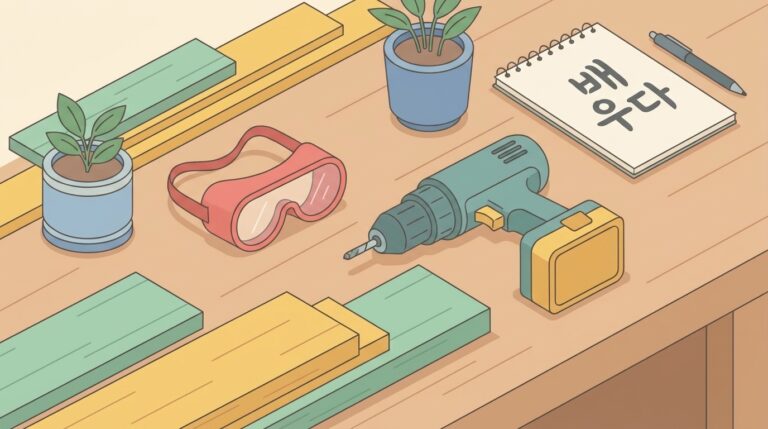
Master the Drill, Conquer the K-DIY Scene: Power Drill Safety and Crafting Etiquette in Korea
안녕하세요! Your favorite daily Korean culture and language navigator here. If you’ve ever scrolled through Today’s House (오늘의집) or watched a cozy K-Drama where the main characters bond over assembling a bookshelf in a sunlit one-room (원룸), you’ve probably felt that sudden, irresistible urge to dive into some DIY woodwork.
But then, reality hits. You’re standing in your Seoul officetel, holding a powerful cordless drill (전동 드릴), and a wave of panic washes over you. What if I drill into a hidden water pipe? What if my landlord loses their mind over wall damage? And oh my god, what if the neighbors upstairs start banging on their floor because of the noise?
Don’t worry! My former student, Sarah, went through this exact ordeal when she tried to install floating shelves in her Hongdae studio. She almost gave up until we sat down over some chimaek (치맥) and mapped out the linguistic and cultural blueprints of Korean DIY. Today, I’m sharing those exact insider secrets with you so you can operate power tools in Korea with absolute confidence and cultural finesse. Let’s get drilling!
Phase 2: Core Expressions Deep Dive
Let’s master the three essential linguistic pillars of Korean woodworking and power tool operation. These will make you sound like a seasoned artisan at any neighborhood workshop.
1. 구멍을 뚫다 (gumeong-eul ttulda)
- Pronunciation: [gu-meong-eul ttul-da] / Sound-alike: “Goo-mung-ool ttul-da”
- Meaning: To drill a hole (Literal: “To pierce a hole”)
- K-Culture Moment: You’ll hear this constantly in healing, slice-of-life K-dramas. Picture the scene where a character helps their neighbor set up an art studio, saying, “내가 여기 구멍 뚫어줄게” (I’ll drill a hole for you here) while soft acoustic music plays in the background.
- Editor’s Insight: While dictionary definitions list this for physical holes, in colloquial Korean, it can also metaphorically mean breaking through a difficult situation. In the workshop, make sure to enunciate the double batchim ‘ㅀ’ in 뚫다 (only the ‘ㄹ’ sound carries over before a consonant, making it sound like ‘뚤다’).
- Situation Spectrum:
- Friends & Casual: ✅ (구멍 뚫어줘)
- Co-workers & Semi-formal: ✅ (여기에 구멍을 뚫어주세요)
- Superiors & Formal: ✅ (구멍을 뚫도록 하겠습니다)
- 🤔 Think About It: Notice how Korean uses highly active, physical verbs. Why do you think Korean DIY culture emphasizes direct, physical verbs (뚫다 – to pierce, 박다 – to drive/hammer) rather than abstract passive phrases? How does this reflect the dynamic nature of Korean work culture?
2. 수평을 맞추다 (supyeong-eul matchuda)
- Pronunciation: [su-pyeong-eul ma-chu-da] / Sound-alike: “Soo-pyeong-ool mah-choo-da”
- Meaning: To level something (Literal: “To match the horizontal”)
- K-Culture Moment: On popular Korean YouTube home styling vlogs, creators spend agonizing minutes adjusting mirrors or shelves, whispering, “수평 맞추는 게 제일 중요해요” (Matching the level is the most important part) to satisfy their viewers’ aesthetic standards.
- Editor’s Insight: The verb 맞추다 (to match/adjust) is a magic word in Korean. You don’t just adjust objects; you “match” your heart, schedules, and even outfits with others. When leveling a shelf, maintaining “수평” is both a structural necessity and an aesthetic obsession in Korea’s design-heavy apartments.
- Situation Spectrum:
- Friends & Casual: ✅ (수평 맞춰봐)
- Co-workers & Semi-formal: ✅ (수평 좀 맞춰주실래요?)
- Superiors & Formal: ✅ (수평을 맞추었습니다)
- 🤔 Think About It: How does the word ‘맞추다’ (to align/cooperate/match) differ from a mechanical term like ‘조절하다’ (to control/regulate)? How does this linguistic choice make woodworking feel more like an art of harmony?
3. 안전장비를 착용하다 (anjeon-jangbi-reul chagyong-hada)
- Pronunciation: [an-jeon-jang-bi-reul cha-gyong-ha-da] / Sound-alike: “An-jeon-jang-bi-reul chah-gyong-hah-dah”
- Meaning: To wear safety gear
- K-Culture Moment: If you visit a trendy “gongbang” (공방 – artisan workshop) in Seongsu-dong for a weekend woodcarving date, the instructor will inevitably point to a sign on the wall and gently remind you to put on your safety goggles and gloves before touching any machinery.
- Editor’s Insight: In casual speech, Koreans simply say “장갑 껴라” (Put on gloves) or “보안경 써라” (Wear safety goggles). However, “착용하다” is the formal, professional verb you will see on safety posters and instructional manuals. Using it shows you respect the workshop rules.
- Situation Spectrum:
- Friends & Casual: ⚠️ (Sounds too textbook; use “안전 장비 다 꼈어?” instead)
- Co-workers & Semi-formal: ✅ (안전장비를 착용해 주세요)
- Superiors & Formal: ✅ (안전장비를 필히 착용해야 합니다)
- 🤔 Think About It: Historically, Korea was famous for “빨리빨리” (hurry, hurry) culture, sometimes at the expense of safety. Today, there’s a massive cultural shift toward “안전 제일” (Safety First). How does this transition show up in modern educational content and workshop etiquettes?
Phase 3: Textbook Korean vs. Real-World Korean Showcase
Let’s look at how classroom Korean contrasts with what you actually say on the dusty workshop floor.
Situation 1: Asking someone to drill a hole for you
- 📖 Textbook Korean: “여기에 구멍을 뚫어 주시겠습니까?” (Would you please drill a hole here?)
- 🗣️ Real Korean: “여기 구멍 하나만 뚫어주세요.” (Just drill one hole here, please.) or “여기 한 번만 박아주세요.” (Can you just drive this screw in once here?)
- 💡 Why the difference? Real conversational Korean relies heavily on softeners like “하나만” (just one) or “한 번만” (just once). It doesn’t mean you literally want only one millisecond of help; it softens the request, making it sound polite, natural, and less demanding.
Situation 2: Addressing noise concerns with neighbors
- 📖 Textbook Korean: “이웃 사람들에게 소음으로 방해를 주지 마십시오.” (Do not disturb the neighbors with noise.)
- 🗣️ Real Korean: “층간소음 때문에 낮에 드릴 돌려야 돼요.” (We have to run the drill during the day because of inter-floor noise.)
- 💡 Why the difference? The textbook sentence is cold and regulatory. Real Koreans refer to the specific social phenomenon of “층간소음” (cheonggan-soeum – inter-floor noise) and use the casual active verb “돌리다” (to spin/run a machine) instead of “사용하다” (to use) or “작동하다” (to operate).
Phase 4: K-Culture Deep Dive & Non-Verbal Manners
4-1. Nunchi (눈치) and Workshop Etiquette
When you are renting space in a shared Korean woodworking shop (목공방), your non-verbal behavior speaks louder than your Korean vocabulary. Here is how to show top-tier nunchi (tact/situational awareness):
1. The “Hold-My-Wood” Courtesy: If you see someone struggling to hold a long timber piece while drilling, don’t just watch. Step in, hold the other end, and say, “잡아 드릴까요?” (Shall I hold it for you?). This instant physical cooperation is highly appreciated.
2. The 3-Second Sweep: Sawdust (톱밥) piles up quickly. In Korea, leaving your workstation messy is considered highly inconsiderate. Sweep up your station immediately after drilling before moving to the next step. It shows you respect the space and the next person.
4-2. The “Gongbang Date” (공방 데이트) Phenomenon
In K-Beauty and K-Travel trends, standard movie-and-dinner dates are taking a backseat to “공방 데이트” (workshop dates). Couples head to trendy neighborhoods like Yeonnam-dong or Seongsu-dong to spend 3 hours sweatily drilling, sanding, and varnishing custom cutting boards, speaker boxes, or stools. It’s seen as a true test of compatibility—how well do you communicate and handle stress when the power tool slips?
Phase 5: Woodshop Interactive Roleplay
- The Setting: You are at “Green Woodshop” (그린 목공방) in Seongsu-dong. Sunlight filters through large windows, warming the scent of pine and fresh oil stain. Soft indie music plays over the hum of dust collectors.
- The Cast: You (a passionate DIYer) and Min-woo (민우), a friendly, apron-clad master instructor with a pencils tucked behind his ear.
Min-woo: (Wiping wood glue off his hands with a smile) 안녕하세요! 오늘 만들 책장은 설계도대로 잘 진행되고 있나요?

You: 네, 거의 다 됐는데 이제 고정할 차례예요. 전동 드릴을 써야 할 것 같아요.

Min-woo: 아, 드릴 작업이군요! 전동 드릴 쓰기 전에 보안경하고 장갑 먼저 챙기셨죠?

You: 아! 깜빡할 뻔했네요. 안전장비부터 착용할게요. (Puts on safety goggles and gloves)

Min-woo: (Nods approvingly) 좋습니다. 안전이 제일이니까요. 비트는 어떤 걸 쓰실 건가요?

You: 이 목재 두께에는 이 비트가 맞나요? 수평도 잘 맞춰야 해서 걱정이에요.

Min-woo: 두께 보니까 딱 좋네요. 드릴 회전 방향(방향 조절 레버)을 꼭 확인하고 가볍게 수직으로 누르면서 뚫으세요.

You: 알겠습니다. 혹시 드릴 돌릴 때 소리가 너무 큰데, 다른 분들께 방해되지 않을까요?

Min-woo: 아하하, 여기는 목공방이라 소음 걱정은 전혀 안 하셔도 됩니다! 편하게 돌리세요.

You: 다행이네요! 그럼 한 번 뚫어보겠습니다. (Carefully positions the drill)

Min-woo: 드릴이 미끄러지지 않게 처음에 힘을 살짝만 주고 구멍을 뚫으세요. 제가 잡아 드릴까요?

You: 네, 잡아 주시면 정말 감사하겠습니다. 수평이 맞는지 봐주세요!

Min-woo: 좋습니다, 아주 완벽해요! 자, 뚫습니다!
🔀 Decision Point: The Drill Bit Starts Slipping!
What do you do when the screw starts spinning in place, making a screeching sound?
- Option A: Keep pressing harder and squeeze the trigger faster to force it in.
- Option B: Stop, release the trigger, and say: “드릴 비트가 헛도는데 어떻게 하죠?” (The drill bit is spinning in vain, what should I do?)
- Option C: Turn off the power, pull the tool out, and hit the wood with a hammer to loosen it.
💡 Feedback Analysis:
- Best Choice: Option B! Screeching means the bit is slipping (헛돌다 – to spin in vain/slip). Forcing it (Option A) will strip the screw head (called “야마 나다” in Korean workshop slang, derived from Japanese but widely used). Option C will ruin your beautiful timber. Asking Min-woo calmly using correct terminology shows high linguistic and technical intelligence!
Phase 6: 10-Second Emotional Shadowing Drill
Practice saying these high-frequency phrases with the right pauses (/) and emotional deliveries to sound like a natural Korean DIY pro!
- [🥺 Apprehensive & Seeking Help]
“저기… / 드릴이 자꾸 / 헛도는데 / 도와주실 수 있어요?”
(Jeogi… / deuriri jakku / heot-doneunde / dowajusil su isseoyo?) -
[😤 Confident & Safety-First]
“보안경 안 쓰면 / 드릴 절대 / 돌리면 안 돼요!”
(Boangyeong an sseumyeon / deuril jeoldae / dollimyeon an dwaeyo!) -
[😊 Elated & Proud]
“와! / 수평이 / 기가 막히게 / 딱 맞았어요!”
(Wa! / supyeongi / giga makhige / ttak majasseoyo!)
Phase 7: K-Culture Mini Dictionary
| Keyword | English equivalent | Real-world Contextual Meaning |
|---|---|---|
| 공방 (Gongbang) | Workshop/Atelier | Creative spaces where Koreans spend weekends crafting leather, perfume, pottery, or wood products. |
| 셀프 인테리어 (Self-Interior) | DIY Home Decor | The highly aesthetic trend among 20s-30s Koreans of remodeling their rented apartments on a budget. |
| 오늘의집 (Onoorui Jip) | “Today’s House” | The absolute bible of Korean interior design—an app where people shop, share room tours, and learn DIY tips. |
| 층간소음 (Cheonggan-soeum) | Inter-floor noise | The number one cause of neighborly disputes in Korea’s dense high-rise apartments. Use tools during the afternoon! |
Phase 8: Traveler’s Survival DIY Kit
If you need to buy or use tools during your stay in Korea, these resources will save your day!
Survival Expressions Card
- Card 1: “드릴 비트 낱개로도 파나요?” (Do you sell drill bits individually?)
- Pronunciation: [deuril biteu natgaerodo panayo?]
- Pro Tip: Traditional hardware stores (철물점) sell individual bits, while big marts might only sell full sets.
- Card 2: “콘크리트벽에 구멍 뚫어도 돼요?” (Am I allowed to drill holes into concrete walls?)
- Pronunciation: [konkeuriteubyeoge gumeong ttureodo dwaeyo?]
- Pro Tip: Ask your landlord this before you hang any heavy mirrors in an rented apartment!
📌 Editor’s Travel Note
If you need tools or hardware in Seoul, don’t look for a massive Home Depot. Instead, open the Naver Map App and search for “철물점” (Cheol-mul-jeom). These are small, cozy neighborhood hardware stores run by local grandfathers (halabeoji) who know everything about the apartments in that specific area. They will happily rent you a drill for a few thousand won!
Phase 9: Critical Insight — “One Step Deeper”
In Western cultures, DIY is often associated with massive suburban garages, yards, and heavy-duty outdoor projects. In Korea, however, DIY is compact, highly organized, and intensely considerate of others. Because over 60% of Koreans live in shared apartment buildings (아파트), operating a power tool is not just a personal hobby—it is a social negotiation.
The anxiety over cheonggan-soeum (층간소음) has birthed silent tools, shock-absorbing mats, and strict scheduling cultures where drilling past 6 PM is considered an unspoken social taboo. Thus, woodworking in Korea is as much about cultivating respect and harmony with your neighbors as it is about crafting beautiful furniture.
💬 Your Turn: How does tool culture and DIY look in your home country? Do you have strict neighborhood noise regulations, or can you drill whenever you please? Tell us in the comments below!
Phase 10: FAQ Schema-Optimized Q&A
Q: Can I drill holes in the walls of my rented Korean studio/officetel?
A: Generally, No for concrete walls without prior permission. Korean landlords are incredibly protective of walls (especially wallpapered ones). Always ask: “벽에 못 박아도 돼요?” (Can I drive a nail/screw into the wall?). Alternatively, look into “non-drill” wall hanging solutions (꼭꼬핀 – wallpaper pin hangers) highly popular on Today’s House.
Q: What is the best time to use a power drill in a Korean apartment?
A: The golden window is between 11:00 AM and 4:00 PM on weekdays, when most neighbors are out at work. Avoid weekends entirely if possible. If you must drill on a Saturday, do it after 1:00 PM and finish quickly.
Q: Where can I dispose of ruined wood or broken drill pieces in Korea?
A: Large pieces of wood cannot be thrown in standard trash bags. You must buy a special waste sticker (폐기물 스티커) from your local community center (주민센터) or apply for waste disposal online through your district office website.
🚨 Common Mistakes Alert!
- Using the wrong drill mode on concrete: If you use regular driving mode on concrete, you will melt the bit. Use the Hammer Drill (해머 드릴) setting!
- Drilling late at night: Doing this will almost guarantee a visit from the security office (경비실).
- Wearing loose clothes around the drill spindle: Never wear loose jewelry or dangling hoodies—they can catch in the rotating drill chuck instantly.
Phase 11: Action Missions
- 🥉 Bronze (The Mirror Challenge): Go to a mirror and practice saying: “수평 한 번만 봐주세요” (Please check the level for me) with a bright, charming smile.
- 🥈 Silver (The Digital Hunt): Open YouTube, search for “셀프 인테리어 드릴” (Self-interior drill), watch a 5-minute Korean vlog, and try to spot at least two of the terms we learned today!
- 🥇 Gold (The Seongsu Challenger): Book a one-day woodcarving or cutting-board-making class at a local Korean gongbang (공방) and successfully request safety goggles using: “보안경 좀 빌려주시겠어요?” (Could you please lend me some safety goggles?).
Phase 12: Interactive Quiz Challenge
Test your K-DIY and drill safety skills!
1. Situational Judgment
You are assembling a desk in your room, and you need to use a drill, but it’s 8:30 PM. What should you do?
– A) Go ahead, it only takes 2 minutes.
– B) Stop immediately and wait until tomorrow afternoon.
– C) Put a thick blanket over the drill to muffle the sound and do it anyway.
2. Fill-in-the-Blank
Fill in the missing verb to complete the safety warning:
“작업을 시작하기 전에 반드시 안전장비를 __________!”
(Before starting work, make sure to wear safety gear!)
– Options: [먹다, 입다, 착용하다, 부르다]
3. True or False?
Traditional neighborhood hardware stores called “철물점” (Cheol-mul-jeom) do not rent out tools to foreigners. (T/F)
🔍 Click here to check the Answers and Explanations!
- Answer: B. Evening drilling is a severe social taboo in Korean residential areas due to immediate noise complaints (층간소음). Wait until the next afternoon!
- Answer: 착용하다 (chagyong-hada). For formal safety gear, “착용하다” is the most natural and professional term to use.
- Answer: False! Many local hardware store owners are incredibly kind and will gladly rent tools for a small deposit or fee if you ask politely: “드릴 대여 가능한가요?” (Is drill rental possible?)
“,
“generate_image_prompt”: “Minimalist flat vector illustration of a cozy Korean woodworking workshop with soft warm colors, showing a modern cordless drill, wood planks, safety goggles, and a tiny green potted plant, no text”,
“title”: “Don’t Panic in Your One-Room: The Ultimate Korean Guide to Power Drills, DIY Woodworking, and Noise Diplomacy”,
“seo_title”: “Korean Power Drill Usage & Safety: DIY Woodworking Guide”,
“seo_desc”: “Master Korean power drill vocabulary, safety tips, and apartment etiquette. Learn how to navigate DIY projects and neighbor noise diplomacy like a local.”,
“keyword”: “Korean DIY, Power drill safety, Today’s House Korea, One-room interior, Woodworking Korean, Learn Korean”
}
“`of_ of of of of of of of of of of of of of of of of of of of of of of of of of of of of of of of of of of of of of of of of of of of of of of of of of of of of of of of of of of of of of of of of of of of of of of of of of of of of of of of of of of of of of of of of of of of of of of of of of of of of of of of of of of of of of of of of of of of of of of of of of of of of of of of of of of of of of of of of of of of of of of of of of of of of of of of of of of of of of of of of of of of of of of of of of of of of of of of of of of of of of of of of of of of of of of of of of of of of of of of of of of of of of of of of of of of of of of of of of of of of of of of of of of of of of of of of of of of of of of of of of of of of of of of of of of of of of of of of of of of of of of of of of of of of of of of of of of of of of of of of of of of of of of of of of of of of of of of of of of of of of of of of of of of of of of of of of of of of of of of of of of of of of of of of of of of of of of of of of of of of of of of of of of of of of of of of of of of of of of of of of of of of of of of of of of of of of of of of of of of of of of of of of of of of of of of of of of of of of of of of of of of of of of of of of of of of of of of of of of of of of of of of of of of of of of of of of of of of of of of of of of of of of of of of of of of of of of of of of of of of of of of of of of of of of of of of of of of of of of of of of of of of of of of of of of of of of of of of of of of of of of of of of of of of of of of of of of of of of of of of of of of of of of of of of of of of of of of of of of of of of of of of of of of of of of of of of of of of of of of of of of of of of of of of of of of of of of of of of of of of of of of of of of of of of of of of of of of of of of of of of of of of of of of of of of of of of of of of of of of of of of of of of of of of of of of of of of of of of of of of of of of of of of of of of of of of of of of of of of of of of of of of of of of of of of of of of of of of of of of of of of of of of of of of of of of of of of of of of of of of of of of of of of of of of of of of of of of of of of of of of of of of of of of of of of of of of of of of of of of of of of of of of of of of of of of of of of of of of of of of of of of of of of of of of of of of of of of of of of of of of of of of of of of of of of of of of of of of of of of of of of of of of of of of of of of of of of of of of of of of of of of of of of of of of of of of of of of of of of of of of of of of of of of of of of of of of of of of of of of of of of of of of of of of of of of of of of of of of of of of of of of of of of of of of of of of of of of of of of of of of of of of of of of of of of of of of of of of of of of of of of of of of of of of of of of of of of of of of of of of of of of of of of of of of of of of of of of of of of of of of of of of of of of of of of of of of of of of of of of of of of of of of of of of of of of of of of of of of of of of of of of of of of of of of of of of of of of of of of of of of of of of of of of of of of of of of of of of of of of of of of of of of of of of of of of of of of of of of of of of of of of of of of of of of of of of of of of of of of of of of of of of of of of of of of of of of of of of of of of of of of of of of of of of of of of of of of of of of of of of of of of of of of of of of of of of of of of of of of of of of of of of of of of of of of of of of of of of of of of of of of of of of of of of of of of of of of of of of of of of of of of of of of of of of of of of of of of of of of of of of of of of of of of of of of of of of of of of of of of of of of of of of of of of of of of of of of of of of of of of of of of of of of of of of of of of of of of of of of of of of of of of of of of of of of of of of of of of of of of of of of of of of of of of of of of of of of of of of of of of of of of of of of of of of of of of of of of of of of of of of of of of of of of of of of of of of of of of of of of of of of of of of of of of of of of of of of of of of of of of of of of of of of of of of of of of of of of of of of of of of of of of of of of of of of of of of of of of of of of of of of of of of of of of of of of of of of of of of of of of of of of of of of of of of of of of of of of of of of of of of of of of of of of of of of of of of of of of of of of of of of of of of of of of of of of of of of of of of of of of of of of of of of of of of of of of of of of of of of of of of of of of of of of of of of of of of of of of of of of of of of of of of of of of of of of of of of of of of of of of of of of of of of of of of of of of of of of of of of of of of of of of of of of of of of of of of of of of of of of of of of of of of of of of of of of of of of of of of of of of of of of of of of of of of of of of of of of of of of of of of of of of of of of of of of of of of of of of of of of of of of of of of of of of of of of of of of of of of of of of of of of of of of of of of of of of of of of of of of of of of of of of of of of of of of of of of of of of of of of of of of of of of of of of of of of of of of of of of of of of of of of of of of of of of of of of of of of of of of of of of of of of of of of of of of of of of of of of of of of of of of of of of of of of of of of of of of of of of of of of of of of of of of_of of of of of of of of of of of of of of of of of of of of of of of of of of of of of of of of of of of of of of of of of of of of of of of of of of of of of of of of of of of of of of of of of of of of of of of of of of of of of of of of of of of of of of of of of of of of of of of of of of of of of of of of of of of of of of of of of of of of of of of of of of of of of of of of of of of of of of of of of of of of of of of of of of of of of of of of of of of of of of of of of of of of of of of of of of of of of of of of of of of of of of of of of of of of of of of of of of of of of of of of of of of of of of of of of of of of of of of of of of of of of of of of of of of of of of of of of of of of of of of of of of of of of of of of of of of of of of of of of of of of of of of of of of of of of of of of of of of of of of of of of of of of of of of of of of of of of of of of of of of of of of of of of of of of of of of of of of of of of of of of of of of of of of of of of of of of of of of of of of of of of of of of of of of of of of of of of of of of of of of of of of of of of of of of of of of of of of of of of of of of of of of of of of of of of of of of of of of of of of of of of of of of of of of of of of of of of of of of of of of of of of of of of of of of of of of of of of of of of of of of of of of of of of of of of of of of of of of of of of of of of of of of of of of of of of of of of of of of of of of of of of of of of of of of of of of of of of of of of of of of of of of of of of of of of of of of of of of of of of of of of of of of of of of of of of of of of of of of of of of of of of of of of of of of of of of of of of of of of of of of of of of of of of of of of of of of of of of of of of of of of of of of of of of of of of of of of_of of of of of of of of of of of of of of of of of of of of of of of of of of of of of of of of of of of of of of of of of of of of of of of of of of of of of of of of of of of of of of of of of of of of of of of of of of of of of of of of of of of of of of of of of of of of of of of of of of of of of of of of of of of of of of of of of of of of of of of of of of of of of of of of of of of of of of of of of of of of of of of of of of of of of of of of of of of of of of of of of of of of of of of of of of of of of of of of of of of of of of of of of of of of of of of of of of of of of of of of of of of of of of of of of of of of of of of of of of of of of of of of of of of of of of of of of of of of of of of of of of of of of of of of of of of of of of of of of of of of of of of of of of of of of of of of of of of of of of of of of of of of of of of of of of of of of of of of of of of of of of of of of of of of of of of of of of of of of of of of of of of of of of of of of of of of of of of of of of of of of of of of of of of of of of of of of of of of of of of of of of of of of of of of of of of of of of of of of of of of of of of of of of of of of of of of of of of of of of of of of of of of of of of of of of of of of of of of of of of of of of of of of of of of of of of of of of of of of of of of of of of of of of of of of of of of of of of of of of of of of of of of of of of of of of of of of of of of of of of of of of of of of of of of of of of of of of of of of of of of of of of of of of of of of of of of of of of of of of of of of of of of of of of of of of of of of of of of of of of of of of of of of of of of of of of of of of of of of of of of of of of of of of of of of of of of of of of of of of of of of of of of of of of of of of of of of of of of of of of of of of of of of of of of of of of of of of of of of of of of of of of of of of of of of of of of of of of of of of of of of of of of of of of of of of of of of of of of of of of of of of of of of of of of of of of of of of of of of of of of of of of of of of of_of of of of of of of of of of of of of of of of of of of of of of of of of of of of of of of of of of of of of of of of of of of of of of of of of of of of of of of of of of of of of of of of of of of of of of of of of of of of of of of of of of of of of of of of of of of of of of of of of of of of of of of of of of of of of of of of of of of of of of of of of of of of of of of of of of of of of of of of of of of of of of of of of of of of of of of of of of of of of of of of of of of of of of of of of of of of of of of of of of of of of of of of of of of of of of of of of of of of of of of of of of of of of of of of of of of of of of of of of of of of of of of of of of of of of of of of of of of of of of of of of of of of of of of of of of of of of of of of of of of of of of of of of of of of of of of of of of of of of of of of of of of of of of of of of of of of of of of of of of of of of of of of of of of of of of of of of of of of of of of of of of of of of of of of of of of of of of of of of of of of of of of of of of of of of of of of of of of of of of of of of of of of of of of of of of of of of of of of of of of of of of of of of of of of of of of of of of of of of of of of of of of of of of of of of of of of of of of of of of of of of of of of of of of of of of of of of of of of of of of of of of of of of of of of of of of of of of of of of of of of of of of of of of of of of of of of of of of of of of of of of of of of of of of of of of of of of of of of of of of of of of of of of of of of of of of of of of of of of of of of of of of of of of of of of of of of of of of of of of of of of of of of of of of of of of of of of of of of of of of of of of of of of of of of of of of of of of of of of of of of of of of of of of of of of of of of of of of of of of of of of of of of of of of of of of of of of of of of of of of of of of of of of of of of of of of of of of of of of of of of of of of of of of of of of of of of of of of of of of of of of of of of of of of of of of of of of of of of of of of of of of of of of of of of of of of of of of of of of of of of of of of of of of of of of of of of of of of of of of of of of of of of of of of of of of of of of of of of of of of of of of of of of of of of of of of of of of of of of of of of of of of of of of of of of of of of of of of of of of of of of of of of of of of of of of of of of of of of of of of of of of of of of of of of of of of of of of of of of of of of of of of of of of of of of of of__of







