

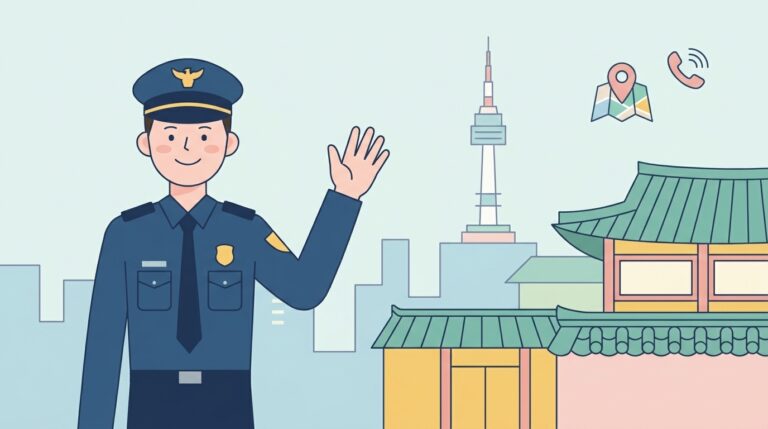
Emergency Korean: How to Ask for Help in Korea (경찰 불러주세요!)
안녕하세요! (An-nyeong-ha-se-yo!) Hello! Welcome back to Daily Hangul, your premium guide to real-life Korean language and culture. I’m your head editor and your personal Seoul-based friend, here to make sure you navigate Korea with absolute confidence.
Phase 1: You’re Safe, But Let’s Be Prepared!
Picture this: You are watching a tense K-Drama. The lead character is walking down a misty alley in Mapo-gu, Seoul. Suddenly, they hear footsteps behind them. They grab their phone, panic, and yell into the receiver. The English subtitles simply say, “Help me!” or “Call the police!”
Have you ever wondered what they actually shouted in Korean?
Korea is famous for being incredibly safe. You can leave your expensive laptop on a cafe table for hours, go to the restroom, and find it untouched when you return! However, emergencies can happen anywhere, at any time. Whether you lose your passport, get lost in a crowded festival in Busan, or need urgent medical or police assistance, knowing how to ask for help in Korean is a superpower that guarantees peace of mind.
Today, we’re going to learn how to shout for help, ask someone to call the police, and make sure you get noticed in an emergency. This guide is based on real questions from our A1 beginner students who wanted to feel 100% secure during their first solo trips to Seoul.
Phase 2: Core Expressions Deep Dive
Let’s learn the 3 most important emergency phrases. Since you are an A1 beginner, we will keep these simple, clear, and highly effective.
1. 경찰 불러주세요!
- Pronunciation: gyeong-chal bul-leo-ju-se-yo
- Sound-alike Guide: “Gyung-chal bool-luh-joo-seh-yo”
- Meaning: Please call the police.
- K-Culture Moment: You will hear this phrase in almost every action or crime K-Drama (like Voice or Signal) when a citizen spots a suspicious situation and runs to a shopkeeper for help.
- Editor’s Insight: 경찰 (gyeong-chal) means “police,” and 불러주세요 (bul-leo-ju-se-yo) means “please call/summon (for me).” Even in an emergency, adding ~요 (yo) at the end keeps it polite so that bystanders immediately take you seriously and help you.
- Situation Spectrum:
- With strangers / Public places: ✅
- To a store clerk or hotel receptionist: ✅
- With close friends (Casual): 🚫 (You would say “경찰 불러!” but in an emergency, politeness gets help faster!)
- 🤔 Think About It: Why do Koreans use polite honorifics (ending in ~요) even during high-stress situations? It shows how deeply mutual respect is hardwired into the Korean social system.
2. 도와주세요!
- Pronunciation: do-wa-ju-se-yo
- Sound-alike Guide: “Doh-wah-joo-seh-yo”
- Meaning: Please help me.
- K-Culture Moment: This is the universal call for help. If you get lost on the subway or need someone to help you carry a heavy suitcase down a steep flight of stairs in Bukchon Hanok Village, say this with a warm smile.
- Editor’s Insight: This is the most versatile survival word in Korea. It comes from the verb 돕다 (dop-da), meaning “to help.”
- Situation Spectrum:
- With strangers / Public places: ✅
- Asking for directions or minor help: ✅
- 🤔 Think About It: When you say 도와주세요, you are appealing to the Korean concept of 정 (Jeong) — a deep, warm feeling of collective connection and empathy towards others. How does your culture express the collective duty to help strangers?
3. 112에 신고해 주세요!
- Pronunciation: il-il-i-e sin-go-hae ju-se-yo
- Sound-alike Guide: “Eel-eel-ee-eh shin-goh-hae-joo-seh-yo”
- Meaning: Please report this to 112 (the police emergency number).
- K-Culture Moment: 112 is the universal police emergency hotline in Korea.
- Editor’s Insight: 신고하다 (sin-go-ha-da) means “to report to authorities.” This is a more direct, urgent way to ask someone to dial the police on their phone.
- Situation Spectrum:
- To bystanders when you can’t access your phone: ✅
- 🤔 Think About It: In Korea, the police (112) and fire/medical emergencies (119) are separated. Why do you think many Asian countries use different numbers for police and ambulance, while some Western countries use a single unified number like 911?
Phase 3: Textbook vs. Real Korean
Let’s compare what dusty grammar textbooks teach you versus what Koreans actually say in real life!
Situation 1: Shouting for immediate help in danger
* 📖 Textbook Korean: “나를 구원해 주십시오!” (na-reul gu-won-hae jup-si-o – Please rescue/salvage me – sounds like a historical novel!)
* 🗣️ Real Korean: “사람 살려!” (sa-ram sal-lyeo! – literally: “Person, save life!” / “Help! / Save me!”)
* 💡 Why it’s different: In a true crisis, nobody uses long grammar patterns. Shouting “사람 살려!” is the standard, instinctual Korean way to scream for your life.
Situation 2: Getting someone’s attention to ask for help
* 📖 Textbook Korean: “실례합니다, 저를 도와줄 수 있습니까?” (sil-rye-ham-ni-da, jeo-reul do-wa-jul su it-seum-ni-ka? – Excuse me, can you help me?)
* 🗣️ Real Korean: “저기요, 죄송한데 이것 좀 도와주세요.” (jeo-gi-yo, joe-song-han-de i-geot jom do-wa-ju-se-yo – Excuse me, I’m sorry but please help me with this.)
* 💡 Why it’s different: Real Korean uses soft qualifiers like 죄송한데 (I’m sorry, but…) and 좀 (a little/please) to soften the request, making the helper feel valued and respected.
Phase 4: Cultural Context — K-Culture Deep Dive
4-1. The Art of “Nunchi” (눈치) in Emergency
If you ever need help in Korea, non-verbal cues are just as important as words. Koreans possess a high degree of 눈치 (Nunchi)—the ability to read the room, expressions, and feelings of others.
- Body Language: If you are in trouble, do not just whisper. Wave your hands, point clearly, and look people in the eye. Making direct eye contact while saying “도와주세요” breaks the social barrier and prompts Koreans to jump into action.
- Using “Jeogiyo” (저기요): Always start by calling out “저기요!” (Excuse me / Over here!) loudly to make people look at you before explaining your emergency.
4-2. K-Travel Connections
If you find yourself lost, injured, or facing a safety issue, Korea has incredible public infrastructure to help you:
* 1330 Korea Travel Hotline: This is a 24/7 free travel helpline run by the Korea Tourism Organization. If you call 1330, you can get instant interpretation services in English, Japanese, Chinese, and more. They can even translate for you when speaking to the police!
Phase 5: Interactive Roleplay Scenarios
Scenario A: Lost Wallet at Hongdae Playground
Setting: It is 10:30 PM on a Friday night in Hongdae. Music is booming from buskers. You suddenly realize your wallet is gone. You approach a friendly-looking Korean college student standing nearby.
Characters:
* YOU: An A1 learner trying to stay calm.
* MIN-SU (민수): A friendly local student (21 years old).
The Dialogue:
- YOU: 저기요! 죄송한데… 😢
(Jeo-gi-yo! Joe-song-han-de…)
“Excuse me! I am sorry, but…”
(🎭 Stage Direction: You look worried and tap your pockets) - MIN-SU: 네? 무슨 일 있어요?
(Ne? Mu-seun il is-seo-yo?)
“Yes? Is something wrong?” - YOU: 지갑을 잃어버렸어요. 😭
(Ji-gabeul i-reo-beo-ryeo-sseo-yo.)
“I lost my wallet.” - MIN-SU: 아, 정말요? 어디서 잃어버렸어요?
(Ah, jeong-mal-yo? Eo-di-seo i-reo-beo-ryeo-sseo-yo?)
“Oh, really? Where did you lose it?” - YOU: 잘 모르겠어요. 핸드폰도 배터리가 없어요.
(Jal mo-reu-ges-seo-yo. Haen-deu-pon-do bae-teo-ri-ga eop-seo-yo.)
“I don’t know. My phone battery is dead too.”
🔀 YOUR TURN! What do you say next to get active help?
* Choice A: “경찰서 어디예요?” (Where is the police station?)
* Choice B: “경찰 좀 불러주세요!” (Please call the police for me!)
* Choice C: “돈 주세요.” (Give me money.)✅ Best Choice: B — Asking them to call the police is the fastest way to get local help, especially if your phone is dead!
- MIN-SU: 아! 알겠어요. 제가 112에 신고해 드릴게요! 📞
(Ah! Al-ges-seo-yo. Jae-ga il-il-i-e sin-go-hae deuri-gae-yo!)
“Ah! I understand. I will call 112 for you!” - YOU: 정말 감사합니다. 도와주셔서 감사해요.
(Jeong-mal gam-sa-ham-ni-da. Do-wa-ju-syeo-seo gam-sa-hae-yo.)
“Thank you so much. Thank you for helping me.”
Scenario B: Emergency Call to Subway Staff
If you feel sick or need help on a subway platform, find the emergency yellow phone on the wall and say this short 3-step conversation:
- YOU: 도와주세요! 머리가 아파요. (Doh-wah-joo-seh-yo! Meo-ri-ga ah-pah-yo.) – Please help me! My head hurts.
- OFFICER: 네, 지금 바로 가겠습니다. (Ne, ji-geum ba-ro ga-ges-seum-ni-da.) – Yes, we are coming right now.
- YOU: 감사합니다. (Gam-sa-ham-ni-da.) – Thank you.
Phase 6: 10-Second Shadowing Drill
Let’s practice speaking with natural speed and emotion! Pay attention to the pauses marked with /.
- Sentence 1 (Urgent/Anxious 🥺):
도와주세요! / 지갑을 / 잃어버렸어요!- (Do-wa-ju-se-yo! / ji-gabeul / i-reo-beo-ryeo-sseo-yo!)
- “Please help me! I lost my wallet!”
- Sentence 2 (Clear and Decisive 😤):
경찰 / 불러주세요! / 112에 / 신고해 주세요!- (Gyeong-chal / bul-leo-ju-se-yo! / il-il-i-e / sin-go-hae ju-se-yo!)
- “Call the police! Please report it to 112!”
Phase 7: K-Culture Mini Dictionary
Let’s build your Korean cultural vocabulary!
- 눈치 (Nunchi)
- Romanization: nunchi
- Meaning: The art of reading situational cues, sensing others’ feelings, and acting tactfully.
- 치안 (Chian)
- Romanization: chian
- Meaning: Public order and safety. Korea is world-famous for its top-tier chian.
- 삐뽀삐뽀 (Bbi-bbo-bbi-bbo)
- Romanization: bbi-bbo-bbi-bbo
- Meaning: The cute onomatopoeia for emergency sirens (police cars and ambulances) in Korea.
- 경찰서 (Gyeong-chal-seo)
- Romanization: gyeong-chal-seo
- Meaning: Police station. Often marked with a friendly blue eagle logo.
Phase 8: Traveler’s Survival Kit
Here are the absolute must-know emergency contacts and resources for anyone traveling to South Korea.
🆘 Essential Emergency Numbers
- Police (경찰): 📞 112
- Fire & Ambulance (소방서/구급차): 📞 119
- Tourist Help & Translation: 📞 1330 (They support 8 languages!)
📌 Editor’s Travel Note
- Emergency Apps: Download the Emergency Ready App (by the Korean government) for English alerts on safety, disasters, and emergency medical center locations.
- CCTV System: Korea has a dense, highly efficient CCTV network. If you lose an item, don’t lose hope! Go to the nearest station; the police can often track it down using cameras.
Phase 9: Critical Thinking Corner — “One Step Deeper”
In many countries, police officers are viewed with high caution or tension. However, in Korea, local neighborhood police boxes, called 치안센터 (chian center) or 파출소 (pachulso), are designed to be warm, friendly community spots. Officers often assist drunk salarymen to get home safely or help lost children buy snacks while waiting for their parents.
🧠 Think Deeper:
This warm approach reflects Korea’s collective culture, where the community looks out for one another. Do police officers in your country play a similar community-friendly role, or is their relationship with the public strictly formal?💬 Your Turn: Share your country’s unique emergency tips or emergency phone numbers in the comments below!
Phase 10: FAQ & Common Mistakes
- Q: Can I use “도와주세요” when asking for a discount at a market?
- A: No! “도와주세요” is only for emergencies or seeking literal help. For a discount, say: “좀 깎아주세요” (jom kkak-a-ju-se-yo – please cut the price a bit).
- Q: What if I don’t speak any Korean when I call 112?
- A: Just say “English, please” or “English interpreter.” The Korean police system has an automated connection to instant translation services.
- ❌ Common Mistake #1: Calling 119 for a minor lost item. Remember: 119 is strictly for fire and medical emergencies. For theft or lost items, use 112 or go to a local police box.
Phase 11: Summary & Action Items
🏆 One-Liner Summary
When you need urgent help, stay calm, make eye contact, and shout: “경찰 불러주세요!” (Please call the police!) or “도와주세요!” (Please help me!).
🎯 Your Action Mission!
- 🥉 Bronze: Say “도와주세요” in front of a mirror 3 times with strong, clear pronunciation.
- 🥈 Silver: Save the numbers 112, 119, and 1330 into your phone contacts right now under “Korea Emergency.”
- 🥇 Gold: Next time you watch a action K-Drama, listen closely for the words 경찰 (police) or 도와주세요 (help me) and post the drama title in the comments!
Phase 12: Interactive Quiz!
Test what you learned today!
1. Which number should you dial if your wallet is stolen?
* A) 119
* B) 112
* C) 114
2. Match the Korean word to its correct English meaning:
* 1) 경찰 (gyeong-chal)
* 2) 도와주세요 (do-wa-ju-se-yo)
* 3) 사람 살려 (sa-ram sal-lyeo)
* Choices: [A: Please help me / B: Police / C: Save my life!/Help!]
3. True or False: You should avoid saying “~요” (~yo) during an emergency because it’s too slow to speak. (T / F)
🔑 Quiz Answers:
- B (112 is for police, while 119 is for ambulance/fire).
- 1-B, 2-A, 3-C
- False. Adding “~요” keeps your request polite yet urgent, which makes bystanders much more eager and comfortable to step in and assist you!
Frequently Asked Questions (FAQ)
Q: What does "경찰 불러주세요!" mean in Korean and how do you pronounce it?
A: In Korean, "경찰 불러주세요!" is pronounced [gyeong-chal bul-leo-ju-se-yo] and means: Please call the police.
Q: What does "도와주세요!" mean in Korean and how do you pronounce it?
A: In Korean, "도와주세요!" is pronounced [do-wa-ju-se-yo] and means: Please help me.
Q: What does "112에 신고해 주세요!" mean in Korean and how do you pronounce it?
A: In Korean, "112에 신고해 주세요!" is pronounced [il-il-i-e sin-go-hae ju-se-yo] and means: Please report this to 112 (the police emergency number).







