

Phase 1: Empathy (스토리 몰입형 오프닝)
안녕하세요! Welcome back to Daily Hangul, your favorite neighborhood guide to living and speaking like a true Seoulite.
Imagine this: You are walking through the breathtaking, light-filled Starfield Library (별마당 도서관) in COEX Mall, or perhaps you’ve stumbled upon a cozy local library in Yeonnam-dong. You see the perfect Korean novel—the very one featured in your favorite K-Drama, Romance is a Bonus Book (로맨스는 별책부록). You want to take it home, cuddle up with a warm cup of sweet yuzu tea, and practice your reading.
You approach the front desk with your library card in hand. Your heart beats a little faster. You know how to say “book” (책 – chaek), but how do you ask to borrow it? And more importantly, how do you make sure you don’t get hit with late fees because you couldn’t understand when to return it?
Don’t worry! Today, we are going to learn how to confidently navigate borrowing books and checking due dates in Korean. Based on real-world experiences from our intermediate students who have successfully navigated Seoul’s public library systems, this guide will turn you from a hesitant visitor into a library regular. Let’s dive in!
Phase 2: Core Expressions (핵심 표현 3선 심층 분석)
1. 책 대출하려고 하는데요. (Chaek dae-chul-ha-ryeo-go ha-neun-de-yo.)
- Pronunciation: Chaek dae-chul-ha-ryeo-go ha-neun-de-yo. / Sound-alike: “Check dae-chool-ha-ryeo-go ha-noon-deh-yo”
- Meaning: “I would like to check out some books.” (Literal: I am intending to do a book loan, so…)
- K-Culture Moment: This is the magic phrase you say right when you place your selected books on the counter. In K-Dramas, this is usually when the camera zooms in on the lead character’s hands touching as they reach for the same library card!
- Editor’s Insight: Using “~하려고 하는데요” (~ryeo-go ha-neun-de-yo) makes your request sound soft and incredibly polite. It signals to the librarian that you are starting a transaction, inviting them to guide you through the next steps.
- Situation Spectrum:
- Friends/Casual: ⚠️ Too formal for close friends, but you wouldn’t borrow books from friends this way anyway.
- Semi-formal (Librarians/Staff): ✅ Perfect!
- Formal (Senior officials): ✅ Highly polite and appropriate.
- 🤔 Think About It: Notice how the Korean word for loaning/borrowing in a formal setting is 대출 (dae-chul), which is also used for bank loans! Why do you think Korean uses highly structured Hanja (Sino-Korean) terms like “대출” instead of the native Korean verb “빌리다” (bil-li-da) at public desks?
2. 반납일이 언제예요? (Ban-nab-il-i eon-je-yeo-yo?)
- Pronunciation: Ban-nab-il-i eon-je-yeo-yo? / Sound-alike: “Bahn-nah-beer-ee eon-jay-yoe-yoe?”
- Meaning: “When is the return due date?” (Literal: When is the return day?)
- K-Culture Moment: Imagine checking out a webtoon compilation book in a cute neighborhood library. You want to make sure you return it on time so you don’t lose your borrowing privileges!
- Editor’s Insight: 반납 (ban-nap) means “return” and 일 (il) means “day.” When spoken quickly, the “p” sound at the end of “반납” links with “일,” making it sound like ban-na-bil. Keep this linking sound in mind so you can catch it when the librarian speaks!
- Situation Spectrum:
- Friends/Casual: ✅ Using “언제야?” (eon-je-ya?)
- Semi-formal (Librarians): ✅ Perfect!
- Formal (Staff): ✅
- 🤔 Think About It: Unlike English, which uses “due date,” Korean directly translates to “return day” (반납일). How does focusing on the act of “returning” rather than “owing” change the vibe of the transaction?
3. 혹시 연기할 수 있어요? (Hok-si yeon-gi-hal su is-seo-yo?)
- Pronunciation: Hok-si yeon-gi-hal su is-seo-yo? / Sound-alike: “Hoke-shee yeon-gee-hahl soo ees-suh-yoe?”
- Meaning: “By any chance, can I extend the due date?” (Literal: Perhaps can I postpone it?)
- K-Culture Moment: You got busy studying for the TOPIK exam, or maybe you got sucked into a 16-episode K-Drama marathon and didn’t finish your book. This phrase is your ultimate lifesaver.
- Editor’s Insight: 연기 (yeon-gi) means to delay or postpone (it also means “acting” in a drama, but context is king!). Adding “혹시” (hok-si – by any chance) at the beginning softens the request, making you sound extremely polite and respectful of library rules.
- Situation Spectrum:
- Friends/Casual: ✅ Using “연기할 수 있어?” (yeon-gi-hal su is-seo?)
- Semi-formal (Librarians): ✅ Perfect!
- Formal (Official systems): ✅
Phase 3: Textbook vs. Real Korean (교과서 한국어 vs 진짜 한국어)
Situation 1: Expressing your intent to borrow books
- 📖 Textbook Korean: “저는 이 책을 빌리기를 원합니다.” (Jeo-neun i chaek-eul bil-li-gi-reul won-hap-ni-da. – “I want to borrow this book.”)
- 🗣️ Real Korean: “이 책 대출해 주세요.” (I chaek dae-chul-hae ju-se-yo. – “Please check this book out for me.”)
- 💡 Why the difference? Textbook Korean often uses the grammatically correct but highly stiff “~하기를 원합니다” (I want to…). Real Koreans prefer direct, action-oriented, yet polite requests using “~해 주세요” (Please do… for me) to keep interactions efficient and natural.
Situation 2: Asking when to return the book
- 📖 Textbook Korean: “도서의 반납 기한은 언제까지입니까?” (Do-seo-ui ban-nap gi-han-eun eon-je-kka-ji-im-ni-da? – “Until when is the return limit of the book?”)
- 🗣️ Real Korean: “이거 언제까지 반납해야 돼요?” (I-geo eon-je-kka-ji ban-nap-hae-ya dwae-yo? – “By when do I have to return this?”)
- 💡 Why the difference? The textbook version sounds like an automated machine reading a Terms of Service page. In real life, locals use “이거” (this) instead of “도서” (literature/book) and the natural obligation grammar “~해야 돼요” (have to do) to sound friendly and human.
Phase 4: K-Culture Deep Dive & Non-Verbal Manners
4-1. Nunchi & Body Language at the Library Desk
When you hand over your books and library card in Korea, remember these two physical manners that show high social intelligence (눈치 – Nunchi):
1. The Two-Hand Pass: Always hand your library card and books to the librarian using both hands. Or, hold your right wrist gently with your left hand as you present the card. This is a subtle sign of deep respect.
2. The Soft Nod: When the librarian hands you the receipt with the due date, bow your head slightly (about 15 degrees) while saying “감사합니다” (gam-sa-ham-ni-da).
4-2. Seoul’s Hidden Cultural Spaces
If you love books, you must visit the Seoul Metropolitan Library, housed in the historic old City Hall building. Unlike standard libraries, modern Korean libraries are community cultural hubs. They offer high-speed Wi-Fi, beautifully curated cafes, and quiet resting zones. Knowing how to ask for book loans opens up these gorgeous architectural marvels to you as a local resident, not just a tourist!
Phase 5: Interactive Roleplay Scenario
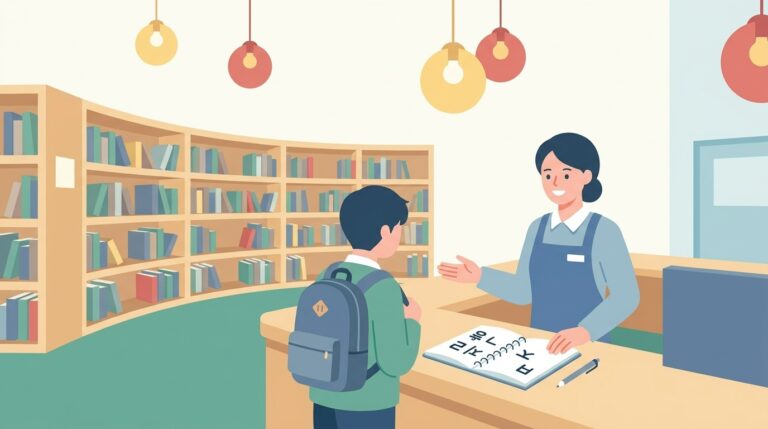
Setting: A quiet, sunny afternoon at the Mapo District Public Library (마포평생학습관). You walk up to the semi-circular wooden desk with two books. A friendly librarian named Ji-eun (지은) looks up and smiles.
- Cast:
- You (Alex): An intermediate Korean learner trying to borrow books.
- Ji-eun (지은): The helpful, warm librarian.
- 지은: 안녕하세요! 오늘 책 대출하시나요?
(An-nyeong-ha-se-yo! O-neul chaek dae-chul-ha-si-na-yo?)
(🎭 Smiling warmly, looking at the books in your hands)
“Hello! Are you checking out books today?” - Alex: 네, 이 책 두 권 대출하려고 하는데요.
(Ne, i chaek du gwon dae-chul-ha-ryeo-go ha-neun-de-yo.)
(🎭 Placing the books gently on the desk with both hands)
“Yes, I’d like to check out these two books.” - 지은: 네, 도서관 회원증 좀 보여주시겠어요?
(Ne, do-seo-gwan hoe-won-jeung jom bo-yeo-ju-si-ges-seo-yo?)
(🎭 Tapping her fingers lightly on the card scanner)
“Sure, could you show me your library card?” - Alex: 아, 여기 있습니다. 외국인 등록증으로 만들었어요.
(Ah, yeo-gi is-seup-ni-da. Oe-guk-in deung-rok-jeung-eu-ro man-deul-os-seo-yo.)
(🎭 Handing over a plastic card with both hands)
“Ah, here it is. I made it using my Alien Registration Card.” - 지은: 확인되었습니다. 알렉스 님 맞으시죠?
(Hwa-gin-doe-os-seup-ni-da. Al-rek-seu nim maj-eu-si-jyo?)
(🎭 Looking at the computer screen and nodding)
“Confirmed. You are Alex, correct?” - Alex: 네, 맞아요. 혹시 반납일이 언제예요?
(Ne, maj-a-yo. Hok-si ban-nab-il-i eon-je-yeo-yo?)
(🎭 Leaning in slightly to catch the dates)
“Yes, that’s right. By the way, when is the due date?” - 지은: 대출 기간은 2주일이라서, 반납일은 10월 24일이에요.
(Dae-chul gi-gan-eun i-ju-il-i-ra-seo, ban-nab-il-eun sip-wol i-sip-sa-il-i-e-yo.)
(🎭 Stamping a small slip of paper and sliding it over)
“The borrowing period is two weeks, so the return date is October 24th.” - Alex: 아, 그렇군요. 혹시 대출 연기도 가능한가요?
(Ah, geu-reoh-gun-yo. Hok-si dae-chul yeon-gi-do gang-eung-han-ga-yo?)
(🎭 Pointing slightly to the book)
“Ah, I see. Is it possible to extend the loan as well?” - 지은: 네, 다음 예약자가 없으면 홈페이지에서 일주일 연장할 수 있어요.
(Ne, da-eum ye-yak-ja-ga eops-eu-myeon hom-pe-i-ji-e-seo il-ju-il yeon-jang-hal su is-seo-yo.)
(🎭 Explaining with polite hand gestures)
“Yes, if there are no reservations, you can extend it for one week on our website.” - Alex: 정말 감사합니다! 잘 읽고 반납할게요.
(Jeong-mal gam-sa-ham-ni-da! Jal ilg-go ban-nap-hal-ge-yo.)
(🎭 Doing a polite 15-degree bow)
“Thank you so much! I’ll read them well and return them.”
🔀 Decision Point!
If you realize you cannot make it to the library by October 24th because of an upcoming trip to Busan, what should you do?
- Choice A: “저 그냥 다음 달에 올게요.” (Jeo geu-nyang da-eum dal-e ol-ge-yo. – “I’ll just come next month.”)
- Critique: 🚫 Oops! Returning books a month late without extension will lock your library card for several weeks!
- Choice B: “혹시 무인 반납기가 밖에 있어요?”
- Critique: ✅ Best Choice! This asks if there is an unmanned return box outside the library. Most Korean libraries have these, allowing you to return books 24/7!
- Choice C: “책을 잃어버렸어요!”
- Critique: ⚠️ Risk! Unless you actually lost the book, saying “I lost the book!” will prompt the librarian to charge you replacement fees.
Phase 6: 10-Second Shadowing Drill
Practice reading these out loud to get the perfect flow! Pay attention to the pause markers / and the emotional cues.
- Drill 1: [😊 Polite and excited]
- “책 좀 / 빌리려고 하는데요.”
- Chhaek jom / bil-li-ryeo-go ha-neun-de-yo.
- (I’d like to borrow some books, please.)
- Drill 2: [🥺 Softly curious]
- “이거 / 언제까지 / 반납해야 돼요?”
- I-geo / eon-je-kka-ji / ban-nap-hae-ya dwae-yo?
- (Until when do I have to return this?)
- Drill 3: [🙏 Hopeful and sweet]
- “혹시 / 일주일만 / 연기해 주실 수 있나요?”
- Hok-si / il-ju-il-man / yeon-gi-hae ju-sil su in-na-yo?
- (By any chance, could you extend it for just one week?)
Phase 7: K-Culture Mini Dictionary
| Word (한글 + Romanization) | Translation | Cultural & Practical Context |
|---|---|---|
| 대출 (Dae-chul) | Book Loan / Checkout | Used universally at libraries. Don’t confuse it with personal bank loans unless you are at a bank! |
| 반납 (Ban-nap) | Return | The act of returning a borrowed item. Look for the 반납함 (ban-nap-ham – return box) near entrances. |
| 연장 (Yeon-jang) / 연기 (Yeon-gi) | Extension / Postponement | Standard practice to get extra reading time. Usually gives you 7 additional days. |
| 회원증 (Hoe-won-jeung) | Membership Card | Often linked to your mobile phone or a physical plastic card. Essential for checkouts. |
Phase 8: Traveler’s Survival Kit
Survival Phrases
- “이 책 어디에 있어요?” (I chaek eo-di-e is-seo-yo?)
- Nuance: “Where is this book?” (Show the book cover on your phone to the librarian!)
- “대출 회원증 만들고 싶어요.” (Dae-chul hoe-won-jeung man-deul-go sip-eo-yo.)
- Nuance: “I want to make a library membership card.” (Bring your Alien Registration Card or Passport!)
- “반납기는 어디에 있나요?” (Ban-nap-gi-neun eo-di-e in-na-yo?)
- Nuance: “Where is the return machine?”
📌 Editor’s Travel Note:
To find your nearest gorgeous public library or local bookstore in Seoul, do not use Google Maps! Instead, download the Naver Map App for incredibly accurate walking directions and public transit routes.
Phase 9: Think Deeper — “한 발 더 깊이”
Korea’s libraries reflect the country’s high-trust society. Many local district libraries let you return books at subway stations using automated smart return boxes. This seamless integration of high technology with civic responsibility shows how deeply Koreans value education and shared community resources.
💬 Your Turn: How does the library system work in your hometown? Do you have unmanned drop-boxes or digital extension apps? Let us know in the comments below!
Phase 10: FAQ & Common Mistakes
Q: Can tourists borrow books from Korean libraries?
A: Generally, No. To physically check out books and take them home, you must have a resident visa (Alien Registration Card – 외국인등록증) or a local address registration. However, tourists are always welcome to read inside the library halls for free without any card!
Q: What happens if I return my library book late in Korea?
A: Instead of monetary fines, Korean libraries usually penalize you by blocking your card. The block period matches the number of days you were late. For example, if you are 5 days late, you cannot borrow books for the next 5 days.
Q: Can I return a book to a different library branch?
A: Yes, in many districts! Seoul operates integrated networks (like “책누리” – Chaek-nuri) that allow you to return books to any branch within the same district or city system. Always double-check at your local counter first!
🚨 Common Mistakes Alert!
- Mistake 1: Saying “책을 돌려주고 싶어요” (I want to give back the book).
- Correct Action: Say “반납할게요” (I will return it). “돌려주다” is conversational and used for personal items, while “반납” is the correct civic term.
- Mistake 2: Handing your ID card over with one hand.
- Correct Action: Use both hands! It shows great respect to public staff.
Phase 11: Action Missions
- 🥉 Bronze (At-Home Challenge): Practice the shadowing drills in Phase 6 three times while looking in the mirror. Focus on making your voice pitch soft and polite!
- 🥈 Silver (Social Challenge): Take a photo of a Korean book you want to read, and post it on social media with the caption: “이 책 대출하고 싶어요!” (I want to borrow this book!) tagging
#DailyHangul. - 🥇 Gold (Real-World Challenge): Visit a local library near you. Find the help desk and ask, “이 책 어디에 있어요?” while showing them a title. You’ve got this!
Phase 12: Interactive Quiz Challenge
Test your knowledge below!
1. Which phrase means “By any chance, when is the due date?”
- A) 책 빌려주세요.
- B) 혹시 반납일이 언제예요?
- C) 회원증 여기 있습니다.
2. Fill in the blank:
“이 책
___________ 하고 싶은데요.” (I would like to borrow/loan this book.)
3. True or False:
Returning a book late in Korea will result in heavy cash fines immediately.
🔍 Click here to check the answers!
- Answer: B (혹시 반납일이 언제예요? is the correct way to ask for the due date.)
- Answer: 대출 (대출 – Dae-chul is the formal term for borrowing books.)
- Answer: False (Instead of cash, your borrowing privileges are suspended for the same number of days you were late!)







