

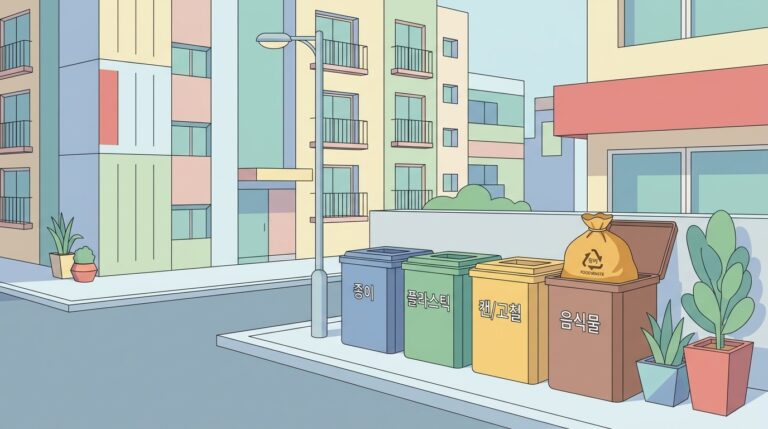
Don’t Get Scolded by Your Korean Landlord! The Ultimate Guide to Food Waste in Korea
안녕하세요! Welcome back to Daily Hangul, your premium Korean language and culture guide. I’m your chief editor, and today we are tackling a topic that has caused sweat, tears, and a lot of awkward encounters with neighborhood grandmas (할머니) for almost every expat in Korea: garbage recycling, specifically food waste.
The K-Drama Reality Check 📺
Picture this: You are living in a cozy rooftop room (옥탑방) just like in your favorite K-drama. You just finished a delicious delivery of Korean fried chicken (치킨). You bundle up the bones and leftovers, put them in a random plastic bag, and drop them in the alley outside. Suddenly, a wild landlord (집주인 아줌마) appears, pointing at your bag with a look of pure betrayal, scolding you in rapid-fire Korean.
This isn’t just a dramatic scene; it’s a real-life rite of passage. Korea has one of the strictest, most sophisticated recycling systems in the world called Jongryangje (종량제). Today, we’re going to make sure you never get scolded. You’ll learn exactly how to talk about, sort, and dispose of your food waste like a true Seoul local!
Phase 2: Core Expressions Deep Dive
1. 음식물 쓰레기
- Pronunciation: [eum-sing-mul sseu-re-gi] (Sounds like: um-sing-mool ssuh-reh-gi)
- Meaning: Food Waste (Literal: “Foodstuff trash”)
- K-Culture Moment: If you watch Korean reality shows like I Live Alone (나 혼자 산다), you will constantly see celebrities complaining about having to take out the eum-sing-mul sseu-re-gi. It is the ultimate household chore bane of existence.
- Editor’s Insight: Remember, in Korea, “food waste” is recycled into animal feed or compost. A golden rule of thumb: If an animal can’t eat it, it’s NOT food waste. (e.g., chicken bones, eggshells, and onion skins go to general trash!)
- Situation Spectrum:
- Casual (친구): ✅
- Semi-formal (직장 동료): ✅
- Formal (어른/상사): ✅
- 🤔 Think About It: Why does Korea separate food waste so strictly compared to other countries? This system reflects Korea’s high population density and deep-rooted community-oriented mindset where environmental maintenance is a shared civic duty.
2. 종량제 봉투
- Pronunciation: [jong-ryang-je bong-tu] (Sounds like: jong-ryahng-jeh bong-too)
- Meaning: Pay-as-you-go garbage bag (Volume-rate disposal bag)
- K-Culture Moment: You can buy these at any convenience store (편의점) or local supermarket (마트). When moving into a new apartment, buying a pack of these is literally the very first thing a Korean friend will tell you to do.
- Editor’s Insight: These bags are region-specific! A bag purchased in Mapo-gu cannot be used in Gangnam-gu. Always buy the ones matching your district.
- Situation Spectrum:
- Casual: ✅
- Semi-formal: ✅
- Formal: ✅
- 🤔 Think About It: Paying for the trash bags you use puts a direct financial price on waste production. Do you think this economic approach would work in your home country?
3. 음식물 쓰레기는 종량제 봉투에 넣다
- Pronunciation: [eum-sing-mul sseu-re-gi-neun jong-ryang-je bong-tu-e neot-da] (Sounds like: um-sing-mool ssuh-reh-gi-neun jong-ryahng-jeh bong-too-eh nuht-dah)
- Meaning: To put food waste in the designated pay-as-you-go bag.
- Editor’s Insight: In spoken Korean, we rarely use the dictionary form “넣다” (to put in). Instead, we say “넣으세요” (please put in) or “넣어야 돼요” (must put in).
- Situation Spectrum:
- Casual: ✅
- Semi-formal: ✅
- Formal: ✅
- 🤔 Think About It: This grammar structure places the object first (음식물 쓰레기는) to emphasize what is being discussed. This highlights the Korean linguistic tendency to prioritize the topic of conversation immediately.
Phase 3: Textbook vs. Real Korean
Let’s look at how Koreans actually talk about this in real life versus what you might find in an outdated textbook.
- Throwing away food leftovers
- 📖 Textbook: 음식물 쓰레기를 쓰레기통에 버리십시오. (Please discard the food waste into the trash can.)
- 🗣️ Real Korean: 음식물은 음식물 봉투에 따로 담아서 버려야 해요. (You have to put food leftovers in a food waste bag separately and throw it away.)
- 💡 Why is it different?: Koreans drop formal grammatical endings like “-십시오” in daily life, preferring “-해야 해요” (must do) to sound helpful yet polite. They also refer to the bag colloquially as “음식물 봉투” (food bag) instead of the full name.
- Buying the bags at a store
- 📖 Textbook: 규격 쓰레기 봉투를 판매합니까? (Do you sell standard-sized garbage bags?)
- 🗣️ Real Korean: 음식물 쓰레기 봉투 노란색(혹은 파란색) 몇 리터짜리 있어요? (What liter sizes of the yellow/blue food waste bags do you have?)
- 💡 Why is it different?: In daily life, referring to the color of the bag (which varies by district but is usually yellow or blue for food waste) and specifying the volume (liters) is much more natural and efficient.
Phase 4: Cultural Context — K-Culture Deep Dive
4-1. The Art of “Nunchi” (눈치) at the Trash Pile
Recycling in Korea is a highly visible social activity. Unlike in some countries where trash is hidden away in private bins, in Korea, you often bring your trash to a designated communal collection spot on the street or in an apartment basement. This is where Nunchi (눈치 – social wits/tact) comes in.
Your neighbors will notice if you throw away unwashed plastic containers or mix food waste with regular trash. Doing it properly shows respect for your community and local sanitation workers.
4-2. K-Drama Trope: The Rooftop Cleaning bonding Session
In romantic comedies, trash sorting is a classic plot device! Think of scenes where the female lead is struggling to carry heavy bags, and the male lead casually walks by, grumbles, but then silently takes the bags from her hands to sort them correctly. Knowing how to recycle isn’t just eco-friendly; in K-dramas, it’s romantic!
Phase 5: Practical Roleplay Scenario
Scenario A: Surviving the Apartment Garbage Spot
- Setting: Sunday evening, 8:00 PM. The communal trash collection area outside a villa in Hongdae. You (the expat tenant) are standing with two bags, looking confused. Min-su (your friendly neighbor, 28) walks up with his own neatly sorted bags.
민수: 안녕하세요! 쓰레기 버리러 나오셨어요? 🗑️
(An-nyeong-ha-se-yo! Sseu-re-gi beo-ri-reo na-o-syeot-eo-yo?)
Min-su: Hello! Are you out to throw away the trash?
(🎭 Stage Direction: Min-su smiles warmly, carrying a bright yellow bag.)
YOU: 네, 그런데 이거 맞는지 모르겠어요. 긁적긁적…
(Ne, geu-reon-de i-geo man-neun-ji mo-reu-get-eo-yo. geul-jeok-geul-jeok…)
YOU: Yes, but I’m not sure if this is correct. Scratching head…
민수: 아, 그 하얀색 봉투는 일반 쓰레기용이에요. 혹시 남은 배달 음식은 어디 있어요?
(Ah, geu ha-yan-saek bong-tu-neun il-ban sseu-re-gi-yong-i-e-yo. Hok-si nam-eun bae-dal eum-sig-eun eo-di it-eo-yo?)
Min-su: Ah, that white bag is for general trash. By the way, where are the food leftovers?
YOU: 그냥 여기 일반 쓰레기에 같이 넣었어요.
(Geu-nyang yeo-gi il-ban sseu-re-gi-e ga-chi neot-eo-yo.)
YOU: I just put them in here with the general trash.
민수: (놀라며) 헉! 안 돼요! 음식물 쓰레기는 따로 버려야 해요. 안 그러면 벌금 나와요!
(Hyeok! An dwae-yo! Eum-sing-mul sseu-re-gi-neun tta-ro beo-ryeo-ya hae-yo. An geu-reo-myeon beol-geum na-wa-yo!)
Min-su: (Surprised) Oh no! You can’t do that! Food waste must be discarded separately. Otherwise, you’ll get fined!
🔀 YOUR TURN! How do you react?
- A) “아, 몰랐어요. 그냥 대충 버릴래요.” (Oh, I didn’t know. I’ll just throw it away roughly anyway.)
- B) “아, 정말요? 죄송해요. 음식물 봉투는 어디서 사요?” (Oh, really? I’m sorry. Where do I buy the food waste bags?)
- C) “벌금이 얼마예요?” (How much is the fine?)
✅ Best Choice: B
Why? Option A is highly disrespectful to the local community and will definitely ruin your relationship with your neighbor. Option C sounds a bit defensive. Option B shows a polite attitude, takes accountability, and asks for practical help.
Let’s continue with Choice B:
민수: 저기 골목 앞에 있는 편의점에서 팔아요. 마포구 음식물 봉투 달라고 하시면 돼요. 2리터짜리가 쓰기 편할 거예요.
(Jeo-gi gol-mok ap-e in-neun pyeon-ui-jeom-e-seo pa-ra-yo. Mapo-gu eum-sing-mul bong-tu dal-la-go ha-si-myeon dwae-yo. I-ri-teo-jja-ri-ga sseu-gi pyeon-hal geo-ye-yo.)
Min-su: They sell them at the convenience store at the end of the alley. Just ask for Mapo-gu food waste bags. The 2-liter ones are convenient to use.
YOU: 아, 마포구 음식물 봉투요? 지금 바로 사러 갈게요. 알려주셔서 감사해요!
(Ah, Mapo-gu eum-sing-mul bong-tu-yo? Ji-geum ba-ro sa-reo gal-ge-yo. Al-ryeo-ju-syeo-seo gam-sa-hae-yo!)
YOU: Ah, Mapo-gu food waste bags? I’ll go buy them right now. Thank you for letting me know!
민수: 아니에요, 모를 수도 있죠! 다음에 또 물어보세요~
(An-i-e-yo, mo-reul su-do it-jyo! Dae-eum-e tto mu-reo-bo-se-yo~)
Min-su: No worries, you could easily not know! Feel free to ask again next time~
Phase 6: 10-Second Shadowing Drill
Practice saying this natural phrase in one go! Pay attention to the pauses (/) and try to mimic the polite, appreciative emotion.
😊 음식물 쓰레기는 / 따로 모아서 / 종량제 봉투에 / 넣어야 해요.
(eum-sing-mul sseu-re-gi-neun / tta-ro mo-a-seo / jong-ryang-je bong-tu-e / neot-eo-ya hae-yo.)
- Emotion: 😊 Polite, helpful, and informative.
- Meaning: “You have to collect food waste separately and put it in a pay-as-you-go bag.”
Phase 7: K-Culture Mini Dictionary
- 분리수거 (bun-ri-su-geo)
- English: Separate trash collection / recycling
- Context: The general practice of sorting plastics, cans, paper, and general waste.
- 일반 쓰레기 (il-ban sseu-re-gi)
- English: General waste / non-recyclable trash
- Context: Put in white district-specific bags.
- 벌금 (beol-geum)
- English: Fine / penalty fee
- Context: Fines for illegal dumping of trash can exceed 100,000 KRW ($80 USD).
- 편의점 (pyeon-ui-jeom)
- English: Convenience store (GS25, CU, 7-Eleven)
- Context: The absolute go-to hub for purchasing local municipal garbage bags.
Phase 8: Traveler’s Survival Kit
Even as a short-term tourist or Airbnb guest, you’ll need to know these basic phrases!
🆘 Survival Expression #1
* 🇰🇷 “음식물 쓰레기 어디에 버려요?”
* (eum-sing-mul sseu-re-gi eo-di-e beo-ryeo-yo?)
* 🗣️ English Pronunciation Guide: Um-sing-mool ssuh-reh-gi uh-dee-eh buh-ryuh-yo?
* 📍 Where to use: Asking your Airbnb host or guesthouse manager.🆘 Survival Expression #2
* 🇰🇷 “종량제 봉투 제일 작은 거 주세요.”
* (jong-ryang-je bong-tu je-il ja-geun geo ju-se-yo.)
* 🗣️ English Pronunciation Guide: Jong-ryahng-jeh bong-too jeh-il jah-goon guh joo-seh-yo.
* 📍 Where to use: At the convenience store checkout counter to buy the smallest trash bag size (usually 1L or 2L for food waste).
📌 Editor’s Travel Note
- Useful Apps: Use Naver Map or KakaoMap to locate the closest major grocery stores if convenience stores run out of bags.
- Cash vs. Card: You can easily buy garbage bags with a credit card at major convenience stores, but some tiny mom-and-pop shops might prefer cash for small-amount bag purchases.
- Tipping: There is absolutely no tipping culture in Korea. Instead, being neat with your trash is considered the best “tip” you can leave your hosts!
Phase 9: Critical Thinking — “A Step Deeper”
🧠 Think Deeper:
Korea’s meticulous recycling system is deeply connected to its historical transition from a developing nation to a global green leader. Because Korea is mountainous with limited landfill space, processing waste efficiently became a survival necessity. The “Jongryangje” system, introduced in 1995, significantly changed public behavior through a mixture of community peer pressure and small economic penalties. This blend of community responsibility and modern systems is a cornerstone of daily life in Korea.💬 Your Turn: “How does your home country manage waste? Do you think a pay-as-you-go bag system like Korea’s would succeed in your city? Let us know in the comments!”
Phase 10: FAQ & Avoiding Misconceptions
- Q: Can I just throw food waste in a normal plastic bag if I tie it tightly?
- A: Absolutely NOT. Doing so is considered illegal dumping. You must use the official, colored, government-regulated “종량제 봉투” designated for food waste.
- Q: Can chicken bones and banana peels go in the same food waste bag?
- A: No! Banana peels are soft enough to be processed as animal feed, so they are food waste. Chicken bones are hard and must go into general trash (일반 쓰레기).
- ❌ Common Mistake: Forgetting that plastic wraps and stickers on fruit peels must be peeled off before throwing the skin into the food waste bag.
Phase 11: Summary & Action Items
One-Liner Summary
Food waste in Korea must go strictly into region-specific pay-as-you-go bags (종량제 봉투) to keep the neighborhood clean and avoid fines!
Action Mission
- 🥉 Bronze: Say 음식물 쓰레기 (eum-sing-mul sseu-re-gi) loud and clear 3 times in front of your mirror.
- 🥈 Silver: Next time you go to a Korean convenience store, practice asking: “음식물 봉투 있어요?” (Do you have food waste bags?).
- 🥇 Gold: Correctly sort your leftovers from your next delivery meal into food waste and general waste!
Phase 12: Interactive Quiz
1. Which of the following is considered FOOD WASTE (음식물 쓰레기) in Korea?
* A) Peach pits (peach stones)
* B) Watermelon rinds (soft skin portion)
* C) Eggshells
* D) Beef rib bones
2. Where should you purchase a 종량제 봉투 (garbage bag)?
* A) Subway station vending machine
* B) Local post office
* C) Convenience store or local mart
* D) Coffee shops
3. True or False: “You can use a Mapo-gu trash bag in Gangnam-gu.”
* A) True
* B) False
🔑 Quiz Answers & Explanations
- B — Watermelon rinds are soft and biodegradable enough for animal feed. Pits, eggshells, and bones are classified as general waste.
- C — Convenience stores (편의점) are the easiest places to buy them.
- B (False) — Waste bags are strictly region-locked! You must use the bags designated for your specific district.
Frequently Asked Questions (FAQ)
Q: What does "음식물 쓰레기" mean in Korean and how do you pronounce it?
A: In Korean, "음식물 쓰레기" is pronounced [eum-sing-mul sseu-re-gi] and means: Food Waste (Literal: "Foodstuff trash")
Q: What does "종량제 봉투" mean in Korean and how do you pronounce it?
A: In Korean, "종량제 봉투" is pronounced [jong-ryang-je bong-tu] and means: Pay-as-you-go garbage bag (Volume-rate disposal bag)
Q: What does "음식물 쓰레기는 종량제 봉투에 넣다" mean in Korean and how do you pronounce it?
A: In Korean, "음식물 쓰레기는 종량제 봉투에 넣다" is pronounced [eum-sing-mul sseu-re-gi-neun jong-ryang-je bong-tu-e neot-da] and means: To put food waste in the designated pay-as-you-go bag.







