

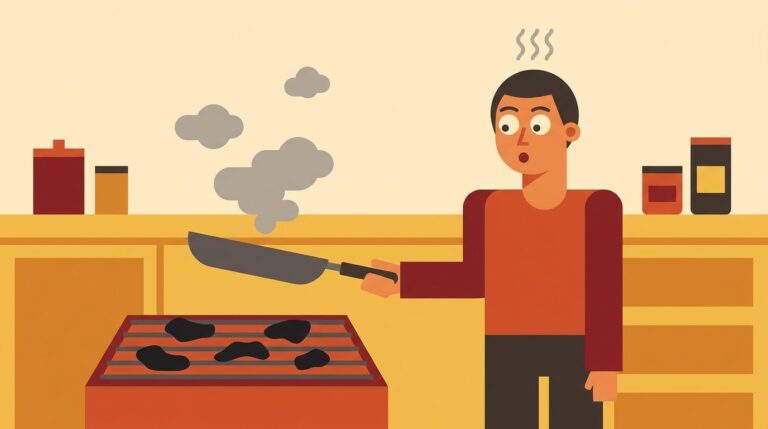
Phase 1: Empathy (The K-Culture Cold Open)
Hello! This is your Daily Hangul Editor.
Imagine this: You are at a bustling Korean BBQ restaurant in Gangnam. The sizzling sound of premium Samgyeopsal (pork belly) is like music to your ears. You, wanting to impress your Korean friends, confidently grab the tongs. “I got this!” you declare. But then, an iconic K-Pop song blasts through the speakers, you get distracted singing along, and suddenly… thick smoke fills the air. The once-glorious golden-brown pork is now a tragedy of black char.
Everyone stares. The ajumma (restaurant auntie) clicks her tongue in disapproval.
In textbooks, you might have learned to say, “저는 고기를 태웠습니다” (I burned the meat). But if you say that in this chaotic, smoke-filled moment, it sounds like you’re reading a news report about a minor incident.
How do you capture that sheer panic, regret, and the “Oops, I messed up!” nuance that native Koreans use? Today, we are going to learn how to talk about your past mistakes—specifically, burning food—like a true local. Trust me, I’ve ruined enough Shin Ramyun pots in my 10 years in Seoul to know exactly how to say this!
Phase 2: Deep Dive into Core Expressions
Let’s look at the B1-level expressions that add flavor and emotion to your cooking disasters.
1. 깜빡했어요 (I completely forgot!)
- Pronunciation: kkam-ppak-hae-sso-yo [Sounds like the ‘gg’ in “egg” followed by a quick pop. Imagine the sound of a light switch flicking off in your brain!]
- Meaning: Literal = I blinked; Real nuance = It completely slipped my mind!
- K-Culture Moment: You put a pot of water on the stove for Tteokbokki, sat down to watch just one episode of Queen of Tears, and suddenly an hour passed. When you realize it, you slap your forehead and shout this.
- Editor’s Insight: This isn’t just “잊었어요” (I forgot). It has a strong visual feeling of something flashing out of your memory. It’s the ultimate “my bad” excuse for minor mistakes.
- Situation Spectrum:
- Close Friends (Casual): 깜빡했어! ✅
- Co-workers (Semi-formal): 깜빡했어요. ⚠️ (Okay, but apologize right after!)
- Boss/Elders (Formal): 🚫 (Too casual, use “제가 미처 생각을 못 했습니다”)
- 🤔 Think About It: “깜빡” is an onomatopoeia for blinking or flickering. Why do Koreans use a word for “blinking lights” to describe human memory?
2. 태워 먹었어요 (I burned it all up / I ruined it by burning)
- Pronunciation: tae-wuh mug-uh-sso-yo
- Meaning: Literal = I burned it and ate it; Real nuance = I accidentally burned it (and I feel stupid about it).
- K-Culture Moment: The holy grail of Korean expressions for ruining things. Whether you burned the toast or scorched the jeon (Korean pancake) for Chuseok, this is what you say while looking at the charcoal-like remains.
- Editor’s Insight: Why “먹다” (to eat)? In Korean slang, adding “-어/아 먹다” to a negative verb emphasizes that you messed up or ruined the situation. You aren’t actually eating the burnt food!
- Situation Spectrum:
- Close Friends (Casual): 태워 먹었어! ✅
- Co-workers (Semi-formal): 태워 먹었어요. ✅ (Great for light self-deprecation)
- Boss/Elders (Formal): 🚫 (Use “제가 실수로 태웠습니다”)
- 🤔 Think About It: Adding “to eat” to emphasize a mistake (e.g., 까먹다 = to forget, 잊어 먹다 = to lose). How does food-related vocabulary reflect the Korean mindset?
3. 불 끄는 걸 깜빡할 뻔했어요 (I almost forgot to turn off the stove!)
- Pronunciation: bul kkeu-neun geol kkam-ppak-hal ppeon-hae-sso-yo
- Meaning: I almost forgot to turn off the fire/stove.
- K-Culture Moment: Rushing out of your Seoul apartment to catch the morning subway, locking the door, and suddenly wondering: “Did I turn off the stove?” You run back inside, turn it off just in time, and sigh in relief.
- Editor’s Insight: The B1 grammar “-(으)ㄹ 뻔하다” means “almost did [something bad].” It’s essential for telling dramatic past-tense stories where disaster was narrowly avoided.
- Situation Spectrum:
- Close Friends (Casual): 깜빡할 뻔했어! ✅
- Co-workers (Semi-formal): 깜빡할 뻔했어요. ✅
- Boss/Elders (Formal): 🚫
Phase 3: Textbook vs. Real Korean
Let’s see how textbooks differ from what you’ll actually hear in a Korean kitchen or BBQ joint.
[Situation 1: Confessing you ruined the food]
* 📖 Textbook Korean: 저는 요리를 하다가 음식을 태웠습니다. (I burned the food while cooking.)
* 🗣️ Real Korean: 아 어떡해! 다 태워 먹었어요 ㅠㅠ (Oh what do I do! I burned it all.)
* 💡 Why is it different?: Koreans use “어떡해” (What do I do) to show empathy for the situation, and “-어 먹다” adds a layer of emotional regret that formal verbs lack.
[Situation 2: Forgetting something on the stove]
* 📖 Textbook Korean: 불 끄는 것을 잊었습니다. (I forgot to turn off the fire.)
* 🗣️ Real Korean: 아 맞다! 가스불 끄는 걸 깜빡했어요! (Ah right! I completely forgot to turn off the gas stove!)
* 💡 Why is it different?: “아 맞다!” (Ah, right!) is the universal Korean exclamation for a sudden realization.
Bottom Note: At the B1 level, mastering these emotional filler words (아 맞다, 어떡해) makes you sound instantly more fluent and relatable.
Phase 4: K-Culture Deep Dive
4-1. Non-Verbal Cues (The “Oops” Body Language)
When you burn the food in Korea, don’t just stand there!
– The Nunchi: Nunchi (눈치) is the subtle art of reading the room. If you burn the meat at a team dinner, immediately grab the scissors to cut off the burnt edges, or apologize playfully to break the tension.
– The Hand Gesture: When saying “어떡해!” (What do I do!), playfully stomping your feet or holding your cheeks emphasizes your genuine panic.
4-2. The K-Food Connection: The Sacred Art of Grilling
In Korean culture, communal eating is everything. At a K-BBQ restaurant, grilling the meat is a huge responsibility, usually falling to the Maknae (the youngest person in the group). Burning the meat isn’t just a culinary mistake; it’s a social faux pas! If you burn the precious Hanwoo (Korean beef), it will be a legendary story your Korean friends will tease you about for years. Using “태워 먹었어요” shows you understand the gravity of this “tragedy” with a sense of humor.
Phase 5: Roleplay Scenario
Setting: Friday night, 7 PM. A smoky Samgyeopsal place near Gangnam Station. Soju bottles line the table. You are the designated griller for your Korean colleagues.
Characters:
– YOU (Expat Learner): Confident but got distracted talking about a drama.
– Minsu (32, Co-worker): Friendly, loves food, currently starving.
Dialogue:
Minsu: 배고파 죽겠어요. 고기 다 익었어요? 🥩
(baegopa jukgesseoyo. gogi da igeosseoyo?)
[I’m starving to death. Is the meat fully cooked?]
YOU: 아! 어떡해요! (Turning over the meat to reveal pitch-black pork belly)
(a! eotteokaeyo!)
[Ah! What do I do!]
Minsu: 헉… 이거 숯 아니에요? ㅋㅋㅋ
(heok… igeo sut anieyo? kkk)
[Gasp… Isn’t this charcoal? lol]
🔀 Your Turn! How should you respond?
– A) “저는 고기를 태웠습니다.” (Textbook robot)
– B) “진짜 미안해요. 얘기하다가 다 태워 먹었어요! 제가 다시 시킬게요!” (The insider)
– C) “아싸! 까맣게 탔다!” (A psychopath)✅ Best Choice: B — You used the natural phrase (태워 먹었어요), acknowledged the distraction, and immediately offered to buy the next round. Maximum Nunchi points!
Phase 6: 10-Second Shadowing Drill
Practice this out loud. Pay attention to the pauses (/) and the emotion tags!
😱 아 어떡해! / 찌개 불 끄는 걸 / 깜빡했어요! / 냄비를 다 / 태워 먹었어요!
(a eotteokhae! / jjigae bul kkeu-neun geol / kkam-ppak-hae-sso-yo! / naembi-reul da / tae-wuh mug-uh-sso-yo!)
Translation: Oh no! I forgot to turn off the stove for the stew! I burned the whole pot!
Phase 7: K-Culture Mini Dictionary
1. 눈치
* Romanization: nunchi
* English: Situational awareness / reading the room.
* Context: The essential social skill in Korea. Knowing when to flip the meat before it burns requires great nunchi.
2. 회식
* Romanization: hoesik
* English: Company dinner.
* Context: The ultimate team-building (and meat-grilling) event in Korean corporate culture.
3. 막내
* Romanization: maknae
* English: The youngest person in a group.
* Context: At K-BBQ, the maknae is unofficially the Head Chef. If you are the youngest, guard that grill with your life!
4. 불판(판)
* Romanization: bul-pan (pan)
* English: The grill pan.
* Context: If you burn the meat, the pan turns black. You must ask the staff to change the pan to save the next batch.
Phase 8: Traveler Survival Kit
Even if you aren’t cooking at home, you will encounter grills in Korea. Here is how to survive a K-BBQ disaster.
🆘 Survival Phrases for K-BBQ
– 🇰🇷 “여기 판 좀 갈아주세요!” (yeogi pan jom gara-juseyo!)
– 🗣️ Meaning: Please change the grill pan here!
– 📍 Use it when: The grill is burnt and black.
– 🇰🇷 “불 좀 줄여주세요!” (bul jom juryeo-juseyo!)
– 🗣️ Meaning: Please turn down the heat!
– 📍 Use it when: The fire is roaring like a volcano and your meat is in danger.📌 Editor’s Travel Note
– Scissor Skills: In Korea, meat is cut with scissors (가위). If you burn the meat, use the scissors to trim off the burnt edges (탄 부분). It’s a lifesaver!
– Tip Culture: You don’t need to tip the staff for changing your burnt grill pan! Tipping is not practiced in Korea.
Phase 9: Critical Thinking Corner — “A Step Deeper”
Food & Identity: The Communal Grill
In many Western cultures, a meal is served on individual plates. If you burn your steak, only you suffer. However, in Korea, the grill sits in the exact center of the table. Everyone shares the same fire, the same meat, and the same stew.
Therefore, burning the food is a shared crisis. It disrupts the harmony of the group. Expressions like “태워 먹었어요” carry a collective apology—you haven’t just ruined your food; you’ve disappointed the community!
💬 Your Turn: How does your culture handle shared cooking? If someone ruins a shared dish, what is the typical reaction? Let us know in the comments!
Phase 10: FAQ & Common Mistakes
Q: Can I use “태워 먹었어요” to my boss at a company dinner?
Maybe, but with caution. If your workplace is very casual, it can be a funny, self-deprecating joke. However, if your boss is strict, stick to the safer: “죄송합니다, 제가 고기를 태웠습니다.” (I’m sorry, I burned the meat.)
Q: Is it rude to ask the staff to cook the meat for me so I don’t burn it?
Not at all! In fact, many premium BBQ places in Korea are “그릴링 서비스” (Grilling service) restaurants where the staff cooks it perfectly for you. Just search for “구워주는 고기집” (Restaurants that grill the meat for you) on Naver Maps!
❌ Common Mistake #1: Taking “태워 먹었어요” literally.
✅ Do this instead: Do NOT try to eat the burnt food just because the verb has “먹다” (to eat) in it. It’s just a grammatical nuance for messing up!
Phase 11: Summary & Action Items
One-Liner Summary: Use “깜빡했어요” when you completely forget, and “태워 먹었어요” to adorably confess you ruined the food by burning it!
Action Mission 3 Steps:
– 🥉 Bronze (Solo): Stand in front of your stove, point at a pan, and dramatically say, “다 태워 먹었어요!” 3 times.
– 🥈 Silver (Online): Post a picture of your past cooking disaster in our community with the caption “제가 다 태워 먹었어요 ㅠㅠ”.
– 🥇 Gold (Real World): Next time you are at a K-BBQ restaurant with a Korean friend, jokingly pretend to burn the meat and use the phrase!
🎬 K-Culture Mission: Watch an episode of a Korean variety show (like Jinny’s Kitchen or I Live Alone). Keep an ear out—you will 100% hear someone yell “다 탔어!” (It’s all burnt!) or “깜빡했다!” (I forgot!).
Phase 12: Quiz — Interactive Challenge
1. Situational Judgment:
You are boiling ramen, but you started watching a K-Pop MV and the water completely boiled away, burning the noodles. What is the most natural thing to say to your roommate?
– A) 저는 라면을 끓이다가 태웠습니다.
– B) 아, 가스불 끄는 걸 깜빡해서 다 태워 먹었어!
– C) 라면이 불에 탔습니다.
2. Fill in the Blank:
“아 맞다! 불 끄는 걸 (________)할 뻔했어!”
(Ah right! I almost forgot to turn off the stove!)
3. True or False – K-Culture Edition:
At a K-BBQ restaurant, if the pan turns black from burnt meat, you should pay a fine to the restaurant. (T / F)
🚨 Click here for Answers!
- B – It perfectly combines the sudden realization (깜빡하다) with the regretful result (태워 먹다).
- 깜빡 (kkam-ppak) – The magical word for forgetting something instantly.
- False – Just confidently yell “여기 판 좀 갈아주세요!” (Please change the pan!) The staff will do it for free with a smile.
Frequently Asked Questions (FAQ)
Q: What does "깜빡했어요 (I completely forgot!)" mean in Korean and how do you pronounce it?
A: In Korean, "깜빡했어요 (I completely forgot!)" is pronounced [kkam-ppak-hae-sso-yo [Sounds like the 'gg' in "egg" followed by a quick pop. Imagine the sound of a light switch flicking off in your brain!] and means: Literal = I blinked; Real nuance = It completely slipped my mind!
Q: What does "태워 먹었어요 (I burned it all up / I ruined it by burning)" mean in Korean and how do you pronounce it?
A: In Korean, "태워 먹었어요 (I burned it all up / I ruined it by burning)" is pronounced [tae-wuh mug-uh-sso-yo] and means: Literal = I burned it and ate it; Real nuance = I accidentally burned it (and I feel stupid about it).
Q: What does "불 끄는 걸 깜빡할 뻔했어요 (I almost forgot to turn off the stove!)" mean in Korean and how do you pronounce it?
A: In Korean, "불 끄는 걸 깜빡할 뻔했어요 (I almost forgot to turn off the stove!)" is pronounced [bul kkeu-neun geol kkam-ppak-hal ppeon-hae-sso-yo] and means: I almost forgot to turn off the fire/stove.







