

Phase 1: Empathy & K-Culture Cold Open
Hello there! It’s your Daily Hangul Editor.
Picture this: You are watching a mega-hit K-Drama. The handsome CEO is driving his sleek, newly released luxury sedan down the Olympic Expressway. Suddenly, the romantic OST swells, he turns on the ‘Highway Driving Assist’ (ADAS), completely takes his hands off the steering wheel, turns his entire body to face the female lead, and stares deeply into her eyes for what feels like three business days.
It looks incredibly romantic on screen, right? But as someone who has driven in Seoul for over a decade, let me tell you—if you try that in real life, you won’t get romance. You will get a chorus of furious honking, a near-miss with a delivery scooter, and possibly a mild heart attack.
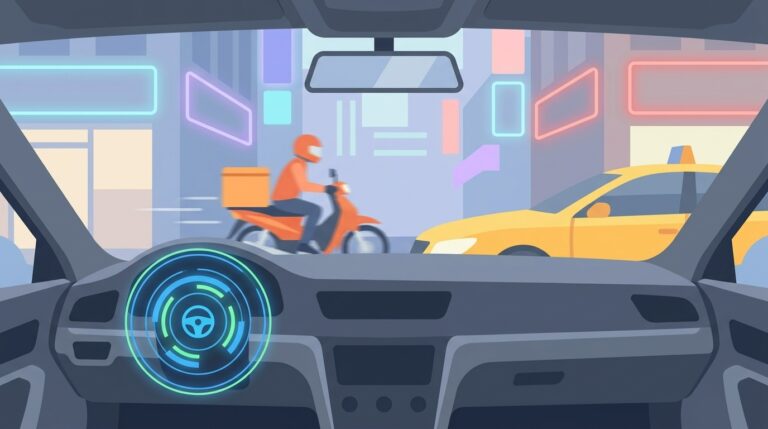
Today, we are talking about Driving (자동차 운전) in Korea, specifically why you should never over-rely on Advanced Driver Assistance Systems (자율 주행 보조 기능의 과신 금지). Korea’s roads are notoriously dynamic. Between the ‘Ppal-li Ppal-li’ (hurry up) culture, unpredictable alleyways, and the sheer volume of delivery motorcycles weaving through traffic, trusting a machine to do all the work is a dangerous game.
For advanced (C2) learners, discussing technology, safety, and reliance requires more than just saying “Be careful.” We need sophisticated vocabulary to express caution, technological limits, and situational awareness. This guide is built on real conversations I’ve had with expats who rented cars for Jeju Island road trips or braved the Gangnam rush hour. Let’s dive in!
Phase 2: Core Expressions Deep Dive
1. 기계를 맹신하지 마세요. (Do not blindly trust the machine.)
- Pronunciation: gigyereul maengsinhaji maseyo. [gi-gye-reul / maeng-shin-ha-ji / ma-se-yo]
- Meaning: Literal: Do not have blind faith in the machine. Real Nuance: Don’t put 100% of your trust in the ADAS; it’s not foolproof.
- K-Culture Moment: You’ll hear this on Korean news channels or from a seasoned Korean taxi driver (기사님) when discussing self-driving car accidents.
- Editor’s Insight: The word 맹신 (Maeng-sin) means ‘blind faith’ or ‘over-reliance.’ It’s a high-level, intellectual word that instantly makes your Korean sound professional and native-like. It’s much stronger than just saying ‘믿지 마세요’ (don’t trust).
- Situation Spectrum:
- Casual friends: ✅ (Though sounds a bit intellectual, it’s used to give strong advice)
- Co-workers (Semi-formal): ✅
- Boss/Elders (Formal): ✅ (Perfect for professional discussions)
- 🤔 Think About It: Why does Korean have so many specific words for ‘trust’ (믿음, 신뢰, 맹신, 과신)? How does this reflect a society that rapidly adopted cutting-edge tech but still highly values human intuition?
2. 자율 주행은 어디까지나 보조 수단일 뿐입니다. (Autonomous driving is, at the end of the day, merely a supplementary tool.)
- Pronunciation: jayul juhaeng-eun eodikkajina bojo sudanil ppunimnida.
- Meaning: Literal: Autonomous driving is up to anywhere just an assisting method. Real Nuance: Self-driving is just an assistant, don’t treat it like the main driver.
- K-Culture Moment: This is the exact phrasing a car salesman at a dealership in Gangnam would use to cover their liability, or how a driving instructor warns a student.
- Editor’s Insight: The grammar structure ~일 뿐이다 (is merely/just) combined with the adverb 어디까지나 (to the bitter end / ultimately) is a C2 powerhouse. It sets a firm boundary on the limits of technology.
- Situation Spectrum:
- Casual friends: ⚠️ (A bit too formal, use “보조일 뿐이야” instead)
- Co-workers (Semi-formal): ✅
- Boss/Elders (Formal): ✅
- 🤔 Think About It: In Korean tech culture, there’s a strong emphasis on the ‘operator’s responsibility.’ How does the phrasing ‘merely a tool’ reflect the Korean legal and social mindset regarding accidents?
3. 방심하는 순간 돌발 상황이 생길 수 있어요. (The moment you let your guard down, an unexpected situation can occur.)
- Pronunciation: bangsimhaneun sungan dolbal sanghwang-i saenggil su isseoyo.
- Meaning: Literal: The moment of carelessness, sudden situations can arise. Real Nuance: Stay alert, or a motorcycle will cut you off out of nowhere.
- K-Culture Moment: You are driving through a narrow alley in Itaewon. You look at your navigation screen for two seconds, and a pedestrian steps out. Your Korean friend gasps and says this.
- Editor’s Insight: 방심하다 (to let one’s guard down) and 돌발 상황 (sudden/unexpected situation) are crucial driving terms. In Korea, ‘dolbal sanghwang’ usually involves a delivery scooter, a suddenly stopping taxi, or a jaywalker.
- Situation Spectrum:
- Casual friends: ✅
- Co-workers (Semi-formal): ✅
- Boss/Elders (Formal): ✅
Phase 3: Textbook vs. Real Korean
[Situation 1: Warning someone about ADAS over-reliance]
* 📖 Textbook Korean: 기계를 너무 믿지 마십시오. (Do not trust the machine too much.)
* 🗣️ Real Korean: 자율주행 켜놨어도 운전대 놓으면 안 돼요. (Even if you turned on autopilot, you shouldn’t let go of the steering wheel.)
* 💡 Why the difference?: Real Korean is highly pragmatic. Instead of a philosophical “don’t trust machines,” locals give actionable advice: “Don’t let go of the wheel.”
[Situation 2: When the ADAS acts up on a Korean road]
* 📖 Textbook Korean: 자동차의 센서가 작동하지 않습니다. (The car’s sensor is not working.)
* 🗣️ Real Korean: 아, 또 센서 오작동하네. 맹신하면 큰일 나요. (Ah, the sensor is acting up again. Big trouble if you blindly trust it.)
* 💡 Why the difference?: Koreans use compound Sino-Korean words like 오작동 (malfunction) heavily in daily life when discussing tech, combined with the dramatic exclamation 큰일 나요 (it will be a big disaster).
Bottom Note: For C2 learners, integrating high-level Sino-Korean words (한자어) like 맹신 (blind trust), 과신 (overconfidence), and 오작동 (malfunction) into casual speech makes you sound incredibly fluent.
Phase 4: Cultural Context — K-Culture Deep Dive
4-1. Non-Verbal Elements & ‘Nunchi’ on the Road
In Korea, driving requires extreme Nunchi (눈치). ADAS relies on painted lines and set distances, but Korean driving relies on reading the ‘mood’ of the road. If a taxi in front of you slightly shifts its weight to the right, your ‘Nunchi’ tells you it’s about to abruptly stop for a passenger, even without a turn signal. ADAS doesn’t have Nunchi. Therefore, physically hovering your foot over the brake (even with Adaptive Cruise Control on) is an expected non-verbal sign of a responsible driver.
4-2. The K-Food Delivery Phenomenon & Road Chaos
Let’s talk about why ADAS struggles in Korea: The Baedal (배달 – Delivery) Culture. Korea’s food delivery is world-class. You can get piping hot fried chicken delivered to a park by the Han River in 20 minutes. But this speed comes at a cost. Delivery riders on motorcycles often weave through traffic, split lanes, and sometimes ignore traffic lights to meet tight deadlines.
Advanced sensors in foreign cars are often calibrated for predictable Western traffic patterns. They can easily miss a scooter darting diagonally across three lanes. When driving in Seoul, you are not just watching other cars; you are participating in a high-stakes dance with delivery riders. Over-trusting your car’s auto-brake here isn’t just lazy; it’s a hazard.
Phase 5: Real-life Roleplay Scenario
Scenario A: The Gangnam Rush Hour Ride
- Setting: Friday night, 8 PM. Teheran-ro in Gangnam. Traffic is crawling. The neon signs reflect off your rental car’s windshield. You are giving a ride to your Korean colleague after a team dinner (회식).
- Characters:
- YOU: An expat working in Seoul, confident in your car’s tech.
- Minsu (32): Your Korean colleague. Friendly, but currently gripping the ‘oh-shoot’ handle above the passenger door.
Dialogue:
Minsu: 차 진짜 막히네요. 운전하기 피곤하시죠?
(cha jinjja makhineyo. unjeonhagi pigonhasijyo?)
[Traffic is really backed up. You must be tired driving, right?]
YOU: 괜찮아요. 어차피 자율 주행 켜놔서 차가 알아서 가요.
(gwaenchanayo. eochapi jayul juhaeng kyeonwaseo chaga araseo gayo.)
[It’s fine. I turned on autonomous driving anyway, so the car is going by itself.]
Minsu: 어? 그래도 강남역 근처에서는 조심하셔야 해요.
(eo? geuraedo gangnamyeok geuncheoeseoneun josimhasyeoya haeyo.)
[Huh? Still, you need to be careful around Gangnam Station.]
YOU: 에이, 요즘 기술이 얼마나 좋은데요. 완벽해요.
(ei, yojeum gisuri eolmana joeundeyo. wanbyeokaeyo.)
[Come on, technology is so good these days. It’s perfect.]
(🎭 Stage Direction: Suddenly, a delivery motorcycle swerves right in front of your bumper. The ADAS alarm violently beeps, but the car reacts a split second too late. You have to slam the brakes manually.)
Minsu: 헉! 거봐요. 제 말이 맞죠? 기계를 너무 맹신하시면 안 돼요!
(heok! geobwayo. je mari matjyo? gigyereul neomu maengsinhasimyeon an dwaeyo!)
[Gasp! See? I was right, wasn’t I? You shouldn’t blindly trust the machine!]
🔀 Your Turn! How do you respond?
– A) “아, 놀랐네요. 역시 기계는 보조 수단일 뿐이네요.” (Ah, that startled me. As expected, the machine is merely a supplementary tool.)
– B) “차가 이상해요! 고장 난 거 아니에요?” (The car is weird! Isn’t it broken?)
– C) “저 오토바이가 미친 거예요!” (That motorcycle is crazy!)✅ Best Choice: A — It acknowledges the cultural tech-reality using high-level C2 vocabulary (보조 수단일 뿐). It shows humility and quick adaptation to the local environment.
⚠️ Choice C Analysis: Blaming the motorcycle might be technically true, but aggressively yelling “미친 거예요” can ruin the polite atmosphere with a colleague.
Scenario B: The K-Drama Illusion
- Setting: A cafe in Jeju Island. You and a friend are renting a car.
Friend: 야, 우리 차에 자율주행 있대! 드라마 주인공처럼 해보자!
(ya, uri chae jayuljuhaeng itdae! deurama juingongcheoreom haeboja!)
[Hey, our car has autonomous driving! Let’s do it like the drama main characters!]
YOU: 야, 정신 차려. 방심하는 순간 돌발 상황 생기는 거 몰라? 드라마랑 현실은 달라.
(ya, jeongsin charyeo. bangsimhaneun sungan dolbal sanghwang saenggineun geo molla? deuramarang hyeonsireun dalla.)
[Hey, snap out of it. Don’t you know unexpected situations happen the moment you let your guard down? Dramas and reality are different.]
Phase 6: 10-Second Shadowing Drill
Shadow this sentence focusing on the C2 vocabulary.
😤 자율 주행은 / 어디까지나 / 보조 수단일 뿐이니까, / 절대 / 맹신하지 마세요.
(jayul juhaeng-eun / eodikkajina / bojo sudanil ppuninikka, / jeoldae / maengsinhaji maseyo.)
- Rhythm Guide: Pause slightly after ‘주행은’ and ‘뿐이니까’. Put a strong, firm emphasis on 절대 (never) and 맹신 (blind trust).
- Sound Analogy: The ‘으’ in ‘은’ sounds like the disgusted grunt you make when stepping in gum.
Phase 7: K-Culture Mini Dictionary
1. 눈치 (Nunchi)
* Romanization: nunchi
* English: Social situational awareness / Reading the room (or the road)
* Context: On Korean roads, Nunchi is your best ADAS. It’s the ability to predict what the erratic driver ahead will do before they even signal.
2. 칼치기 (Kalchigi)
* Romanization: kalchigi
* English: Reckless, sharp lane changing
* Context: A highly dangerous driving maneuver where a car violently cuts in front of you with almost no clearance. ADAS systems hate this.
3. 과속 방지턱 (Gwasok bangjiteok)
* Romanization: gwasok bangjiteok
* English: Speed bump
* Context: Korea has an extraordinary amount of aggressive speed bumps. If you over-rely on cruise control, you will fly over these and ruin the car’s suspension.
4. 대리운전 (Daeri unjeon)
* Romanization: daeri unjeon
* English: Designated driver service
* Context: After a heavy drinking session (회식), you hire someone to drive your car home for you. Much safer than trusting a computer!
Phase 8: Traveler Survival Kit
Planning a road trip in Jeju Island or braving Seoul’s traffic? Here is your survival kit.
🆘 Survival Phrases for Renting/Driving
– 🇰🇷 “이 차에 자율 주행 보조 기능이 있나요?” (i chae jayul juhaeng bojo gineung-i innayo?) -> Does this car have ADAS features?
– 🇰🇷 “내비게이션 영어 지원 되나요?” (naebigeisyeon yeong-eo jiwon doenayo?) -> Does the navigation support English?
– 🇰🇷 “깜빡이 좀 켜주세요!” (kkamppagi jom kyeojuseyo!) -> (Yelling in the car) Please turn on your blinker!📌 Editor’s Travel Note:
– Best Apps: DO NOT use Google Maps for driving in Korea; it doesn’t have live traffic data due to security laws. Download Kakao Navi (카카오내비) or T Map (티맵).
– Tolls: Most rental cars have a ‘Hi-Pass’ (하이패스) terminal. You just drive through the blue lanes at toll gates, and the rental company bills you later.
Phase 9: Critical Thinking — “One Step Deeper”
🧠 Think Deeper: Media vs. Reality (미디어 vs 현실)
Korean Dramas are notorious for heavy Product Placement (PPL). Over the last few years, automotive brands have heavily pushed their ADAS features through romantic K-Drama tropes—the male lead taking his hands off the wheel to kiss the female lead, or to gently wipe a tear from her cheek.
However, this creates a dangerous cognitive dissonance. The media portrays Korean technology as an infallible utopian tool. Yet, the reality of Korean infrastructure—with its hyper-dense population, delivery gig economy, and aggressive driving habits—requires intense human vigilance. This stark contrast highlights how media exports an idealized version of Korean modernity, while locals know that survival requires ‘Nunchi’ and a healthy dose of skepticism towards machines.
💬 Your Turn: Does media in your country exaggerate the capabilities of autonomous vehicles? Have you ever had a scary moment trusting a GPS or car sensor too much? Share in the comments!
Phase 10: FAQ & Avoiding Misunderstandings
Q: Can I use the word ‘맹신하다’ (blindly trust) to my boss?
A: Yes! Because it is an advanced Sino-Korean word, it sounds very analytical and objective. Saying “사장님, 이 데이터를 맹신하시면 안 됩니다” (Boss, you shouldn’t blindly trust this data) sounds professional, whereas “너무 믿지 마세요” might sound a bit condescending.
Q: Why does my car navigation in Korea warn me about ‘speed cameras’ every 5 minutes?
A: Welcome to Korea! Speed cameras are everywhere, and navigation apps strictly warn you. Your ADAS might not catch the sudden speed limit drops (e.g., School Zones dropping to 30km/h), which carry massive fines. Do not trust the car to brake in time for a camera!
❌ Common Mistake #1: Confusing ‘보조 (Bojo – Assistant/Supplementary)’ with ‘자동 (Jadong – Automatic)’.
✅ Do this instead: Always remember ADAS translates to 보조 시스템. It is an assistant, not a chauffeur.
Phase 11: Summary & Action Items
- One-Liner Summary: ADAS is an amazing feature, but in Korea’s dynamic and unpredictable driving environment, it is 어디까지나 보조 수단일 뿐 (merely a supplementary tool)—never let your guard down!
Action Mission 3 Steps:
– 🥉 Bronze (Solo): Stand in front of a mirror and say “기계를 맹신하지 마세요” with a very serious, veteran driver expression.
– 🥈 Silver (Online): Go to a Korean learning forum and write a short sentence about your car using the word ‘돌발 상황’ (unexpected situation).
– 🥇 Gold (Real World): Next time you are in a taxi in Korea and the driver complains about traffic or sudden stoppers, enthusiastically agree: “맞아요, 방심하면 큰일 나요!” (Right, if you let your guard down, it’s big trouble!)
K-Culture Mission:
Find a K-Drama scene where a character uses self-driving mode for romantic purposes. Take a screenshot, laugh at the unrealistic nature of it, and remind yourself: “방심은 금물!” (Carelessness is taboo!)
Phase 12: Quiz — Interactive Challenge
1. Situational Judgment: You are driving on a highway in Korea with ADAS on. A delivery motorcycle suddenly merges into your lane. What is the most appropriate C2-level thought?
– A) 차가 알아서 멈추겠지. (The car will stop on its own.)
– B) 아, 돌발 상황이네. 역시 보조 수단일 뿐이야. (Ah, an unexpected situation. As expected, it’s merely a supplementary tool.)
– C) 오토바이가 멋지다. (The motorcycle is cool.)
(Answer: B. It demonstrates awareness of the limits of tech using advanced phrasing.)
2. True or False – K-Culture Edition:
“In Korea, it is highly recommended to use Google Maps for driving navigation because it integrates perfectly with Korean road systems.” (T/F)
(Answer: False. Due to national security laws, Google Maps cannot store local map data on foreign servers, making its navigation features highly limited. Use Kakao Navi or T Map!)
3. Fill in the Blank:
기계를 너무 _______하지 말고, 항상 전방을 주시하세요.
(Hint: Do not ‘blindly trust’ the machine)
(Answer: 맹신)
Frequently Asked Questions (FAQ)
Q: What does "기계를 맹신하지 마세요. (Do not blindly trust the machine.)" mean in Korean and how do you pronounce it?
A: In Korean, "기계를 맹신하지 마세요. (Do not blindly trust the machine.)" is pronounced [gigyereul maengsinhaji maseyo. [gi-gye-reul / maeng-shin-ha-ji / ma-se-yo] and means: Literal: Do not have blind faith in the machine. Real Nuance: Don't put 100% of your trust in the ADAS; it's not foolproof.






