

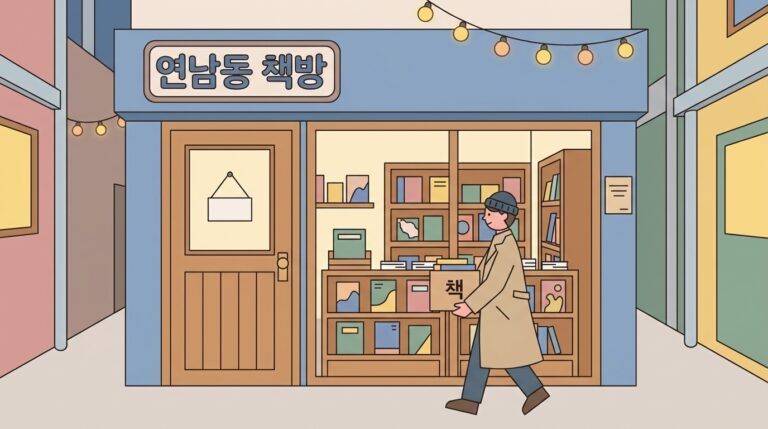
Demystifying Korean Indie Publishing: Surviving the Distribution Jungle as an Author
Hello there! This is your Daily Hangul Lead Editor.
Imagine this: You are watching a K-Drama like Romance is a Bonus Book (로맨스는 별책부록) or Our Beloved Summer (그 해 우리는). The protagonist is sitting in a sunlit, aesthetically pleasing cafe in Yeonnam-dong, sipping an iced Americano while delicately editing a manuscript. It looks so romantic, doesn’t it?
But let me tell you a secret as someone who has navigated the vibrant but ruthless back-alleys of Seoul’s publishing scene: The real drama doesn’t happen at the writing desk; it happens when you try to sell the book.
Today, we are diving deep into the world of 독립 출판 (Indie Publishing). For a C2 level learner, grasping industry-specific jargon and the cultural nuances of Korea’s hyper-competitive market is a game-changer. Whether you dream of publishing your own photo essay in Seoul, or you just want to casually drop some serious insider knowledge at a book club in Hapjeong, this guide is your ultimate survival manual. We’re moving past textbook grammar into the real, raw vocabulary of creators.
Let’s turn the page!
Phase 2: Core Expressions — The Author’s Toolkit
Let’s look at the sophisticated vocabulary indie authors use when they step out of the studio and into the business world.
1. 입고처를 뚫다
- Pronunciation: ipgocheoreul ttulta [Sounds like: ip-go-chuh-reul ttul-ta]
- Meaning: (Literal) To pierce through stocking locations. (Real nuance) To successfully secure distribution channels or get bookstores to stock your book.
- K-Culture Moment: You’re at a hoeshik (회식) with fellow indie writers, and someone excitedly announces they finally got their books into a famous indie bookstore in Jeju. Everyone raises their soju glasses to celebrate this massive victory.
- Editor’s Insight: The verb 뚫다 (to pierce/penetrate) is highly colloquial yet widely used in business to mean “securing a difficult deal or channel.” It implies that the barrier to entry was thick and hard to break.
- Situation Spectrum:
- Close friends/Fellow writers (Casual): ✅
- Bookstore owners (Semi-formal): ⚠️ (Use ‘입점하다’ or ‘입고하다’ instead)
- Formal business proposals (Formal): 🚫
- 🤔 Think About It: Why does Korean use aggressive, physical verbs like ‘뚫다’ (pierce) or ‘맨땅에 헤딩하다’ (headbutt the bare ground) to describe starting a business? What does this tell you about Korea’s competitive corporate culture?
2. 재고를 떠안다
- Pronunciation: jaegoreul tteoanda [Sounds like: jae-go-reul ttuh-an-da]
- Meaning: (Literal) To embrace/hold the inventory. (Real nuance) To be burdened with unsold stock.
- K-Culture Moment: The painful reality of self-publishing. You print 1,000 copies to lower the unit cost, but now your tiny one-room apartment (원룸) is filled to the ceiling with boxes of books serving as a makeshift dining table.
- Editor’s Insight: The verb 떠안다 implies taking on a heavy burden, often unwillingly or inevitably. It’s a beautifully tragic word that perfectly captures the physical and financial weight of unsold books.
- Situation Spectrum:
- Close friends (Casual): ✅
- Co-workers/Peers (Semi-formal): ✅
- Formal/Public interviews (Formal): ✅ (Often used in news reports too)
- 🤔 Think About It: Physical books take up physical space, which is a luxury in densely populated Seoul. How does the concept of space influence Korean publishing trends like the rise of web novels and webtoons?
3. 마이너한 취향을 저격하다
- Pronunciation: maineohan chwihyangeul jeogeokhada [Sounds like: ma-ee-nuh-han chwee-hyang-eul juh-gyuk-ha-da]
- Meaning: (Literal) To snipe a minor taste. (Real nuance) To perfectly cater to a very specific, niche audience.
- K-Culture Moment: An indie book completely ignores mainstream trends (like stock market guides or test prep) and instead focuses entirely on “A collection of photos of sleeping street cats in Busan.” It becomes a cult hit among cat lovers.
- Editor’s Insight: 취향 저격 (taste sniping) is a crucial cultural concept. In a society that traditionally valued conformity, the rise of “취향” (personal taste) signifies a massive cultural shift among Millennials and Gen Z.
- Situation Spectrum:
- Close friends (Casual): ✅
- Social media marketing (Semi-formal): ✅
- Formal contracts (Formal): 🚫
Phase 3: Textbook vs. Real Korean
At the C2 level, you know how to be polite. Now you need to know how to sound like a native industry insider.
[Situation 1: Discussing the difficulty of distribution]
* 📖 Textbook Korean: 제 책을 팔아줄 서점을 찾기 매우 어렵습니다. (It is very difficult to find a bookstore that will sell my book.)
* 🗣️ Real Korean: 유통망 뚫는 게 진짜 맨땅에 헤딩이네요. 대형 서점 매대에는 명함도 못 내밀어요. (Securing a distribution network is literally headbutting the bare ground. I can’t even hand my business card to the display tables at mega-bookstores.)
* 💡 Why it’s different: “매대” (display stand) is industry jargon. “명함도 못 내밀다” is an idiom meaning you are not even worthy of being considered for competition.
[Situation 2: Explaining your book’s target audience]
* 📖 Textbook Korean: 이 책은 소수의 사람들을 위한 책입니다. (This book is for a small number of people.)
* 🗣️ Real Korean: 완전 뾰족한 타겟을 노린 독립출판물이에요. 대중성은 좀 떨어지죠. (It’s an indie publication aiming for a very sharp target. It lacks mass appeal.)
* 💡 Why it’s different: In marketing and publishing, a niche target is often described as “뾰족한” (sharp). “대중성” (mass appeal) is the ultimate metric for commercial success.
Phase 4: Cultural Context — K-Culture Deep Dive
4-1. The Non-Verbal Nuance: The “Nunchi” of Book Delivery
When an indie author visits a local bookstore to pitch their book, 눈치 (Nunchi) is everything. Bookstore owners are busy and often overwhelmed by requests. You don’t just aggressively demand shelf space. You buy a coffee, perhaps purchase a book from their store first, and then softly ask, “혹시 입고 문의는 어떻게 받으시나요?” (By the way, how do you receive stocking inquiries?). Handing over your sample copy with two hands and a slight bow is non-negotiable.
4-2. K-Drama vs. Reality: The Mega-Bookstore Monopoly
If you watch K-Dramas, bookstores are magical places where lovers reunite across aisles. But from a C2 publishing perspective, the Korean book market is heavily monopolized by massive chains (Kyobo, Aladin, Yes24). For an indie author, getting into these chains requires going through a 총판 (chongpan – wholesale distributor), which takes a massive cut of the profit, often leaving the author with pennies. This is why the rise of independent bookstores (독립 서점) in trendy neighborhoods like Haebangchon and Seongsu-dong is not just an aesthetic trend; it’s a vital survival ecosystem for independent creators, operating mainly on a 위탁 판매 (consignment sale) basis.
Phase 5: Real-Life Roleplay Scenario
Setting: A bustling independent book fair in Seoul (like Unlimited Edition). You are standing at your booth, tired but proud. Ji-eun, a well-known indie bookstore owner from Jeju Island, approaches your booth and picks up your photo essay about expat life in Korea.
Characters:
– YOU: An expat author who self-published their first book.
– Ji-eun (35): Discerning, influential indie bookstore owner. She loves unique stories but hates generic content.
Dialogue:
Ji-eun: 어머, 표지가 너무 예쁘네요. 기획이 되게 신선해요.
(eomeo, pyojiga neomu yeppeuneyo. gihoegi doege sinseonhaeyo.)
[Oh, the cover is so pretty. The planning/concept is very fresh.]
YOU: 감사합니다. 제가 한국에서 5년 살면서 느낀 점을 사진이랑 엮어봤어요.
(gamsahamnida. jaega hangugeseo onyeon salmyeonseo neukkin jeomeul sajinirang yeokkeobwasseoyo.)
[Thank you. I wove together my experiences from living in Korea for 5 years with photos.]
Ji-eun: 그렇구나. 혹시 지금 유통은 어떻게 하고 계세요? 독립서점 위주로 입점하셨나요?
(geureokuna. hoksi jigeum yutongeun eotteoke hago gyeseyo? dongnipseojeom wijuro ipjeomhasyeonnayo?)
[I see. How are you handling distribution right now? Have you mostly stocked in independent bookstores?]
YOU: 네, 대형 서점은 아직 엄두도 못 내고 있고요. 발품 팔아서 몇 군데만 입고시켰어요.
(ne, daehyeong seojeomeun ajik eomdudo mot naego igguyo. balpum paraseo myeot gundeman ipgosikyeosseoyo.)
[Yes, I haven’t even dared to think about mega-bookstores yet. I’ve been doing the legwork and only got it stocked in a few places.]
Ji-eun: 저희 서점 단골들 취향을 완전 저격할 것 같은데, 저희 쪽에도 입고 부탁드려도 될까요?
(jeohi seojeom dangoldeul chwihyangeul wanjeon jeogeokhal geot gateunde, jeohi jjogedo ipgo butakdeuryeodo doelkkayo?)
[I feel like this will perfectly hit the tastes of our regular customers. Could I ask you to stock it with us too?]
🔀 Your Turn! How should you respond?
– A) “아싸! 대박! 당장 보낼게요!” (Yay! Jackpot! I’ll send it right now!)
– B) “감사합니다! 혹시 위탁 판매 수수료율은 어떻게 될까요?” (Thank you! By the way, what is the commission rate for consignment sales?)
– C) “대형 서점에 먼저 넣고 싶어서요. 좀 생각해 볼게요.” (I want to get into mega-bookstores first, so I’ll think about it.)✅ Best Choice: B — Reason: At the C2 level, you need to navigate business smoothly. Acknowledging the offer gracefully while immediately moving to professional logistics (commission rates) shows you understand the indie publishing ecosystem. Indie bookstores typically take a 30% to 35% cut.
⚠️ Choice C Analysis: This is incredibly rude to an indie bookstore owner and shows a lack of nunchi. You are essentially telling her she is your backup plan.
Phase 6: 10-Second Shadowing Drill
Practice your elevator pitch! Remember, confidence is key, but arrogance is a faux pas.
😊 제 책은 / 대중적이진 않지만, / 아주 뾰족한 취향을 / 저격하는 에세이입니다. (je chaegeun / daejungjeogijin anchiman, / aju ppyojokan chwihyangeul / jeogeokaneun esei-imnida.)
(My book isn’t mainstream, but it’s an essay that hits a very sharp/specific niche taste.)
Phase 7: K-Culture Mini Dictionary
Master these terms to navigate the Korean publishing scene like a native:
1. 입고 (Ipgohada)
* Romanization: ipgo
* English: Stocking / Warehousing
* Context: The standard term used when requesting a bookstore to carry your book. You send an “입고 메일” (stocking request email).
2. 위탁 판매 (Witak panmae)
* Romanization: witak panmae
* English: Consignment sales
* Context: Bookstores don’t usually buy indie books outright. They display them, and if they sell, they take a percentage (usually 30%) and remit the rest to the author.
3. 샘플북 (Saempeul-buk) / 견본 (Gyeonbon)
* Romanization: saempeul-buk / gyeonbon
* English: Display copy / Sample copy
* Context: In Korean bookstores, books are often sealed to prevent damage. A sample copy is essential for readers to flip through before buying.
4. 굿즈 (Gutjeu)
* Romanization: gutjeu
* English: Merchandise
* Context: In Korea’s competitive market, a book alone often isn’t enough. Authors create matching postcards, stickers, or masking tapes (goods) to entice buyers. The design aesthetic is paramount.
Phase 8: Traveler Survival Kit (Bookstore Edition)
Even if you aren’t publishing a book, exploring Korea’s independent bookstores is a must for any culture lover. Here is your survival kit for navigating them.
🆘 Survival Expressions
– 🇰🇷 “독립출판물 코너는 어디에 있나요?” (dongnip chulpanmul koneoneun eodie innayo?)
– 🗣️ Pronunciation Guide: [dong-nip chul-pan-mul co-nuh-neun uh-dee-eh in-na-yo?]
– 📍 Where to use: In larger bookstores that have a dedicated indie section.
- 🇰🇷 “이거 샘플북 혹시 있나요?” (igeo saempeulbuk hoksi innayo?)
- 🗣️ Pronunciation Guide: [ee-guh sam-ple-book hok-shee in-na-yo?]
- 📍 Where to use: When a book you want to browse is wrapped in plastic.
📌 Editor’s Travel Note
– Finding Indie Bookstores: Use KakaoMap or Naver Map and search for “독립서점” (Independent Bookstore) or “책방” (Bookroom). Popular areas include Yeonnam-dong, Mangwon-dong, and Jeju Island.
– Etiquette: Indie bookstores are small businesses, not libraries. While browsing is welcome, taking prolonged photos of the inner pages without buying is considered incredibly rude (진상).
Phase 9: Critical Thinking — “One Step Deeper”
🧠 Think Deeper: Language & Power in the Publishing World
The language used in Korean publishing vividly reflects the power dynamics of the industry. Mega-bookstores are often referred to as “갑” (the party with power), while authors and small publishers are “을” (the subordinate party). Expressions like “매대를 사다” (buying the display stand) highlight how visibility in a capitalist society requires capital. Yet, the indie publishing scene’s language is entirely different—it relies on words like “연대” (solidarity), “취향” (taste), and “공감” (empathy). This dichotomy showcases a rebellion against Korea’s mainstream ‘fast-and-massive’ culture, offering a sanctuary for slow, deeply personal narratives.💬 Your Turn: Does your home country have a strong independent publishing scene? Do small creators face similar struggles against corporate monopolies? Let us know in the comments!
Phase 10: FAQ & Avoiding Mistakes
Q: When pitching my book to a bookstore owner, should I use formal language (존댓말)?
A: ABSOLUTELY. Always use high-level formal language (하십시오체/해요체) when conducting business. Using casual language (반말) even to someone younger in this context will instantly ruin your professional reputation.
Q: Can I negotiate the consignment ratio (위탁 판매 수수료율)?
A: No. Unlike markets where haggling is expected, indie bookstore commission rates (usually 30-35%) are industry standard. Trying to negotiate this down makes you look amateurish and disrespectful of the bookstore’s operating costs.
❌ Common Mistake #1: Treating an indie bookstore owner merely as a “cashier.”
✅ Do this instead: Address them as “사장님” (Boss/Owner) or “책방지기님” (Bookstore Keeper). They are curators of culture, and acknowledging their role builds the relationship you need to sell your book.
Phase 11: Summary & Action Items
One-Liner Summary: Securing distribution in Korea’s indie publishing scene requires not just a good book, but understanding the intricate dance of nunchi, consignment business (위탁 판매), and catering to specific tastes (취향 저격).
Action Mission:
– 🥉 Bronze (Solo): Read the shadowing sentence aloud 3 times, focusing on sounding confident but polite.
– 🥈 Silver (Online): Go on Instagram, search the hashtag #독립출판물 (Indie Publications), and leave a supportive comment in Korean on a creator’s post (e.g., “표지가 너무 예뻐요!” – The cover is so pretty!).
– 🥇 Gold (Real-world): Visit an indie bookstore in Korea, find a book you like, and use the survival expression to ask if there is a sample book available.
Special K-Culture Mission: Watch an episode of a Korean documentary about local bookstores (like 다큐멘터리 3일 on bookstores) and try to catch the word “입고” or “재고”!
Phase 12: Quiz — Interactive Challenge
1. Situational Judgment: You finally printed your self-published poetry book, but now you have 500 copies sitting in your living room. What is the most natural, native-sounding way to describe this to your Korean friend?
– A) 제 방에 책이 많아요. (I have many books in my room.)
– B) 재고를 몽땅 떠안았어요. (I am burdened with all the inventory.)
– C) 책을 유통하고 있어요. (I am distributing books.)
2. Fill in the Blank:
“내 책은 인기는 없지만, 고양이 좋아하는 사람들의 ________을/를 완벽하게 저격했어!”
(My book isn’t popular, but it perfectly hit the
________ of cat lovers!)
3. True or False – K-Culture Edition:
In Korean independent bookstores, it is perfectly acceptable to take photos of the entire text of a book to read later, as long as you tag the store on Instagram. (T/F)
Answers (Click to reveal)
1. B. A is too basic, C implies successful business. B captures the painful reality of self-publishing at a C2 level.
2. 취향 (chwihyang – taste).
3. False. This is considered “진상” (terrible customer behavior) and copyright infringement. You should buy the book!
Did you enjoy this deep dive into the Korean publishing world? If you had to write an indie book right now, what would the title be? Share it below! 👇
Frequently Asked Questions (FAQ)
Q: What does "입고처를 뚫다" mean in Korean and how do you pronounce it?
A: In Korean, "입고처를 뚫다" is pronounced [ipgocheoreul ttulta [Sounds like: ip-go-chuh-reul ttul-ta] and means: (Literal) To pierce through stocking locations. (Real nuance) To successfully secure distribution channels or get bookstores to stock your book.
Q: What does "재고를 떠안다" mean in Korean and how do you pronounce it?
A: In Korean, "재고를 떠안다" is pronounced [jaegoreul tteoanda [Sounds like: jae-go-reul ttuh-an-da] and means: (Literal) To embrace/hold the inventory. (Real nuance) To be burdened with unsold stock.
Q: What does "마이너한 취향을 저격하다" mean in Korean and how do you pronounce it?
A: In Korean, "마이너한 취향을 저격하다" is pronounced [maineohan chwihyangeul jeogeokhada [Sounds like: ma-ee-nuh-han chwee-hyang-eul juh-gyuk-ha-da] and means: (Literal) To snipe a minor taste. (Real nuance) To perfectly cater to a very specific, niche audience.







